Categories
Accountability crime and punishment government transparency Popular responsibility

Five for Ferguson

Michael Brown is dead. No video can bring him back.

As the world remembers, Brown was the unarmed 18-year-old black man killed in a violent 2014 altercation with Officer Darren Wilson, who is white — making Ferguson, Missouri, famous.

Or rather, infamous.

With little information, folks quickly picked sides. Some claimed Brown was gunned down in cold blood with his hands up, yelling, “Don’t shoot.” After seeing footage from a convenience store surveillance camera, which showed Brown seeming to strong-arm an employee and steal cigarillos* mere minutes before the fatal police encounter, others placed the blame on Brown.

Subsequent rioting left dozens injured, seventeen businesses torched and millions in property damage. Meanwhile, President Obama’s Department of Justice found Officer Wilson’s actions justified.

However, had Wilson been equipped with a lapel camera, that footage would have enhanced finding justice. Moreover, the knowledge that the public could see the truth of what happened might have prevented the riots and recriminations.

More information is better.

That’s why the best news of all is this: on April 4, three weeks from today, the people of Ferguson will vote on The Public Video Recording Accountability Amendment to Ferguson’s City Charter. The charter amendment mandates that officers wear lapel cameras while on duty and sets sensible rules for allowing maximum public access.

The campaign needs your help to alert Ferguson voters about the election by mailing information on the ballot measure. For instance, studies demonstrate that not only do police behave better when wearing cameras, but so do the citizens with whom they interact.

Would you give five dollars for Ferguson?

Please help bring a better day for justice and transparency.

It’s Common Sense. I’m Paul Jacob.

* Over the weekend, more video surfaced from the convenience store as part of a documentary entitled, “Stranger Fruit,” which suggested Michael Brown had made a drug deal at the store, and not stolen anything. A St. Louis County prosecutor disputed the filmmaker’s interpretation, and released more footage.



Printable PDF


Categories
Accountability education and schooling free trade & free markets national politics & policies responsibility

The Leading Edge of Higher Ed

“People are paying tons of money to be kept out of the real world . . . being taught by people most of whom have never even worked in the business world. It’s kinda crazy.”

Well, yeah. There’s a lot of crazy in modern college life.

Which is one reason to work around it. That’s what Isaac Morehouse — quoted above — has done.

Morehouse is the founder of Praxis. You may have heard him on The Tom Woods Show or seen him interviewed on Fox News. “The mindset of ‘obey the rules, follow procedures, chase credentials, chase grades, and wait to be told what to do and you’ll be handed this magical ticket to a job,’” Morehouse told Fox’s Tucker Carlson, “it’s just not true.”

His alternative is simple: leverage the apprenticeship idea, combine it with counseling and instruction, and arrange with participating companies a guaranteed job at program’s end.

Our college system deserves a failing grade. Colleges sponge away fortunes (often borrowed) from students, while neglecting to train them to do much of anything but . . . college work.

This means not only that college grads have trouble finding work, but, as Mr. Morehouse discovered before he hit upon the Praxis idea, there are many, many companies trying to hire competent workers, but unable to find them.

A market opportunity!! Praxis unites demand and supply, connecting companies needing smart, energetic, cooperative workers with willing, eager young folks seeking meaningful (and well-paid) employment.

You can find a good overview of his effort — and a way to sign up! — at discoverpraxis.com.

Praxis’s testimonials are inspiring.

As the future should be.

This is Common Sense. I’m Paul Jacob.


Printable PDF


Categories
Accountability media and media people moral hazard national politics & policies responsibility

War on Page A-10

War was once big news. Now? Not so much.

Which may be a function of the never-ending War on Terror, no end in sight in Afghanistan and an Iraq War that is officially over . . . except for the fighting.

Last October, Green Party presidential candidate Jill Stein busied fact-checkers by claiming the U.S. was “bombing seven countries.” True, declared PolitiFact: Afghanistan, Iraq, Libya, Pakistan, Somalia, Syria and Yemen.

Yemen is better known after January’s raid that killed Navy SEAL Ryan Owens, wounded three other SEALs, and killed 14 to 25 Yemeni civilians, including children. Last week, during President Trump’s speech to Congress, Owens’s widow, Carryn, received a thunderous ovation.

But, as I argued at Townhall, “Ryan Owens and his widow and her three now fatherless children deserve more than applause.“ How about thoughtful policies and a Congress that holds the executive branch accountable?

Invading Iraq was a mistake. So was President Obama’s swerve over to destabilize Libya.

“We are not about to send American boys 9 or 10 thousand miles away from home to do what Asian boys ought to be doing for themselves,” President Lyndon Johnson once said . . . right before he sent more American soldiers to Vietnam.

Consider that U.S. Special Forces were deployed to 70 percent of the world’s nations in 2016. And, in recent weeks, President Trump asked for a $54 billion increase in military spending, and we have learned of Pentagon plans to seek a “significant increase in U.S. participation” against ISIS.

We owe it to those in uniform to ask tough questions, including: Is what we’re doing really worth a single American life?

This is Common Sense. I’m Paul Jacob.


Further reading:

Reason: Is the Military Really “Depleted” After Years of Record-High Spending?

The Atlantic: Fighting Terrorism With a Credit Card

The National Interest: America Is Never (Ever, Ever) Ending the War on Terror


Printable PDF


Categories
crime and punishment First Amendment rights folly ideological culture moral hazard national politics & policies responsibility

Campus Freedom in Peril

  1. What is the percentage of tenured faculty on American campuses who are still unambiguously on the side of free intellectual exchange?
  2. What is the percentage of them who are willing to express that position openly?

Sociologist Charles Murray asked those questions near the end of his reflections on Thursday’s Middlebury College event, in which his speaking engagement was interrupted by shouting mobs and he and his colleagues were physically attacked*.

Murray thinks the answer to the first question is “more than 50 percent.” He doubts that is the answer to the second.

He is pessimistic about free inquiry on campus.

And has reason to be.

College faculty members are closing ranks, as many at Middlebury did, calling Murray — famous for books such as Losing Ground and The Bell Curve — “a discredited ideologue paid by the American Enterprise Institute to promote public policies targeting people of color, women and the poor”** and “not an academic nor a ‘critically acclaimed’ public scholar, but a well-funded phony.”

Mark J. Perry has listed many more complaints, all offered as reasons not to listen or debate with the famous intellectual.

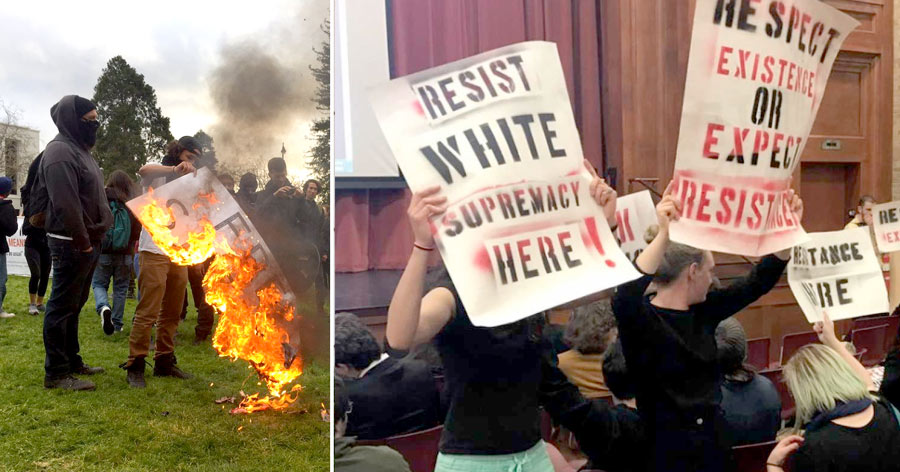
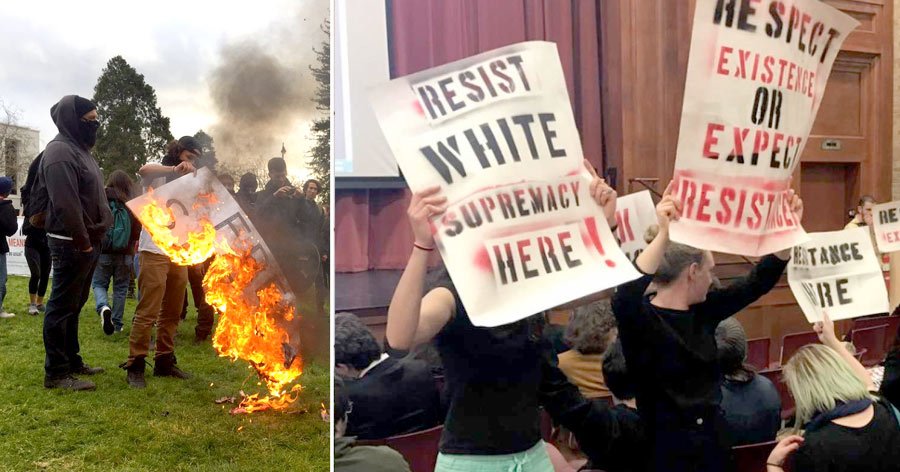
That was last Thursday. On Saturday, a pro-Trump, “Proud Boys” march in Berkeley culminated not only in violence, bloodied faces, destroyed property, but also in the burning of a purloined “Free Speech” placard.

The University of California at Berkeley seems uninterested in controlling the mobs. Berkeley City Police have poorly defended non-leftist protestors. It’s open season on freedom of speech and the right to peaceably assemble.

Unless something is done, officially, mobbing will be the new normal. And our basic rights? A memory.

This is Common Sense. I’m Paul Jacob.


* His colleague Professor Allison Stanger was seriously injured in the riotous shoving and grabbing. Murray tweeted yesterday, “Everybody in the mob could be criminally prosecuted, but those who injured Prof. Stranger must be.”

** It is worth noting that his recent Coming Apart was entirely devoted to the economic performance and culture of white Americans.


Printable PDF


Categories
Accountability government transparency national politics & policies responsibility

Overkill, Not Parsimony

Two truths: national defense is a necessity; national defense is a racket.

The latter is the case because the former is the case. Big spenders rely on “better safe than sorry” to always push the envelope, over-investing rather than under-investing.

So, we are trapped — and our new president knows this. Before Trump ran for office, he said that sequestration cuts to the Pentagon budget had not gone far enough. But when he threw his hat into the ring, he promised to “make our military so big, so powerful, so strong that nobody — absolutely nobody — is going to mess with us.”

President Trump now proposes over fifty billion dollars in new defense spending. More soldiers, more ships, more fighter jets.

John Stossel argues that Americans are not necessarily suckers for this game. At least, a majority does not support increasing military spending.

More importantly, Stossel challenges the whole “overkill always” strategy. “America is going broke, and our military already spends almost $600 billion dollars [annually],” Stossel says. “That’s more than the next seven nations spend — combined.”

Now would be a good time to not only rethink Middle East policy, but to re-consider our expensive role as world policeman (speaking of “national” defense). During the campaign, Trump was criticized for questioning our alliances and demanding more of our allies. But he was right. I hope he’ll get tough in prodding our allies to ultimately provide their own defense.

Even more basic? Demand an audit of the Pentagon before new funds are thrown into the five-sided money pit.

This is Common Sense. I’m Paul Jacob.


Printable PDF


Categories
Accountability initiative, referendum, and recall moral hazard nannyism responsibility

Whose Constitution Is It, Anyway?

Last November’s biggest mistake? Colorado voters passing Amendment 71. It makes the Rocky Mountain State’s constitution exceedingly more difficult for voters to amend through the initiative petition process.

And more like it may be in the offing. Legislation is moving in Florida to require a 66.7 percent vote to amend the state constitution. Already, a 60 percent vote is required, but legislators remain fearful voters can muster that.

The Ohio Modernization Commission, a legislatively created mix of legislators and insiders, is recommending a new constitutional amendment to — you guessed it — make it tougher for voters to pass amendments. Future voter-initiated amendments must pass twice, by a 55 percent supermajority.

There are also efforts to weaken citizen initiatives in Arizona and Maine.*

The big money behind Colorado’s Amendment 71 told whopper after whopper to win. They pretended to love and revere the constitution. Finally, they put former Denver Broncos Super Bowl champion quarterback John Elway on television — spot after spot — telling voters the amendment “protects our constitution.”

But . . . from whom?

You see, politicians and special interests don’t have to amend the state constitution to spend money on themselves or their cronies. From their perch in the state capitol, they can do that with a simple statute.

But you and I need the ability to pass constitutional amendments. Why? Only through the constitution can we limit the power of those same politicians — the power of government. Legislators can overrule a mere statutory ballot initiative (and often do).

That’s what this battle is all about. Politicians mean to limit our power to limit theirs.

This is Common Sense. I’m Paul Jacob.


* Thankfully, South Dakota legislators defeated several bills aimed at making it tougher to place initiatives on the ballot.


Printable PDF


Categories
Accountability folly free trade & free markets local leaders moral hazard nannyism porkbarrel politics responsibility too much government

Small Target, Big Subsidy

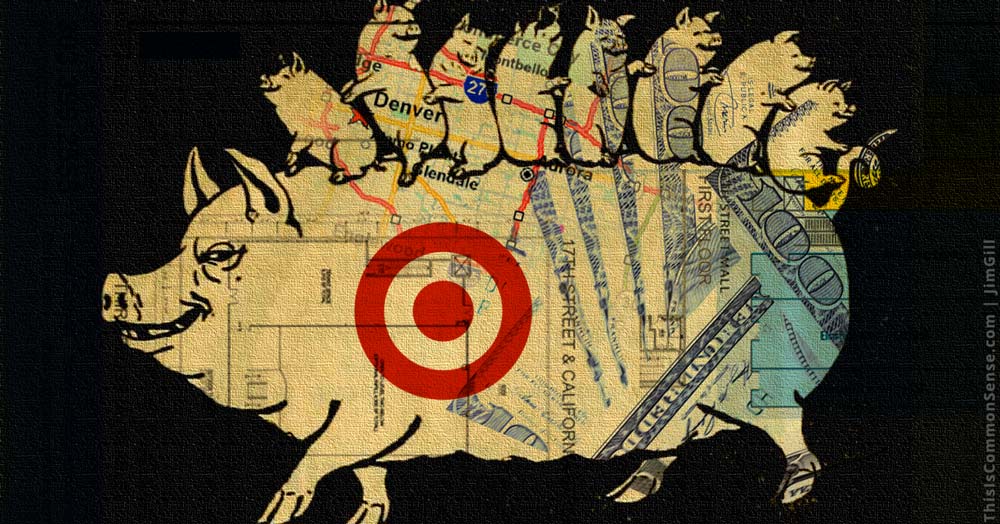
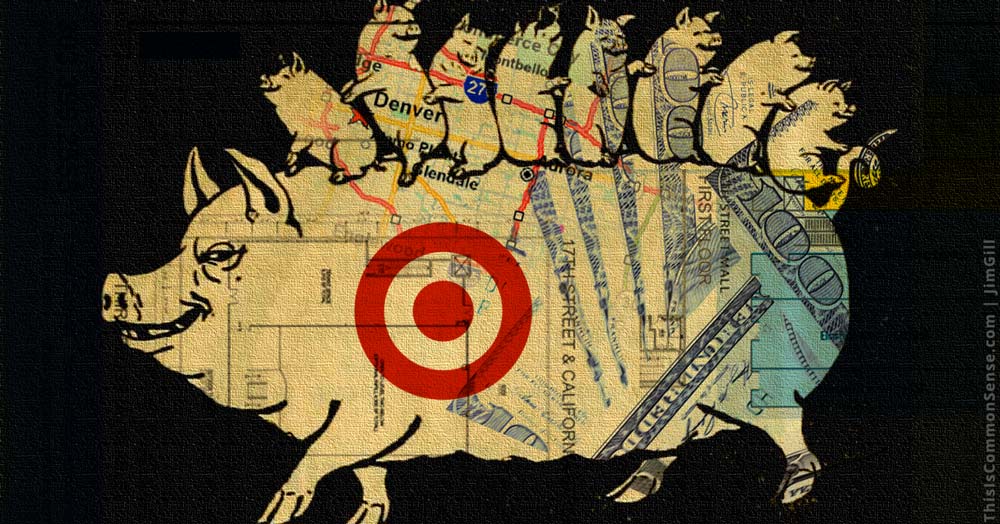
Something has gone wrong when, to get a tenant to move into an empty space in your prime-location building, you need a $4 million subsidy.

And when I say “prime location,” I’m not engaging in Trumpian over-statement. The downtown Denver, Colorado, property location sees over 35,000 pedestrians per day . . . and that’s with the primo slot empty.

But to get that slot filled, the owners have negotiated with the city government to nab a $2 million “incentive” to fix the place up for Target, which is thinking of leasing the location to put up a smaller-than-usual “flexible-format” store. Oh, and another $2 million for “operational” costs, which seems to be some kind of a loan to be paid back from taxes to be collected — and shared by the city for 20 years with the owners.

In other words, it’s the darnedest business deal you’ll ever see (and never get): up-front money not from a bank or investors, but from Denver’s city government “BIF” — Business Investment Fund — which is obviously part of a convoluted scheme fed by taxes and devised by . . . people I wouldn’t trust with my money.

Structuring deals like this is how modern cronies — er, cities — operate, I know. Am I alone in judging it corrupt on the surface and corrupting in the details?

If prime commercial property has gone unused for about a decade — as this three-storied mall space has — I’d think that maybe the owners have set the rents too high or the city has been a bit too greedy with taxes.

Or both.

This is Common Sense. I’m Paul Jacob.


Printable PDF


Categories
general freedom ideological culture initiative, referendum, and recall national politics & policies responsibility too much government

Adios, California?

Californians account for more than one of every ten Americans.

For now.

Three years ago, an initiative sought to split the mega-state up. Had that measure succeeded, the U.S. Congress would have decided whether to permit the Golden State to become six separate states — with ten more U.S. Senators.

Now, a group called “Yes California” is petitioning for a 2018 ballot measure on leaving these United States altogether: Secession. “California could do more good as an independent country than it is able to do as just a U.S. state,” says its website.

Supporters argued in a recent Washington Post feature that California “subsidizes other states at a loss.” Indeed, it’s one of 14 states that get less money back from the federal government than paid in taxes.

And there’s Trump. Opposition to the president is palpable. California provided Hillary Clinton with a 4.3 million popular vote margin over Republican Donald Trump, 1.5 million more than her national margin.

“It’s understandable why the election of an evil white supremacist swindler as president,” wrote Zócalo Public Square’s Joe Mathews in the Fresno Bee, “has given the idea of California independence such currency.” Nonetheless, he opposes #CalExit as divisive and “not very Californian.”

Nationally, for partisan reasons, Republicans may cheer it, while Democrats shudder.

Me? I’m for self-determination.

But, remember: Northern Californians have been agitating to secede from the state since 1941. Those desires are picking up steam — especially with trepidation over whether the Oroville dam will hold. Folks feel unrepresented in the state capitol.*

And they are. Already 21 of the 23 northernmost counties have made declarations to form the State of Jefferson.

Let Californians decide . . . county by county.

This is Common Sense. I’m Paul Jacob.


* Note that Trump won by a landslide in the counties that would comprise Jefferson, our would-be 51st state.


Printable PDF


Categories
general freedom individual achievement responsibility

Freedom’s Friends

Yesterday marked a solemn anniversary. Seventy-four years ago — on Feb. 22, 1943 — three German students at the University of Munich were tried for treason by the Nazis, convicted and then executed via the guillotine, all in one day.

Days earlier, Hans Scholl and his sister Sophie had been caught distributing a leaflet at the university, which read: “In the name of German youth, we demand restitution by Adolf Hitler’s state of our personal freedom, the most precious treasure we have, out of which he has swindled us in the most miserable way.”

Hans had in his pocket a draft of another leaflet, in Christoph Probst’s handwriting. That seventh leaflet, never distributed, led to Christoph’s arrest and execution, along with Hans and Sophie.

The three were part of a small group of students who wrote and distributed leaflets under the name The White Rose — a symbol of purity standing against the monstrous evil of the Third Reich. The leaflets decried the crimes of National Socialism, including the mass murder of Jews, and urged Germans to rise up.

Three more members were later executed: Willi Graf, Alex Schmorell and Professor Kurt Huber. Another eleven were imprisoned.

Their resistance was ultimately futile, unsuccessful . . . but not pointless. They would not remain cogs in the killing machine that had taken the most advanced society in the world to the depths of depravity. They took a stand against what George Orwell later characterized as “a boot stamping on a human face, forever.”

Let’s remember, and say, “Never again.” And have the courage to make those words true.

This is Common Sense. I’m Paul Jacob.

N.B. For an excellent account of The White Rose, consult the aptly titled A Noble Treason, by Richard Hanser. See also Jacob Hornberger’s The White Rose — A Lesson in Dissent. The Orwell quotation is from the dystopian novel 1984.


Printable PDF

Categories
crime and punishment First Amendment rights ideological culture moral hazard national politics & policies responsibility

Wolves Crying Wolf

People have a right to defend themselves. Right? Especially against rape and murder.

“This is not about free speech,” Yvette Felarca yelled to the crowd at the University of California-Berkeley, gathered weeks ago to “shut down” a scheduled speech by Milo Yiannopoulos, the controversial Breitbart editor.

Felarca, a national organizer for By Any Means Necessary (BAMN)*, the militant group with the incendiary name, argued that Milo wasn’t “interested in any genuine debate.”

She continued, “But what they’re really trying to do is they’re trying to assert their power, threaten us, intimidate us, rape us, kill us! This is real. This is life and death.”

Given such sentiments, it is hardly surprising that the protest turned violent — leaving people beaten, bloody on the pavement, and racking up $100,000 in property damage.

Not to mention causing the cancellation of the talk sponsored by the Berkeley College Republicans. Felarca called this a smashing success. Asked by reporters how she could justify violence to squelch speech, Felarca simply dubbed Milo “a fascist.”

Yesterday, in my Townhall column, “Hate Is Our Business,” I addressed the Southern Poverty Law Center’s just-released report, “The Year in Hate and Extremism.” The report continued the SPLC’s habit of calling entirely peaceful conservative and religious organizations “hate groups.”

The man who shot a security guard at the Family Research Council in 2012, but was thankfully blocked from further mayhem, used the SPLC’s “Hate Map” to target their office.

In its reports, the “progressive” SPLC completely ignores BAMN and violent left-wing groups. And by crying wolf in mislabeling non-violent organizations as “hate groups,” it provides the unhinged — BAMN, Antifa, and lone-wolf lunatics — very dangerous ammunition.

This is Common Sense. I’m Paul Jacob.


* Ms. Felarca also has a day job, as a public school teacher at Martin Luther King, Jr. Middle School in the Berkeley Unified School District. That has generated some controversy.


Printable PDF