Categories
Accountability general freedom government transparency incumbents insider corruption local leaders moral hazard national politics & policies term limits

“Dorky” Doesn’t Define It

“Term limits,” said Daniel McCarthy, editor of The Modern Age, in a recent podcast conversation with historian Tom Woods, “was one of the dorkiest ideas of the 1994 so-called Newt Gingrich revolution.”

He characterized it as not having really gone anywhere.

Huh?

Granted, Congress is still not term-limited. But Americans in 15 states — including California, Colorado, Florida, Michigan, and Ohio, and representing 37 percent of the nation’s population — do enjoy term-limited state legislatures.*

And it sure wasn’t Newt Gingrich’s idea. Gingrich opposed it.

McCarthy repeats the old chestnut that what term limitation “winds up doing is actually weakening Congress and congresspeople in particular — relative to their own staff, who stay in Congress and become sort of experts and learn how to manipulate their congressman, and also relative to the executive branch who have people rotate in from time to time.”

Nifty theory — one very popular with politicians, who know that voters fear unelected influences on legislation.

The reality, however, is that Congress, designed by the Constitution’s framers to be both most powerful and closest to the people‚ is, today, the weakest branch.

And legislators are not term limited.

Ditch the “manipulation theory”; adopt a “collaboration theory”: legislators with Methuselah-long careers learn, sans “rotation in office,” to feather their own nests and those of the interest groups that fund their re-elections (and insider trading schemes).

Term limits remain popular with normal Americans because voters intuitively grasp the reality of such everyday corruption, which is directly tied to Congress having sloughed off so much constitutional responsibility.

We need term limits to restore a Congress sold out by professional politicians.

This is Common Sense. I’m Paul Jacob.



* Nine of the ten largest cities in America likewise have termed-limited their elected officeholders. For more information, see the links to the column from which this episode of Common Sense is condensed.

PDF for printing


Categories
Accountability government transparency insider corruption local leaders media and media people nannyism national politics & policies political challengers Regulating Protest responsibility

Not Fine with Feinstein?

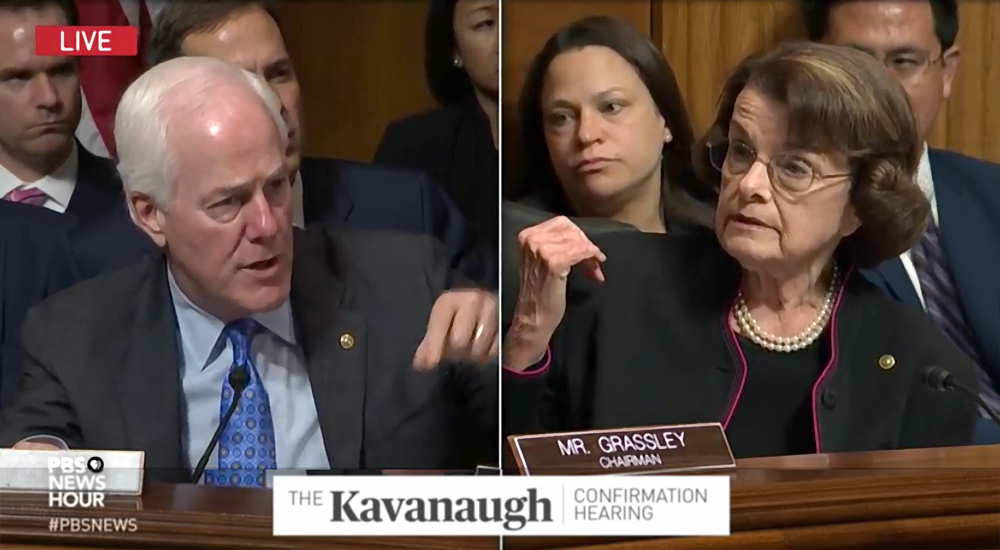
Could it be that Sen. Dianne Feinstein, Democrat of California, may not be liberal enough?

The San Francisco Democrat has ostensibly represented the Golden State in the United States Senate for the last 26 years. Before that, Feinstein spent eight years on San Francisco’s Board of Supervisors and then a decade as mayor.

Now, after 44 consecutive years as a public official, what does the 85-year-old Feinstein seek? More. That is, another six-year lease on her powerful perch in the U.S. Senate.

But the Executive Board of the California Democratic Party — Feinstein’s Party — just said, “No way!”

A whopping 65 percent of the 333-member board opted for State Sen. Kevin de León, a fellow Democrat seen as more “progressive.” Only seven percent supported endorsing Feinstein.

Keep in mind that Feinstein is already on the November ballot. She was the leading vote-getter in California’s primary last month. Yet, she received only 44 percent of the vote: a majority does favor someone else.

In February, 2,700 activists at the State Democratic Party Convention in San Diego voted 54 to 37 percent for State Sen. De León over U.S. Sen. Feinstein.

“Feinstein, who spends much of her time in Washington, has had a distant relationship with party activists for years,” noted the Los Angeles Times report.

Still, what Democratic Party activists want may not matter so much. Mrs. Feinstein enjoys tremendous name recognition and, according to the Times, has “$7 million in campaign cash socked away as of May, ten times what De León had.”

That money seems to be Sen. Feinstein’s real base of support.

This is Common Sense. I’m Paul Jacob.


PDF for printing


Categories
Accountability crime and punishment government transparency media and media people moral hazard national politics & policies Regulating Protest responsibility

The Deeply State

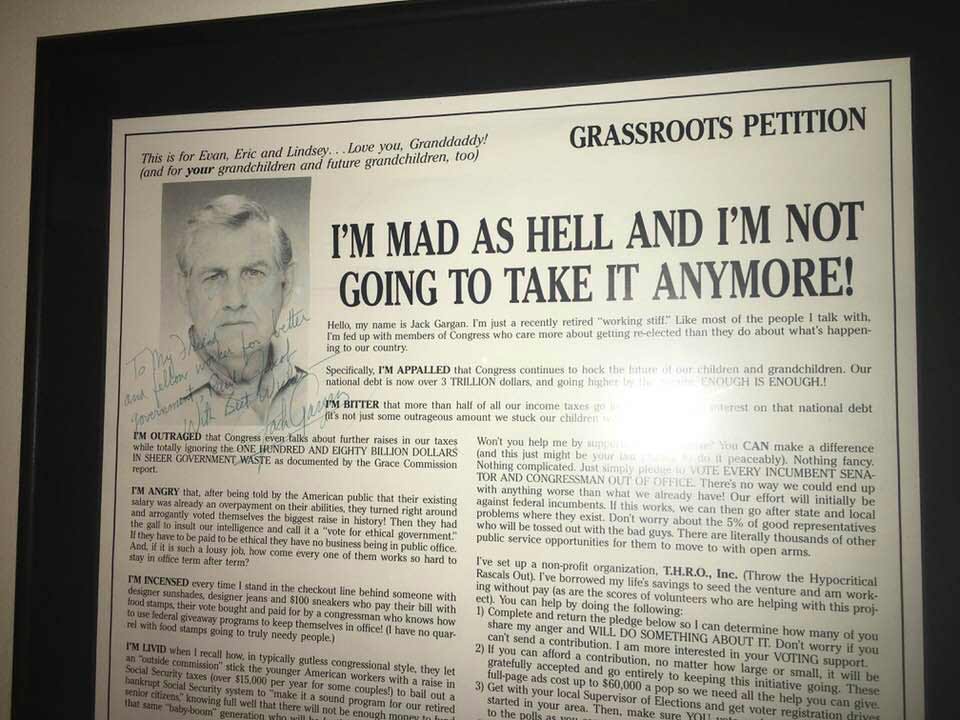
FBI agent Peter Strzok is offended.

Deeply.

He takes pains to clarify: he sent emails during the last presidential campaign expressing a willingness and readiness and commitment to preventing a Trump Presidency because he, Agent Strzok, is patriotic.

Deeply.

During yesterday’s contentious congressional interrogation, fielding questions regarding just how anti-Trump he was during the last presidential campaign, Peter Strzok denied that his obvious and admitted political bias affected his professional conduct.

“Like many people, I had and expressed personal political opinions during an extraordinary presidential election,” said Agent Strzok. “My opinions were expressed out of deep patriotism.”

But it wasn’t just a matter of expression, was it? One text message was an assurance that he would “stop” Trump’s election. When challenged on this, Strzok admitted that his memory was faulty.

Deeply?

“At no time, in any text,” Strzok said, decisively, “did those personal beliefs enter into the realm of any action I took.”

When a citizen expresses a credible threat to a president, federal agents investigate. His exchange with his “girlfriend,” Lisa Page, was not what we now call an “existential threat,” of course. Ms. Page had texted her worry about a Trump win: the man was “not ever going to become president, right? Right?!” Strzok’s reply was not vague: “No. No he won’t. We’ll stop it.” The threat is, at most, covert-political, back-room. FBI-ish. The couple were, after all, a part of an investigation into Donald Trump’s alleged Russian connection.

Though one could easily understand a married man assuring his inamorata simply to puff himself up in her eyes, this assurance sure looks different to our eyes — it cannot help but make us suspicious.

Deeply.  

This is Common Sense. I’m Paul Jacob.


PDF for printing


Categories
general freedom ideological culture insider corruption media and media people national politics & policies political challengers

Plantation Revolt

The #Walkaway movement started with Brendan Straka, who proclaimed that his tribe — the liberal Left — had become “intolerant, inflexible, illogical, hateful, misguided, ill-informed, un-American, hypocritical, menacing, callous, ignorant, narrow-minded, and, at times, blatantly fascistic.”

Mr. Straka’s beef — and the general tenor of the pile-on Twitterstorm — was not about Democratic Party policy, as Scott Adams noted. It was about the left-of-center movement’s rhetorical/propagandistic rut. Since the election of Donald Trump, Democrats had come to rely almost exclusively on the feeding of frenzy by psychological manipulation, by ginning up fear.

Straka’s appeal to “walk away” became a hit, especially amongst those “racial, sexual, and religious minorities in America” that he says the Democrats have treated as if they owned.

Yet the Washington Post pooh-poohs the trend as just a social media blip — over-hyped by the very nature of the medium itself.

Plausible?

David Catron says no. Before the #WalkAway movement, he writes in The American Spectator, African-American voters had already walked away from Hillary Clinton’s candidacy in enough numbers to allow Trump his victory. And this bodes badly for the Democratic Party, for, as Catron quotes YouTube sensation Candace Owens, “I’ve seen black liberals go conservative, but never seen a black conservative go liberal.”

It doesn’t take many defections, says Carton: “All that is needed is about 5 percent more African-Americans to vote Republican and another 5 to 10 percent to simply stay home.”

But be warned: wishful thinking and Straka’s litany of political vices — “groupthink, hypocrisy, division, stereotyping, resentment” — can overtake any movement pretty quickly.

Anti-leftists in general and Republicans in particular are not immune to mass mania and suicide-by-panic.

This is Common Sense. I’m Paul Jacob.


PDF for printing


Categories
Accountability ballot access folly general freedom ideological culture initiative, referendum, and recall media and media people national politics & policies political challengers responsibility U.S. Constitution

Should Non-Citizens Vote?

“A lot of people would like to say this is an immigration issue. It’s really not,” offered Gary Emineth, the head of North Dakotans for Citizen Voting and a candidate for state senator.  

“It’s really about preserving the right for U.S. citizens, and in our case, North Dakota residents, to only be the voters in all elections across the state of North Dakota,” added Emineth. “And that’s why we want it in the constitution.”

Turning in more than 35,000 voter signatures on petitions last Friday, Emineth and others placed a constitutional amendment on this November’s ballot that, if passed, would make voting the exclusive right of U.S. citizens in North Dakota.

Elsewhere in the country, Emineth points out, non-citizens are already voting — in Chicago and San Francisco, and in 11 cities across Maryland. Moreover, campaigns are underway across the country to give non-citizens the vote — in California, Connecticut, New York City, Boston and Montpelier, Vermont.

Opponents claim the North Dakota measure is completely unnecessary, as the state doesn’t currently allow non-citizens to cast a ballot, nor has any city yet attempted to allow non-citizens to vote. But Emineth’s goal is to keep it that way.

Moreover, University of North Dakota Law Professor Steven Morrison acknowledged to The Forum in Fargo that “the proposed amendment does clean up what could be a grammatical loophole since the word ‘every’ doesn’t conclusively exclude non-citizens from voting. . . .”

It is a very simple proposition: Do you want voting to be the exclusive right of U.S. citizens? Or should non-citizens be allowed to vote?

Coming to a ballot near and Fargo.*

This is Common Sense. I’m Paul Jacob.



* With some help from Liberty Initiative Fund.


PDF for printing


Categories
general freedom meme national politics & policies U.S. Constitution

Independence Day

independence:

noun

1. freedom from the influence, control, or determination of another. If a country has independence, it has its own government and is not ruled by any other country.

2. If a country has independence, it has its own government and is not ruled by any other country.


Happy Independence Day!


Categories
Accountability First Amendment rights folly general freedom ideological culture media and media people moral hazard nannyism national politics & policies Regulating Protest too much government U.S. Constitution

Freedom “Weaponized”

Justice Elena Kagan has a way with words. The conservative majority on the court, she said after two recent rulings, is “weaponizing the First Amendment.”

What a phrase! But what does it mean?

“Conservative groups, borrowing and building on arguments developed by liberals,” explains The New York Times, “have used the First Amendment to justify unlimited campaign spending, discrimination against gay couples and attacks on the regulation of tobacco, pharmaceuticals and guns.”

First: if “liberals” now find themselves not supporting the idea of particular freedoms, or freedom in general, are they really “liberal”?

Second: “borrowing arguments” is what we expect to happen. Logic isn’t partisan.

Third: the point of the Bill of Rights is to “weaponize” the defense of freedom.

Remember, it is freedom of speech; freedom of the press; freedom of association; freedom of exercising one’s religion. The First Amendment weaponizes their defense by disallowing Congress from legislating against them.

Now, it has long been a “problem” that these listed freedoms blend together. They all work together or don’t work at all. And each points to freedom more broadly.

Kagan wants to read freedoms narrowly — though liberals historically have, indeed, read them broadly.

She’s objecting to two recent rulings. The first prohibits states from requiring pregnancy centers to talk up abortion options to their clients. An obvious free speech issue. The second prohibits governments from backing unions in their extraction of “agency fees” from non-members. An incontrovertible issue of freedom of association.

Kagan and The New York Times apparently think that “liberalism” means defending some freedoms in some contexts, but denying freedom in others.

This is Common Sense. I’m Paul Jacob.



Illustration by Newtown grafitti


Categories
Accountability crime and punishment ideological culture media and media people moral hazard national politics & policies political challengers responsibility

Black Mask Terrorism

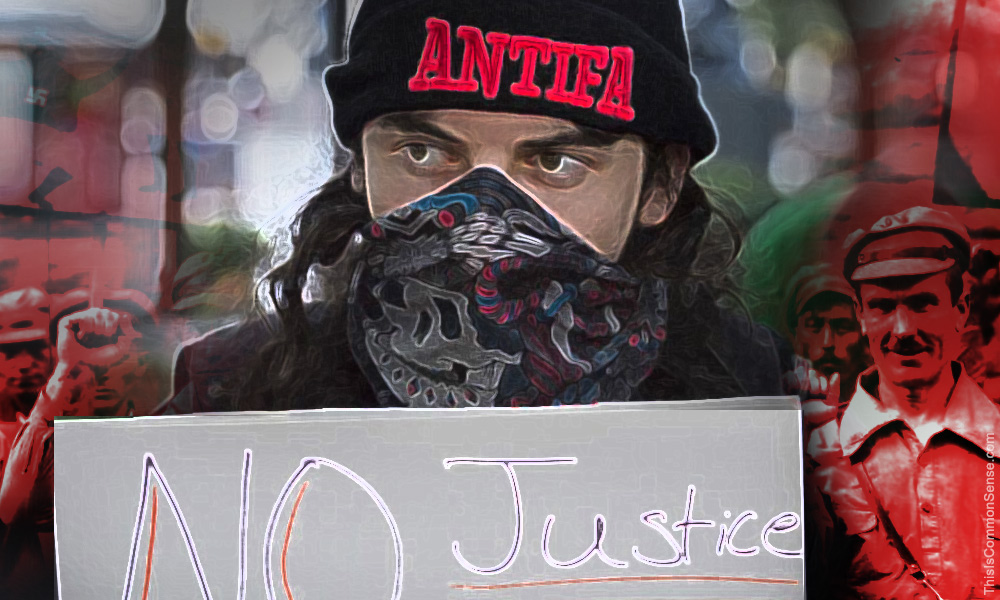
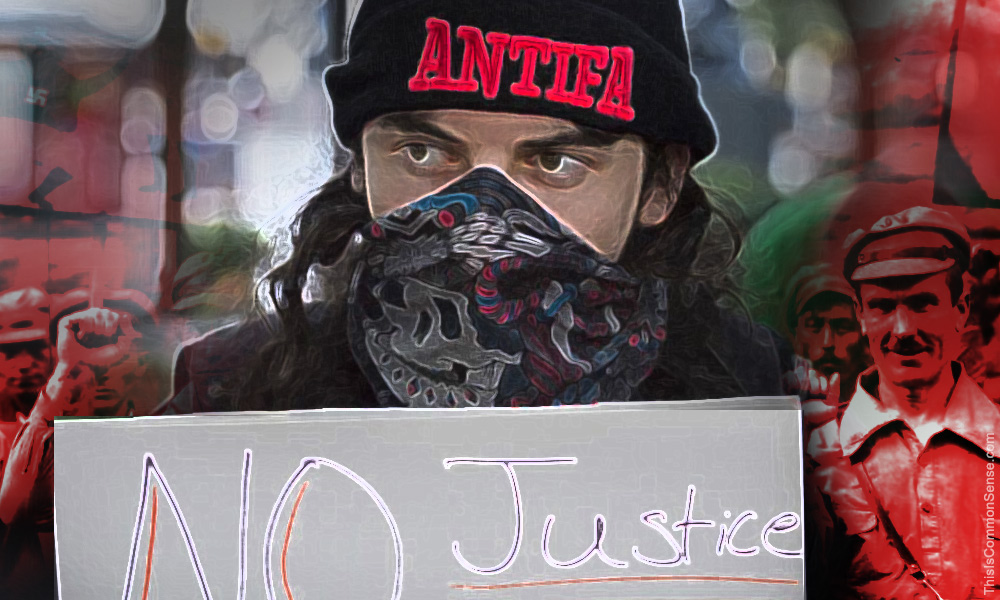
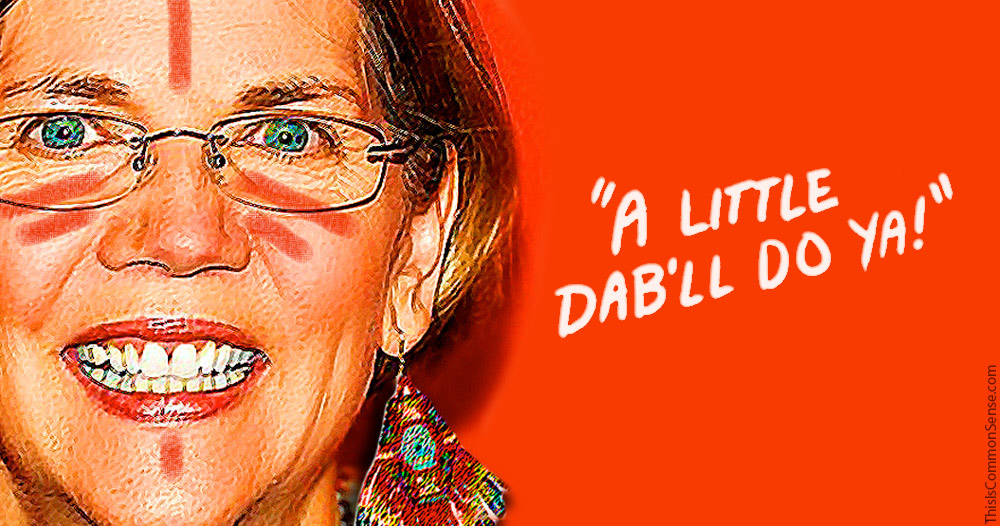
I was in Arkansas on Saturday when the downtown streets of Portland, Oregon, “exploded into its worst protest violence of the Trump era,” as The Guardian explains. “More than 150 supporters of the far-right Patriot Prayer group fought pitched street battles with scores of anti-fascist protesters. In total, nine people were arrested.”

Notice that “Patriot Prayer” — a group sponsored by a Republican Senatorial candidate, and which says it stands for free speech — was labeled “far right” while the “anti-fascist protesters” were not called “far left.”

Characteristically, The Guardian vagues it up. “Violence suddenly ‘erupted,’” noted a Romanian YouTuber of the British rag’s evasiveness. “Who started it? We don’t know.”

Well, from the videos I saw it looked like the “anti-fascists” started it. The “patriots” were marching down the street when a young man, with helmet and backpack, and a young women, dressed in black, marshaled antifa mobs towards the legal march, and then stones and bottles were thrown, and explosives, too . . . into the Patriot Prayer rally.

Note: the Patriot Prayer group had filed the paperwork for the march; antifa had not. The Portland police did not protect the licensed marchers, but did revoke their license, telling everyone to disperse (threatening “duress” to the non-compliant) after the violence broke out.

If you did not carefully look at more than one video, you might be confused. Indeed, not all videos showed the crucial break from peace to violence.

So, what other clues might one look for?

In old cowboy movies, whoever ganged up masked, and wore black, were usually the bad guys.

Antifa — thanks for providing the clues: masks, black fighting gear, and Luciferian handsigns.

This is Common Sense. I’m Paul Jacob.


Categories
Accountability crime and punishment general freedom ideological culture media and media people moral hazard national politics & policies responsibility

Eighty-sixing Civility

Had Sara Huckabee Sanders been asked to leave the Washington, DC, Red Hen, rather than the restaurant of that name in Lexington, Virginia, things might’ve turned out a bit different. In the nation’s capitol, it is illegal to discriminate against customers for reasons of political affiliation.

Out in Lexington? Not so much. One can “86” a politico there with impunity, I guess.

A Yelp reviewer defended the restaurateur’s request not to serve President Trump’s Press Secretary. “Thank you for refusing to serve a person who lies to the American people for a living.”

Wait — I thought that is what all Press Secretaries do: present the official lie. Be that as it may, or not, objecting to one Administration and not another implicitly endorses the policies and lies of the Administration not censured. And the grounds given in this Red Hen cluckery — that the Trump Administration is racist, etc. — might possess a tad more plausibility had the Obama Administration not engaged in policies startlingly similar to the ones Trump and Sanders are blamed for.

The “right to refuse service to anyone” may be a right retained by the people, but since the Ninth Amendment is a dead letter, and the federal government, at least, does not recognize such rights when the refused parties fall into certain “protected groups,” talking about it at length is probably a waste of time.

While the anti-Trump side of the current political-cultural divide seems resolute in denying a right to refuse to bake specialty cakes for gay couples, refusing to serve standard meals to political enemies is apparently copacetic.

Which can only mean: that democratically elected and appointed government officials are not the right “protected group” — which is odd, isn’t it, when those doing the discriminating call themselves “Democrats”?

This is Common Sense. I’m Paul Jacob.


PDF for printing


Categories
Accountability crime and punishment education and schooling national politics & policies responsibility U.S. Constitution

Will Feds Foil Foolish Licensing?

It would be nice if the federal government used its often-abused authority over state and local governments to outlaw various forms of state and local oppression.

In his book Leviathan: The Growth of Local Government and the Erosion of Liberty, Clint Bolick argues that the federal government is not alone in hugely violating individual rights. Eminent domain, asset forfeiture, zoning, and occupational licensing are among the modes of sub-federal assault on the innocent. Even as policymakers in various regions of the land act to stop the worst of these abuses, they proceed unchecked elsewhere.

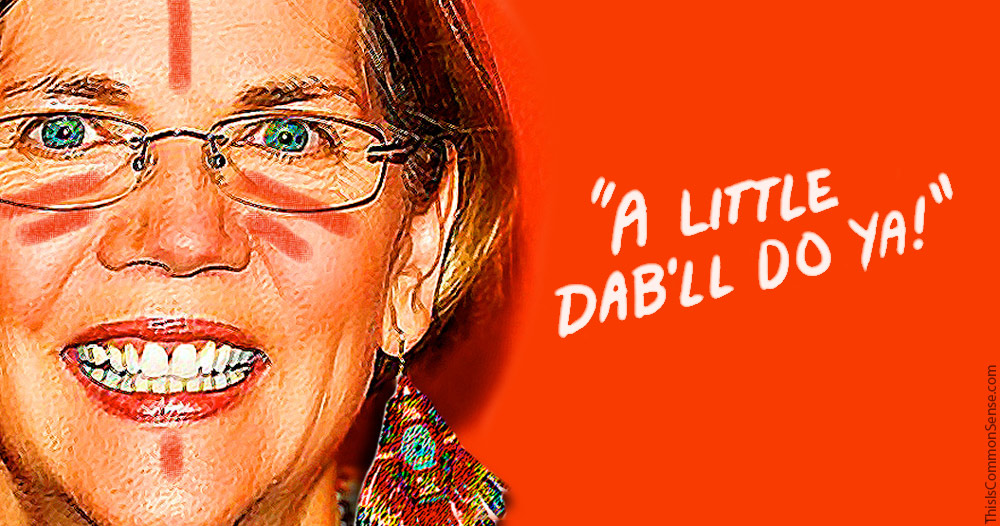
U.S. Senators Marco Rubio and Democrat Elizabeth Warren are the unlikely duo who may interrupt the now-common practice of depriving delinquent borrowers of student loans of their right to earn a living from certain trades. Rubio recently admitted on Twitter that as a Florida lawmaker, he once voted to allow the state “to suspend professional licenses of those who defaulted on student loans. I WAS WRONG. . . . How can they pay back if they can’t work?”

Yes, Rubio was wrong.

Senator Warren, for her part, agrees that the practice is “wrong and counterproductive.”

The bi-partisan duo’s bill would prohibit states from denying driver’s licenses and occupational licenses to borrowers who default on student loans.

I don’t think the legislation goes as far as it should, even in the delimited area of occupational licensing. The absurdities of occupational licensing go way beyond the scope of the proposed remedy.

But it’s a start.

This is Common Sense. I’m Paul Jacob.



PDF for printing


Photos by Gage Skidmore and Edward Kimmel