Categories
Accountability government transparency incumbents initiative, referendum, and recall local leaders nannyism political challengers Regulating Protest term limits too much government

Strange It Is

Strange for the Arlington, Texas, City Council to hold a meeting on a Sunday evening, much less one to “consider suspending the city charter.”

That is how the Fort Worth Star-Telegram reportedthe latest twist in the term limit controversy that has engulfed the city with a lawsuit and competing ballot proposals.”

Led by Zack Maxwell, citizens in this Fort Worth adjacent community of 400,000 gathered 11,000 voter signatures to place a term limits charter amendment on the November ballot. It would limit councilmembers to three two-year terms. It also figures in past service, so five of the eight current councilmembers would be blocked from seeking re-election in the coming two years.

With swift legislative prowess, the council responded, passing its own competing “term limits” measure, which incidentally allows them to stay 50 percent longer in office.

But there’s one problem: the council did not follow the law, which requires multiple readings, with one at a regular meeting. 

Actually, there’s a second problem: Mr. Maxwell challenged the council’s unlawful action in court. 

The court blocked the council’s measure. 

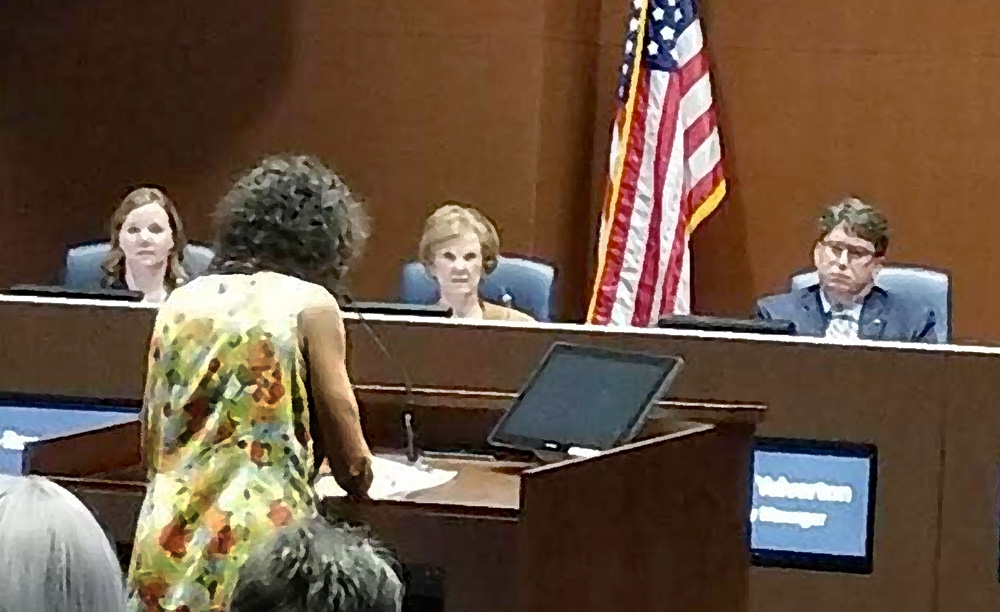
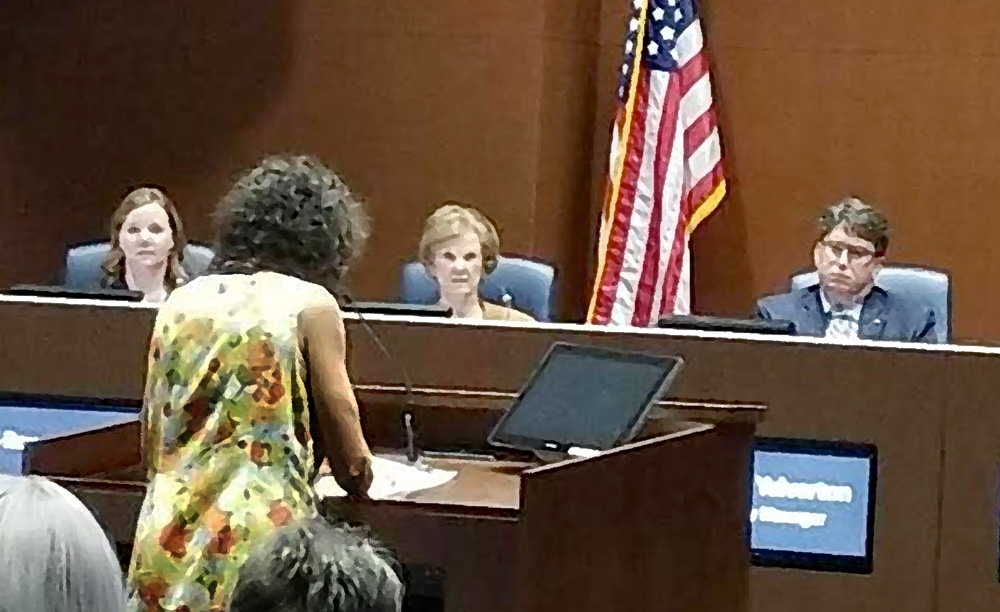
That left the council holding an unusual weekend meeting to suspend the rules and re-pass their fumbled alternative to the term limits voters really want. But news travels fast and city hall was “packed.” 

“You’re suspending the rules because your jobs are in jeopardy,” charged one man.

A woman told the council, “You guys should be absolutely embarrassed about this.”

“After hearing from dozens of angry residents,” the paper explained, “[t]he council voted unanimously to not suspend the rules, finally killing its own term limit proposal.”

Politicians doing the right thing . . . having exhausted every other possibility.

This is Common Sense. I’m Paul Jacob. 


PDF for printing


Photo from the Fort Worth Star-Telegram


Categories
Accountability incumbents initiative, referendum, and recall insider corruption local leaders political challengers term limits

Sneaky Lobbyists Prefer Sneakiness

The Arkansas Chamber of Commerce’s CEO and chief lobbyist, Randy Zook and Kenneth Wall, have formed Arkansans for Common-Sense Term Limits. 

The Chamber has a burning hatred for term limits — Common-Sense or otherwise — just like every other lobbyist and special interest. But Zook and Hall are fibbing in their name because they realize that voters love term limits. 

The ballot committee’s stated purpose? To “advocate for the disqualification or defeat” of the Arkansas Term Limits Amendment, which citizens just petitioned onto the ballot, collecting 129,000 signatures.

Defeating such a popular ballot measure isn’t likely. Instead, these politically-experienced lobbyists are preparing to sue, hoping to disqualify valid voters’ signatures on some ginned-up technicality, feigning confusion over the clear ballot language — anything that might keep democracy from coming this November.*

At issue? The difference between real term limits and ridiculous ones.

That is, between term limits set by citizens and those set by legislators themselves. 

Currently, legislators can serve for 16 years in a single seat under the state’s “limits.” And because two-year Senate terms aren’t counted at all, senators can stay as long as 22 years. 

Legislators snuck this past voters in 2014 with a ballot title claiming only to “establish” term limits . . . amidst other lies. Politicians thereby turned Arkansas’s toughest-in-the-nation term-limit law into the nation’s very weakest — a significant 50 percent longer than limits in any other state.**

Unfazed by all the corruption in the Arkansas Legislature, Chamber lobbyists are focused on putting politicians in their pocket for as long as possible. 

But those pesky Arkansas voters are once again in the way.

This is Common Sense. I’m Paul Jacob.


* After recently threatening to challenge the signatures of another initiative petition, Zook had to admit that he was not aware of a single problem or deficiency in the petition. But he quickly added, “It’s a very complicated process.”

** Arkansas’s term limits were the same as Michigan’s until 2014, three terms, six years in the House and two-terms, eight-years in the Senate.

PDF for printing


Original photo by Jeff Kubina


Categories
Accountability folly general freedom government transparency initiative, referendum, and recall local leaders nannyism responsibility too much government

Minimum Sense

Suddenly, the Democrats who dominate the Washington, D.C., City Council seem unwilling to increase the minimum wage for tipped workers — despite their official support for legislative minimum wage rate increases.

And a vote of the citizens.

Initiative 77, which passed easily last month, requires restaurant employers to incrementally increase the “tipped wage” until rates “reach what will be the uniform minimum of $15 an hour by 2025.”

“Initiative 77 is something I believe will be very harmful to our restaurants and, more importantly, our restaurant workers,” argues Councilman Jack Evans, one of three council members pledging repeal.

A spokesperson for One Fair Wage DC, calling a repeal “deeply undemocratic,” notes that “D.C. voters don’t like it when Republicans in Congress do it, and we trust council will not stoop to that level.”

Yet it would not be “the first time the city’s lawmakers overturned a decision by the electorate,” the Washington Post reminds readers, citing “a decision in 2001 when the D.C. Council overturned term limits approved by voters.”*

I’m all for ballot measures to decide any issue the people have a right to decide . . . limited by all of our inalienable rights as individuals. Minimum wage laws constitute an abuse of our First Amendment right to association, which neither legislatures nor voters may legitimately abridge.

That the council doesn’t recognize this right of association, yet nonetheless thinks it should nullify a vote of the people tells you everything you need to know about the sorry state of representation.

This is Common Sense. I’m Paul Jacob.


* And even quoting moi on the incredible hypocrisy dating back 17 years: “If you’re in a city struggling to get representation in the first place, that’s a terrible signal to say that your own local officials don’t respect their own citizens.”


PDF for printing


Categories
Accountability ballot access folly general freedom ideological culture initiative, referendum, and recall media and media people national politics & policies political challengers responsibility U.S. Constitution

Should Non-Citizens Vote?

“A lot of people would like to say this is an immigration issue. It’s really not,” offered Gary Emineth, the head of North Dakotans for Citizen Voting and a candidate for state senator.  

“It’s really about preserving the right for U.S. citizens, and in our case, North Dakota residents, to only be the voters in all elections across the state of North Dakota,” added Emineth. “And that’s why we want it in the constitution.”

Turning in more than 35,000 voter signatures on petitions last Friday, Emineth and others placed a constitutional amendment on this November’s ballot that, if passed, would make voting the exclusive right of U.S. citizens in North Dakota.

Elsewhere in the country, Emineth points out, non-citizens are already voting — in Chicago and San Francisco, and in 11 cities across Maryland. Moreover, campaigns are underway across the country to give non-citizens the vote — in California, Connecticut, New York City, Boston and Montpelier, Vermont.

Opponents claim the North Dakota measure is completely unnecessary, as the state doesn’t currently allow non-citizens to cast a ballot, nor has any city yet attempted to allow non-citizens to vote. But Emineth’s goal is to keep it that way.

Moreover, University of North Dakota Law Professor Steven Morrison acknowledged to The Forum in Fargo that “the proposed amendment does clean up what could be a grammatical loophole since the word ‘every’ doesn’t conclusively exclude non-citizens from voting. . . .”

It is a very simple proposition: Do you want voting to be the exclusive right of U.S. citizens? Or should non-citizens be allowed to vote?

Coming to a ballot near and Fargo.*

This is Common Sense. I’m Paul Jacob.


* With some help from Liberty Initiative Fund.


PDF for printing


Categories
Accountability general freedom government transparency initiative, referendum, and recall local leaders national politics & policies political challengers term limits

The Other Maine Thing

Tuesday’s biggest election news was the victory for Ranked Choice Voting (RCV) in Maine. This is the second statewide vote for this reform, which allows voters to rank the candidates by first choice, second choice and so on.*

Voters first passed it in 2016, but the next year the voters’ “representatives” in the legislature repealed the law, overturning their vote.

Undeterred, RCV supporters filed a referendum and again went out and gathered enough petition signatures to refer the legislature’s repeal to a vote of the people. On Tuesday, Maine’s voters vetoed the legislature, keeping Ranked Choice Voting.

Initiative and referendum sure are helpful.

RCV is not partisan; it requires the winner to have some level of support from a majority of voters and fixes the wasted vote problem. In Maine, however, the Republican Party opposed. On election day, Republican Gov. Paul LePage even threatened not to do his duty and certify the results.

Paul Jacobs (Vice chair of the [FairVote] Board) whom I once knew and thought was a good American,” a Republican friend posted on my Facebook page, “has helped unleash the hounds of Hell” . . . adding that “now the voters are so confused by the terrible procedure that voting will be a nightmare this Tuesday!”

Yet voters used the new voting system for the first time Tuesday in candidate primaries before deciding Question 1 on their ballot — about keeping RCV. As one Portland voter put it, “It’s pretty easy to do, despite the negative publicity.”

We need more control over government with our vote. And when voters speak, politicians should listen.

It wouldn’t hurt political activists to listen, too.

This is Common Sense. I’m Paul Jacob.


* I’ve discussed the idea in this space many times — there’s more information on how it works here.

PDF for printing


Categories
crime and punishment folly free trade & free markets general freedom initiative, referendum, and recall local leaders nannyism national politics & policies privacy

Legalize Cancer Fighting

“Do all former congressmen have to get cancer before we’re gonna get medical marijuana or recreational marijuana?”

That’s what Reason TV’s Nick Gillespie asked Billy Tauzin at the Cannabis World Congress and Business Exposition. Tauzin’s a former Representative for Louisiana’s 3rd District. He moved from Congress to lobbying for Big Pharma — I mean, PhRMA, a drug lobbying group — and then to Lenitiv Scientific, where he works now.

The company produces “a line of innovative, high quality cannabis and hemp-derived CBD products,” its website informs. These products, says the former Republican politician, are so effective that he now expresses some regret that he could not have had access to such drugs when he was fighting cancer more than a decade ago. Today’s cancer patients have it easier, because of cannabis-derived products, including CBD.

Hence Gillespie’s question — which almost answers itself.

With a No.

The number of states that have legalized or decriminalized marijuana for recreational or medicinal uses (or both) is growing all the time, usually without the help of politicians with or without cancer.

The movement has mostly been carried on by We, the People through initiative and referendum. Especially the crucial early steps.

But politicians are beginning to follow our leadership.

Which, in a society where citizens are in charge, is all to the good.

Though powerful opposition remains, Tauzin speculates, “I think if we took a silent vote, secret ballot, we’d win tomorrow easily.”

So, given a little more time for Congress to catch up with the culture, freedom can prevail, no cancer necessary.

This is Common Sense. I’m Paul Jacob.


PDF for printing


Categories
crime and punishment general freedom ideological culture initiative, referendum, and recall local leaders national politics & policies political challengers property rights Regulating Protest too much government

A Sanctuary from Centralization

Defiance . . . nullification. It is a trend.

I take it as a sign of our contentious times that we now witness states in open rebellion against centralized control from the Imperial City of Washington, D.C., while cities and counties are also rattling the chains set by their respective state capitals.

The sweep of marijuana decriminalization and legalization is only the most obvious. The rise of “sanctuary cities” defying federal government immigration laws — often backed up by state legislatures — has been a contentious issue, with progressives supporting this sort of nullification and conservatives opposing it.

But the latest development does not hail from the left.

In Illinois, a number of rural governments have taken a cue from the immigration debate by “declaring themselves sanctuary counties for gun owners,” we learn from the AP’s Don Babwin, writing in the Chicago Tribune. “The resolutions are meant to put the Democratic-controlled Legislature on notice that if it passes a host of gun bills . . . the counties might bar their employees from enforcing the new laws.”

An Effingham County Board Member calls “sanctuary” an attention-getting “buzzword,” reporting that “at least 20 Illinois counties and local officials in Oregon and Washington have asked for copies of Effingham County’s resolution.”

Now, cities and counties do not have an analogous relationship to their state governments as do states to the federal government: the states created the “United States of America,” while cities and counties are also state creations.

Yet this move is important. It shows a growing recognition of the tyrannical nature of centralized power.

And the usefulness of decentralization.

This is Common Sense. I’m Paul Jacob.


PDF for printing


Categories
Accountability general freedom government transparency initiative, referendum, and recall local leaders moral hazard nannyism national politics & policies

Principle and Compromise

Last Friday, Tim Eyman — the Evergreen State’s best-known ballot initiative practitioner — won an important court case.

But he also scuttled an amazingly impressive compromise between state legislators, police, and the proponents of Initiative 940.

The measure was written and promoted by De-Escalate Washington, a group that includes several relatives of deceased victims of recent controversial police shootings. I-940 would implement violence de-escalation and mental health training for police, and require law enforcement personnel to provide first-aid to save lives. Most likely Washington voters tell pollsters they approve.

De-Escalate Washington got the required signatures, sending this “indirect initiative” to Olympia. The Legislature was faced with three choices:

  • approve the initiative as written;
  • not act, letting the measure go to the ballot; or
  • approve an alternative and place both proposals on the ballot.

The Legislature tried to “create a fourth option”: it passed the measure with amendments.

And that’s what Thurston County Superior Court Judge Christine Schaller found unconstitutional. She sent the measure, un-amended, to the ballot for a vote of the people.

Interestingly, those amendments were the result of negotiations among the measure’s advocates, the police, and the Legislature. There had been many congratulations all around on the “historic” compromise. But, “historic” or no, legislatures must follow the law.

Tim Eyman is pleased that the court defended the constitutionally defined initiative process by definitively siding against the backroom compromise.

And voters will still get the chance to vote on the proposal.

This is Common Sense. I’m Paul Jacob.


PDF for printing


Categories
ballot access general freedom initiative, referendum, and recall moral hazard nannyism national politics & policies political challengers responsibility term limits

The Yellow and White Lines

If I’ve heard it one million times, I’ve heard it ten: “We already have term limits; they’re called elections.” A statement usually offered as the beginning and end of wisdom regarding the problems term limits are designed to tackle.

Equally “profound” is the collateral claim that “the only term limits we need are an informed electorate.”

Such generalities “prove” too much. Any formal restraint of government could be thus airily dismissed.

  • “The only Bill of Rights we need is an informed electorate.”
  • “The only checks and balances we need are an informed electorate.”
  • “The only prerequisites for running for office we need are an informed electorate.”

If formal rules don’t matter, why write these things down or try to enforce them in light of principle and precedent? Just get your informed electorate and let the informed electorate handle it.

To preserve and strengthen our republic and our liberties, we do need an informed electorate. We also need many other things, including well-known, widely accepted, consultable, objective limits on government power.

One such limit limits terms.

Term limits on legislators, executives and even judges combat political corruption, empower informed voters, and give informed and capable electoral challengers more opportunities to effectively present their ideas.

The fact that a given political or cultural factor is crucial to the commonweal doesn’t mean that no other factors are also crucial.

Don’t tell drivers of cars that all they need are skills and gas.  You also need lines on the road — limits to keep us out of the ditch, and from head-on collisions.

This is Common Sense. I’m Paul Jacob.


PDF for printing


Categories
ballot access initiative, referendum, and recall local leaders political challengers Regulating Protest too much government

New-Fangled Vote Counting

Call me old-fashioned, but when you go to the pols to cast your vote on a ballot measure, your Yes vote should count for yes and your No vote for no.

And if you choose not to vote, your non-vote should count for neither yes nor no.

That’s just common sense. Right?

Well, meet its antithesis: Proposal 97, now being considered by Florida’s powerful Constitution Revision Commission (CRC).* Proposal 97 would count all those who do not cast a vote for or against a ballot measure as a No vote against it.

To pass a constitutional amendment in the Sunshine State already requires a supermajority vote of at least 60 percent of those who do cast a vote on the measure. Under Proposal 97, counting all those not voting on it as No votes, that percentage would necessarily go even higher. If 10 percent don’t vote, Yes would have to come in at 67 percent to win.

This is minority rule . . . with an extra perverse twist.

The supermajority requirement encourages big money interests to spend heavily against ballot initiatives — even when the issues have clear majority support — because if they can manage to lose by less than 20 points (60–40 percent), they win. Now all opponents need do is poison the water with the nastiest campaigning imaginable, causing more voters to throw up their hands or pinch their noses and avoid the issue . . .

. . . thus, being counted as voting No.

Don’t abstain. Stop Proposal 97. Tell them NO here.

This is Common Sense. I’m Paul Jacob.


* How powerful is the CRC? Every 20 years it meets with the awesome authority to refer constitutional amendments directly to the ballot — as many as it wishes and the amendments can be packaged to include several different subjects. No other state has a similar body. Of the 37 commission members, the governor appoints 15, the Senate president and the House speaker each appoint nine, the chief justice of the state supreme court appoints three and the attorney general is an automatic member.


PDF for printing