Categories
Accountability ballot access general freedom government transparency initiative, referendum, and recall local leaders moral hazard

Fear of Voters

You are a state legislator, say. And an issue could be placed on the ballot on which a majority of your state’s citizens might not vote according to your preference. What would you do?

  1. Educate your fellow citizens on the merits of your position; or
  2. Dawdle while calling a lobbyist for advice; or
  3. Change the constitution to make it impossible for such a vote to ever be held?

State Rep. John Enns chose option C — perhaps after exhausting B. Stamping out Oklahoma’s ballot initiative process, freeing Enns and other legislators from this citizen check at the ballot box, is the essence of his House Bill 1603.

The Sooner State already possessed the toughest petition requirements in the country.  Supporters must gain the country’s highest percentage of voter support (15 percent) while limited to the second shortest time period (90 days) to circulate petitions.

On top of this current statewide slog, Enns’ constitutional amendment would require also qualifying in every single county. Oklahoma has 77 counties.

As the Tulsa World editorialized, “he wants to make it impossible.”

What lousy rationale lies behind Enns’ desire to destroy democratic governance?

In response to another legislator’s query about his “fear that some marijuana bill will . . . become a state [ballot] question,” Enns claimed his effort was “not pre-emptive.” But he acknowledged his strong opposition to legalizing recreational marijuana, which he pointed out “had been done through initiative petition” in other states.

Enns is afraid of Oklahoma voters having their say. He should be.*

This is Common Sense. I’m Paul Jacob.


* I mean, of course, that Rep. Enns should fear being booted out of office on his keister. He should not have to fear physical reprisal. The Tulsa World reports that the Oklahoma Highway Patrol is now providing security to Enns, after a death threat was received related to his HB 1603.


PDF for printing


Categories
general freedom government transparency initiative, referendum, and recall local leaders moral hazard political challengers responsibility term limits too much government

Graceless Memphis Politicians

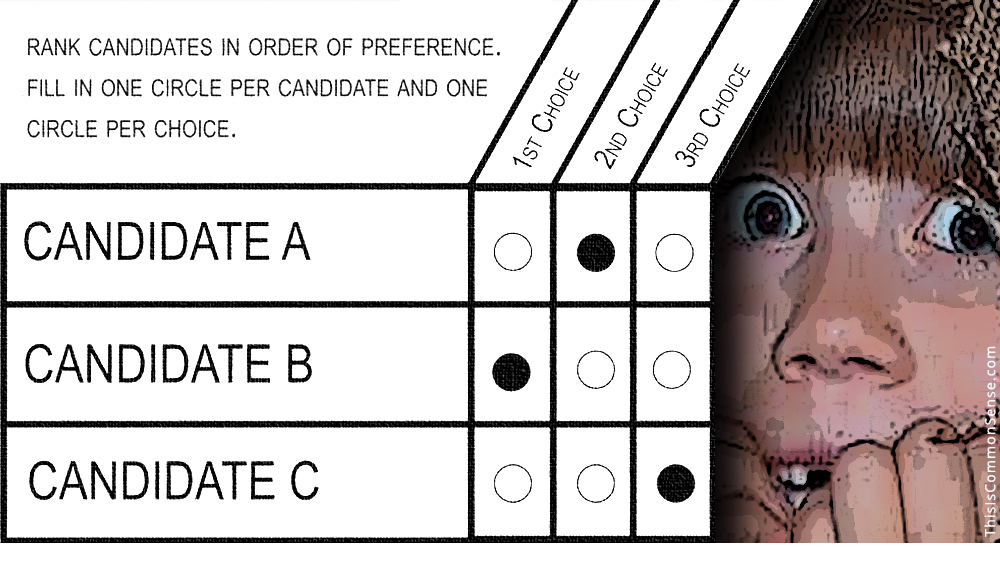
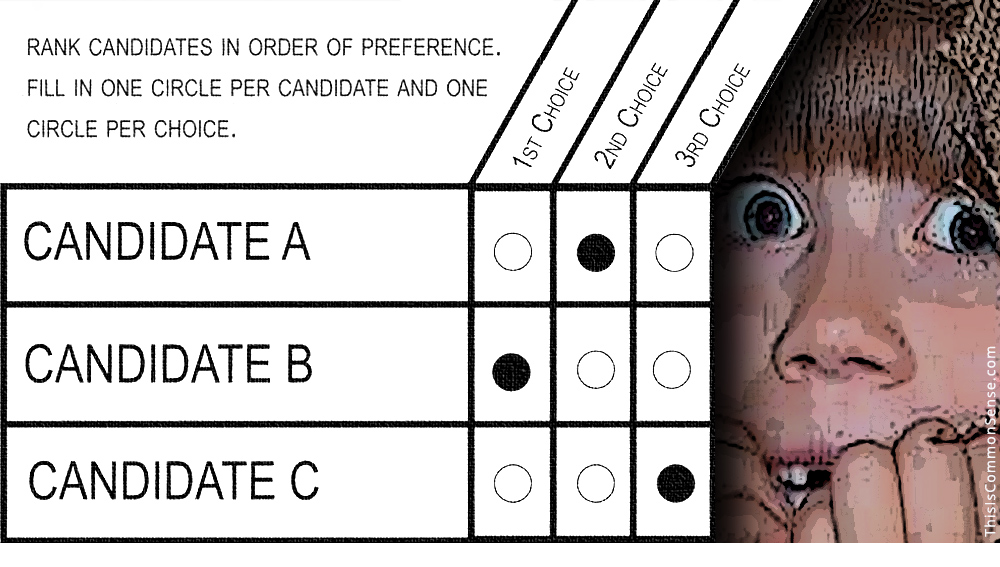
“We could care less about instant runoff voting,” fibbed Allan Wade, the city attorney for Memphis, Tennessee.

Wade was rebutting the recent Commercial Appeal revelation that Memphis’s “City Council worked behind the scenes to find a sponsor for legislation this year that could ban instant-runoff elections statewide.”

After long relying on the mayor’s lobbyists, was it purely coincidental that the council suddenly spent $120,000 on its own Nashville lobbyists?

One of the bill’s sponsors, Rep. Mark White (R-Memphis), missed the memo. He acknowledged being “approached . . . on the council’s behalf to ask if he would again sponsor the bill.” A lobbyist also confirmed to the Memphis Flyer that the council engaged him to push the ban on what is also known as ranked choice voting.

So, the city council is directly lobbying the Tennessee Legislature to overrule their city’s residents — who voted 71 percent YES for instant runoff voting in 2008.

And there’s a twist. The council has placed two measures that would repeal instant runoff voting on this November’s ballot, hoping to somehow convince voters to scrap the reform. Wait . . . why lobby the legislature when the voters are already set to make the decision?

Oooooooooohhhhhhhh!!!!!!!!!!!!!!!!!!!

“Now they are using our money to take away that choice from us,” protests Aaron Fowles with Save Instant Runoff Memphis.

This city council — in addition to their sneaky, anti-democratic assault on instant runoff voting — has also placed a measure on the ballot to weaken their own term limits, passed by an 80 percent vote.

To paraphrase Memphis’s King, these rabid-dog politicians ain’t never caught a rabbit and they ain’t no friends of ours.

This is Common Sense. I’m Paul Jacob.


P.S. After media coverage, a hearing on the Senate version of the bill to ban instant runoff voting, SB 2271, was abruptly postponed for three weeks.


PDF for printing


Categories
First Amendment rights free trade & free markets general freedom initiative, referendum, and recall nannyism national politics & policies privacy property rights Second Amendment rights Tenth Amendment federalism too much government U.S. Constitution

Winning Too Much?

“We’re Number 17!!!”

This lacks a certain triumphant note.

It is nothing like the “We’re Number 1!” the Swiss are now hollering as they pump their arms into the air, waving giant #1 foam fingers against the backdrop of snow-covered Alps.

Actually, knowing the Swiss, they are probably a bit more restrained. Still, you get the point.

Number 1 in what, you ask? Creamy, delicious chocolate, perhaps? Banking? Skiing?

Freedom.

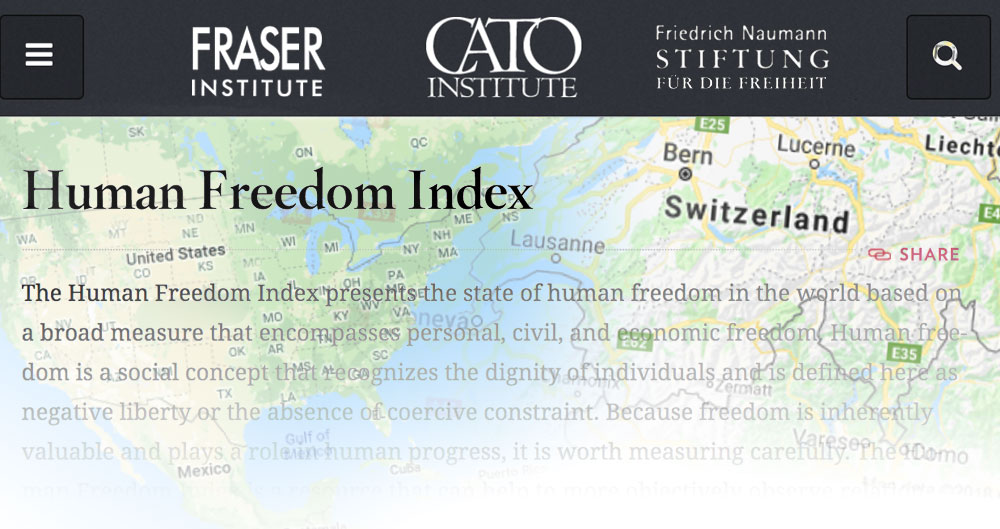
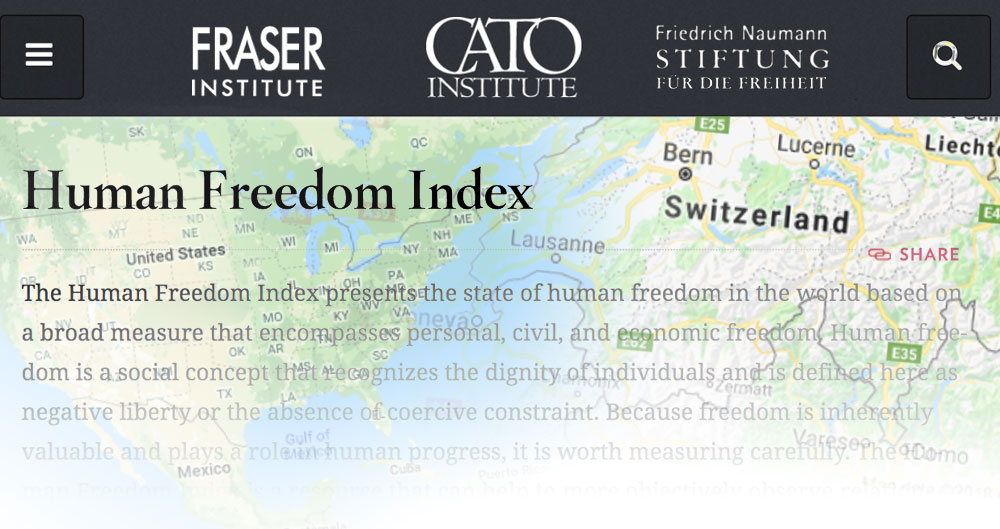
The Human Freedom Index 2017, jointly published by the institutes Cato, Fraser, and Liberales, is hot off the presses. The report ranks the countries of the world on “personal, civil, and economic freedom.”

This year, Switzerland switched places with Hong Kong, which had come in first the year before. The U.S. moved up from 23rd place in 2016, but down from 2008, when we were challenging Top 10 status at Number 11.

“Weak areas [for the U.S.] include rule of law, size of government, the legal system and property rights,” according to a Cato video.

Let’s compare Switzerland to the United States. The 1848 Swiss Constitution creates 26 sovereign cantons (states), greatly influenced by our system of federalism. In the 20th century, Americans in 26 states and most localities borrowed from the Swiss, establishing a system of direct democratic checks on government — what we call ballot initiatives and referendums.

Both countries have constitutional limits on government, protecting individual rights — even from fully democratic tyranny. But in the freest nation in the world, Switzerland, citizens possess a powerful direct democratic check on their government at all levels . . . while we do not.

After all, we’re Number 17.

This is Common Sense. I’m Paul Jacob.


PDF for printing


Categories
Accountability ballot access general freedom government transparency initiative, referendum, and recall local leaders national politics & policies political challengers responsibility tax policy term limits too much government

What Unlimited Government Costs Us

“Olympia can’t restrain itself,” Tim Eyman wrote the other day, a judgment on legislative irresponsibility hardly unique to the Evergreen State. Citizens around the country have cause to lament the difficulty of obtaining anything close to a good legislature.

Too often the merely “bad” would constitute a significant improvement.

Which is why legislators need to be put on a short leash. Limits on government must be written into law, where possible into either the U.S. Constitution or state constitutions, so the limits cannot be tampered with by legislators, good or bad.

Washington State initiative guru Tim Eyman, cited above, has made a career of working for just those kinds of limits. In 2007, Eyman and the citizen group Voters Want More Choices petitioned onto the statewide ballot a requirement that any tax increase must receive a two-thirds vote from both legislative chambers.

Voters passed the measure* in 2007, 2011 and 2012.

In an email to supporters this month, Eyman presents data — an “amazing real-world comparison” — to help us understand how effective the limits were . . . while they lasted.

He notes that “with the 2/3 rule in effect from 2008-2012, those 5 legislative sessions cost the taxpayers $6.894 billion” in increased taxes.

And he compares that to the five years (2013-2017) since the state’s highest court struck down the voters’ two-thirds mandate: “WITHOUT the 2/3 rule, those 5 legislative sessions cost the taxpayers $23.679 billion.”

“Without the fiscal discipline imposed by citizen initiatives,” Eyman concludes, “politicians cannot hold back.”

Now we have hard evidence for what unlimited government costs us: more than three times more!

This is Common Sense. I’m Paul Jacob.


* Washington State’s ballot initiative process allows voters to pass simple statutes but not constitutional amendments. For two years after passage, legislators must garner a two-thirds vote to override a ballot initiative. After those two years, only a simple majority is required.


PDF for printing


Categories
Accountability folly general freedom government transparency initiative, referendum, and recall local leaders moral hazard national politics & policies term limits

Illinois’s Chicken-and-Fish Supreme Court

A constitution is the law of the land only to the extent that it’s enforced. And in Illinois, the right of citizen initiative — provided for in the state constitution — is not enforced.

The constitution’s wording is explicit: “Amendments . . . may be proposed by a petition signed by a [specified number of electors]. . . . Amendments shall be limited to structural and procedural subjects contained in Article IV.”

Does that Article IV discuss the subject of election procedures, including eligibility requirements, thereby opening the door to a citizen-initiated term limits amendment? Yes, it does. Section 2, subsection (c), for example, specifies citizenship, age, and residency requirements.

Yet the Illinois Supreme Court has repeatedly chucked the results of effective petition drives to get a state legislative term limits question on the ballot.

The justices rely on the venerable Fallacy of Tortured Misreading.

Former Illinois legislator Jim Nowlin recently pointed out that in 1976, the court concluded that the wording about how initiative proposals “‘shall be limited to structural and procedural subjects’. . . meant a proposal must make both kinds of changes.” The lone dissenter on the court “opined to the effect: When I see a restaurant sign that says, ‘We have chicken and fish,’ that doesn’t mean you have to order both chicken and fish!”

The right of citizen initiative is a crucial means of reforming government when those in government won’t reform themselves. The citizens of Illinois have that right. But, for now, they also don’t.

That ain’t Common Sense. I’m Paul Jacob.


PDF for printing


Categories
Accountability Common Sense incumbents initiative, referendum, and recall local leaders moral hazard national politics & policies responsibility term limits

Agreeable America

Americans actually agree on a lot of things; it’s a pity that today’s media and political debates play up the discord.

Or so argues A. Barton Hinkle at The Richmond Times-Dispatch. Sure, he admits, “[a] lot of people seem willing to tear your head off over the smallest thing.” But “on some topics, the public is of one mind, or as close to that as you can get.”

Hinkle notes that “Nine out of 10 Americans think a background check should be required for every firearm purchase.”  A few percentage points fewer wish to keep “Dreamers” in the country; a mere one point fewer disapprove of civil asset forfeiture. Medical marijuana is approved of by 83 percent of Americans.

Not on Hinkle’s list? American agreement on term limits. A year ago, a Rasmussen Poll found support for limiting congressional terms at 74 percent of likely voters, with only 13 percent opposed and 13 percent undecided. This overwhelming public support has been consistent for many decades.

But consistently ignored by Congress. Not so surprisingly.

Can Americans put their united oomph behind their overwhelming agreement? U.S. Term Limits thinks so.

The group isn’t depending on cajoling the Congress, either. They’re mobilizing concerned citizens to convince 34 state legislatures to call a Term Limits Convention.* The convention’s purpose is to propose a constitutional amendment for congressional term limits, which then still requires 38 states to ratify it.

Rather than brewing up a civil war over tweets and “microaggressions,” join the Term Limits Team.

Let’s agree to agree. And make our representatives agree, too.

This is Common Sense. I’m Paul Jacob.

* As Article V of the U.S. Constitution states, “The Congress . . . on the application of the legislatures of two thirds of the several states, shall call a convention for proposing amendments, which, in either case, shall be valid to all intents and purposes, as part of this Constitution, when ratified by the legislatures of three fourths of the several states . . .


PDF for printing


Categories
Accountability general freedom government transparency incumbents initiative, referendum, and recall local leaders political challengers

Initiative Surplus?

Only nine out of 50 states can pay their bills and meet their obligations; 41 cannot, barring major tax increases or spending cuts.

That’s what we learn in last month’s “Financial State of the States” report from Truth in Accounting (TIA).

Alaska is in the best shape, “with $11 billion in assets to pay future bills”; New Jersey’s in the worst, needing “to come up with $208 billion in order to meet its promised obligations.”

Sheila Weinberg, TIA’s founder, works hard to counter governments’ creative accounting. It’s trickery, really, which “would be considered criminal for private sector corporations.” One gimmick is “promising to pay employee benefits in the future, but not fully funding the benefits programs as they rack up obligations.”*

Thankfully, TIA’s financial analysis includes items such as already-made pension and healthcare commitments.

Now, let’s expand the analysis, collating these findings to separate between initiative and non-initiative states**:

  • Seven of the nine states with a “taxpayer surplus” — where government can pay its bills and meet its obligations — have the ballot initiative process.
  • The 23 initiative states comprise 46 percent of the states. Yet, initiative states comprise a whopping 78 percent of financially healthy states.
  • Of the 20 states carrying a larger-than-average taxpayer burden, 15 states (75 percent) lack the initiative process.

Granted, this represents a correlation between states with citizen-initiated ballot measures and healthier fiscal policy, not necessarily causation. Still, I’m not surprised states where citizens have more say so are better governed.

This is Common Sense. I’m Paul Jacob.


* “This short term fix allows governments to artificially ‘balance their budgets’ by not counting certain obligations as official debt.”

** There are 23 initiative states and 27 non-initiative states. Two referendum-only states— Maryland and New Mexico — are considered non-initiative states, and so is Illinois. Illinois is considered a non-initiative state, because its ballot initiative process is so severely restricted as to be non-existent. Only one measure has ever appeared on the ballot.


PDF for printing


Categories
general freedom initiative, referendum, and recall political challengers Regulating Protest

Self-Determination, Anyone?

An election can be a clarifying event.

So can the suppression of an election.

Over the weekend, more than two million Catalans, greater than 40 percent of those eligible, voted in a referendum on independence from Spain. To which Spain’s Prime Minister Mariano Rajoy declared, “There was no independence referendum in Catalonia today.”

Rajoy certainly tried to stop it.

Spanish authorities shut down referendum websites and sent hordes of national police into the region to seize ballots and forcibly prevent people from voting. News reports are full of those police using rubber bullets on crowds, smashing their way into polling places and roughing up people.

Nearly a thousand citizens of Catalonia were injured in various clashes.

While the referendum result was a lopsided 90 percent opting for independence, previous polling shows Catalans split on the question. Perhaps the suppression worked best with those opposed to separation from Spain, who seem to have stayed home.

Let the people have a fair vote and follow the result. Anything less suggests support for the unthinkable: holding the Catalans in Spain against their will.  

Last week, Iraqi Kurds also held a referendum in which voters overwhelmingly favored separation — in this case from Iraq and for the formation of their own wholly independent nation. And, likewise, others, including the United States, tried to block the vote. Thankfully, not by force.

Yet. Turkey and Iran oppose an independent Kurdistan because they fear it will embolden demands by their own Kurdish populations for greater autonomy. Or independence.

In a world with respect for freedom, the principle is obvious: self-determination. Take it as far as you like.

Or even as far as Ludwig von Mises took it.*

This is Common Sense. I’m Paul Jacob. 


* “The right of self-determination,” Mises wrote in Liberalism (1927), “in regard to the question of membership in a state thus means: whenever the inhabitants of a particular territory, whether it be a single village, a whole district, or a series of adjacent districts, make it known, by a freely conducted plebiscite, that they no longer wish to remain united to the state to which they belong at the time, but wish either to form an independent state or to attach themselves to some other state, their wishes are to be respected and complied with. This is the only feasible and effective way of preventing revolutions and civil and international wars.”


PDF for printing


Categories
Accountability ballot access general freedom government transparency ideological culture initiative, referendum, and recall insider corruption local leaders national politics & policies property rights Regulating Protest responsibility too much government U.S. Constitution

The Great Faction

Politics isn’t a pretty business.

Frédéric Bastiat called the beast it serves “that great fiction” not because it doesn’t exist — intrusive state power sure persists — but rather because what it promises cannot really happen: “everyone living at the expense of everyone else.”

What can we do? How do we counteract a game that is rigged to increase the insanity, not reduce it?

Last week I indicated one thing a minor party with that goal in mind could do: use its power of spoiling elections to change major party behavior, and thus give citizens a fighting chance to restrain governmental metastasis.

Cancer.

I also suggested “blackmailing” the major parties into setting up a system of voting that . . . ends the power to blackmail! I believe that system — ranked choice voting — holds many positives, not the least of which is ending strategic voting, wherein voters are tempted to “falsify” their own preferences and support candidates they might dislike. This is as corrupting to the citizenry as the Great Fiction itself.

Let’s hope a savvy minor party leverages the major parties, gaining reforms to improve the system. Regardless, we can all — independently — push two other limits on political power:

  1. term limits at all levels, and
  2. initiative and referendum rights in all the states, not just the 26 that have it now.

Initiative and referendum rights would give ordinary citizens the leverage to possibly restrain the mad rush to live at each others’ expense. With the initiative, citizens can gain term limits, which produce more competitive legislative elections and lead to fewer legislators captured by the interests loitering in the capitol.

This is Common Sense. I’m Paul Jacob.


PDF for printing


Categories
Accountability general freedom initiative, referendum, and recall local leaders political challengers Regulating Protest too much government

Know Your BS

“Help me get my B.S. in the voters pamphlet,” read the subject-line of Tim Eyman’s email

Eyman is a practitioner of the art of the voter initiative, foremost in his state, Washington, and one of the most effective nationwide.*

This particular call to action concerns the voter pamphlet statements about a tax increase placed on Washington State’s November ballot by the mayor and city council in Tim’s hometown of Mukilteo.

“In the pro statement,” Eyman explained, “they wrote that the need for the tax increase was ‘indisputable.’” Which his rebuttal countered with: “Politicians always say the need for higher taxes is ‘indisputable.’ We call B.S. on that.”

It is rather to the point.

But soon he received word from the city that, “The Auditor feels the language is inappropriate and would like you to choose different wording.” Rather than “We call B.S. on that,” it was suggested that he might use: “We call foul.”

Eyman objected. He pointed out that B.S. is used ubiquitously; he sent the city examples.

“I called the ACLU,” his email noted, and “they thought it was B.S. for the government to say you can’t say B.S.”

Eyman’s own attorney, Stephen Pidgeon, sent the city a detailed letter pointing out that this is exactly the speech protected under the First Amendment.**

The City of Mukilteo has yet to announce a final decision. Tim Eyman invites all of us to send an email to encourage the city to Let Eyman Keep his B.S. in the Voters Pamphlet.

This is Common Sense. I’m Paul Jacob.


* He was once even dubbed “America’s No. 1 freedom fighter” — by me.

** Pidgeon also offered, “While the pious may construe the inference of these two alphabetic avatars as meaning something crude, my client may very well have been referencing an ancient Latin phrase ‘Bubulum Stercus’ which no average voter would ever find inappropriate.”


PDF for printing