Categories
Accountability government transparency insider corruption local leaders moral hazard responsibility term limits

Politicians Bearing GIFs

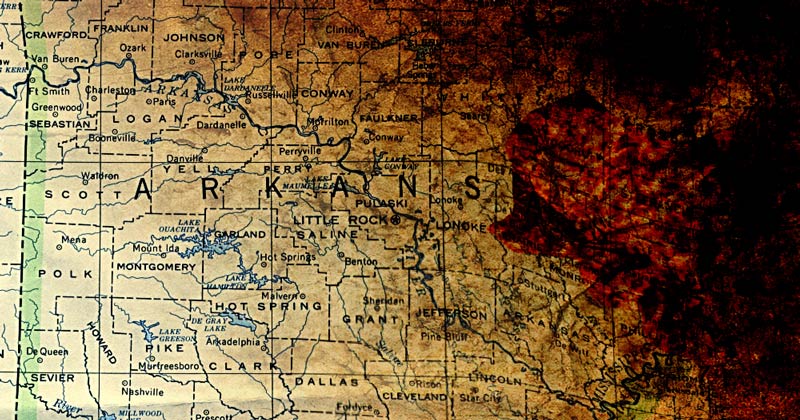
Yesterday, we discovered that the biggest term limits opponent in Arkansas — former state senator Jon Woods — also allegedly led an elaborate legislative fraud scheme, whereby he and a state representative traded tax dollars for cash bribes.

For now, Woods is an unindicted co-conspirator. But last week, the representative involved pled guilty to a felony carrying a possible 20-year prison term and directly implicated Sen. Woods.

Woods’s alleged criminality involves the GIF program — General Improvement Funds. Legislators can personally direct GIF dollars to pet projects and favored cronies, taking political credit. The process is similar to congressional earmarks. And just as corrupting.

In an article entitled, “How a 1997 Power Grab is costing Arkansas taxpayers millions on pet projects,” the grassroots group Conduit for Action explains that the GIF rules changed just before our new millennium, when term limits first cleaned out the state House (1998). The old batch of legislators gave themselves unchecked control over this vote-buying slush fund.

And that is when even bigger corruption surfaced. “A Federal grand jury shook the Arkansas political establishment today with a long list of political corruption indictments that reaches to the apex of the state Legislature,” the New York Times reported in 1999.

Back then, Sen. Nick Wilson was Arkansas’s loudest term limits critic . . . until his three-decade-long career ended with a guilty plea to 133 counts of racketeering and other public corruption.

Interesting that top legislative enemies of term limits, both past and present, wear the Scarlet Letter “C” for corruption. Coincidence?

Term limits are no friend to corruption. And vice-versa.

This is Common Sense. I’m Paul Jacob.

Printable PDF

Arkansas, corruption, term limits, Jon Woods, GIF


Categories
Accountability crime and punishment folly government transparency insider corruption local leaders porkbarrel politics responsibility

Hog-Wild Corruption

Former Arkansas State Rep. Micah Neal pled guilty last week to a felony charge of conspiring “with an Arkansas state senator to use their official positions to appropriate government money to certain nonprofits in exchange for bribes.”

Neal, who embraced graft his first month in office, received $38,000 in “legislating-around” money between 2013, when he entered the House, and 2015.

Court documents mention a number of seasoned conspirators, though not by name. There’s mysterious Senator A, who took Rep. Neal under his crooked wing.

Their scheme, reported Arkansas Business, “direct[ed] $600,000 in state GIF funds to the Northwest Arkansas Economic Development District, which then distributed it to two nonprofit entities.” Those two outfits — Entities A and B — then kicked back dough to Rep. Neal and Senator A through bagmen.*

Arkansas Business sorted out “the alphabet soup of unindicted people and entities.” It turns out Senator A, the ringleader, is someone we’ve encountered before: former State Senator Jon Woods.

Remember Issue 3, the dishonestly-worded 2014 constitutional amendment that weakened term limits (while telling voters it “established term limits”), imposed a gift ban so “tough” that now all legislators can get free meals from lobbyists anytime, and created an “Independent Citizens Commission” (a majority appointed by legislators) that gave legislators a 148 percent pay raise?

That was Woods’s.

His indictment appears imminent.

Meanwhile, Neal’s attorney extends to us his client’s wish that “this case does not overshadow all the good he did while serving as [a] representative.”

What good? The term limits scam.

Neal’s corruption doesn’t overshadow all he did as a legislator — it illuminates it.

This is Common Sense. I’m Paul Jacob.
 

* Three additional conspirators were engaged in delivering the bribe money to Rep. Neal and Sen. Woods. In court papers, these bagmen were referred to as Person A (a lobbyist for Entity A), Person B (“the president of Entity B and a friend of Senator A”) and Person C (“a friend of Senator A and Person B”).


Printable PDF

Arkansas State Rep. Micah Neal, Independent Citizens Commission, Senator Jon Woods


Categories
Accountability government transparency initiative, referendum, and recall local leaders moral hazard

Rules for Rulers?

Politicians in Tampa, Florida, have forced citizens there to vote for term limits, and then vote to keep those term limits again and again — against attempts to repeal or weaken the limits. So I keep my eye out for news from the city.

Earlier this month, Mike Deeson, an investigative reporter with WTSP 10 News, Tampa Bay’s CBS affiliate, exposed Mayor Bob Buckhorn’s open violation of the city charter’s requirement that all department heads must be city residents. Buckhorn hired Sonja Little, now the city’s highest paid employee, to serve as his Chief Financial officer, and admits on camera that he promised her she would not have to move into the city.

“The question is,” the mayor explained, “do you want talent or do you really make the residency — she’s only about a mile away from the city border — the issue?” Buckhorn answers his own question, “I would rather have talent” . . . than follow the law.

In even slipperier fashion, Mayor Buckhorn has attempted to get around the clear, unequivocal wording in the charter by claiming Ms. Little has served as the “interim” Chief Financial officer for the last five years!

Reporter Deeson asks the operative question: “[I]f you’re going to ignore the residency requirement, what other parts of the charter should you just ignore?”

Deeson worries about provisions requiring competitive bidding, guarding against conflicts of interest and mandating term limits, which is “particularly problematic for a mayor who is in his second term and has to leave office when it’s over.”

On social media, Tampa residents are unloading on the mayor with numerous variants of: “This is truly what’s wrong with government.”

This is Common Sense. I’m Paul Jacob.

Printable PDF

Tampa, initiative, corruption, Mayor, Mike Deeson, Mayor Bob Buckhorn


Categories
government transparency ideological culture national politics & policies U.S. Constitution

A Funny Thing Happened on the Way to a Reform

Going into the presidential race, last year, Donald Trump was far from a typical Republican.

His rich man braggadocio, his prior support for abortion, and much else, put him culturally at odds with the social conservative wing of the GOP. He dared heap scorn on neoconservative foreign policy strategy, sacrosanct since Reagan on the right. He has supported many Democratic programs, not the least of which is the Gephardtian protectionism that pulled in so many moderate Democrats.

Besides, as he has famously stated, Democrats loved him, asked him for money, and (not coincidentally) gave him praise . . . right up until he started his campaign under the Republican banner. Then he was excoriated as sexist, racist, xenophobic, Ugly Americanist. Ivanka, his eldest daughter — extraordinarily close to him — was a registered as a Democrat recently enough that she couldn’t even vote for him in the primary.

Ideologically, he has been all over the map.

So one might reasonably think he would govern as a centrist. A non-humble Jimmy Carter retread, perhaps.

But he has assembled the most conservative cabinet in our lifetime. Far more conservative than Ronald Reagan’s. Predictably, Democrats are freaking out.

Why the move “rightward”?

Well, if all the Democratic leadership plus most of the moderate Republican leadership have come out strongly against you — in high moral dudgeon — what point is there to appease them?

The cost of the Trump anathematization strategy may become all too clear in Trump’s first Hundred Days.

This is Common Sense. I’m Paul Jacob.

Printable PDF

Trump, protest, conservative, centrist, right, illustration


Categories
Accountability government transparency media and media people national politics & policies too much government

Seventeen, Again

The first I heard of an actual enumeration of federal “intelligence agencies” was from Hillary Clinton. In the final presidential debate, she claimed that the truths spilling out of the Podesta emails had been revealed courtesy of Russian hackers, and she knew this because all 17 U.S. “intelligence agencies” had briefed her.

Seventeen!

The number, at least, does not come from a secret source. Business Insider had popularized it. “These 17 Agencies Make Up The Most Sophisticated Spy Network In The World,” Paul Szoldra informed us three-and-one-half years ago in a fascinating listicle.

Call me paranoid . . . but if I am told that the government has 17 spy agencies, I wonder about one more: The Really, Really Secret Infodump Agency. There is, after all, no official definition of “government agency”; the federal government doesn’t even publish an official overall count, intelligent or otherwise.

Besides, the prime number 17 just seems too . . . contrived. Sixteen or 18? Boring numbers. But 17? Its numerological magic lends plausibility to “the most sophisticated spy network in the world.”

Of course, when Mrs. Clinton insisted that all 17 had concurred that the Russians were on Trump’s side, I did not believe her. And now that mainstream media outlets — in an apparent frenzy to prove themselves a more reliable fake news source than the Twittersphere, blogosphere, Facebook-o-sphere and Breitbart combined — run with nearly the same story, I don’t believe them, either.

It is as if they’ve had their talking points delivered in a secret dossier.

Reasons for doubt? All the anonymous sources, all the hedges on the order of “may be linked to” and “‘one step’ removed.”

Fake news. Brought to you by the number 17.

This is Common Sense. I’m Paul Jacob.

Printable PDF

spy, spies, intelligence, agency, 17, Hillary Clinton, Russia


Original (cc) photo byAli T on Flickr

Categories
Accountability First Amendment rights government transparency media and media people national politics & policies

Prestige, Trump & the Media

“Donald Trump’s election has really undermined America’s democratic prestige in China,” offered Claremont McKenna College Professor Minxin Pei on a recent hour of The Diane Rehm Show, public radio from our nation’s capital. When Pei added that it has “set back the prospect of democracy in China for years,” Mrs. Rehm let out an audible moan.

Then Diane asked her guests, “as members of the press” what they “make” of President-Elect Trump’s “rejection of his meeting with The New York Times.”

“It seems,” bemoaned James Fallows, the Atlantic’s national correspondent, “a continuation of his not having any normal press conferences, dealing entirely outside normal press channels and seeming not to recognize the legitimacy of this part of the democratic fabric.”

“I don’t know anything about the specific details about the New York Times meeting,” admitted the Financial Times’ Geoff Dyer. Still, that didn’t stop Dyer from announcing that, “But it’s part of a pattern . . . to a much more conflict-ual, antagonistic, almost bullying relationship with the media.”

Elizabeth Economy, with the Council on Foreign Relations, found it “disturbing” that Donald Trump thinks “he can be his own media, he can simply tweet out whatever he wants, he can make his homegrown videos and sort of impart his information directly to the American public, without the mediating influence of the media.”

Let’s welcome Elizabeth to America.

“We are all recognizing we’re on new terrain now and need to find some way to keep telling the truth, or our best approximation of it, in very different circumstances,” concluded Fallows ominously.

Trump, as you’ll recall, did wind up attending that meeting at The Times.

This is Common Sense. I’m Paul Jacob.


Printable PDF

Donald Trump, media, journalism, twitter, tweet, direct, illustration


Categories
ballot access general freedom government transparency media and media people national politics & policies political challengers

A Brexit Effect?

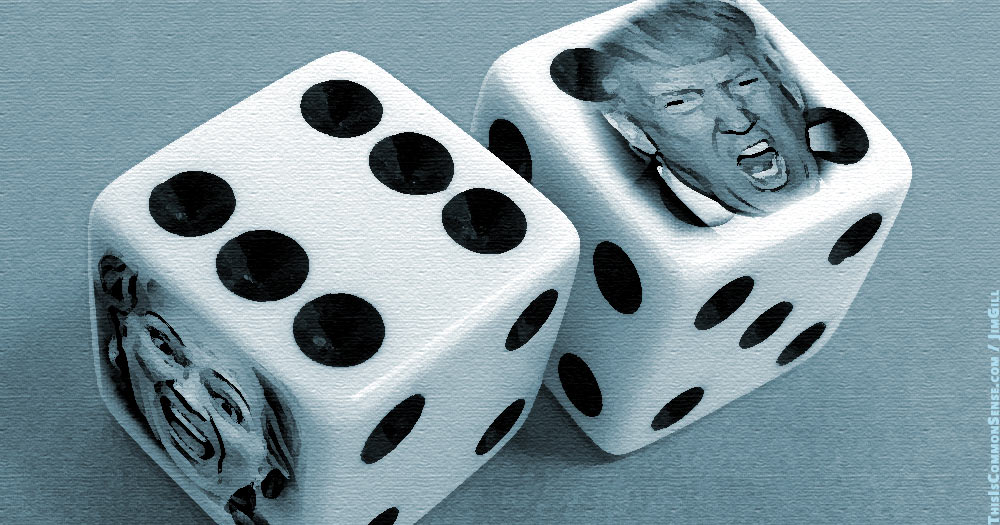
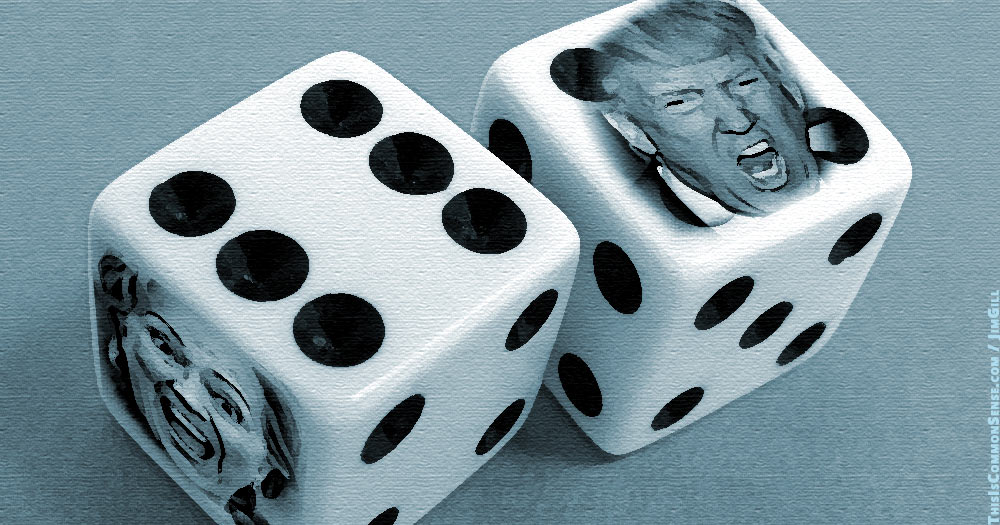
Before the Brexit vote, the likelihood of British secession from the European Union garnered a mere 25 percent chance. That was according to European betting markets, which are usually more accurate. In June, the Brits voted Brexit.

Donald Trump has made much hay of this, understandably.

On Tuesday, the odds of a Trump victory hit the same mark: 25 percent.

Gwynn Guilford’s report on this was drolly titled “Donald Trump has the same odds of winning as Jon Snow ruling Westeros, according to betting markets.”

On June 11, Business Insider had reported that Hillary was increasing her lead; on October 18, it exulted that the Irish betting markets had “already declared a winner” — not Trump. On November 1, the news aggregator merely noted that Moody’s is calling the election a landslide for Clinton.

But BI is also covering the scandal that has disturbed the Clinton camp. There’s no love lost between the Federal Bureau of Investigation and the Department of Justice, explains Natasha Bertrand in “‘The Antichrist personified’: ‘Open warfare’ and antipathy toward Clinton is reportedly fueling the FBI leaks.” The meat of her representation is that “much of the agents’ frustration . . . may boil down to partisanship”; the FBI is “Trumpland.”

Yet the article ends quoting another FBI official insisting that both Trump and Clinton are awful candidates.

A plausible judgment.

Whether late-in-the-game revelations of Clinton corruption and FBI probing can defy current odds and produce a Clinton defeat remains to be seen. As of Thursday evening, polls-only forecasts placed the odds of winning at 67/33 in favor of Mrs. Clinton, while electionbettingodds.com placed them at 70.2/29.2.

This is Common Sense. I’m Paul Jacob.

 

N.B. Late-breaking Brexit news: The United Kingdom’s high court ruled yesterday that Parliament must vote to approve Brexit before the secession can proceed.


Printable PDF

gamble, betting, HIllary Clinton, Donald Trump, president, presidency, election, voting, illustration, creative commons


Categories
folly government transparency ideological culture media and media people nannyism national politics & policies

The Problem with Ruth Marcus

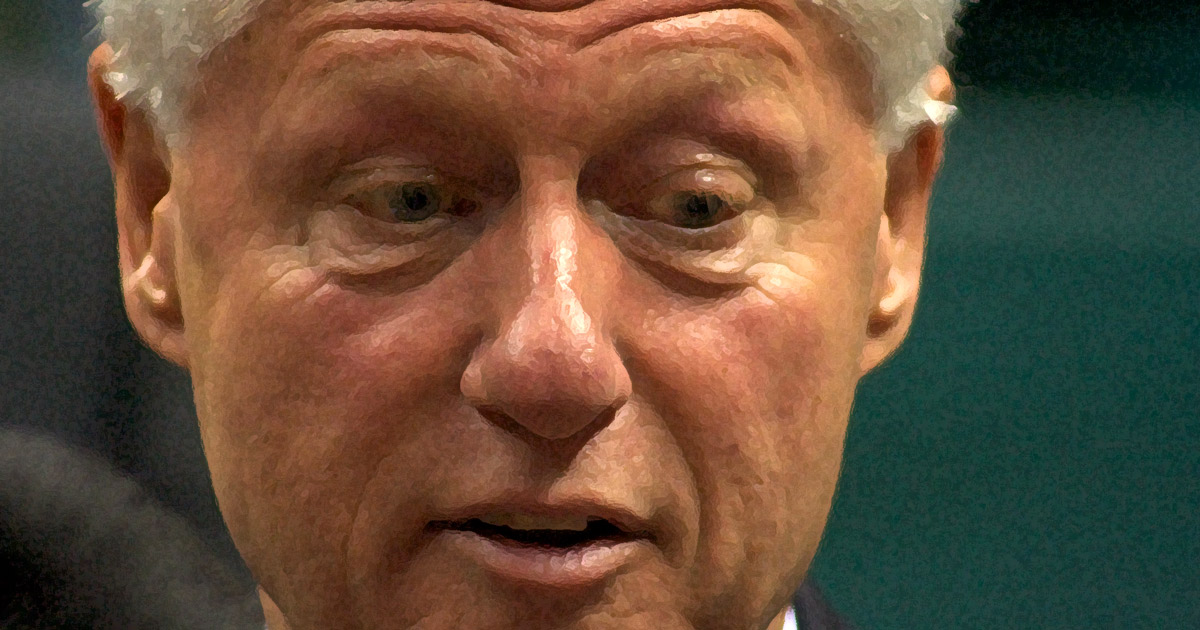
Channeling The Sound of Music’s Mother Superior, Washington Post columnist Ruth Marcus asks, “How do you solve a problem like Bill Clinton?”

Marcus means Bill’s problematic possible return to the White House, the scene of his crimes, as First Dude in a new Clinton Administration — specifically his difficulties with “the twin minefields of sex and money.”

Starting with sex, Marcus argues that, “Trump’s misbehavior with women is a far more important topic than Clinton’s” because “Trump is on the ballot; Bill Clinton is not.”

True, except that Mrs. Clinton has promised to place Mr. Clinton “in charge of revitalizing the economy,” which Mrs. Marcus called “crazy.” Maybe, but it wasn’t Trump’s idea to ballyhoo the old two-for-one Clinton couple “advantage.”

“There is no condoning a record that reflects not just serial adultery, but abuse of power,” writes Marcus. Yet, she does precisely that by adding, “Clinton was a successful president who deserved the two terms for which he was elected, but his misbehavior would disqualify him from a third term even if the Constitution allowed it.”

What?! Quite a convenient drawing of the line, eh?

Of course, the problem isn’t merely Bill, as the columnist admits: “[I]t has become clear that they cannot be trusted to appropriately navigate ethical boundaries between their private interests and public responsibilities.”

Complaining about the “incessant schnorring for private jets, luxury vacation lodging, expensive trifles” by the Clintons, Marcus warns that, “It cannot happen in a new Clinton White House, especially with a Republican Party already drooling over the prospect of congressional investigations.”

But, Ruth, how will electing Hillary Clinton the next president cause Bill & Hill to change their ways?

This is Common Sense. I’m Paul Jacob.

Printable PDF

Bill Clinton, First Gentleman


Categories
Accountability crime and punishment general freedom government transparency moral hazard nannyism national politics & policies political challengers Regulating Protest responsibility too much government

How Insidious the Plot?

The story of the Wisconsin John Doe raids against conservatives, covered yesterday and the day before, is a big one. Huge. So I now continue.

The rest of the story? Recently, materials that police seized from the subjects of those dawn raids were leaked, illegally, to the Guardian newspaper — in direct violation of a court order. Yet more lawlessness.

Who leaked this information? Well, it was in the possession of the Milwaukee County prosecutors, and they haven’t alleged a Russian hack.

What’s really going on? Eric O’Keefe stated on Monday that “even though they never brought a charge, the prosecutors did achieve one of their major goals: the unlawful seizure of millions of private communications to create a searchable database of political intelligence spanning Wisconsin and the entire country.”

In short, the abusive investigation was part and parcel of a partisan effort.

State Rep. Dave Craig is urging the creation of a special legislative committee to “take sworn testimony . . . to determine whether those charged with the public trust have acted maliciously by intentionally leaking sealed materials in violation of state policy.”

It’s important that justice be done. To prevent future tyranny.

We don’t want to see a repeat of the IRS abuse of Tea Party groups without anyone being held to account.*

This is Common Sense. I’m Paul Jacob.
 

* Speaking of the IRS, it turns out that the head of Wisconsin’s Government Accountability Board (GAB) was a pal of Lois Lerner, who headed the IRS division responsible for violating the civil rights of Tea Party groups — before she took the Fifth, refusing to testify before Congress and then retiring with a six-figure pension. Further, there is evidence the GAB may have illegally provided confidential information to the IRS in hopes of getting the Feds to join in harassing these conservative groups.


FOR MORE ON THIS INCREDIBLE STORY


Printable PDF

Eric O'Keefe, Gov. Scott Walker, John Doe, Wisconsin


Categories
Accountability crime and punishment government transparency moral hazard nannyism national politics & policies political challengers Regulating Protest responsibility too much government U.S. Constitution

A Morning After

Yesterday we celebrated the end to “a disgraceful episode in Wisconsin history” — the dawn police raids of the so-called John Doe investigations against conservatives alleged to have violated campaign finance regulations.

State and federal courts ruled that no laws were broken and some laws were unconstitutional — certainly Milwaukee County DA John Chisholm’s prosecutorial methods violated the rights of citizens the court called innocent.

The U.S. Supreme Court’s decision, announced Monday, not to hear Chisholm’s appeal thankfully ends this particular reign of error and terror.

So what have we learned?

First, courage is contagious. Had Eric O’Keefe with the Wisconsin Club for Growth not bravely spoken out, others would have remained quiet, and the prosecutors might have gotten away with what National Review’s David French called “a pure intimidation tactic to try to terrify conservatives into silence.”

Another unmistakable conclusion: yes indeed, it can happen here.

It has.

Obviously.

And if changes are not made, it will happen again.

Reforms have already been won. Not only is the John Doe investigation shut down, the law was changed, allowing for no more John Doe attacks. The Government Accountability Board, found to have acted from partisan motives, has been completely disbanded and new ethics bodies formed.

Another avenue of correction comes through the courts. The MacIver Institute filed a class-action lawsuit against Milwaukee County DA John Chisholm and others for illegally seizing documents, and Cindy Archer, whose home was raided by police, has filed a civil rights lawsuit.

Ms. Archer’s suit was dismissed after a federal judge ruled that the prosecutors had immunity. But that dismissal is now on appeal before the federal Seventh Circuit Court of Appeals.

The prosecutors will go to court . . . as defendants.

This is Common Sense. I’m Paul Jacob.

Printable PDF

Eric O'Keefe, Gov. Scott Walker, John Doe, Wisconsin