Categories
Common Sense free trade & free markets general freedom initiative, referendum, and recall local leaders nannyism national politics & policies political challengers Regulating Protest too much government U.S. Constitution

Don’t Kill Colorado!

America has lots of problems. Colorado isn’t one of them.

Search the Internet and confirm that the Rocky Mountain State is the fourth best state “to make a living”; sixth best for homeowners; third on CNBC’s “Top States for Business”; and even holds a coveted first place in “arts engagement.”

What’s not to like?

I know Colorado, fondly, as the only state with a Taxpayer Bill of Rights (TABOR), a constitutional amendment requiring state legislators who want to hike spending or taxes to first ask citizens for approval. It was passed by voters in 1992, by citizens’ initiative.

Imagine that! Citizens in charge. In real life.

In Colorado.

Unsurprisingly, TABOR has long been No. 1 on Big Government’s hit list; for politicians, lobbyists, university presidents and political insiders, it’s the bane of their existence.

Along with the citizen initiative process, from which it came.

That’s why Colorado’s political establishment spent a million dollars to put Amendment 71 on next Tuesday’s ballot. They aim to kill both TABOR and the citizen initiative.

The amendment allows any partial or total repeal of TABOR — or other current parts of the state constitution — with a simple majority vote of 50-percent-plus-one. But it demands that any new enactment of taxpayer protection (or other reform) leap over a 55 percent supermajority hurdle.

Fair?

It means that a court decision, which “reinterprets” any provision of the Taxpayer Bill of Rights, could only be corrected by citizens with a supermajority vote. And citizens would face an avalanche of big spending from big labor and big business. That’s not a bug, but a feature for the powerful forces behind 71.

Still, Amendment 71’s murderous intent goes deeper. The measure also destroys the ability of regular people and grassroots groups to petition constitutional amendments onto the ballot. Instead of one statewide petition drive, Amendment 71 adds 35 additional onerous petition requirements — in every single senate district in the state.

The next question is obvious: Did the political big-shots behind Amendment 71, who blew a cool million dollars to gather their signatures, manage to meet their own mandate for future initiatives by qualifying in all 35 senate districts? Not even close.

While the lobbyists and politicians behind 71 have spent many additional millions claiming Colorado is the easiest state to amend the constitution, a real expert — Dane Waters, chairman of the Initiative & Referendum Institute — concludes just the opposite. His analysis indicates that Colorado’s process is actually “one of the most difficult in the country.” And should 71 pass, Colorado would have “the most strict distribution requirement anywhere in the world,” he said.

Waters fears that by blocking initiative constitutional amendments “on top of the fact that the legislature [in Colorado] has the authority to overturn any statutory initiative, [Amendment 71] will basically shut down the initiative process in Colorado.”
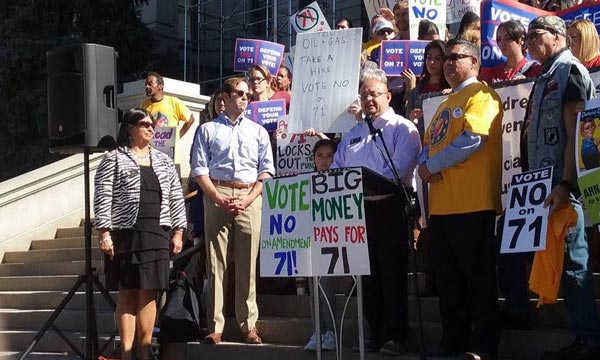
And that is how voters would be silenced and the investments powerful interests have made in the Centennial State’s legislature would be protected.

So there is no reason to be shocked when a bevy of special interests — most notably oil and gas interests, but also gambling interests and other major lobbies — raise and spend over $20 million dollars carpet-bombing the state’s electorate with TV and radio ads, slick mailings, and robo calls to support Amendment 71. They’re trying to convince voters to restrict their own power and increase the legislature’s leverage, since those special interests feel much more “comfortable” with politicians making all the decisions.

And voters making exactly none.

The politicians and lobbyists behind 71 have pulled out all the stops. Big money dominates the airwaves; all four living former state governors are on board; and their TV spots even feature the beloved Hall of Fame Denver Broncos QB John Elway.

But in the end, the beautiful thing about a ballot initiative is that voters have the final say.
And that’s why grassroots groups from throughout the state and all across the leftright spectrum, from the state’s free-market Independence Institute to progressive Common Cause, from pro-TABOR taxpayer groups to more liberal anti-fracking activists, from Colorado NARAL to Colorado Right to Life — those who care about citizens having a say in government — are standing up to the big money establishment barrage, joining the coalition to Stop71.org.

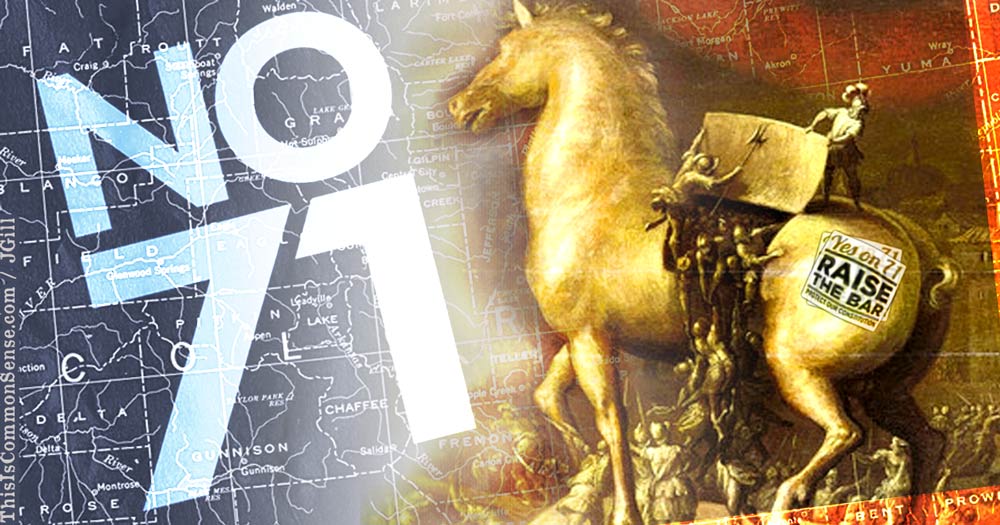
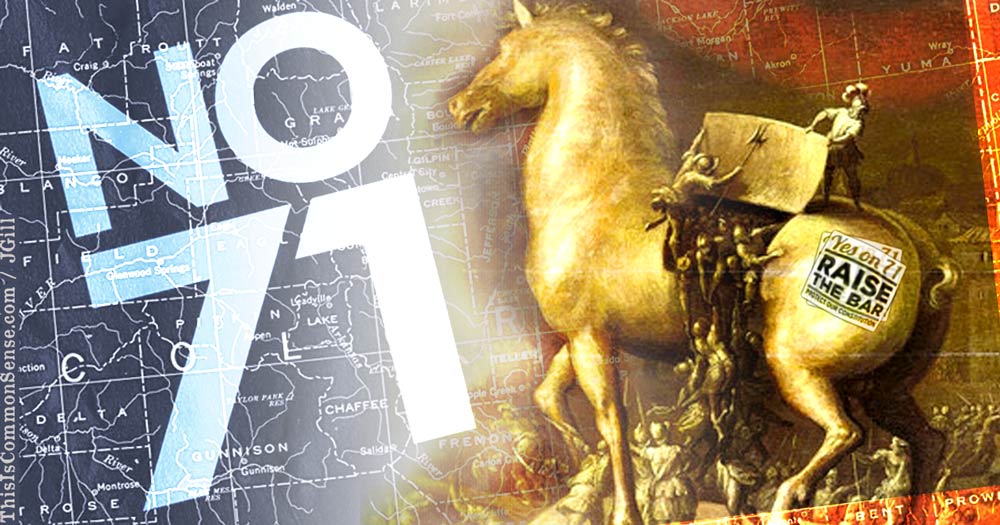
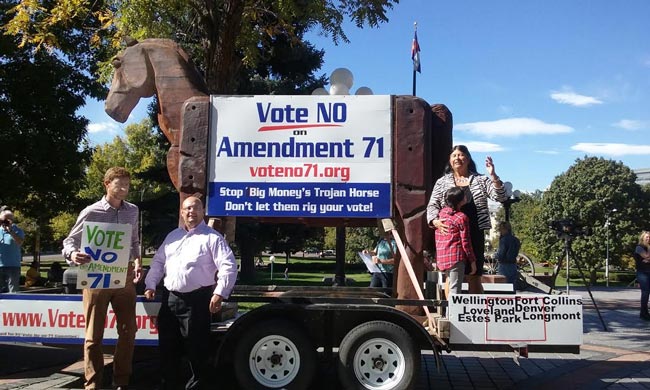
Weeks ago, to kick off the campaign, Citizens in Charge Foundation provided the Vote No on 71 Committee a 10-foot tall, carved, wooden Trojan Horse. The float has been wheeled across the state on a trailer, dramatizing that Amendment 71 is a Trojan Horse from big money interests, who pretend they’re protecting the constitution when they’re actually seeking to restrict citizen power. Providing this focal point has allowed dozens of Colorado citizens to speak out to fellow voters, garnering tons of media attention in the process.

The Trojan Horse continues to reach voters, but like stone soup, the Vote No on 71 campaign has grown in many diverse ways:

  • The head of Common Cause, Elena Nunez, and the head of the Independence Institute, Jon Caldara, have bridged ideological divide to reach out to editorial boards across the state, resulting in the Denver Post and most other major papers editorializing against 71.
  • The Colorado League of Responsible Voters raised several hundred thousand dollars and is running a TV spot countering the millions spent by proponents.
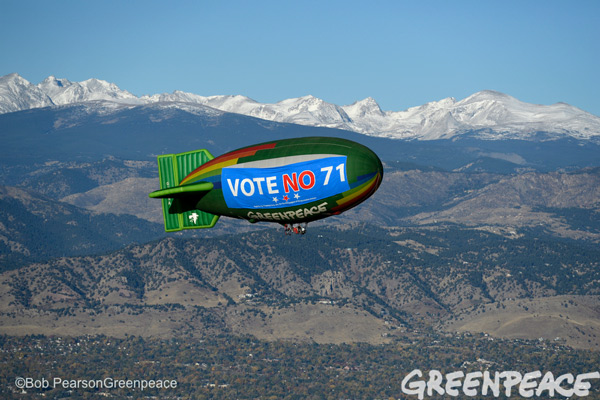
  • The Greenpeace blimp floats over the state, sending the Vote No on 71 message airborne.
  • The coalition has grown to more than 76 groups, each contacting its membership and urging folks to spread the word against 71.
  • A number of groups are advertising against 71 on Facebook.
  • A volunteer phone bank has been set up making thousands of calls to likely voters.

As this election winds down, we know we’re underdogs against the big-shots and their big money. But we also know we cannot let them kill the initiative without a fight. And we know that if we can reach enough Colorado voters with our message against Amendment 71, we can defeat it.

Help us reach more Colorado voters. The best way you can help is to make a financial gift right now. Today. The hour is very late, some voters have already cast their ballots, more are voting every day up until Nov. 8.

Please don’t let them kill Colorado. Help now:
  • Your $50 giftcovers gas for the Trojan Horse to reach another town
  • Your $100 giftpays to put 1,000 flyers on voters’ doorknobs.
  • Your $500 gift – launches Facebook ads reaching 5,000 voters or more.
  • Your $1,000 giftpays for robo phone calls to 10,000 folks who haven’t voted yet, reminding them to vote NO on Amendment 71.

Please give what you can. And take action now.

Can’t afford to give? How about giving your time?

Join our volunteer phone bank and dedicate a few hours one night this week or over the weekend to call likely Colorado voters between 4 pm and 8 pm Mountain Time. You can sign up here for two or four hour shifts and we’ll walk you through how it works.

You do NOT have to live in Colorado to pick up the phone and educate Rocky Mountain State voters about Amendment 71.
Those pushing Amendment 71 claim they want to protect the state constitution from “too many” amendments. But where’s the problem? They won’t say what amendments they believe don’t belong in the constitution.

No, they aren’t seeking to protect Colorado’s constitution, but rather Colorado’s political establishment.

The good guys, Colorado citizens, have taken aim to shoot down Amendment 71. They’ll save the initiative and good government . . . if you’ll pass the ammunition.

This is Common Sense. Thanks for your serious consideration. I’m Paul Jacob.
 

Printable PDF

TABOR, Amendment 71, Colorado, Raise the Bar, initiative, voter rights, Taxpayer Bill of Rights,


Categories
Accountability free trade & free markets property rights tax policy

Taxation to What End?

Oregonians have quite a few ballot measures this year.

And only one of them seems obviously nutty: Measure 97.

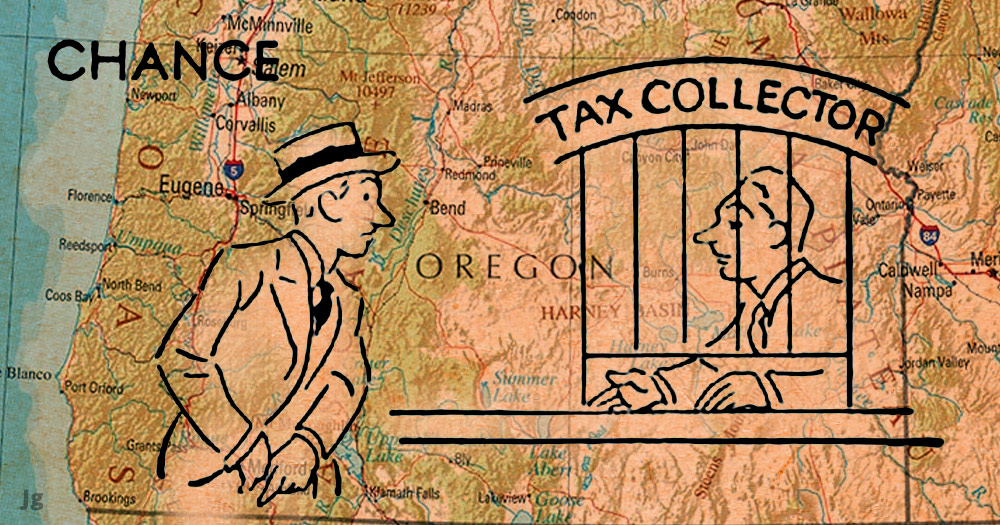
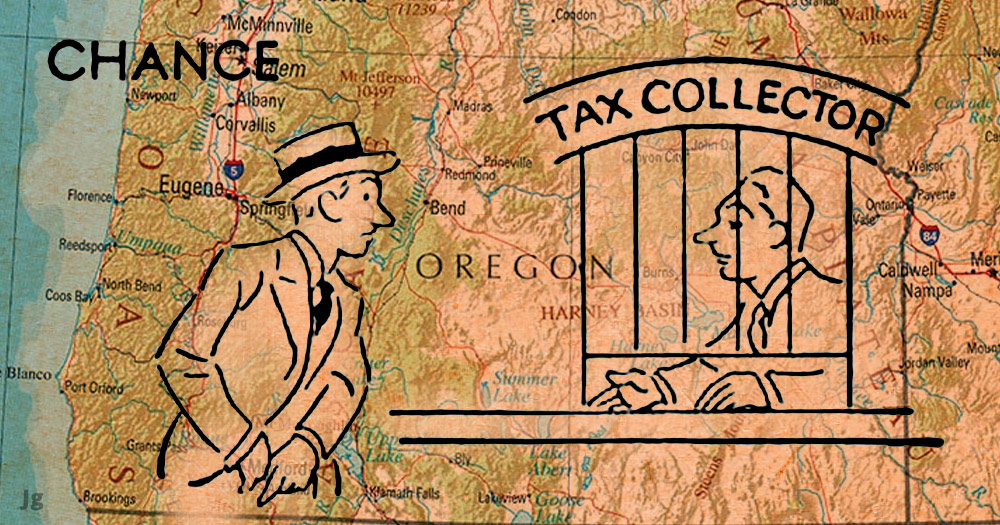
It would raise taxes on the very biggest of companies. The richest — that is, those with $25 million in sales.

Among the reasons given for this excise hike, which is estimated to be the biggest in the state’s history, are a whole bunch of “ooh, look at what we can do with all that loot!” enticements. Yes, and then there is the tried-and-untrue staple of the left, the “make large and out-of-state corporations pay their fair share in taxes” ploy.

Admittedly, trying to get out-of-state entities to pay for your benefits is classic. What “Let somebody else pay” lacks in nobility and morality it makes up for in avarice’s perennial appeal.

But the practical problem? A tax hike is just a bid on a future expropriation. Tax targets can, in effect, counter-offer by moving, or threatening to move, out of taxing territory.

Imagine yourself a thief. Then imagine first announcing to your victims where, when and how much you intend to take.

Right now Oregon sports the tenth best business environment in the country and, maybe, the lowest business taxes*. Raise taxes to the “middle of the pack” and businesses begin to look at states with lower rates.

Objectionable? Doesn’t matter. Folks go into business to make profits, not pay taxes.

Against this reality? Measure 97’s many bigwig supporters: the progressive Democratic governor, Democratic legislators and big-spending public employee unions eager to expand their bottom lines.

But by seeking to maximize near-term tax rates, these greedy special interests risk losing revenue further off, after businesses flee the state.

This is Common Sense. I’m Paul Jacob.


* The Oregon Center for Public Policy ranks Oregon as tied with Connecticut for the lowest in the nation.


Printable PDF

Oregon, tax, taxes, corporate, corporation, illustration, Measure 97


Categories
folly free trade & free markets moral hazard national politics & policies too much government

Trump’s Road Rage

There is no reason why the states shouldn’t handle their own infrastructure. Not only in funding, but in direction and method of production and “distribution.”

But politicians aiming for the presidency tend not to even consider that heresy. And journalists, of course, tend to rah-rah for the nationalist planning notion, too. It’s easier to cover everything from Washington. I remember much talk of “our crumbling infrastructure” back in the 1980s.

Thankfully, Shikha Dalmia has not jumped onto that bandwagon. The Reason writer notes that Trump is trumping Obama’s fling with “shovel-ready jobs,” demanding that the federal government spend up to a trillion in infrastructure “stimulus.”

Forget for the moment the obvious contradiction: pretending to be an outsider, Trump is pushing as “insiderish” a program as imaginable.

I wonder: is Trump playing the cuckoo here, placing an alien idea into his constituents’ nests? Are his supporters about to be “cucked”? (As alt-rightists like to put it.)

Trump looks abroad for models of beautiful roads and bridges and trains and all the rest. If you travel “from Dubai, Qatar, and China,” he bemoans, our biggest cities give off a certain “Third World” vibe.

Dalmia blanches: “the countries Trump is praising as models for a better America are all autocracies that have made a complete hash of things.”

Boy, we do not need to find another way to make a complete hash of things here in the States. And our federal budgets are strained (and pushing us further into debt) as it is.

Besides, it is not written in stone, concrete, or even asphalt, that these United States’ roads and bridges must be made the federal government’s business.

This is Common Sense. I’m Paul Jacob.


Printable PDF

infrastructure, shovel ready, government, roads, illustration


Categories
folly free trade & free markets general freedom moral hazard too much government

When Parasites Collide

There are times I wish I were a tax accountant.

You know, just so I could better understand the news.

The European Commission has handed Apple, Inc., a $14.5 billion tax bill.

Owed to Ireland.

Apple, the tax commissioners said, had paid too little in taxes to Ireland, amounting to a mere 1 percent of the company’s European profits.

The Emerald Isle’s normal corporate tax rate is 12.5 percent.

On first read, this sounded like a tale of crony capitalism, with the EU’s tax authorities riding in, heroically, holding aloft the gonfalon of fair play, on the side of truth, justice, and an even playing field.

Well, the story gets complicated. The U.S. Treasury has protested the ruling as unfair. And Senator Chuck Schumer called it a “cheap money grab.”

The Wall Street Journal opinion page comes out on Apple’s side, too, but gives some specifics. Apple paid all the taxes it owed under Irish and EU law, but the ruling wasn’t about law, it was, we are told, about politics.

I can believe that.

So, as near as I can make out, what we have here are three sets of governmental interests, each intent on sucking the most out of a rich, innovative, and wildly successful multinational corporation.

It’s hard not to side with the target, Apple, and think of the other groups as mere parasites.

After all, my non-accountant’s spidey sense suspects that Schumer objects because the U.S. government isn’t going to get any of that $13 billion.

Preferring an “expensive money grab,” I suppose.

This is Common Sense. I’m Paul Jacob.  


Printable PDF

Apple, EU, tax, Europe, Ireland, illustr


Categories
Accountability free trade & free markets general freedom moral hazard nannyism responsibility too much government

States of the Unions

As Americans contemplate the intellectual breakdown of our two major parties, Brits and Europeans are trying to figure out what the state of their union is.

Does Brexit spell disaster for Europe?

Germany’s vice-chancellor is just the latest European bigwig to preach gloom and doom. According to the BBC, “Sigmar Gabriel said the EU would go ‘down the drain’ if other states followed Britain’s lead and that the UK could not keep the ‘nice things’ about Europe while taking no responsibility.”

What that “responsibility” is, I do not know.

But look: it is not as if an international order is all that difficult. In the 19th century, freedom of movement was accepted as the civilized standard — except in Russia.

In the 1800s, Britain and France agreed to bilateral free trade, and then Britain went unilateral with free trade. Prosperity ensued in Britain. Even in Europe proper, the century-long trend of wealth was upward.

And now a number of economists are advising the new British government to follow that old path — “a unilateral free trade deal would allow the UK to import cheaper goods and gain access to new markets, delivering greater prosperity,” The Guardian summarized.

Maybe the EU should go under. For the key to the union was subsidies along with EU-regulated trade. European states could adopt free trade without bullying from Brussels. And forget subsidies as a way of life.

America could do likewise, but not if Hillary or The Donald gets elected.

This is Common Sense. I’m Paul Jacob.


Note:  In most browsers, hovering your mouse over the bolded, silver text will give you “footnotes” of explanation.


Printable PDF

Brexit, Europe, hysteria, trade, economics, illustration


Categories
free trade & free markets general freedom ideological culture meme moral hazard nannyism national politics & policies too much government

If they can do it, why can’t we?

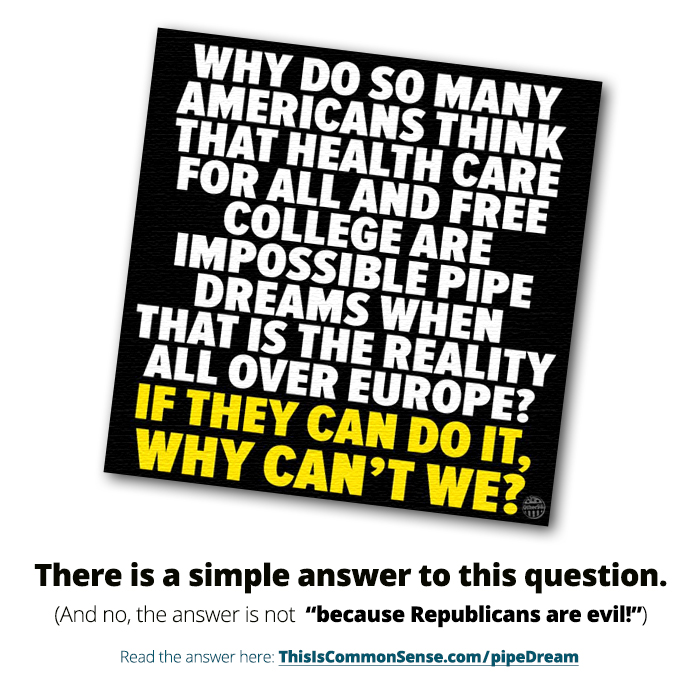
In Europe, some large programs (like “free” healthcare and college”) appear to work for some countries and are a complete disaster for other nations. In many southern European nations, citizens look on state provided healthcare with horror, and make every effort to insure that they don’t have to depend on that system.
American progressives are strangely incurious about what makes some systems work and other systems crash and burn. In many cases, the explanation is cultural and institutional. (As it happens, Scandinavians had a well-established culture of hard work and self reliance and social cohesion, which is what made the establishment of a large welfare state even possible. When the Scandinavians began their ambitious welfare programs, it was a point of honor among many to NOT USE IT. This attitude has been eroded over time).
The Scandinavian models also have had better success rates because they have focused on maintaining a VERY FREE business environment, with corporate taxes LOWER than are found in the US, and limits placed on unions (a practice that would be abhorrent to the average American progressive).

When large government programs are established in the U.S., they quickly become bloated, inefficient and corrupt. The government is currently $21 trillion in debt.


Why not demonstrate that they can do the job they already have before being given control of the healthcare industry (an estimated 1/5 of the economy)?

Opponents of the progressive welfare state believe that considerable damage could be done to the American system (which has always been a powerhouse of innovation and expertise), and many people could be hurt.


Categories
folly free trade & free markets general freedom moral hazard national politics & policies tax policy too much government

Whose Side Are They On?

Excuse me if I drive over familiar roadways. But we are witnessing one of the great revolutions in human cooperation.

And our governments and politicians are working mightily to block traffic.

I refer, of course, to Uber and Lyft and the like.

The innovation that these companies bring to market? Enabling everyday drivers to leverage their personal investment in a capital good — a car or SUV — to make extra bucks (or even a living) while efficiently serving people who want rides.

Ride-hailing apps on smart-phones provide more security and consumer guidance than the old taxi services ever bothered to even try. The elaborate online rating system, where drivers rate riders and vice versa, provides a new market in information that outstrips government “regulation” as a consumer defense system.

And consumers get better rides, cheaper.

The Uberization of ride sharing competes directly with taxis, of course, and that’s a problem . . . for taxi companies. And the politicians who have regulated them for years. This regulation never was about consumer protection, but politicians just feathered their own nests with campaign contributions through crony capitalism, helping some taxi services at the expense of others.

And customers.

The latest idiocy hails from Massachusetts, which has enacted a 20¢ per trip tax on all ride-sharing apps, with 5¢ of each charge slated for subsidizing the old, established taxi services.

Taxachusetts’s Republican governor, Charlie Baker, has been sucked in to the government racket, choosing to support old cronies rather than customers.

Still, it could have been worse. The advocates of the tax had initially demanded Uber be banned.

This is Common Sense. I’m Paul Jacob.


Printable PDF

Uber, Lyft, Taxi, protection, tax, crony, cronyism, illustration


Illustration based on original cc photo by GörlitzPhotography on Flickr


Categories
education and schooling folly free trade & free markets general freedom ideological culture national politics & policies responsibility too much government

Miseducated and Unemployed

The persistence of the issue of raising the minimum wage is an indictment of public education, for at least two reasons:

  1. It shows that “our” schools are not teaching basic economics. Generally, those who think minimum wages help the poor do not understand what wages are (price of labor), why they are paid (worker productivity bolstering the bottom line) and what a minimum wage law is (a prohibition on contracting for work below the arbitrary government-prescribed rate).
  2. It shows that schools aren’t preparing the young for real-world activity. Wages track productivity. If disturbingly large numbers of people are affected by the minimum, that means they haven’t been adequately trained in the skills they need.

Bernie Sanders wanted a 15-buck minimum. Hillary went on record supporting a 12-buck rate. Donald Trump would prefer that the minimum wage regulations be enacted by the states, though he says a hike to ten dollars per hour would really help the less fortunate.

It wouldn’t.

That is the tacit theme in a Wall Street Journal piece on the recent minimum wage rate hikes in 14 American cities, including the nation’s capital. A classic, succinct article on BET makes the point even more stark: a duo of economists from Trinity University “report that when a state, or the federal government, increases the minimum wage, Black teens are more likely to be laid off. The duo analyzed 600,000 data points, which the Employment Policies Institute says included ‘a robust sample of minority young adults unprecedented in previous studies on the minimum wage.’”

Just as theory predicts.

Could it be that politicians promise a raise because they believe government-schooled Americans too miseducated to know better?

This is Common Sense. I’m Paul Jacob.


Printable PDF

minimum wage, illustration, money, economics


Categories
Accountability free trade & free markets moral hazard national politics & policies responsibility

It’s the Stupid Economy

When Bill Clinton ran for president, the slogan inside his campaign’s war room was a blunt reminder to focus on “the Economy, Stupid.” This was Clinton’s first enduring contribution to the American stock of catch-phrases.

Now, Bill’s wife, Hillary, seeks the top banana position. But she has a harder job than Bill: he could fight against a lackluster incumbent caught in a big lie (“No New Taxes,” another slogan). Hillary is almost required to defend the outgoing president, in no small part because she served in his Cabinet.

If she were candid, she’d address the weak recovery and long-term stagnation.

Her slogan could be, “It’s the Stupid Economy.”

No matter what politicians say, however, secular (long-term) stagnation is a thing. Lots of people have given up, are off the roles of job-searchers and so don’t appear in official unemployment statistics, and too many people have taken early retirements on trumped-up disability claims.

At least, economist Lawrence Summers is decrying it, jet-setting around the world to meet with financial leaders and political functionaries.

I doubt his diagnosis, however. Summers talks Keynesian, pointing to inadequate aggregate demand. While there may be something to the general shift in the desire to hold monetary assets, leading to deflation and even negative interest rates, I bet the underlying problem is regime uncertainty — when widespread fears of the future and doubts about governmental consistency and follow-through lead the owners of capital to withhold investing in production.

There are also the effects of general regulatory and redistributionist kludge.

When the problems stem from your favored policies, you can’t revive FDR’s slogan “nothing to fear but fear itself” and let it go at that.

Hillary will surely explain — Thursday night.

This is Common Sense. I’m Paul Jacob.   


Printable PDF

HIllary Clinton, Obama, Bill Clinton, economy, election, illustration


Categories
Accountability folly free trade & free markets general freedom government transparency initiative, referendum, and recall moral hazard nannyism national politics & policies property rights

The Return of the Philosopher King

On Sunday, at Townhall, I addressed the whining attacks on referendums and “democracy” that followed the Brexit referendum.

The most outrageous? A broadside from Jason Brennan.

“To have even a rudimentary sense of the pros and cons of Brexit,” argues this Robert J. and Elizabeth Flanagan Family Associate Professor of Strategy, Economics, Ethics, and Public Policy at the McDonough School of Business at Georgetown University, “a person would need to possess tremendous social scientific knowledge. One would need to know about the economics and sociology of trade and immigration, the politics of centralized regulation, and the history of nationalist movements.”

In other words, most Brits needn’t worry their pretty little heads about deciding their future; experts have everything under control.

Brennan has a new book coming out, Against Democracy, wherein he posits that we need “a new system of government — epistocracy, the rule of the knowledgeable.”

Sound familiar? ’Tis the old Platonic whine in new wineskins.

This Philosopher King is necessary, you see, because citizens don’t posses the advanced degrees to judge whether Brennan is right or wrong. We can’t even find a Holiday Inn Express in the phonebook. Or a phonebook.

Nonetheless, why not consult other known knowers?

The late William F. Buckley, Jr., well-educated and well-spoken on political matters, once declared that he would “rather entrust the government of the United States to the first 400 people listed in the Boston telephone directory, than to the faculty of Harvard University.”

“Incestuous, homogeneous fiefdoms of self-proclaimed expertise are always rank-closing and mutually self-defending, above all else,” warned journalist Glenn Greenwald, an expert on such hooey.

“I know no safe depositary of the ultimate powers of the society but the people themselves,” wrote Thomas Jefferson, “and if we think them not enlightened enough to exercise their control with a wholesome discretion, the remedy is not to take it from them, but to inform their discretion by education.”

Most decisions in a free society are thankfully made by individuals (not voters, bureaucrats, or academics) about their own lives.

But when legitimate decisions of governance must be made, I’ll take democracy over rule by experts.

This is Common Sense. I’m Paul Jacob.


Printable PDF

technocracy, expert, epistocracy Brexit, illustration