Categories
Accountability crime and punishment incumbents local leaders national politics & policies term limits

One Incumbent Falls

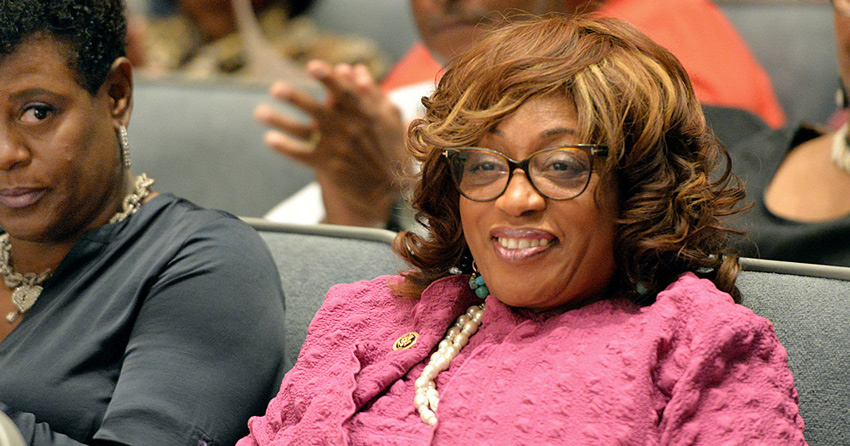
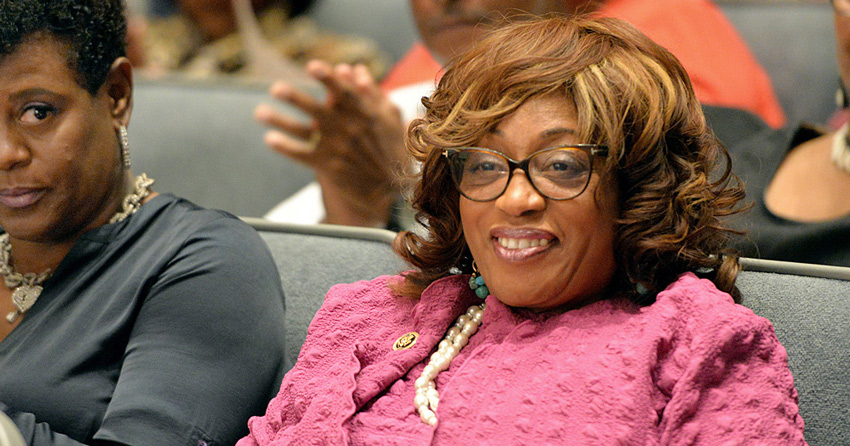
When former U.S. Rep. Corrine Brown (D-Fla.) was indicted last July on 24 felony counts of fraud and obstruction, she suggested that if the FBI hadn’t wasted time investigating her for milking a charity for personal gain, they might have prevented the Orlando massacre.

“These are the same agents that was not able to do a thorough investigation of [Pulse nightclub shooter Omar Mateen],” Brown screeched at reporters, “and we ended up with 50 people dead.”

Last week, the former congresswoman* was convicted of 18 felonies related to fraudulently raising $800,000 for the One Door for Education Foundation, which only spent $1,200 on two small college scholarships — 0.0015 of what was raised . . . for college scholarships.

As the Feds put it, Congresswoman Brown and her congressional chief of staff “used the vast majority of One Door donations for their personal and professional benefit, including tens of thousands of dollars in cash deposits that [her chief of staff] made to Brown’s personal bank accounts.”

Hundreds of thousands of dollars were spent on “events hosted by Brown or held in her honor, including a golf tournament in Ponte Vedra Beach, Florida; lavish receptions during an annual conference in Washington, D.C.; the use of a luxury box during a concert in Washington, D.C.; and the use of a luxury box during an NFL game in the Washington, D.C., area.”

The 70-year-old Brown spent nearly a quarter of a century in Congress. Now she awaits sentencing to as many as 277 years in prison — a quarter of a millennia.

It’s yet another good argument for term limits.

This is Common Sense. I’m Paul Jacob.


* As I explained in greater detail at Townhall, out of 435 congressional seats up for election in 2016, Congresswoman Brown was one of only five incumbents defeated in the 2016 primary elections. Two of the five defeated — Brown and Rep. Chaka Fattah (D-Penn.) — faced multiple-count felony indictments. Two others were victims of redistricting that pushed them into new districts. Only one incumbent who was un-indicted and running in an incumbent district was defeated.


Printable PDF


Categories
Accountability free trade & free markets general freedom national politics & policies property rights responsibility

Juicer Choosers

We all have our complaints about this company or that, this product or that.* And it is popular to rag on “consumerism” and the emptiness of “capitalism.” But put it into perspective: me “wasting money” on, say, an expensive juicer is nowhere near as offensive — that is, worth a rant, an excoriation, a philippic — than the government wasting money on . . . anything else.

Or, for that matter, on juicers.

At this point, you may be wondering, “what’s with this juicer business?”

Well, it is all about the hullabaloo regarding, er, a juicer business!

Juicero, to be precise.

The well-funded-at-startup Silicon Valley biz makes the expensive Juicero Press. And news. Newsweek and Washington Post were just two major media outlets to lay into the company. They characterized Juicero and its product as a symbol of all that’s wrong with Silicon Valley.

Wow. What weight for one niche-market company to bear.

While journalists in print and online fret over how Silicon Valley offers up empty gewgaws and gadgets for the “temporarily rich” — a few decades ago members of this class were excoriated as Yuppies — over at Star Slate Codex Scott Alexander reminds us that Silicon Valley does all sorts of things.

One juicer cannot stand for everything else.

Besides, when “Capitol Hill screws up, tens of thousands of innocent Iraqis get killed,” Alexander writes. When “Silicon Valley screws up, people who want a pointless Wi-Fi enabled juicer get a pointless Wi-Fi enabled juicer.”**

Forcing many people to pay for dubious-at-best products, or enticing a few people to pay for harmless luxuries? You see why I prefer the latter.

This is Common Sense. I’m Paul Jacob.


* You should listen to me curse my computers! Or, on second thought, no. You shouldn’t.

** “Which by all accounts,” Alexander concludes, “makes pretty good juice.” Even if squeezing the company’s frozen packets yourself works just as well.


Printable PDF


Categories
Accountability folly general freedom moral hazard national politics & policies

An Inconvenient Empire

“Don’t look to the United States for hope. Our values make us sympathetic to your plight, and, when it’s convenient, we might officially express that sympathy. But we make policy to serve our interests, which are not related to our values. So, if you happen to be in the way of our forging relationships with your oppressors that could serve our security and economic interests . . . You’re on your own.”

That’s Senator John McCain’s New York Times op-ed mockery of Secretary of State Rex Tillerson, who recently told State Department employees that conditioning our foreign policy “on someone adopting our values . . . creates obstacles to our ability to advance our national security interests, our economic interests.”

In his op-ed, entitled “Why We Must Support Human Rights,” McCain recounted the hope it gave him to know America would not abandon him as a prisoner of war during Vietnam. But, of course, Tillerson wasn’t suggesting the U.S. abandon POWs.  

McCain highlighted dissidents throughout the world, urging the U.S. to speak out for them, to provide “hope . . . a powerful defense against oppression.”

No fan of President Trump*, the senator is playing up the praise Trump has awkwardly offered despots, including Russia’s Vladimir Putin, the Chinese leaders behind the Tiananmen Square massacre and recently North Korea’s Kim Jong-un. Still, recent successes in freeing Americans and others from the grasp of tyrants in Egypt, Iran and China suggest some degree of caring by Tillerson, Trump and Co.

The inconvenient truth? American foreign policy has long pursued certain political and economic interests at the expense of extolling human rights. As Glenn Greenwald wrote in The Intercept: “The list of U.S.-supported tyrants is too long to count. . . .”

Hypocrisy alone won’t change that.

This is Common Sense. I’m Paul Jacob.


* Very early in the presidential campaign, Trump needled the senator and reacted to McCain being called a war hero, by echoing a four-lettered Chris Rock routine: “He’s not a war hero. He was a war hero because he was captured. I like people who weren’t captured, okay. I hate to tell you.”

In 1967, McCain was shot down over Hanoi, North Vietnam, on his 23rd bombing mission of the war. He broke both arms and one leg and nearly drowned after parachuting into a lake. Denied medical treatment by the North Vietnamese, McCain spent the next five and a half years as a POW, some of it at the infamous “Hanoi Hilton” prison, where he was tortured.


Printable PDF


Categories
Accountability folly moral hazard national politics & policies

Hotel Afghanistan

“You can check out any time you like, but you can never leave.”

Is Afghanistan becoming the Hotel California?

Back in 2014, Obama declared victory — well, he called it “over.” We even informed our enemies ahead of time that we were leaving, to show good manners.

But as wars are known to do, it keeps not stopping. That is, bullets whiz by and bombs explode . . . and our American military hasn’t left. 

Obama feared that if we pulled out completely from the longest war in our history, the Afghan government would soon collapse and the Taliban would rush back to power. Last year the Taliban controlled more of the country than at anytime since 2001, when we first . . . “won.”

Now President Trump, the purported isolationist, stares at a report from military commanders on what to do. Their answer, according to the Washington Post, is to send “at least 3,000” more soldiers to Afghanistan, in addition to the 8,500 currently stationed there. And to allow US troops to engage in greater combat.

“The plan would also increase spending on Afghanistan’s troubled government,” the Post reported. But more money won’t un-corrupt the system.

Afghanistan expert Andrew Wilder with the U.S. Institute of Peace predicts that, “the U.S. is going to send more troops, but it’s not to achieve a forever military victory. Rather, it’s to try to bring about a negotiated end to this conflict.”

Will American soldiers be laying down their lives merely to better the odds for negotiating an improbable “good deal” with the Taliban?

This is Common Sense. I’m Paul Jacob.


Printable PDF


Categories
Accountability folly general freedom moral hazard porkbarrel politics property rights responsibility tax policy too much government

No Rich No More

Connecticut has a budget problem. There’s not enough money to spend.

WTNH-TV in New Haven paraphrased the situation along with the response of Connecticut’s very progressive governor: “Income tax revenue collapses; Malloy says taxing the rich doesn’t work.”

The news story explains, “Connecticut’s state budget woes are compounding with collections from the state income tax collapsing, despite two high-end tax hikes in the past six years.”

Hmmm. Despite the tax increases? Or . . . “because the state of Connecticut depends too much on its wealthy residents,” as the report continued, “and wealthy residents are leaving . . .”

A Yankee Institute report notes that “the exodus of wealth from the state as top earners and businesses relocate to more tax-friendly states” is a major problem. Institute President Carol Platt Liebau calls it a “terrible cycle of tax increases followed by deficits followed by even more tax increases.”

Yet, state legislative Democrats are back pushing more tax hikes on “the rich.” Senate legislation would jack up the tax rate — retroactively — on those with income of $500,000 or more. House legislation would slap a 19 percent surcharge on some hedge fund earnings. In response, the head of the Connecticut Hedge Fund Association testified that his “industry is populated by exactly that type of person that will move based on tax policy.”*

A song by Ten Years After comes to mind:  

Tax the rich, feed the poor
Till there are no rich no more

Doesn’t sound like a good idea even in song.

This is Common Sense. I’m Paul Jacob.


* It’s worth noting that Gov. Malloy is now “against raising taxes again to fill the deficits and is instead focusing on spending cuts . . .”


Printable PDF


Categories
Accountability folly general freedom ideological culture media and media people moral hazard nannyism political challengers responsibility too much government

French Beacon

“Since the French Revolution,” the New York Times pontificated online, “the nation has often been viewed as a beacon of democratic ideals.”

Really? Can a nation of constitutional turnovers — kings and republics and revolutions and foreign occupation — be a beacon? Most often we in America compare our Revolution to France’s, focusing on The Terror: mob rule and proto-totalitarianism.

On Friday, “the staff of the centrist candidate Emmanuel Macron said… that the campaign had been targeted by a ‘massive and coordinated’ hacking operation, one with the potential to destabilize the nation’s democracy before voters go to the polls on Sunday.” A few minutes later, the campaigns fell under the country’s election gag rule, unable to debate immediately prior to the voting. The government told the media not to look at what was dug up in the “hack” (which everybody said was by Russians). Though Macron’s putative Islamization plan is worth looking at, surely.

Much talk (at the Times and elsewhere) of how the hack destabilized democracy. No talk, for some reason, about how the election regulation gag rule did.

The idea that information might destabilize democracy? Awkward.

Still, we can see how an info-dump’s timing might destabilize an election.

But since Macron won by a large margin, the Late Exposure Strategy may have backfired, Russians or no.

The most obvious oddity in reportage? The continued reference to former Socialist Party hack Macron as “centrist” while Le Pen is called “far right” ad nauseam. Macron is pro-EU; Le Pen is nationalist. Neither are reliably for freedom. The fact that Macron packaged his En Marche ! Party as centrist doesn’t make it so.

This is Common Sense. I’m Paul Jacob.


Printable PDF


Categories
Accountability general freedom insider corruption local leaders moral hazard national politics & policies too much government U.S. Constitution

Separation of Senators

The separation of powers doctrine has been a bedrock principle of small-r republican government. Each branch — legislative, executive, judicial — should be independent, and check the power of the other branches.

This requires that no person hold positions simultaneously in more than one branch of government.

Which brings us to Nevada State Senator Heidi Gansert. In addition to being a legislator, she’s currently employed by the University of Nevada-Reno as executive director for external relations . . . an executive branch position.

One can certainly understand why she wants to keep her prestigious legislative perch, while maintaining her annual $203,000 from the university. But those pesky folks at the Nevada Policy Research Institute’s Center for Justice and Constitutional Litigation insist Gansert adhere to the constitution.

They’ve filed a lawsuit.

As if to dramatize why “separation of powers” matters, consider Senate Bill 358, which sought to reform civil asset forfeiture in Nevada. The legislation couldn’t get out of the Senate Judiciary Committee, where State Senator Nicole Cannizzaro is vice-chair. She also holds a $99,000 position as a Clark County deputy district attorney.

Senator Cannizzaro’s presence on the Senate Judiciary Committee, as it pertains to forfeiture legislation, begs for a lesson on separation of powers,” the Nevada Policy Research Institute’s Daniel Honchariw wrote in the Las Vegas Review-Journal.

“Reform would’ve meant less money for district attorneys,” Honchariw explained, “which, in addition to police departments, directly profit from forfeitures.”

Nevada’s legal precedent on separation of powers is less clear-cut regarding Cannizzaro’s conflicting role in local government, than for Gansert’s state position. But the potential for mischief is the same — and obvious.

This is Common Sense. I’m Paul Jacob.


Printable PDF


Categories
Accountability free trade & free markets initiative, referendum, and recall insider corruption moral hazard national politics & policies porkbarrel politics too much government

A Wall of Separation

Whatever you think of Thomas Jefferson’s letter to the Danbury Baptists, wherein he celebrated the First Amendment for “building a wall of separation between Church & State,” let’s agree that it would have been nice had he penned another letter — to the Waterbury Methodists or someone — urging a wall of separation between Sports and State.

Last week, actor Tom Hanks became another brick in my hoped-for wall. “It’s a billion-dollar industry,” Hanks said of the National Football League.

[T]hey have billion-dollar TV contracts. All the owners are billionaires. And yet when they want to build a stadium they’re going to use for 10 weeks out of the year, they expect the city taxpayers to buy the building.

Hanks is livid. The recent “deal” that lured his beloved Oakland Raiders to Las Vegas included $750 million in public funds to build a $1.9 billion stadium. The Raiders are planning to stay in Oakland for the 2017 and 2018 seasons, while that new stadium is built. “When the Raiders leave,” the beloved star declared, “I am going on an NFL moratorium for two years.”

Unfortunately, Hanks appears more angry that his team is leaving (eventually), than with the principle that taxpayers ought not be ripped off.

Subsidizing businesses is cronyism, not capitalism. It’s even more outrageous when the poor must pay for the rich.

But how to stop it? In every city where citizens can propose ballot initiatives, let’s petition and pass measures requiring a public vote before any such subsidy.

It may not be the great wall I’d prefer, but it’s a high hurdle providing taxpayers some important protection.

This is Common Sense. I’m Paul Jacob.


Printable PDF


Categories
Accountability crime and punishment folly general freedom moral hazard nannyism Regulating Protest too much government

The Oregon Fail

My children used to play “The Oregon Trail,” an early computer game where one navigated the amazingly dangerous wagon trip out west — often dying of dysentery or drowning while crossing a river.

Oregon remains treacherous.

Yesterday, we bemoaned the cancellation of a parade because a Republican Party group’s participation elicited threats of violence. Now, we find that writing a thoughtful letter to public officials about problematic traffic lights garners a $500 fine.

Mats Järlström, a Swedish electronics engineer, made the mistake of moving to Beaverton, Oregon, and then compounded his error by sending an email to Oregon’s engineering board alerting them to a traffic light problem that put “the public at risk.”

The Oregon State Board of Examiners for Engineering and Land Surveying responded by informing him that statute “672.020(1) prohibits the practice of engineering in Oregon without registration . . . at a minimum, your use of the title ‘electronics engineer’ and the statement ‘I’m an engineer’ . . . create violations.”

Mr. Järlström expressed shock at the bizarre response. “I’m not practicing engineering, I’m just using basic mathematics and physics, Newtonian laws of motion, to make calculations and talk about what I found.”

After a red-light camera ticketed his wife, Järlström investigated and discovered that the yellow light didn’t give drivers slowing down to turn at the intersection enough time.

He wasn’t disputing the ticket, just attempting to right a wrong. Which is apparently against the law, when bureaucrats are committing the wrong.

The Institute for Justice accuses the licensing board of “trying to suppress speech.” Thankfully, they’re helping Järlström sue in federal court.

This is Common Sense. I’m Paul Jacob.


Printable PDF


Photograph by Tom Godber on Flickr


Categories
Accountability free trade & free markets general freedom national politics & policies tax policy

Death and . . .

It’s a sure thing — that most folks will like President Trump’s tax cuts. Though we don’t yet know all the details.

When it comes to taxes, less is more

That is, if you’re paying taxes. It is no great mystery that people like it when their own taxes are reduced.

But what about reducing other people’s taxes?

“The core economic case for tax cuts is that they reduce the obstacles to creative and productive activities,” economist Don Boudreaux explained yesterday at the Café Hayek blog.

Cutting the corporate tax rate — which even former President Bill Clinton supported during last year’s campaign — won’t immediately appear in people’s paychecks, but can stimulate economic growth helping everyone. Recent experiences in both Britain and Canada bear this out.

Cutting taxes, of which “the rich” pay more, can also spur growth.

Yet, these ideas do not dominate popular discussions of tax cuts. Boudreaux lamented media reporting that treats any tax reduction as simply a “‘gift’ to high-income earners,” dubbing the coverage: “Biased. Benighted. Blind.”

“Suppose that freedom of the press were reported in the same way as . . . a ‘giveaway to the press’?” he asked. “Most people, of course, do not own newspapers or other media outlets.”

Boudreaux concluded, “When the press is free, the chief beneficiaries are the general public.”

Freedom — of both the press and to keep more of the fruits of our labors — helps the common man. As well as the uncommon man. A tax cut for me helps me directly, and you indirectly. And vice versa. Just as a free press is great for those in journalism as well as those of us not in journalism.

That is not blind, but eyes open; not benighted, but enlightened; not biased, but . . .

. . . Common Sense. I’m Paul Jacob. 


Printable PDF