Categories
Accountability crime and punishment folly ideological culture moral hazard responsibility

Sticks & Stones

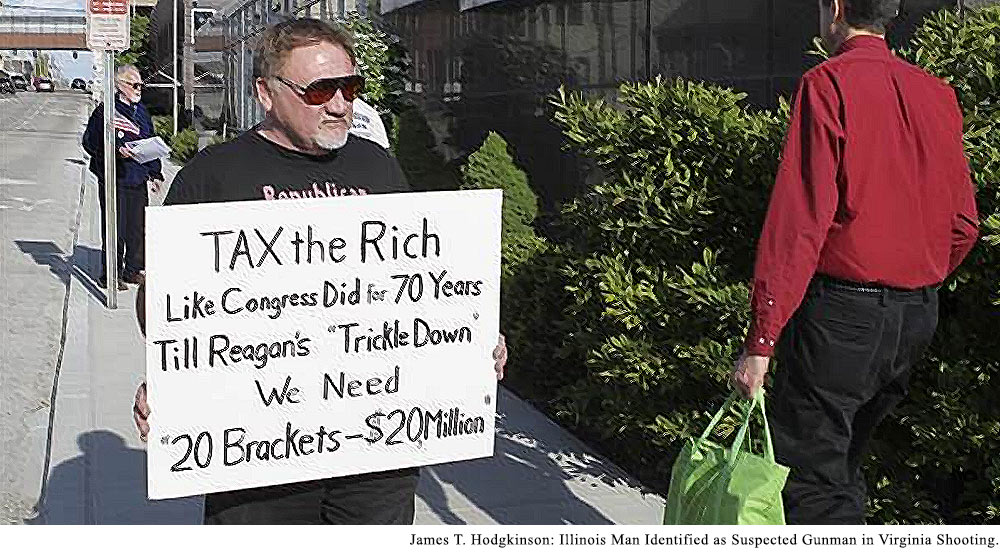
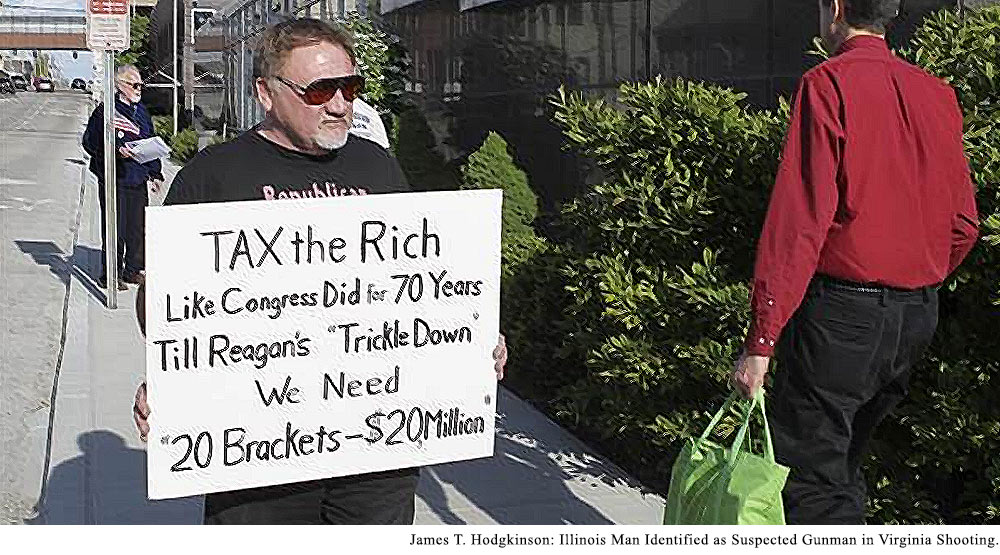
James Hodgkinson of Belleville, Illinois, came to Alexandria, Virginia, where for the last few months he lived in his van . . . undoubtedly down by the river. Yesterday, he wielded an assault rifle, attempting to massacre Republican congressmen at a park practicing for tonight’s annual charity Congressional Baseball Game.

He shot House Majority Whip Steve Scalise, who remains in critical condition; a lobbyist also in critical condition; a staffer, hit in the leg and released from the hospital; and two Capitol Police officers, who still shot and captured the shooter. Hodgkinson later died in custody.

Politically, the down-on-his-luck, 66-year-old assailant was a big fan of MSNBC’s Rachel Maddow and volunteered for Sen. Bernie Sanders’ presidential campaign. So, what does his act of violence say about Maddow? Nothing. How much is it Sen. Sanders’ fault? Zero.

The Washington Post reports that Hodgkinson was “angry with President Trump,” noting this violence came “amid harsh political rancor and a divided country.”

Michelle Malkin declared she had “warned for more than a decade about the unhinged left’s rhetoric.”

“The hatred is raw, it is undiluted, it’s just savage,” Rush Limbaugh offered. “These are the mainstream of the Democrat base, and I don’t have any doubt that they are being radicalized.”

It harkens back to then-President Bill Clinton’s success in blaming the 1995 Oklahoma City Bombing on “loud and angry voices” (read: Rush Limbaugh) who “spread hate. They leave the impression that, by their very words, that violence is acceptable.”

Sure, we should hold speakers accountable for dehumanizing verbal attacks on their opponents. But not for acts of violence these speakers do not commit, nor condone.

Condemn the violence. Stop using it to smear your opponents.

This is Common Sense. I’m Paul Jacob.


Printable PDF


Categories
First Amendment rights folly general freedom moral hazard nannyism responsibility too much government

Legal Not to Lie About Your Milk

Mary Lou Wesselhoeft doesn’t have to lie about the milk she’s selling. The Florida Department of Agriculture has lost in court. Mary Lou has won.

Ocheesee Creamery sells pasteurized milk without any additives. One of her products is skim milk. Ocheesee sells skim milk without vitamin additives, which is perfectly legal to do. But the Florida government claims that only skim milk with the additives counts as real “skim milk,” the kind you can call skim milk in speech to customers. (Kafka, did you write this horror story? Fess up!)

Give credit to the judge who asked: “Can the state, consistent with the First Amendment, take two words out of the English language and compel its citizens to use those words only as the government says?” The reply of the government’s lawyer? “Yes.”

Creepy.

Mary Lou’s victory is also a victory for all Americans who want to exercise their right to tell the truth about what they’re selling. And it’s a victory for the Institute for Justice, which took up the case on her behalf. At its website, IJ points out how easy it would be to annihilate freedom of speech by letting the government redefine words at will. We’re not free if our freedoms can be arbitrarily defined away by the people in power.

The Institute specializes in defending our rights against senseless government intrusions. Until such laws and regulations are repealed, it seems that the Institute will always have much to do — unfortunately. But, fortunately, it keeps on doing it.

This is Common Sense. I’m Paul Jacob.


Printable PDF


Categories
Accountability incumbents insider corruption moral hazard national politics & policies term limits too much government

Most Hated

I was once “the most hated man in Washington.”* Why? For my work on term limits.

I wore the appellation as a badge of honor.

Last year I noted that Ted Cruz had taken up the mantle, but now, certainly, it’s President Donald Trump’s.

Has ever a president been as hated?

Thomas Jefferson was characterized as the Antichrist. Andrew Jackson made many enemies in overthrowing the Second National Bank. But John Tyler is the most interesting case.

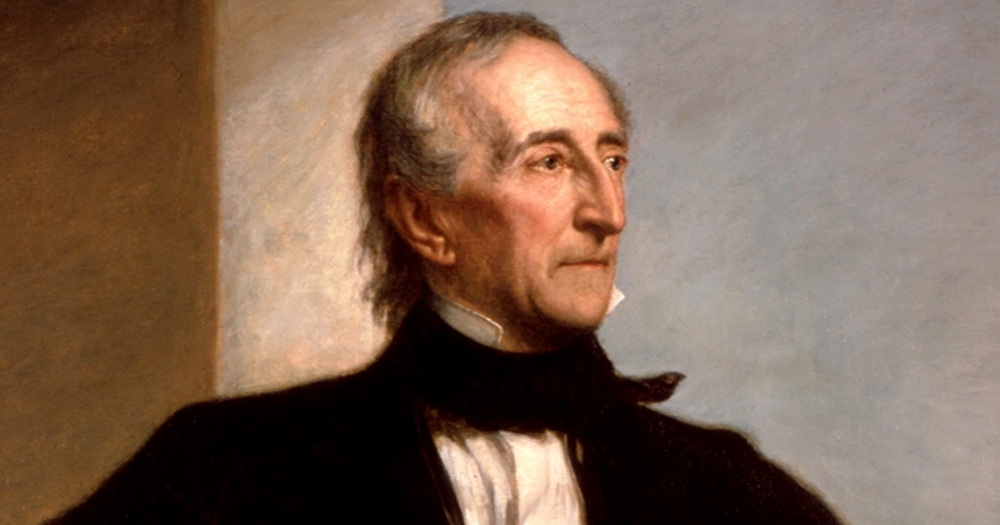
President Tyler was a Jeffersonian democrat who took up the office from William Henry Harrison, who died several weeks after being sworn in. Tyler was never accepted as legitimate by — get this — the Whig Party that nominated him. He was dubbed “His Accidency.” After opposing a revival of the national bank notion, there were riots, and his party expelled him. He received hundreds of death threats in the mail. Later he was almost impeached.

Admittedly, Republicans haven’t abandoned Trump — yet. But the Democrats have opposed him from the beginning. And the Entertainment Industrial Complex never ceases to wage a culture war against him. What should the most hated man do?

Make the most of it.

One of his promises was to put congressional term limits into the Constitution. Congress is reluctant. But Trump can do what I couldn’t: use all the powers of the presidency — from the bully pulpit to the veto pen — to leverage those in Congress into proposing a constitutional amendment.

It won’t make President Trump any less hated in Washington, but will win support everywhere else.

This is Common Sense. I’m Paul Jacob.


* That was in days of yore, the 1990s, and it was Bob Novak who gave me the appellation. Politicians, lobbyists and other government insiders hate term limits.


Printable PDF


Categories
Accountability general freedom initiative, referendum, and recall local leaders

Citizens Triumphant

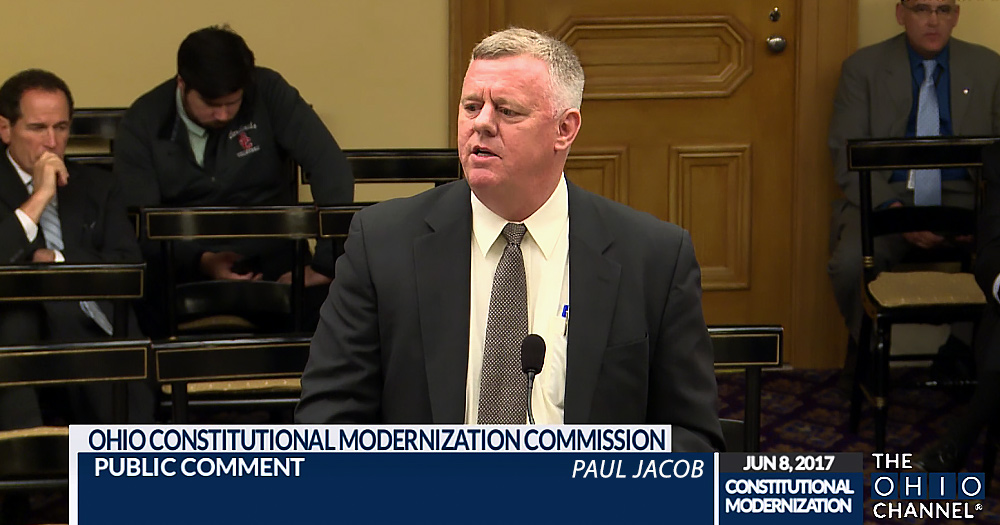
Last week, the Ohio Constitutional Modernization Commission considered whether to recommend a constitutional change to create an obvious double standard: requiring citizen-initiated constitutional amendments to obtain a 55 percent supermajority vote, while the very same amendments proposed by legislators would only need 50-percent-plus-one for passage.

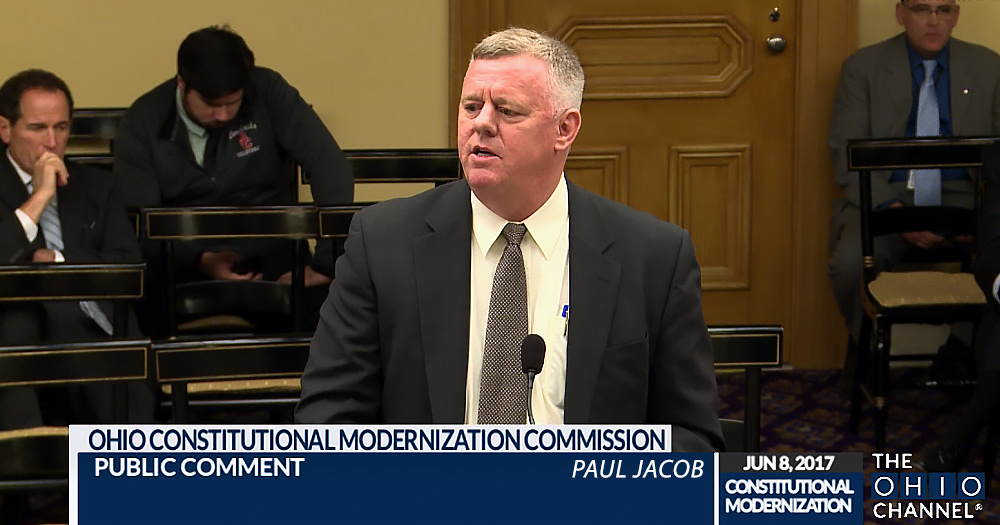
I traveled to the capitol in Columbus, joining a room full of Ohio citizens and organizations testifying in opposition. As I explained at Townhall yesterday, after hearing from the people, the Commission tabled the idea.*

For more than four years, the Constitutional Revision and Updating Committee deliberated over how to improve the constitution and came to a consensus in favor of the aforementioned double standard (sent to the full Commission). And yet, at a well-attended public hearing, no one defended the proposal.

While bias favoring the legislature seemed obvious, commissioners bristled at the suggestion that — established and funded by the legislature — they lacked independence. “If there were one or two legislative members on our committee, that was it,” offered non-legislator Janet Abaray.

Actually, four of the nine members on Abaray’s committee are currently state legislators — not one or two. Plus, two more previously served in the legislature. That’s two-thirds of the committee comprised of current or former legislators.

Moreover, the published minutes provide a peek into the thinking behind the proposed double standard. For instance, “what have emerged lately are initiated amendments to the constitution that are inconsistent with the purpose of the constitution.”

It is the people who will decide what belongs in the people’s constitution — not the legislature.

And not the legislature’s commission.

That’s the truth that Ohioans spoke to power.

And power listened.  

This is Common Sense. I’m Paul Jacob.


* The commission came to this conclusion with only one dissenting vote.


Printable PDF


Categories
folly free trade & free markets local leaders moral hazard nannyism property rights responsibility too much government

Housing Horror

Housing in Oregon’s north-central urban region is becoming more and more like San Francisco’s — out of the budgetary reach of huge swaths of average workers.

“The median rental household can’t comfortably afford a two-bedroom apartment in 28 of Oregon’s 36 counties,” Elliot Njus writes for The Oregonian. But it is worst in Portland and the three counties in the region: Multnomah, Washington, Clackamas. 

The findings come from a group called the National Low Income Housing Coalition. Njus quotes Alison McIntosh, of another group, the Neighborhood Partnerships, who not unreasonably concludes that “folks are really struggling to make ends meet.”

Well, yeah. This was predicted, long ago.

The state of Oregon began a comprehensive land-use planning system, decades ago, to prevent urban sprawl. At about the same time the Portland-region’s three major counties began a concentrated effort to . . . concentrate populations within the area. Confine them. Regulate them. Economists and other critics* from the very beginning predicted rising housing costs. And other problems.

Now, of course, the usual groups react in precisely the wrong ways: rent control. The State House in Salem recently passed legislation to uncork rent control. Thankfully for renters, the Senate nixed the idea. 

But we can be sure this proven housing killer (a disaster where tried) will resurface. Common sense (as well as reams of economic research) tells folks how bad an idea this would be, exacerbating the problem it aims to solve.

Alas, some folks look at government more as magic than as just another flawed, human institution.

This is Common Sense. I’m Paul Jacob.


* One set of critics can be found at the Cascade Policy Institute, which describes Oregon’s land-use regulatory system as “the nation’s most restrictive” — adding that “every square inch of Oregon has been zoned by government planners, with the result that development of any type is prohibited on most private land.”


Printable PDF


Categories
crime and punishment free trade & free markets general freedom moral hazard nannyism too much government

Sin, Soda and Say

Government policy in Seattle, Washington, is being driven by an outright socialist on the city council. The mayor, apparently starving for attention, proposed a goofy new sin tax last year.

Now, writes Reason’s Baylen Linnekin, “Seattle lawmakers are expected to vote early next week on a citywide soda tax that would add more than $2.50 to the cost of a twelve-pack of soda.”

The tax’s proponents’ rationale is too familiar: sugary sodas are bad for us, so we must be discouraged from drinking them.

Besides, politicians want to spend our money.

The problem, of course, is that the more successful they are at the first task, discouraging the ‘sin’ itself, the less revenue for them to throw at voters to prove their ‘caring’ nature . . . and buy votes.

But it is not as if those are the only competing factors involved. “The tax would undoubtedly drive consumers,” writes Linnekin, “to buy more groceries in the city’s suburbs.” Bellevue and Kirkland are nice towns. And nearby.

Arguing for a tax like this — as a social engineering mechanism — is not only crude, but flies in the face of the very best wisdom, that of Jean-Baptiste Say:

A tax can never be favorable to the public welfare, except by the good use that is made of its proceeds.

But elitist nannyism corrupts politicians, who make it their job to steer our consumption.* And they tend to be resistant to the “best scheme of finance,” which is, as J.-B. Say put it, “to spend as little as possible; and the best tax is always the lightest.”

If the tax goes in, Seattleites, drive to out-of-town Costco or Walmart.

Then drive your greedy nannies out of office.

This is Common Sense. I’m Paul Jacob.


* Considering the mayor’s push to include diet sodas in the sin tax, how competent at this are they? It’s the sugary drinks that are known killers, but the diet drinks are mainly imbibed by wealthier folks. The mayor wants to appease the socialist on the council, and pointedly not favor the “privileged.”


Printable PDF


Categories
Accountability crime and punishment folly general freedom media and media people moral hazard nannyism responsibility too much government

Another Push for Censorship

It’s almost as if politicians are hell-bent on expanding government at the expense of our freedoms . . . and grandstanding to ‘look like they are doing something.’

The two proclivities are not unrelated.

Take Theresa May, Great Britain’s Tory Prime Minister. After yet another terrorist attack in her country, this time on the London Bridge, she re-iterated her party’s intent to censor the Internet.

“We cannot allow this ideology the safe space it needs to breed,” May said on Sunday. But this “safe space,” she went on, “is precisely what the Internet, and the big companies that provide Internet-based services, provide.”

Now, blaming ISPs and social platforms is a crude form of business scapegoating—something I would expect from her opponent in the upcoming elections, Jeremy Corbyn, the much-loathed (but inching ahead in the polls) top banana of Labour.

As a conservative, May should understand markets and the limitations of government interventionism a bit better than a nearcommunist. She might recall that previous attempts to regulate the means of communication almost never to work, and, in those few cases when they do, never stay scaled to the original target issue.

They expand. To cover more than just terrorism, as in this case.

What’s more, Jim Killock of the Open Rights Group makes the case that such a move would likely “push these vile networks into even darker corners of the web, where they will be even harder to observe” — scuttling the alleged purpose of the Conservative Party’s longed-for censorship.

May knows this. But she is a politician. She has power, and she wants to keep it.

It’s almost as if power corrupts or something.

This is Common Sense. I’m Paul Jacob.


Printable PDF


Categories
general freedom initiative, referendum, and recall local leaders nannyism political challengers Regulating Protest

Delivering a Double Standard

Former State Representative Matt Lynch got right to the point in his Cleveland Plain Dealer op-ed: “The people’s right to amend the Ohio Constitution through the ballot initiative is under attack.”

Created by the Ohio Legislature to consider constitutional amendments, the Ohio Constitutional Modernization Commission (OCMC) has a hidden purpose: provide cover for that same legislative body. As Lynch aptly notes, the OCMC “is filled with politicians and lobbyists. Thus, commission recommendations must be scrutinized for fidelity to the public good versus the special interests of political insiders.”

This Thursday at the capitol in Columbus, OCMC will consider whether to recommend that state legislators propose an amendment to the state constitution to make future amendments more difficult. That’s an awfully bad idea in itself. But, bizarrely, the greater difficulty would depend entirely on who proposes the amendment.

The working OCMC recommendation makes no change to the legislature’s ability to propose and pass constitutional amendments. What it would do is make it tougher for citizen-initiated amendments. Most unhelpfully, the recommendation would require only citizen-proposed amendments to garner a supermajority of 55 percent of the vote.

Consequence? Suppose a measure proposed by citizens — term limits, ethics reform, government transparency — was massively outspent by powerful interests, and yet still won 54.9 percent of the vote. It would lose.

Yes, the 45.1 percent of voters would defeat the 54.9 percent of voters.

Call it “New Math.”

The very same issue proposed by legislators would win . . . and be added to the state constitution.

The double standards are breathtaking,” writes Lynch,* adding, “and no other state has such unfair rules.”

This is Common Sense. I’m Paul Jacob.


* Sunday at Townhall, I also discussed this double standard. And the word may be getting out. Townhall always adorns my column with a photograph — this time featuring Ohio Attorney General Mike DeWine, also a Republican candidate for governor in 2018. DeWine’s campaign objected to being pictured, arguing they have no involvement with the OCMC. DeWine’s picture has been removed.


Printable PDF


Categories
general freedom moral hazard nannyism responsibility too much government

The $659,000 Non-Question

The so-called “Motor Voter” law of 1993 created a national mandate: when people obtain their drivers’ licenses at the Department of Motor Vehicles, ask them if they’d also like to register to vote.

The federal mandate is perhaps heavy-handed, but the underlying idea has merit.

Now a new idea is gaining ground, taking the notion (nudge, nudge) a step further. Let’s not bother asking people if they want to sign up to vote, the proposal runs. Government should simply register them. Without asking.

It is a form of paternalism.

“It flips the presumption, where right now they ask you if want to be registered,” argues D.C. Council member Charles Allen. “Instead of that, we’re just going to go ahead and get you registered, and that absolutely helps enfranchise voters.”

“Lawmakers in 32 states have introduced measures in the last year to automatically register drivers to vote,” reports the Washington Post.

Some folks contend there isn’t much difference between asking if someone wants to register and registering them without asking. Well, if there isn’t much difference, why spend the $659,000 that Washington, D.C. officials estimate it will cost over the next four years for their new “don’t-ask” program.

Of course, there is a difference in the two policies: sort of like between offering people something to eat and force-feeding them.

Some Americans have no desire to vote or be registered. It is surely no business of any state or local government to act as if their preferences don’t count.

And what good are a bunch of names on a voter list if they aren’t interested? Is someone going to vote for them?

This is Common Sense. I’m Paul Jacob.


Printable PDF


Categories
Accountability First Amendment rights incumbents local leaders Regulating Protest U.S. Constitution

Homer’s Recall Odyssey

Freedom of speech isn’t a free pass to avoid the consequences of what one says. Or does. Tell that to three members of the Homer, Alaska, city council — Donna Aderhold, David Lewis and Catriona Reynolds — who are the subject of a recall petition.

Well, a superior court judge just did.

Represented by the ACLU, the trio sued to block a recall petition with more than enough voter signatures. Their lawsuit challenged the city attorney’s acceptance of the legal rationale for the recall, claiming the recall attempt punishes the politicians for their speech.

“To conclude that anytime a recall petition is based in part or in whole on what a politician said is protected by the First Amendment,” Superior Court Judge Erin Marston ruled, “would be to eviscerate the recall statute to such an extent that the populace would almost never be able to seek recall of any of their elected officials.”

Now the recall moves forward.

In most of this Land of the Free, citizens lack the ability to recall their elected officials. In places that do have the process, it is rarely used. When it is used, it is often portrayed as voters throwing a temper tantrum.

Or an unfair election do-over.

Or mean-spirited ‘vendetta politics.’

Not so. The petition requirements make recalls very difficult. Recalls don’t happen without some serious problems with the current officeholder(s). And once a recall is triggered, there follows a democratic vote to decide whether citizens want to keep the sitting hireling or find someone new.

Seems pretty reasonable.

When politicians are recalled and removed, they deserve it.*

This is Common Sense. I’m Paul Jacob.


* The problem seems never to be that good politicians are being recalled, but that too many politicians who should be recalled are not. Back in 2003, the governor of California was recalled. He deserved it. In 2011, a whopping 88 percent of Miami-Dade County voted to recall Mayor Carlos Alvarez. He earned it, too.


Printable PDF