Categories
regulation too much government

Regulating BBQ

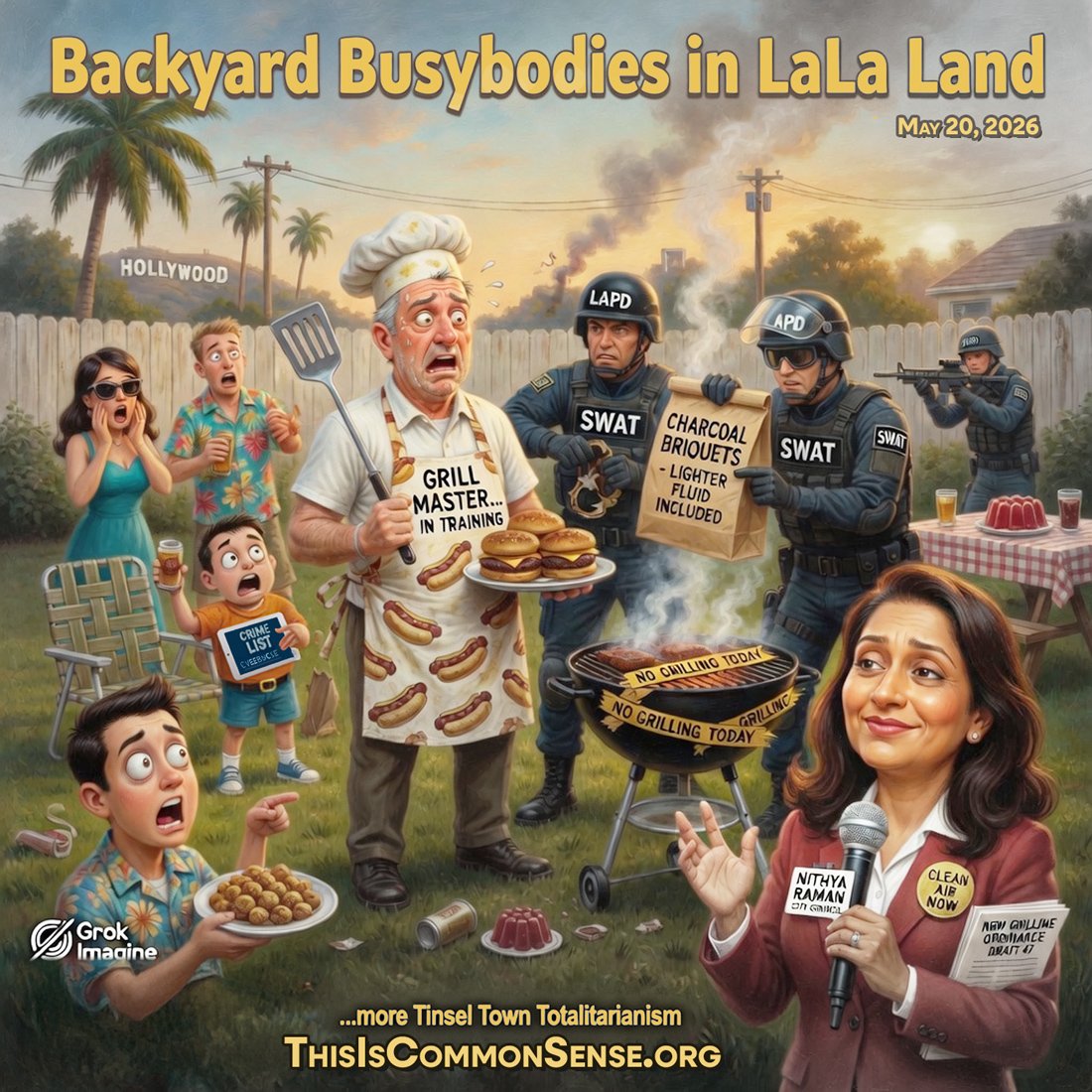
Los Angeles councilwoman Nithya Raman wants city officials to impose new regulations on backyard grilling when conditions are dry and windy. The mayoral candidate proposed restricting “backyard barbecues, fire pits and other open flames” in residential neighborhoods when such conditions exist.

Cities often prohibit burning leaves on windy days, in part because burning leaves may spread too easily when it’s blustery. But barbecues are more contained.

National Review’s Noah Rothman suggests that the caution would be more plausible if California had ever suffered a “rash of fires — or even just one — attributable to the careless mishandling of charcoal briquettes.”

Accidental causes of conflagrations tend to be things like lightning strikes and faulty power lines. These work in conjunction with poorly managed forests.

Arson, a big danger in recent years, comes in a variety of forms, as Mr. Rothman explains. “The record-breaking 2024 Park Fire was set by an intoxicated motorist who pushed his car into some flammable brush after an accident.”

The Palisades Fire was “first set by an embittered anti-capitalist vigilante” who hated the rich.

Arson and drunk driving are already illegal.

Anybody can try to cook hamburgers by setting a fire in the middle of high vegetation and calling this a “barbecue.” But that’s not the kind of thing Raman had in mind.

Fortunately, another councilwoman, Monica Rodriguez, managed to block Raman’s effort to toss a wet blanket on barbecues.

“The last thing Angelenos need,” Rodriguez says, “is a ban on hosting a carne asada in their own backyard.”

This is Common Sense. I’m Paul Jacob.


PDF for printing

Illustration created with Grok Imagine

See all recent commentary
(simplified and organized)
See recent popular posts
Categories
folly free trade & free markets general freedom moral hazard nannyism responsibility too much government

Signature Nonsense

Did anyone really need this?

Last year, California’s Governor Jerry Brown signed into law Assembly Bill No. 1570, which concerns collectibles, particularly signed-by-author or artist books. But it doesn’t mention books, and is confusingly written. What a mess.

Who asked for it?

It certainly wasn’t the struggling booksellers who have come to depend on signed authors’ copies. In the Age of Amazon.com, book vendors need to add value to stay afloat.* Author-signed copies help.

The law says that for signed-by-creator collectibles sold for more than $5 — yes, a mere five smackers — sellers must provide customers a Certificate of Authentication. The law specifies nine “helpful” directions for said certificates. So imagine an edition of Brian Doherty’s Radicals for Capitalism, signed by the author at, say, a non-profit dinner, or at a bookstore signing, or even a late-night bar —discounted to not much over five bucks.** The bookseller must not only provide a certificate, but list the book’s provenance. Talk about an added cost of doing business.

I mention Mr. Doherty not merely because of his excellent book, but because he has not unreasonably confessed that “my own interests could be harmed by any attempt to actually enforce the letter of this law.”

This week on EconTalk, economist Mike Munger mentioned the market’s built-in regulatory features — reputation being the most obvious — for helping consumers avoid getting ripped off buying books . . . and paintings . . . and anything else improved by creator signature.

But, really, can’t we make do with a little caveat emptor as well as caveat lector? Better than regulations this dense.

This is Common Sense. I’m Paul Jacob.


* The number of independent bookstores plummeted (down a thousand) around the country between 2000 and 2007. But there seems to be an increase since then, despite (or because of?) Abebooks and Alibris and other dot coms.

** I found a signed copy of Doherty’s history at Abebooks for $10.


Printable PDF