Categories
Accountability folly free trade & free markets general freedom local leaders moral hazard nannyism national politics & policies property rights responsibility too much government

Against Flexibility?

Do politicians have any idea what they are doing?

In Oregon, Senate Bill 828 just passed the Senate and is now being favorably reviewed in the House. The law would require “large employers in specified industries to provide new employee[s] with estimated work schedule and to provide current employee with seven days’ notice of employee[’s] work schedule.”

But will the measure help employees? Really?

The notion is called the “Fair Work Week.” Pushed by Democrats, it has gained bipartisan support. The basic idea: allow time (under full force of law) for workers to manage their own schedules and personal economies.

Trouble is, in the name of making work easier to manage, it attacks flexibility.

Which is something many workers want. More than notification.

Indeed, the study commissioned by the City of Seattle for their similar regulatory scheme acknowledged that reducing flexibility is not necessarily a godsend for workers.

“A more predictable schedule,” the report noted, “is not always one that an employee would prefer. A schedule known with certainty is a cold comfort if it yields too little income to survive.”

The report went on to explain that many of the labor market’s scheduling inconveniences are themselves the result of other government regulations, such as ObamaCare.

Christian Britschgi, writing at Reason, predicts that passing the Oregon law would mean “a fairer worker week” for some, but for others, “no work week at all.”*

Meanwhile, the Seattle study noted that it was workers in small businesses who are most likely to be discomfited by last-minute scheduling changes. The Oregon law applies only to big businesses.

This is Common Sense. I’m Paul Jacob.


* A standard, negative consequence of most “well-intended” legislation.


Printable PDF


Categories
folly free trade & free markets general freedom ideological culture moral hazard nannyism national politics & policies property rights responsibility too much government

Minimally Mugged By Reality

It should shock no one: forcing businesses to pay steep minimum wages ends up pushing some businesses out . . . of business. Yesterday I looked at what minimum wage laws can do to low-skilled workers. Today, consider the employers. When we make it harder to turn a profit, it becomes harder to profit. Businesses that can’t at least break even close their doors.

Many business owners are inclined to promote, politically, politicians who in turn support minimum wage hikes. Do they change their minds when mugged by reality? Alas, the trauma alone won’t convert a person to principled allegiance to free markets.

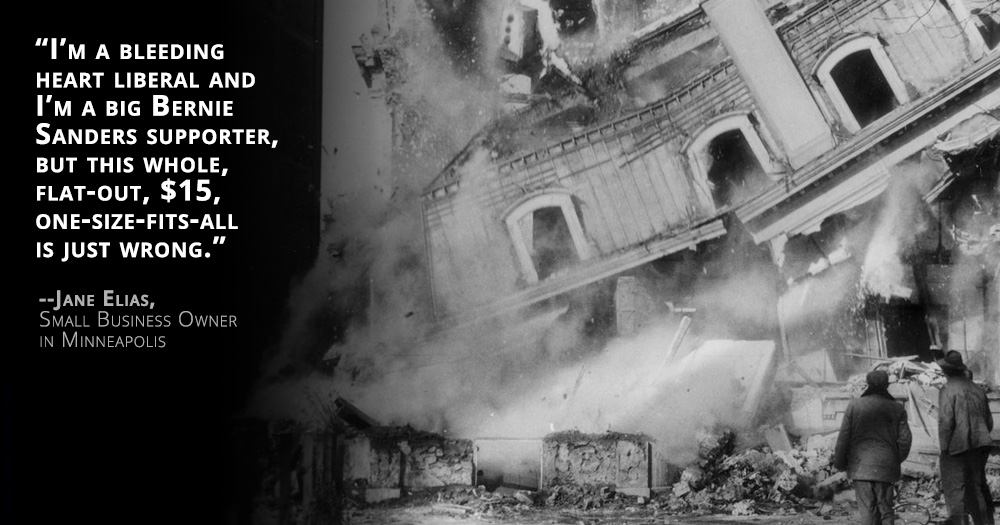
I was reminded of this fact by a story about business owners in Minneapolis who stress their Sandernista credentials.  

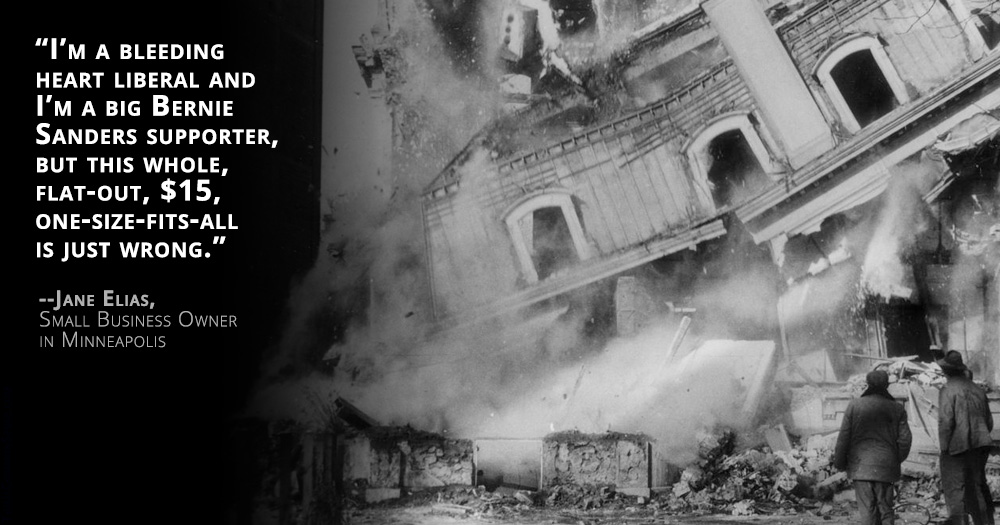
“I’m a bleeding-heart liberal and I’m a big Bernie Sanders supporter,” says businesswoman Jane Elias, an art store owner. “But this whole flat-out, $15, one-size-fits all is just wrong.” Another victim, restaurant owner Heather Bray, says she’s a “proud, proud progressive.” But: “The arithmetic doesn’t work. People will not continue to go to budget-conscious restaurants when they’re no longer budget-conscious.”

So . . . arbitrary minimum-wage demands don’t add up in light of the demands of running their businesses under their particular circumstances. Well, no disagreement here. But take it further, please. Keep doing the math. The bottom line is that everybody, not just you — and always, not just sometimes — has the right to make his own decisions about his own life and property.

And profit by it.

This is Common Sense. I’m Paul Jacob.


Printable PDF


Categories
Accountability ideological culture local leaders moral hazard nannyism national politics & policies responsibility too much government

Minimum Wage Laboratory

Not every popular idea about government policy is good. Or bad. How do we tell the difference?

One way is evidence.

The modern administrative state was promoted heavily by social scientists who thought that piecemeal social engineering should be tested. A few even thought that the older experiment in limited-government federal republicanism gave Americans a near-ideal testing ground: “the laboratory of democracy.”*

Activists and politicians have been pushing big increases in the minimum wage in cities around the country. Seattle, Washington, has been one of those, establishing an $11.00/hour legal minimum in April of 2015, then raising that limit by two dollars in 2016. Now the results are in.

The City of Seattle commissioned a study of “the wage, employment, and hours effects of the first and second phase-in of the Seattle Minimum Wage Ordinance,” and it shows clear results:

  1. The first hike led to “modest reductions in unemployment” but scant change in over-all low-wage employment.
  2. The second hike led to a 9 percent reduction in hours worked at wages below $19/hour;
  3. a reduction of over $100 million per year in total payroll for low-wage jobs; and
  4. total payroll losses average about $125 per job per month.

Jonathan Meer, an economist teaching at Texas A&M University, calls this an “unmitigated disaster.” But he notices that a backlash against it was immediate.

To those who object: do you object to the method or the conclusions?

The only halfway plausible rationale for social engineering of this kind — top-down interventions into markets — has been “social science.” Rejecting evidence is to reject science, which is to reject . . . the minimum wage idea itself.

This is Common Sense. I’m Paul Jacob.


* The idea is to test policy tried in one location against its goals. What works should be mimicked, but only after the evidence is in and results accepted as good. And dropped in cases where not.


Printable PDF


Categories
Accountability general freedom initiative, referendum, and recall local leaders national politics & policies responsibility term limits

Today’s Leaders

We have a new president. Many people put a lot of trust in him — and many more hate him and seek to bring him down. In both cases, presidential politics takes up an inordinate portion of our brain space.

Over the weekend I twice wrote about four heroic senators, standing up to the insiders in their own party. Getting a lot of deserved attention.

But remember: the real leaders are not in Washington, D.C.

Right now, a half dozen issues are undergoing revolution. Legalized gay marriage swept through state after state; meanwhile, Democratic leaders (Clinton, Obama) lent none of their prestige to the cause.*

It was local and state activists who led. And even wide swaths of “the people” were out in front.

Not politicians.

Marijuana legalization has occurred in state after state, mostly by initiative petitioning. It wasn’t the politicians who pushed this through. It was activists.

And, again, the people.

The politicians — including, now, the new Attorney General — largely obstructed the advance of freedom on this issue.

Much the same can be said for improving police-citizen relations with mandatory cop cams and transparency protocols. In the past, much the same pattern could be seen regarding term limits and tax limitation measures. In most cases of progress, politicians have actually represented the rear guard.

Which should give us something to think about. We face a looming sovereign debt crisis, the pension system bubble, and ongoing culture wars regarding campus (and general) free speech.

If you think something should be done, minds should be changed, don’t look for a national figure. Look locally. Look to yourself. Go online.

Master the mechanisms of social change.

This is Common Sense. I’m Paul Jacob.


*That is, these politicians “became leaders” on the issue at the point the issue needed no leadership. They remained opposed to change until the last moment, when the direction was firmly set and most of the watershed marks had been made.


Printable PDF


Categories
free trade & free markets general freedom local leaders national politics & policies political challengers property rights responsibility too much government

The Real ObamaCare Opposition

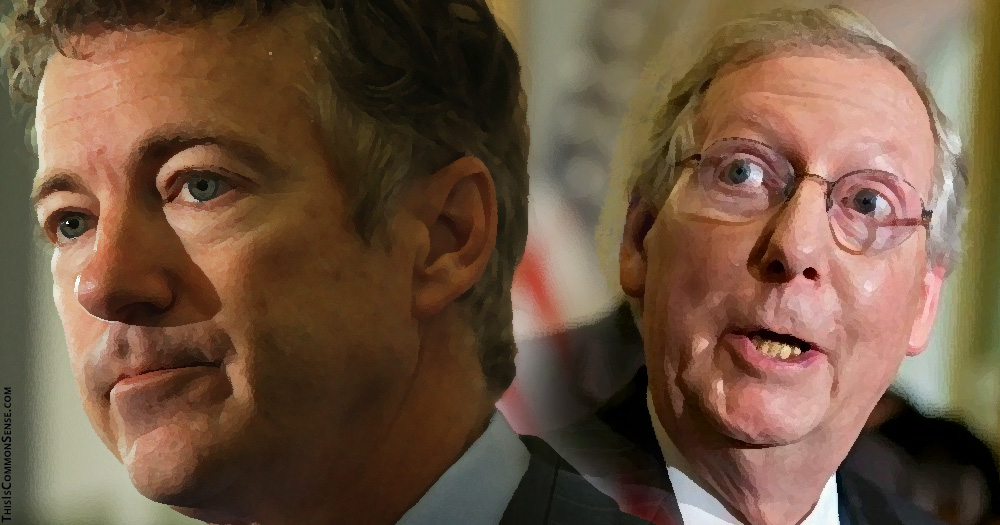
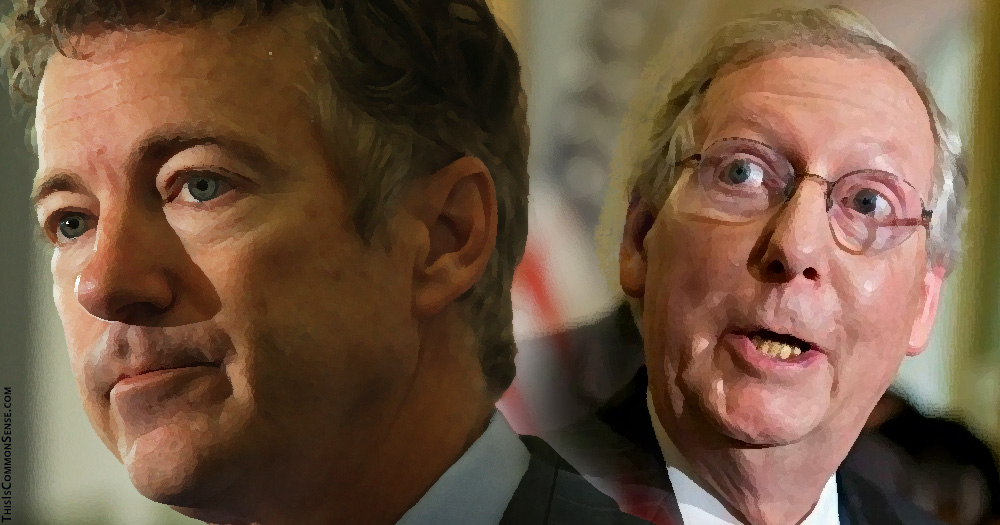
Senate Majority Leader Mitch McConnell (R-Ky) has introduced a bill to compromise between the House’s recent Affordable Health Care Act and the current “ObamaCare” Affordable Care Act. Though there seems to be some “what the heck, go with it” enthusiasm for it on Capitol Hill, it’s not coming from Senators Rand Paul of Kentucky, Ted Cruz of Texas, Ron Johnson of Wisconsin and Mike Lee of Utah.

‘‘Currently, for a variety of reasons, we are not ready to vote for this bill,” their joint statement from yesterday reads.

Their objections? Well, they agree that there are “provisions in this draft that represent an improvement to our current healthcare system but. . .”

— and this is a big but

“it does not appear this draft as written will accomplish the most important promise that we made to Americans: to repeal Obamacare and lower their healthcare costs.’’ Their opposition, the Boston Globe tells us, puts the TrumpCare wannabe in jeopardy.

Dr. Rand Paul is the key figure in the opposition. One of Capitol Hill’s ongoing amusements has been to watch the junior Kentucky senator repeatedly pit himself against his state’s senior member — who, the Globe tells us, now threatens “to bring the bill to a vote next week even if he doesn’t have the necessary votes.”

Pressure tactics.

Which you need to put an obviously bad bill through Congress.

Too many mainstream Republican congressmen lack the courage of their constituents’ convictions. They apparently do not really believe that a freed-up health care system and insurance market can work to the general good.

At least, not in time for the next election.

This is Common Sense. I’m Paul Jacob.


Printable PDF


Categories
ideological culture incumbents local leaders media and media people national politics & policies

Monied Hopes Dashed

Democrats had high hopes. Their come-back after the 2016 defeats seemed near at hand. After all, Trump is proving increasingly erratic and incompetent, and the Republican mis-handling of the ObamaCare repeal appears to be a disaster of ginormous proportions.

How could they not start taking seats in Congress back?

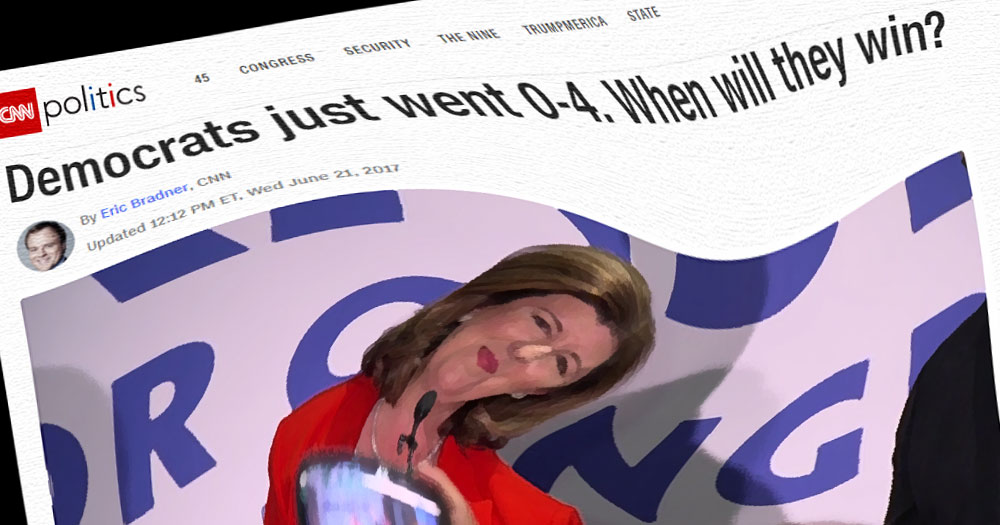
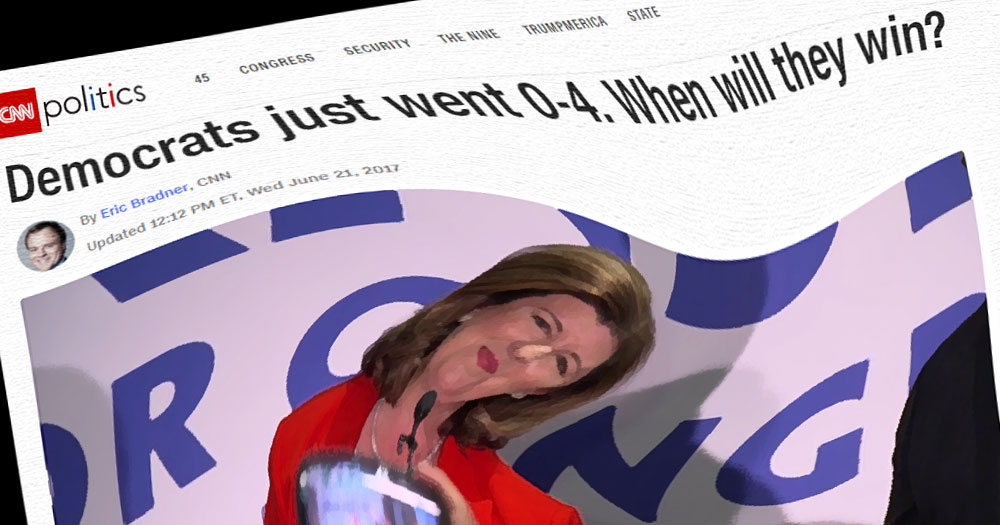
There were four open seats requiring new votes this late Spring. “Democrats tried an inoffensive moderate message in Georgia,” CNN’s Eric Bradner informs us. “They ran a banjo-strumming populist in Montana. They called in the cavalry in South Carolina and tried to catch their foe sleeping through a long-shot in Kansas.”

Democrats failed, 0-4.

Why? Well, the congressional vacancies were made by the new president’s appointments, and he may have targeted those districts that were especially safe. Nevertheless, CNN notes, “[t]he party got closer than it has in decades to winning some of the four seats — a sign they’ve closed their gaps with Republicans in both suburban and rural areas. . . .”

But there is a lesson here that CNN did not draw from the debacle. The much-lamented Georgia race, in which Jon Ossoff lost to Republican Karen Handel, was a race in which Ossoff out-spent Handel six to one in what is called “the most expensive House race in history.” And yet, somewhat oddly and perhaps hypocritically, Ossoff, the bigger spender, went on air complaining about money in politics.

All that moolah did not push him over the top. Ossoff and the Democrats — as well as the feckless Republican majority — might look for fewer excuses and stand for something voters actually want.

This is Common Sense. I’m Paul Jacob.


PDF for printing


Categories
crime and punishment folly free trade & free markets general freedom nannyism national politics & policies responsibility too much government

Serving Consumers? Punish!

New media ballyhooer Douglas Rushkoff made waves this week. Citing an un-named friend who went hysterical about Amazon.com’s purchase of Whole Foods, he asserted that such “unease is widespread, and has raised new calls for breaking up Jeff Bezos’s impending monopoly by force.”*

The company has “surely,” he claimed, “reached too far.”

Apparently, serving customers exceptionally well is bad for business.

Yes, he almost totally ignored the pro-consumer benefits of Amazon. Had to — his case makes no sense when you factor in us consumers. He focused, instead, on Amazon’s success in terms of its recent “online and offline retail sales growth” and its control of 40 percent of cloud storage and streaming services.

He went on to spin a bizarre fantasy about how disruptive bigness is in business. His economically illiterate farrago reminds me of the sad case made against pre-antitrust Standard Oil, a company which, during the whole time of its growth prior to break-up, kept on producing more fuel at ever-decreasing prices.** Broken up because of . . . fears about how businesses change. And of bigness itself.

As long as consumers are being served, this reaction strikes me as paranoid. When businesses get big (and even near-monopolistic) and then cease to serve customers, they fail. While serving customers, there is no call for fretting over businesses that move from one success to another  — which is what Rushkoff has the gall to worry about.

The call for Amazon’s break-up over-sells government and necessarily under-serves consumers.

This is Common Sense. I’m Paul Jacob.


* Rushkoff’s piece in Fast Company was the first I heard of such a “call.” Rushkoff is the coiner of the term “media virus” and a sort of populist pusher of market skepticism.

** For the bizarre story of the Standard Oil case, and how it made no economic sense whatsoever, see Dominick T. Armentano, Antitrust: The Case for Repeal (Ludwig von Mises Institute, 1999), p. 41-43, and Antitrust and Monopoly (Independent Institute, 1990), pp. 57-60.


Printable PDF


Categories
Accountability folly free trade & free markets general freedom initiative, referendum, and recall local leaders moral hazard porkbarrel politics responsibility too much government

Go Nats?

Just a few miles away from where I live sits the stadium of the Potomac Nationals. I’m a fan. I’d hate to see the team we call the P-Nats leave.

But . . . Hasta la vista.

The owner of this minor league affiliate of Major League Baseball’s Washington Nationals is demanding a new stadium. He threatens to move out of Prince William County, Virginia, if he does not get it.

The Prince William County board of supervisors has already expressed interest in floating bonds to raise the $35 million the fancy new stadium would require — with the privately owned team paying the money back, with interest, over the next 30 years.

Compared to other crony-ish deals around the country, not such a terrible taxpayer swindle. Still, zillions of wrongs don’t make this right. County taxpayers would be on the hook in case of default. And if the marketplace believed the team could actually make such payments, a bank or other investors would come to the rescue.

Thankfully, a monkey wrench has been thrown into the deal. A county supervisor has proposed that voters should get a chance to decide, via a November referendum. The board of supervisors will consider the referendum tonight.

Voters should get the final say. But if there is a referendum, as much as I love having the team here, I will vote NO. I don’t cotton to forcing others to pay for my preferred entertainment.

Government has certain legitimate roles. Subsidizing sports is not one.

Even if the new stadium would be closer to my home than the old one.

This is Common Sense. I’m Paul Jacob.


Printable PDF


Categories
free trade & free markets general freedom national politics & policies responsibility

The Poverty Retirement Non-plan

A “conundrum” is “an intricate and difficult problem” or “a question or problem having only a conjectural answer.”*

In his June 8 article, “The Jobs Conundrum,” economist Gerald P. O’Driscoll focuses on a very big problem that we do not have sure answers to, yet.

Unemployment figures are down, but the number of non-working adults in the prime of their lives is up. O’Driscoll explains: “Unemployment” is a term of art and does not mean simply the number of people not working. It comprises the number of people not working and who are looking for a job.” Many aren’t “unemployed” for the simple reason that they are not trying to be employed.

They are, I suppose you could say, in early retirement, mostly a kind of poverty retirement.

Economists call it a drop in “labor force participation.” It used to be that men in the prime of life not looking for work constituted a mere 6 percent of the population. Now it’s 15 percent.

O’Driscoll, I notice, doesn’t engage in much conjecture to explain why. He merely insists, instead, that the trend is big, unemployment figures don’t track it, and that it has huge consequences.

I’ve heard some interesting (and puzzling) theories about the whys, of course. Blame feminism; blame the welfare state; blame the Chinese!

But even before we settle on a definitive answer, many movers and shakers now contemplate establishing — and are even experimenting with — a universal basic income as a way to alleviate this problem.

My conjecture? It would make the problem worse.

This is Common Sense. I’m Paul Jacob.


* The original, primary meaning of “conundrum” — “a riddle whose answer is or involves a pun” — is not relevant to this pun-free column.


Printable PDF


Categories
folly free trade & free markets general freedom moral hazard nannyism responsibility too much government

Signature Nonsense

Did anyone really need this?

Last year, California’s Governor Jerry Brown signed into law Assembly Bill No. 1570, which concerns collectibles, particularly signed-by-author or artist books. But it doesn’t mention books, and is confusingly written. What a mess.

Who asked for it?

It certainly wasn’t the struggling booksellers who have come to depend on signed authors’ copies. In the Age of Amazon.com, book vendors need to add value to stay afloat.* Author-signed copies help.

The law says that for signed-by-creator collectibles sold for more than $5 — yes, a mere five smackers — sellers must provide customers a Certificate of Authentication. The law specifies nine “helpful” directions for said certificates. So imagine an edition of Brian Doherty’s Radicals for Capitalism, signed by the author at, say, a non-profit dinner, or at a bookstore signing, or even a late-night bar —discounted to not much over five bucks.** The bookseller must not only provide a certificate, but list the book’s provenance. Talk about an added cost of doing business.

I mention Mr. Doherty not merely because of his excellent book, but because he has not unreasonably confessed that “my own interests could be harmed by any attempt to actually enforce the letter of this law.”

This week on EconTalk, economist Mike Munger mentioned the market’s built-in regulatory features — reputation being the most obvious — for helping consumers avoid getting ripped off buying books . . . and paintings . . . and anything else improved by creator signature.

But, really, can’t we make do with a little caveat emptor as well as caveat lector? Better than regulations this dense.

This is Common Sense. I’m Paul Jacob.


* The number of independent bookstores plummeted (down a thousand) around the country between 2000 and 2007. But there seems to be an increase since then, despite (or because of?) Abebooks and Alibris and other dot coms.

** I found a signed copy of Doherty’s history at Abebooks for $10.


Printable PDF