Categories
media and media people national politics & policies Voting

The Non-​Citizen Dodge

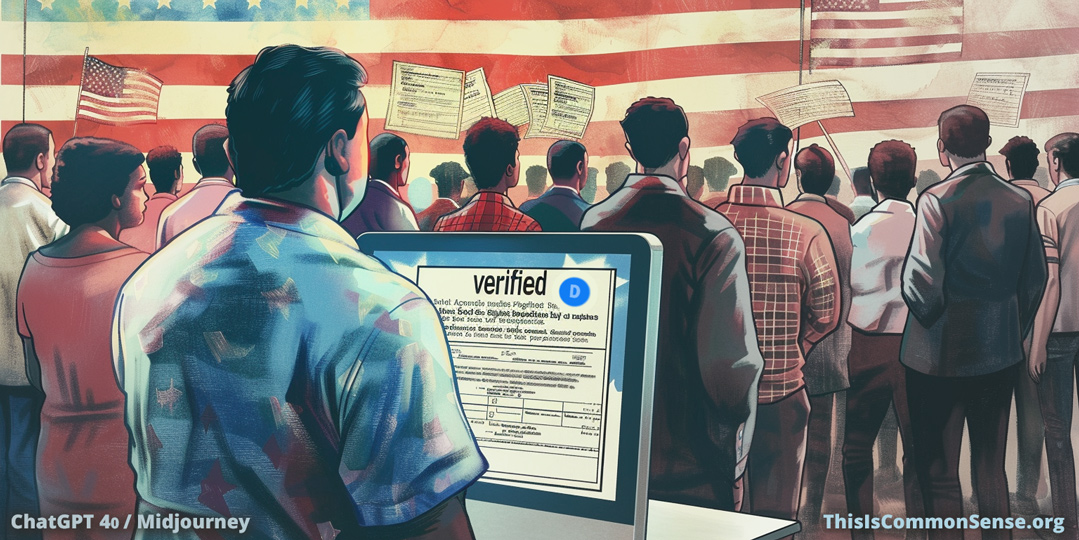
After telling Meet the Press viewers that non-​citizen voting is “exceedingly rare” and “already against the law,” NBC’s Kristen Welker asked Georgia Secretary of State Brad Raffensperger what he thought about “efforts to prevent non-​citizens from voting.”

“I believe only American citizens should be voting in our elections,” replied Raffensperger. “I’m the first secretary of state in Georgia to ever do 100 percent citizenship verification,” adding that Georgia officials discovered “about 1600 people that attempted to register, but we couldn’t verify citizenship, so they weren’t put on the voter rolls.”

The Secretary also explained that his office “just won a court case which came from the left, the Coalition of the People’s Agenda and the New Georgia Project, which was founded by Stacey Abrams.”* Raffensperger points out that the lawsuit “tried to stop us from doing citizenship verification before people were put on the voter rolls.”

“Good news, good news for everyone,” Michigan Secretary of State Jocelyn Benson chided, dismissively. “All of us want to make sure only U.S. citizens are voting in our elections. And all of us follow the law, ensure the federal provisions are protected, and that we’re ensuring that only valid votes are counted in our state.”

Democrat Benson reiterated that “regardless of our party affiliation, we’re doing all that we can and more to ensure, as the facts show, in all of our states, that only U.S. citizens are voting.”

“What you just said there was ‘federal provisions,’” responded Raffensperger, noting that non-​citizens have been given the vote — legally — at the local level in a number of states. 

He argued that states should place in their constitutions “that only American citizens are voting in any election in your state.”**

Still, Welker inquired, “Is it a red herring?”

No, Raffensperger answered, arguing that “already there’s the left-​wing groups trying to get noncitizens voting in local elections in Washington, D.C., New York City and in other places.” And he asked, “Why are we getting sued by the left to stop us from doing citizenship verification?”

Many Democrats and much of the media continue to dodge such questions. 

This is Common Sense. I’m Paul Jacob. 


*In her first run for Governor, Abrams said her “blue wave” was “comprised of those who are documented and undocumented” and specifically acknowledged that she “wouldn’t oppose” allowing non-​citizens to vote at the local level. 

** Americans for Citizen Voting has worked closely with the Georgia Secretary of State to place such constitutional amendments on six state ballots this November: Idaho, Iowa, Kentucky, Missouri, South Carolina, and Wisconsin. North Carolina may soon become the seventh state to do so. 


PDF for printing

Illustration created with ChatGPT 40 and Midjourney

See all recent commentary
(simplified and organized)
See recent popular posts

Categories
ballot access election law judiciary

A Done Decision

We probably needn’t feel suspense about whether the Wisconsin Supreme Court will let certain sloppy voting practices continue.

The Wisconsin Institute for Law and Liberty and the chairman of the Racine County Republican Party filed a lawsuit alleging that Racine city officials illegally used a van to collect absentee ballots in 2022. A circuit court ruled that such mobile voting sites violate state law.

Now, “without allowing any lower appellate courts to rule first,” the state’s supreme court will decide whether the circuit court is right about that.

The high court voted 4 to 3 to accept the case. The three justices who opposed end-​running the appellate courts are conservative (read: Republican); the other four are liberal (read: Democrat).

The Democrat justices voted to take the case at the request of the Democratic National Committee, which leads a political party known to be a proponent of slapdash voting procedures, slapdashery that observers tend to agree favors Democrats.

Chief Justice Annette Ziegler, who is part of the conservative bloc, has stated that the “liberal” justices proceeded in this way in order to help the Democrats politically. Ziegler knows her “liberal” colleagues, and I guess they must be the sort of progressives who don’t make conscientious adherence to the law in the service of election integrity a top priority.

So I think what’s about to happen is more of a foregone conclusion than it is a cliffhanger.

We know how the court will decide — but wouldn’t we love a surprise ending?

This is Common Sense. I’m Paul Jacob.


PDF for printing

Illustration created with Midjourney

See all recent commentary
(simplified and organized)
See recent popular posts

Categories
ballot access insider corruption partisanship

Words for Jersey Insiders

Effrontery. Chutzpah. Impudence.

I’m of course talking about partisan politics.

The case at hand is covered by Matthew Petti at Reason, “Are New Jersey Voters Too Dumb for Normal Ballots?” In this April 3rd report, Petti explains that a “federal judge has ordered Democrats in New Jersey to draw up ballots fairly instead of putting their favorite candidates at the front. But state Democratic bosses think that voters can’t be trusted to figure out how to think for themselves.”

This is a dispute about ballot design. Remember the notorious “butterfly” ballots that so confused Palm Beach County, Florida voters in 2000? You know, even Pat Buchanan acknowledged that thousands in the liberal county voted for him by mistake. 

Well, this is similar, though here the case is not so much a confusing ballot but a simple ballot with favored candidates getting the easiest-​to-​spot slots. “All but two of the state’s counties endorse candidates for the primary and then place their endorsed candidates all in one line,” explains NPR’s Nancy Solomon. “It’s called the ‘county line’ or ‘the party line’ and it includes candidates for various positions.… The other candidates for the same seat are placed in what’s known as ballot Siberia – way off to the right on the ballot and all alone.”

But when the party machine tried to replace the serially indicted Senator Bob Menendez with the governor’s wife, a challenger complained. And sued. And won.

County clerks are appealing the decision — but the court still requires them to design a new ballot.

“New” … meaning like ballots nearly everywhere.

This is Common Sense. I’m Paul Jacob.


PDF for printing

Illustration created with PicFinder and Firefly

See all recent commentary
(simplified and organized)
See recent popular posts

Categories
ballot access election law

More Is Less

Jose Barrios was “quite happy to hear we’re going to have more democracy, not less in the District of Columbia.”

Barrios, the president of D.C. Latino Caucus, was reacting to a federal judge’s ruling to toss out the legal challenge, brought by several city voters, to the D.C. Noncitizen Voting Act.

That underlying law, passed by the DC City Council in 2022, certainly puts the “more” into democracy, allowing anyone residing in our nation’s capital for 30 days, even if in the country illegally, to legally vote for mayor, city council and local ballot measures. 

And I do mean “anyone.” China’s ambassador to the U.S. and other Chinese nationals working at their embassy are today eligible voters in Washington. Same for the FSB agents and other Russian nationals working out of their embassy. 

Federal Judge Amy Berman Jackson dismissed the lawsuit on the grounds that plaintiffs “were simply raising a generalized grievance.” She elaborated: “They may object as a matter of policy to the fact that immigrants get to vote at all, but their votes will not receive less weight or be treated differently than noncitizens’ votes.”

I object to her poor choice of terms. “Immigrants” have been voting in this country for the last century and hopefully always will: By becoming citizens. 

The judge’s ruling also highlights that who votes is a pretty fundamental constitutional question, one that voters should decide. 

Yesterday, Idaho’s legislature voted to place a Citizen Only Voting Amendment on this November’s ballot — joining Wisconsin, Iowa, and Kentucky, which have similar amendments on the ballot. 

Certainly, yes, bestowing the vote on foreign citizens residing in the city for 30 days is an expansion of democracy. But sometimes more is less.

So, let’s ask voters.

This is Common Sense. I’m Paul Jacob. 


PDF for printing

Illustration created with PicFinder and Firefly

See all recent commentary
(simplified and organized)
See recent popular posts
Categories
crime and punishment election law general freedom

Free to Petition

In December 2020, True the Vote helped Georgians to file elector challenges “based on data showing over 364,000 voters appeared to be ineligible to vote due to change in residency.”

Section 21 – 2‑230 of Georgia Code Title 21 states that any elector “of the county or municipality may challenge the right of any other elector of the county or municipality, whose name appears on the list of electors, to vote in an election.”

Nevertheless, Fair Fight Action, the group founded by Stacey Abrams, sued True the Vote for allegedly intimidating voters.

That suit has now been thrown out.

In a 145-​page ruling, Judge Steve Jones questioned aspects of TTV’s strategy. But he concluded that “there is no evidence that Defendants’ actions caused (or attempted to cause) any voter to be intimidated, coerced, or threatened in voting.”

According to True the Vote attorney Jake Evans, the decision “establishes that eligibility challenges under Section 230 are a proper method to ensure voter rolls are accurate.”

In a formal statement, True the Vote said that the court has “affirmed that citizens have the right to lawfully petition their government in support of election integrity without fear of persecution or prosecution.”

Critics of the decision bemoan the encouragement that it will give to organizations seeking to expose voter fraud. And the problem is … ? 

It’s not as if filing a challenge under 230 guarantees success; a board of registrars must still determine whether the challenge is valid. Besides, fighting actual ballot fraud is not an attack upon democracy, but a shoring up.

This is Common Sense. I’m Paul Jacob.


PDF for printing

Illustration create with PicFinder and Firefly

See all recent commentary
(simplified and organized)
See recent popular posts

Categories
ballot access partisanship

Enthusiasm for Extremism in Action

She insists it’s about the rule of law. And not political. Not in any way.

“Maine Secretary of State Claims Politics Played ‘No Role’ in Booting Trump Off Ballot,” is how The Epoch Times headlined the story.

Secretary of State Shenna Bellows has unilaterally barred former President Donald Trump from the Maine presidential primary ballot. As in the Colorado case, the excuse rests with the January 6, 2021, protest rally and mob entrance into the capitol building. She says that “the weight of evidence” she “reviewed indicates that it was an insurrection.” 

Knowing what real insurrections are, and what words mean, and the long history of protests that get out of hand, including in recent times, most non-​partisan people, as well as all Trump supporters, must conclude just the opposite: no insurrection was even attempted.

Bellows may actually believe that the January 6 events constituted an insurrection, that her job allows her to do what has never been done in American history, and that this would be good for the nation.

On the insurrection issue, she and Democrats rely upon motivated reasoning. People worked up in a cause can believe almost anything that would aid the cause. Still, the common-​sense guess is that almost no one really believes her … but of course her Democratic comrades must pretend.

On the scope of her position, prudence would usually steer a partisan such as herself away from doing such a radical thing.

On the good of the nation, the clear hyperpartisan appearance would exacerbate tensions around the country, widening the divide into a chasm.

What may really be in evidence, though, is that leftists are mimicking the radicalism of the pandemic lockdowns, driven by the sheer frenzy of their vision of themselves as embodiments of righteousness … always to exercise arbitrary power.

An enthusiasm that spreads virally. As a mania. 

Thus does extremism work.

This is Common Sense. I’m Paul Jacob.


PDF for printing

Illustration created with PicFinder and Firefly

See all recent commentary
(simplified and organized)
See recent popular posts

Categories
election law Voting

Voting Unbound, Democracy Unhinged

In our nation’s capital, local voting rights are expanding and metastasizing so fast it is hard to keep up.

Exhibit A, a 12 – 1 vote of the City Council last year, telling the world: It is absolutely crucial to our democracy that China’s ambassador to the United States be given the same vote on who should be mayor, council member, or decide ballot measures, that any American citizen living in the District of Columbia would be entitled. 

Hey, let’s not disenfranchise the spies working out of the Russian embassy, either. Let ’em all vote! 

After all, they pay taxes. Might have their kids in the schools. 

In the country illegally? Fuhgeddaboudit! You can vote in DC. In fact, if an invading army took Washington by military force, and then held it for 30 days, the enemy soldiers could legally vote themselves into office. 

If only this were hyperbole!

A year ago, all the Republicans — along with 1 in 5 Democrats — in the U.S. House voted to nix the District’s crazy foreign citizen voting plan, as is Congress’s constitutional authority. But the Democrat-​controlled Senate refuses to act.

Last week, Abel Amene, whose Ethiopian family was granted asylum more than 20 years ago, became the first non-​citizen to be elected to a D.C. office. Abel won one of nearly 300 seats on the Advisory Neighborhood Commission, where the average district contains roughly 2,000 residents. 

My only question: why hasn’t he become a citizen? 

While the ANC has absolutely no power whatsoever, it is likely that its commissioner, Vanessa Rubio, lusts for more power and authority. Earlier this week she was fined $500 for voting twice in the 2020 election — once in Maryland and another time in Washington, D.C. 

She originally told authorities she did not recall voting twice. Later she suggested that because D.C. isn’t a state, voting there didn’t count … as if everyone gets one vote in Washington and another where they actually live.

Rubio’s 2020 fraud reminds us that not every vote should count.

This is Common Sense. I’m Paul Jacob.


PDF for printing

Illustration created with PicFinder and Firefly

See all recent commentary
(simplified and organized)
See recent popular posts

Categories
ballot access crime and punishment election law

Elections Overturned & Undermined

Sure, democracy is a messy affair. But it does require several fine balances. One of them is that elections must be trustworthy: neither rigged nor gamed.

In recent years, many elections have been charged to be somehow “stolen.” Hillary Clinton accused Donald Trump of “stealing” the 2016 presidential election; Donald Trump, in turn, accused the Democrats of stealing the 2020 election, in which he was given his walking papers.

Now reports by Roman Balmakov, at Epoch TV, show that election irregularities at the local level can not only be contested, but elections overturned. 

Sans “insurrection.”

“In a shocking turn of events,” explains Balmakov, “a judge in Connecticut overturned a primary election because the evidence of fraud was just so overwhelming.” Video captured late-​night ballot box stuffing, with identifiable government-​employee perps. The judge overturned Bridgeport’s Democratic primary race for mayor.

In a sheriff’s race in a Louisiana parish an even more extraordinary set of events occurred. An election wherein a candidate lost by one vote was challenged; a recount adjusted the figures but the single-​vote spread remained. Another challenge led the state Supreme Court to appoint a judge to look into the mess, and he found one: clear evidence of massive voting irregularities. He demanded a new election.

But Roman Balmakov’s report from yesterday may spark wider interest. It was about a thorough Rasmussen poll of 2020 voters: “1‑in‑5 people who voted by mail committed some type of voter fraud.” You might say they confessed as much in how they answered the poll. 

All three stories cast a dark light on the state of American democracy. But the poll may be the most troubling. 

If not how little interest the Rasmussen survey has garnered from major media.

This is Common Sense. I’m Paul Jacob.


PDF for printing

Illustration created with PicFinder and Firefly

See all recent commentary
(simplified and organized)
See recent popular posts

Categories
First Amendment rights Internet controversy social media

Memester to the Pokey

It was a joke. For which he’s been sent to prison.

A political joke online.

Admittedly, it wasn’t very funny. It certainly wasn’t new. That is, the general idea has been floating around for as long as there have been ballot boxes. 

The ur-​form of the joke is “Hey, [political opponent], why don’t you deposit that ballot right here in this handy receptacle [trash can]?”

The specific joke that got Douglass Mackey into big trouble sported an image of a smiling black woman in front of a white-​on-​blue “African Americans for Hillary/​President” sign, along with the message: “Avoid the line. Vote from home. ¶ Text ‘Hillary’ to 59925 ¶ Vote for Hillary and be a part of history.”

It arguably flirted with dirty tricks of the sort honest people don’t engage in. But a lot of partisans do that sort of thing, not just Mr. Mackey, who posted the joke to his now-​defunct “Ricky Vaughn” Twitter account. A better version of the joke about the same time was not only never prosecuted, the link to it’s still on Twitter (X). It just so happens, however, to have been made by a Democrat … against Trump voters.

Trolls flirting with Dirty Trick status are not criminals; there is the First Amendment. But what Mackey was successfully prosecuted for (he was sentenced last week to seven months) was “Election Interference.”

Tellingly, ZERO is the number of voters stepping up to testify that they were tricked into texting 59925 and then not voting by his lame meme. If there were any, they might understandably be too humiliated to bear witness.

Curiously, the law he violated does not mention misinforming a person as a criterion for criminality.

A country that selectively prosecutes this sort of thing — can it be said to be free?

This is Common Sense. I’m Paul Jacob.


PDF for printing

Illustration created with Picfinder and Firefly

See all recent commentary
(simplified and organized)
See recent popular posts

Categories
Accountability ballot access Voting

Time and Money

The Democratic governor of Pennsylvania, Josh Shapiro, expects the state government to automate voter registration by the 2024 election. This will “save taxpayers time and money.”

Unless they opt out, prospective voters are to be enrolled when they get a state ID or a driver’s license at the DMV.

According to the Libertarian Party of Pennsylvania, it will also make it easier for “uninterested, uninformed people to wield political power.” And perhaps also make it easier for ineligible noncitizens to vote — folks whom most Democrats, at least, strongly suspect would be more likely to vote Democrat were they somehow enabled.

It’s not fair to noncitizens, however, to register them without their consent and to send them the instruments of casting a ballot, when doing so is illegal and could ruin their chance to become citizens.

And registering and confusing immigrants has been happening in Pennsylvania — under a less lax system.

Shapiro pretends that security will be improved thereby, too. Automating voter registration adds “important levels of verification to the voter registration process.” But Pennsylvania doesn’t need to register people automatically to require a photo ID for registration or voting. (Which it doesn’t, currently; a paycheck or utility bill suffices.)

Political figures often complain about the expenses involved in special elections, recall elections, citizen initiatives, and other paraphernalia of democracy that cater to motivated, informed, active citizens — it is almost as if they regard this kind of voting as coming at their expense. It does not take long dealing with incumbent politicians to intuit that they would rather we just accept everything that they do without demur.

Freedom, democratic institutions and their safeguards, sound electoral procedures, voting machines, getting to the voting booth — even acquiring, filling out and mailing absentee ballots — all such things cost time and money.

We’d save time and money by not eating, too. But that’s hardly a triumph of economy.

This is Common Sense. I’m Paul Jacob.


PDF for printing

Illustration created with PicFinder​.ai

See all recent commentary
(simplified and organized)
See recent popular posts