Categories
free trade & free markets political economy Popular

Opportunity for . . . All?

Simple pleasures are the best. So are simple questions.

Senate Bill 2306 in North Dakota “would make it easier for spouses of military personnel to transfer their existing occupational licenses for use in North Dakota, provided they are in good standing and licensed by a reasonable entity,” explains Rob Port at his SayAnythingBlog.

Occupational licensing has exploded, covering a mere 4-5 percent of occupations 60 years ago, but nearly 30 percent today. That’s a serious hurdle for folks trying to break into the marketplace.

Over at the Foundation for Economic Education, economist Daniel Mitchell calls licensing a “win-win” for politicians and interest groups that “get to impose barriers that limit competition.” 

Not winning? Taxpayers and consumers, says Mitchell. “Or a poor person who wants to get a job.”

An Institute for Justice report released last November concluded that “licensing costs the American economy $197.3 billion” annually by “preventing people from working in the occupations for which they are best suited” and “forcing people to fulfill burdensome licensing requirements that do not raise quality.” Meanwhile, the health and safety benefits attributable to this licensing labyrinth seem scant.

A recent Grand Forks Herald editorial endorsing SB-2306 pointed to the state’s “more than 13,000 unfilled jobs, many of which require licensing,” arguing that “[o]ften, trailing military spouses are qualified to fill those openings, but because of the existing licensing process they are not able to immediately work.”

“[W]hy not make this sort of license reciprocity good for everyone moving into our state?” Mr. Port adroitly inquired.

Yes, Big Government: Tear down these barriers!

For all.

This is Common Sense. I’m Paul Jacob.


PDF for printing

licensing, license, permission, work, labor, regulations

See all recent commentary
(simplified and organized)
See recent popular posts


Categories
ideological culture national politics & policies too much government

Warren’s No Socialist

Senator Elizabeth Warren knows that when people trade, both sides gain. She made that clear last year, in a fascinating interview in The Atlantic. But then she went blithely on, saying that she could fix markets by creating a “level playing field.”

Markets create value, but Mrs. Warren asserts that “when the markets are not level playing fields, all that wealth is scraped in one direction.” 

How? People are still trading, even in bumpy playing fields. 

She turns to the crisis of 2008, when many people discovered that they had entered into unsustainable mortgages. She explains how her shiny new regulatory program leveled that playing field.

But her scheme did not even out the bumps in the mortgage industry that existed before the crash:

  • the moral hazard of Fannie Mae and Freddie Mac, 
  • the previous congressional “fix” that pushed banks to accept poor people as good loan risks when they were not (in the name of racial justice, of course), 
  • the regulatory rule that created ratings agencies sans competitive market incentives, and
  • the Federal Reserve policies that fed the whole housing bubble mania.

She just added another burdensome layer of government.

Politicans sure love to pile on.

Now she offers a new scheme, a child-care program that Reihan Salam, this week again in The Atlantic, says “risks increasing the federal deficit, driving up the cost of child care, and squeezing stay-at-home parents.” 

And Mr. Salam says that last risk is one Warren should understand particularly well, since she had “made her reputation as a public intellectual by warning against it.”

Warren’s no socialist — she wants to “save capitalism”! Yet by only adding to government kludge, she might as well be one.

This is Common Sense. I’m Paul Jacob.


PDF for printing

Elizabeth Warren, housing bubble, crash, regulations, finance

See all recent commentary
(simplified and organized)
See recent popular posts

Categories
meme moral hazard too much government

How to Know

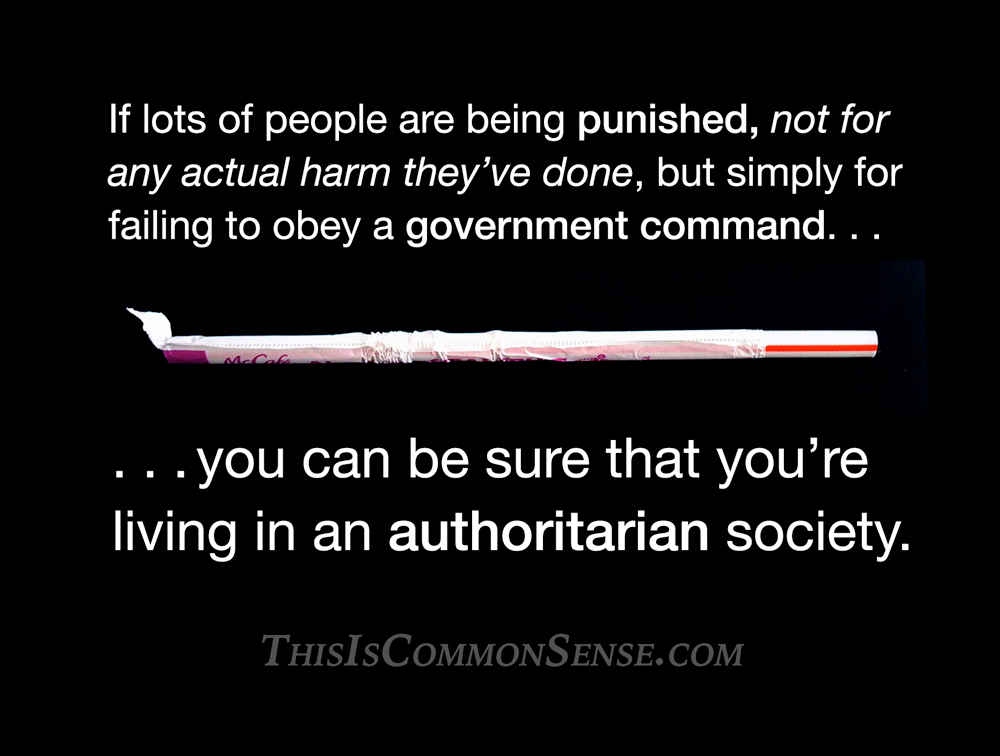
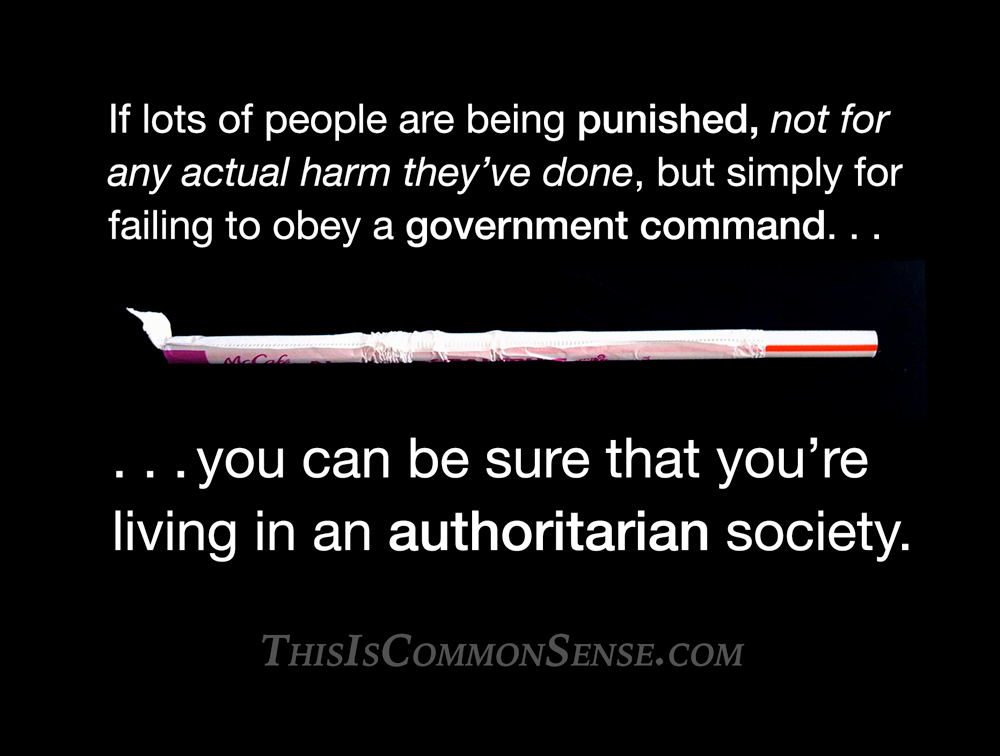
Many people don’t seem to realize that a prohibition (banning something) is AUTHORITARIAN BY DEFINITION. Whether it’s drugs, guns, alcohol, offensive language, dangerous ideas, texting while walking(!), plastic straws(!)… authoritarians are perfectly happy to use government violence to force the rest of us behave as they wish. Because they think they know what’s right for everybody else. They are the authorities. They are the keepers of the truth. For the rest of us, the message is clear: obey or be punished.

The spectacle of people screaming about Trump’s “authoritarianism” while simultaneously demanding more regulations, more bans, more restrictions… would be funny if it weren’t so dangerous.


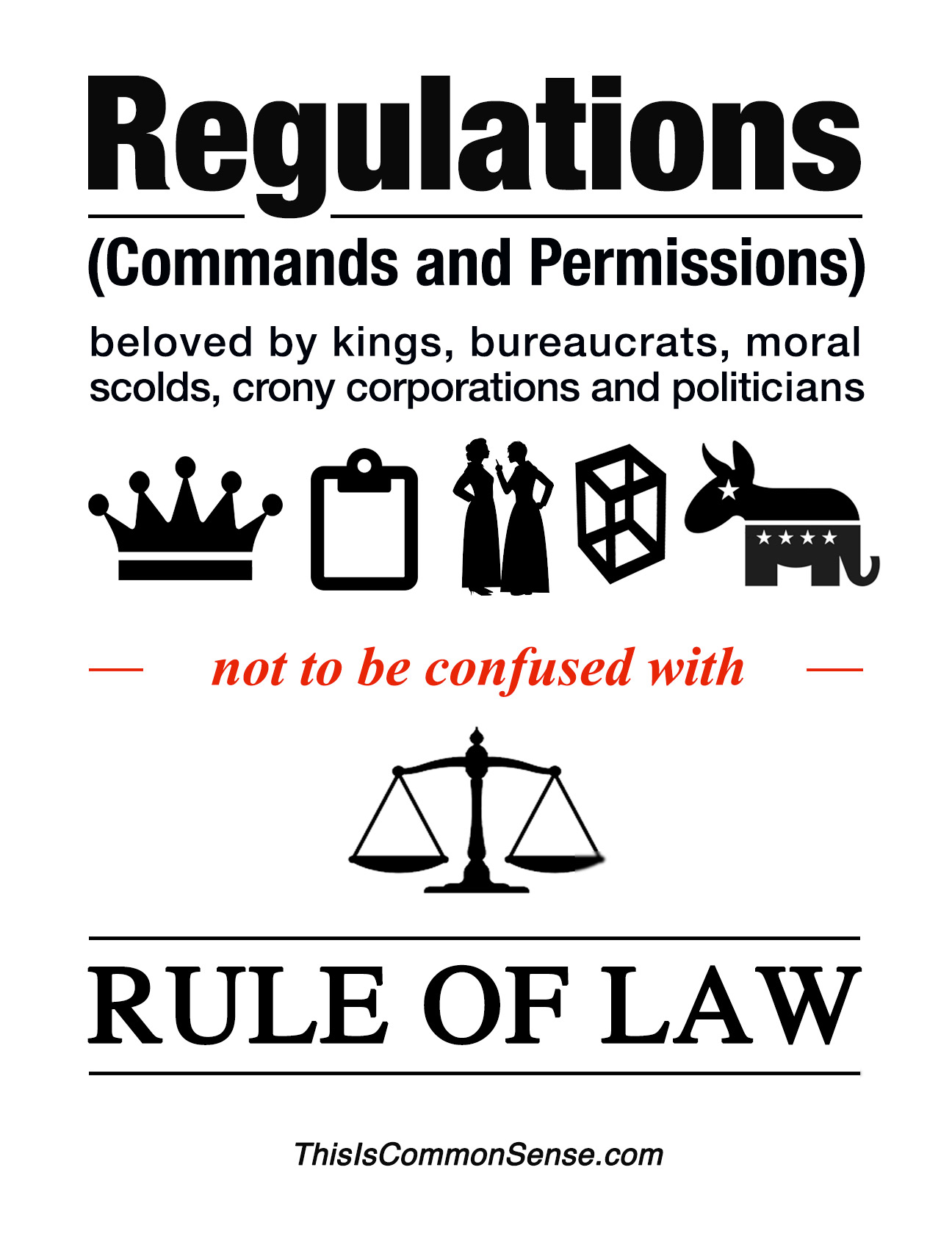
A “rule of law” is based on general principles, and makes room for — or, better yet, is based upon — the protection of individual rights.

It used to be common to say, “a rule of law, not of men”; it was even as common in political oratory as was spouted out over drinks at the Rotary. But as the modern Regulatory State has grown in scope and power, most folks seem to have lost track of the notion. It is now not even a cliché. Few even of our most educated folks can explain this idea. Vast swaths of the mis-educated public appear not to “get” the idea of limiting government to the enforcement of a few general principles; instead, they cry for more “regulations” (along with additional spending and maybe even a whole new division of the executive government) every time a crisis, tragedy or atrocity occurs.

So we are left with a political culture in which the words of Tacitus seem to a majority as implausible at best, evil at worst: “The more the laws, the more corrupt the State.” Contrary to today’s trendy prejudice, we do not need “more laws” — edicts legislated by representatives, or regulations concocted by bureaucracies — we need Law.

As in, “a rule of Law.”

regulations, rule of law, control, freedom

See all recent commentary
(simplified and organized)
See recent popular posts
Categories
meme

An Important Distinction

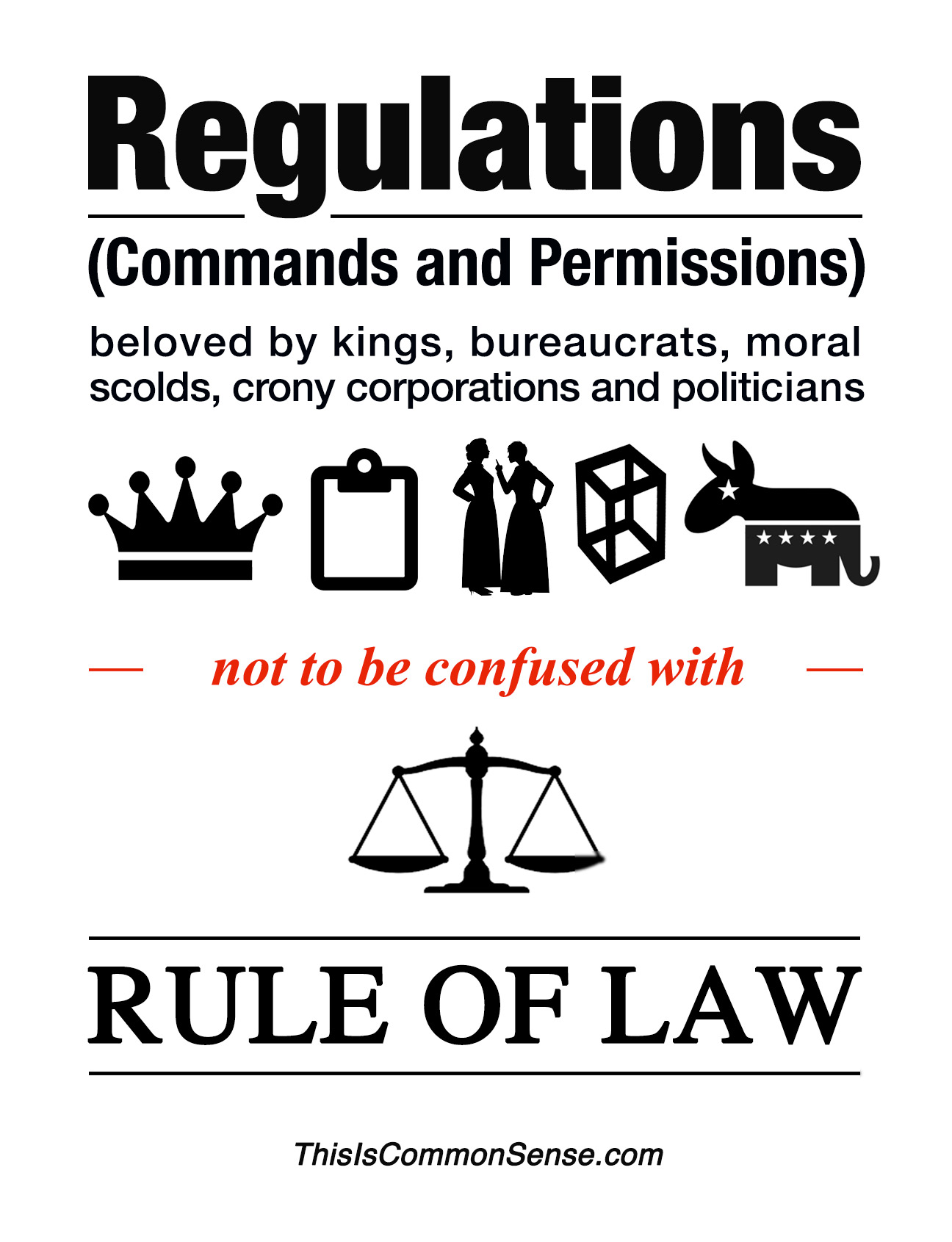
A “rule of law” is based on general principles, and makes room for — or, better yet, is based upon — the protection of individual rights.

It used to be common to say, “a rule of law, not of men”; it was even as common in political oratory as was spouted out over drinks at the Rotary. But as the modern Regulatory State has grown in scope and power, most folks seem to have lost track of the notion. It is now not even a cliché. Few even of our most educated folks can explain this idea. Vast swaths of the mis-educated public appear not to “get” the idea of limiting government to the enforcement of a few general principles; instead, they cry for more “regulations” (along with additional spending and maybe even a whole new division of the executive government) every time a crisis, tragedy or atrocity occurs.

So we are left with a political culture in which the words of Tacitus seem to a majority as implausible at best, evil at worst: “The more the laws, the more corrupt the State.” Contrary to today’s trendy prejudice, we do not need “more laws” — edicts legislated by representatives, or regulations concocted by bureaucracies — we need Law.

As in, “a rule of Law.”

straw, regulations, law, punishment, punish, authoritarian society

Are you truly free?


See all recent commentary
(simplified and organized)
See recent popular posts
Categories
free trade & free markets too much government

San Francisco Obstructionism

Bob Tillman wants to build a 75-unit apartment building in San Francisco.

He owns the property — a laundromat. He just wants to convert it. But although there are no good reasons why he shouldn’t, city officials and activists opposed to the property rights of developers have been blocking the project. Tillman has spent years and hundreds of thousands of dollars just trying to get started.

His plight “encapsulates the political dysfunction that’s turning San Francisco . . . into an exclusive playground for the ultra-wealthy,” says Reason magazine.

Because of the government’s general antagonism to development, and specific policies such as rent control, much less housing is getting built in the city than would have been possible in a fully free market.

The population is growing quickly, but housing isn’t keeping up. Which results in unnecessarily high rents and housing prices.

None of this is shocking if you understand basic economics. The greater the supply of a good, the cheaper the price tends to be — all other things being equal. That qualification is important. If the supply of oranges doubles but everybody suddenly starts an all-orange-juice diet, orange prices may remain the same or even rise — but less than the price would have risen without the greater supply.

Many factors, including monetary factors, can affect the price of a good. All I’m saying is that if you want the benefits of more housing, including rents that are lower than they would have been without the new housing, you must build houses and apartment complexes.

Stop something from being built and, unfortunately, it won’t be there.

This is Common Sense. I’m Paul Jacob.


PDF for printing

San Francisco, homeless, zoning, housing, regulations
Photo by Mussi Katz

See all recent commentary
(simplified and organized)
See recent popular posts

Categories
initiative, referendum, and recall insider corruption term limits

Corruption, Arkansas-Style

On Friday, the Arkansas Supreme Court struck Issue 3, a citizen-initiated measure to restore legislative term limits, from Arkansas’ November ballot. The Court declared, 4-3, that there weren’t enough “valid” signatures.

This, despite opponents never disputing that more than enough Arkansas voters had signed the petition.

In recent years, legislators have enacted a slew of convoluted laws, purposely designed to wreck the initiative and referendum process.* The regulations give insiders and partisans a myriad of hyper-technical “gotchas” that can be used to disqualify whole sheets of bonafide voter signatures.

“The legislature,” explained former Governor Mike Huckabee recently, “sucker-punched the people of Arkansas and expanded their terms. They did it, I think, very dishonestly — by calling it an ethics bill . . . that had nothing to do with ethics. It was all about giving themselves longer terms.”

Since getting away with that 2014 ballot con job, giving themselves a whopping 16 years in office, seven Arkansas state legislators have been indicted or convicted of corruption. The author of that tricky ballot measure, former Sen. Jon Woods, just began serving an 18-year federal prison sentence for corruption.

Other corruption, that is.

“It’s one reason I think term limits are a very important part of our political system today,” said Huckabee. It is, he argued, “easier to get involved in things that are corrupt the longer you stay.”

Now, sadly, after 2014’s fraudulent ballot measure and two 4-3 state supreme court decisions neutering the entire ballot initiative process, political corruption can continue unabated in the Natural State. 

This is Common Sense. I’m Paul Jacob.


* The state supreme court has ignored the clear language in the state constitution regarding such petitions: “No legislation shall be enacted to restrict, hamper or impair the exercise of the rights herein reserved to the people.”

N.B. For relevant links, check yesterday’s splash page for this weekend’s Townhall column.

PDF for printing


Categories
Accountability folly general freedom media and media people Second Amendment rights too much government

Simplistically Wrong

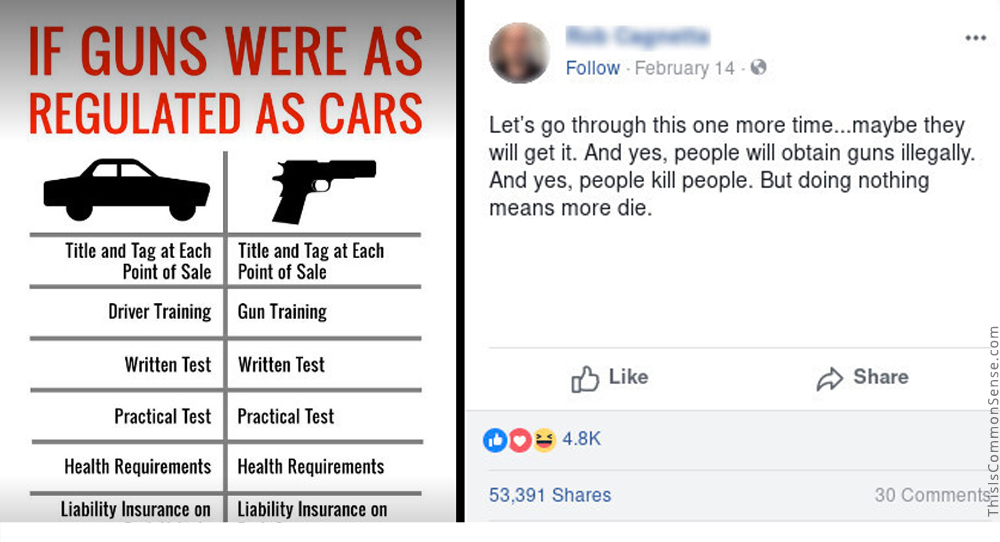
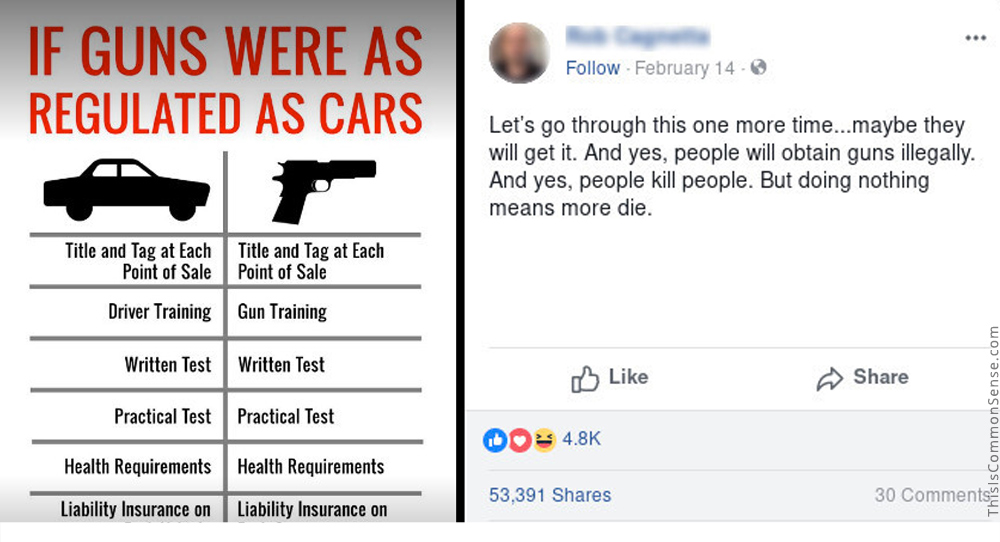
A clever “meme” made the rounds earlier this year showing, in two columns, what it would be like were guns regulated like cars.

How reasonable that would be!

“Title and tag at each point of sale”; “Driver training”/“Gun training”; Liability insurance on each vehicle/gun”; etc. It seems sound, no?

No.

The memester failed to address a context: our car and driver regulations apply to vehicles and drivers on government-run roads. On your own property you can drive all sorts of vehicles, unregulated. And it is on their own property that most gun owners’ firearms stay most of the time.

So, treating “guns like cars” would put government deeper into our private affairs.*

The meme came into an economist’s view packaged under the slogan “doing nothing means more people die.” He saw problems. For example, “someone might propose that each person above the age of 10 years old be interned in a mental-health camp, until and unless experts appointed by the state certified that he or she was not a danger to society.”

Same logic — we cannot do nothing, can we?

Another economist dubbed the problem we have identified here as “a simplistic model of public policy.” Policy advocates tend to assume that if you change a policy we get only one effect. Not true.  

A third economist (I’m going for a trifecta!) discovered that even adding safety features to cars comes at a cost in human life: feeling safer, drivers compensate . . . and it is non-drivers who suffer. More drivers hit more pedestrians.

Be cautious when you drive, sure. Be cautious when you shoot, of course.

But be cautious, especially, when you prescribe new laws.

This is Common Sense. I’m Paul Jacob.


* Not to mention that gun rights are specifically enshrined in the Constitution and vehicle rights . . . not so much.

PDF for printing


Categories
Accountability crime and punishment folly free trade & free markets general freedom media and media people moral hazard nannyism national politics & policies property rights Regulating Protest too much government U.S. Constitution

That Something You Do

Congress grilled Facebook CEO Mark Zuckerberg, last week, and as usual ended up roasting itself.

“Zuckerberg has already experienced the worst punishment of all,” quipped comedian Trevor Noah on The Daily Show. “He had to spend four hours explaining Facebook to senior citizens.”

Utah Sen. Orrin Hatch, retiring after his 42nd consecutive year in Washington, asked, “How do you sustain a business model in which users don’t pay for your service?”

“Senator,” Zuckerberg incredulously replied, “we run ads.”

Inc. magazine reported the obvious: “several of our elected leaders asked questions that were highly uninformed, or in some cases just plain weird.”

Uninformed. Weird. That’s them, alright.*

Still, the Washington establishment seems to seriously think these same congressmen ought to be re-writing privacy rules.

“Elected officials know the public wants them to do something to protect their privacy,” announced Chuck Todd, host of NBC’s Meet the Press. “The question now turns to what is that something?”

“Americans are largely together on this issue,” Todd said, citing a recent poll where a similar “66 percent of Democrats and 68 percent of Republicans say they want more control over the information companies have about them.”

But Democrats and Republicans are together on something else: Only 21 percent of Democrats and a tiny 14 percent of Republicans “trust the federal government” to act on the issue.

The senators, though obviously “confused about basic topics,” Emily Stewart wrote at Vox,  “seem to agree they want to fix something about Facebook. They just have no idea what.”

Please Congress: DON’T “do something.” Don’t do that thing you do.

This is Common Sense. I’m Paul Jacob.


* Reason TV has a very funny video on the Zuckerberg hearing.


PDF for printing


Categories
Accountability education and schooling free trade & free markets general freedom local leaders national politics & policies responsibility too much government

SEZ Ed

The great barrier to educational advance in our time is the federal government. The second great barrier? Your state government. The third great barrier? Your local government.

Proposals to break up government-subsidized and -enforced school monopolies have ranged from tax credit proposals and voucher programs to charter schools and (the biggest success so far) home schooling.

But it may be time to advance something a little . . . more daring. Break the stranglehold of government on dysfunctional schooling.

How?

Apply the “free trade zone” (FTZ) idea to education.

We remember the FTZ proposal because of its rise in popularity amongst academics and policy wonks in the 1980s and 1990s. But the notion is an old one. And in China, where they are called “special economic zones” (SEZs) — and it is this term that is catching on — they have been amazingly successful, the former fishing village of Shenzhen being the most obvious example.

What about America? Take a devastated region, like inner-city Chicago or Detroit,* and simply nullify the regulations and rules. (This probably would require federal enabling legislation on top of state leadership.) With the ensuing freedom and opportunity, entrepreneurs, established businesses and schools, teachers, community groups and activists could cook up new solutions to the oldest schooling problem there is:

actual education.

I’ve heard whispers of this Educational SEZ idea for some time now.

It is time for rational and quite public discussion.

And then the shouting.

This is Common Sense. I’m Paul Jacob.


* Of course, any area could work. The reason to focus on demonstrably failed educational regions is that such areas have lost hope, and thus the politically resistant are likely to give in and allow it.


Printable PDF


Categories
First Amendment rights folly general freedom moral hazard nannyism responsibility too much government

Legal Not to Lie About Your Milk

Mary Lou Wesselhoeft doesn’t have to lie about the milk she’s selling. The Florida Department of Agriculture has lost in court. Mary Lou has won.

Ocheesee Creamery sells pasteurized milk without any additives. One of her products is skim milk. Ocheesee sells skim milk without vitamin additives, which is perfectly legal to do. But the Florida government claims that only skim milk with the additives counts as real “skim milk,” the kind you can call skim milk in speech to customers. (Kafka, did you write this horror story? Fess up!)

Give credit to the judge who asked: “Can the state, consistent with the First Amendment, take two words out of the English language and compel its citizens to use those words only as the government says?” The reply of the government’s lawyer? “Yes.”

Creepy.

Mary Lou’s victory is also a victory for all Americans who want to exercise their right to tell the truth about what they’re selling. And it’s a victory for the Institute for Justice, which took up the case on her behalf. At its website, IJ points out how easy it would be to annihilate freedom of speech by letting the government redefine words at will. We’re not free if our freedoms can be arbitrarily defined away by the people in power.

The Institute specializes in defending our rights against senseless government intrusions. Until such laws and regulations are repealed, it seems that the Institute will always have much to do — unfortunately. But, fortunately, it keeps on doing it.

This is Common Sense. I’m Paul Jacob.


Printable PDF