Categories
Accountability general freedom ideological culture media and media people moral hazard national politics & policies

Don’t Trump the Gun

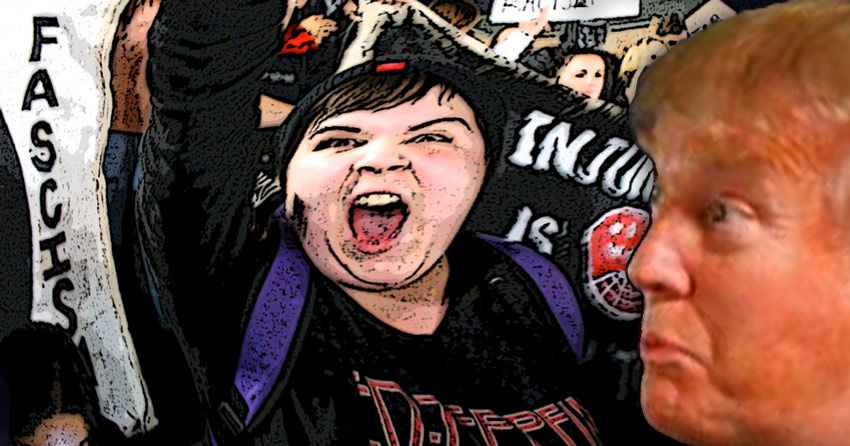
The 2016 presidential election will go down in history as a doozy. The Trump win was a surprise, even shocking many of his supporters. But the most obvious lesson we learned pertains to the modal Obama-Hillary voter.

Well, make that lessons. Plural.

  1. Today’s most vocal Democrats don’t seem to understand democracy. The “deal” of our democratic republic, as I learned in Civics and “on the streets,” is that you do your best for your party, candidate, or policy, and accept the results . . . until the next election. Whiners, rioters and Hollywood actors (to place them in descending order of tolerability) would serve their cause better by remembering this.
  2. It has become commonplace, now, to make sweeping judgments about one’s opponents based on little or no information. Or erroneous info. On no basis whatsoever, nearly every lefty YouTuber and street shouter I have seen yammers on about how anti-gay Trump is. Truth is? No president has ever entered the White House more pro-gay than Donald J. Trump.
  3. Actual policy issues mean too little to too many. What does matter? Style. Obama has “good style.” Bush had “dumb style.” Trump has “evil style.” Substance? Results?

Blankout.

Tomorrow the President-elect becomes President. And Resident of 1600 Pennsylvania Avenue*. As skeptical as some of us may be (myself included), we owe it to ourselves, our neighbors, and the country — perhaps the world — to give the president a chance. At least, take a deep breath and let him make a mistake before pouncing.

Meanwhile, let’s also stop denigrating half the country — that is, those who voted for Trump. Consider their alternative.

This is Common Sense. I’m Paul Jacob.


* Part-time? Will he really spend a lot of time in Trump Tower?

Printable PDF

Trump, president, inauguration, democracy, election, protest


Categories
government transparency ideological culture national politics & policies U.S. Constitution

A Funny Thing Happened on the Way to a Reform

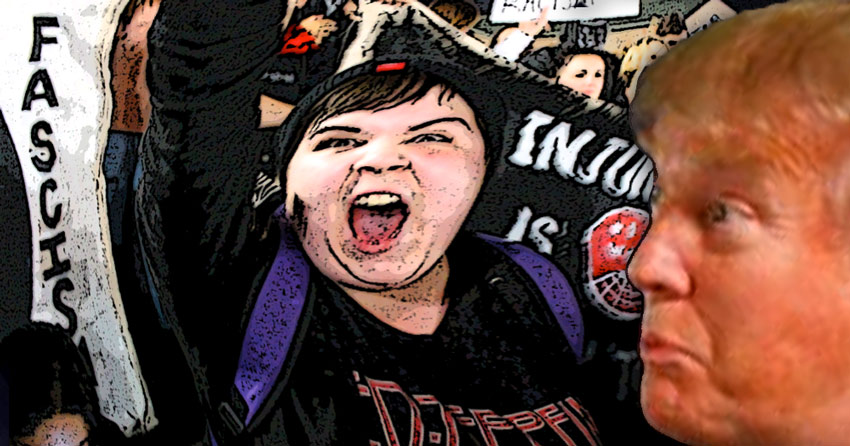
Going into the presidential race, last year, Donald Trump was far from a typical Republican.

His rich man braggadocio, his prior support for abortion, and much else, put him culturally at odds with the social conservative wing of the GOP. He dared heap scorn on neoconservative foreign policy strategy, sacrosanct since Reagan on the right. He has supported many Democratic programs, not the least of which is the Gephardtian protectionism that pulled in so many moderate Democrats.

Besides, as he has famously stated, Democrats loved him, asked him for money, and (not coincidentally) gave him praise . . . right up until he started his campaign under the Republican banner. Then he was excoriated as sexist, racist, xenophobic, Ugly Americanist. Ivanka, his eldest daughter — extraordinarily close to him — was a registered as a Democrat recently enough that she couldn’t even vote for him in the primary.

Ideologically, he has been all over the map.

So one might reasonably think he would govern as a centrist. A non-humble Jimmy Carter retread, perhaps.

But he has assembled the most conservative cabinet in our lifetime. Far more conservative than Ronald Reagan’s. Predictably, Democrats are freaking out.

Why the move “rightward”?

Well, if all the Democratic leadership plus most of the moderate Republican leadership have come out strongly against you — in high moral dudgeon — what point is there to appease them?

The cost of the Trump anathematization strategy may become all too clear in Trump’s first Hundred Days.

This is Common Sense. I’m Paul Jacob.


Printable PDF

Trump, protest, conservative, centrist, right, illustration


Categories
links

Townhall: Mass Protests Against Massive Failure

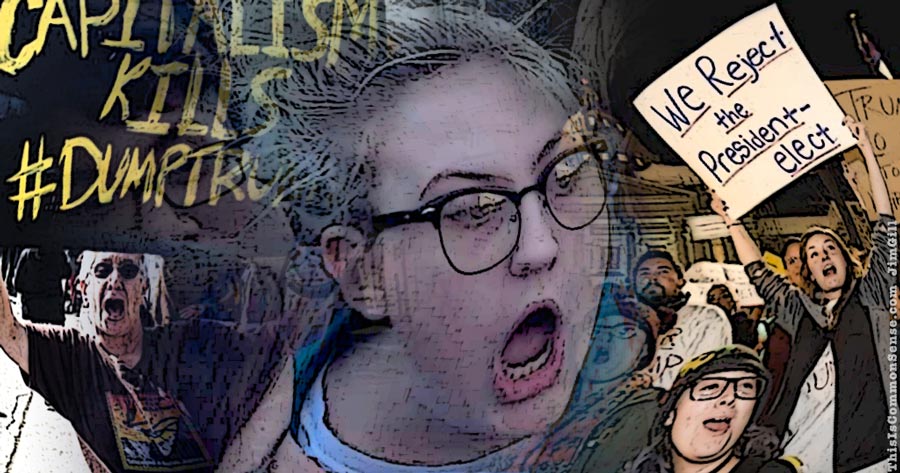
Millions of people, around the world, are taking to the streets, to protest . . . what?

Could they possibly have legitimate gripes? Yes. Do they? Mostly. Will the protests do any good? Open question.

All this and violence, too, at Townhall.com. March on over, then rush back here for more reading.

Categories
insider corruption political challengers too much government

Protesting “Capitalism”?

While Americans appear mildly unsettled or perhaps “ticked off” about recent government revelations, elsewhere in the world citizens move from “unease” to “unrest” and outright “protest.”

The protests that erupted first in Turkey and now in Brazil and elsewhere are filled with the ranks of the young, not a few of whom have noticed something: They are getting a raw deal.

Many of their issues are meat-and-potatoes: lack of jobs, burdensome student debts and, in Brazil, a bus fare rate increase made ugly in the context of cost overruns in taxpayer support for the World Cup and Olympics.

The young Turks protested, at first modestly, over planning for a park, but a harsh police crackdown led to more widespread marches, sit-ins, and demonstrations — which now often bring up questions of the current administration’s repressive anti-modernist, anti-freedom agenda.

This more heroic theme resonates elsewhere, too.

In Bulgaria the issue most protested appears to be police brutality and the general spirit of repression. In Latin America, opposition to corruption has moved from old stand-by to vital question of the day.

The saddest statement I heard was this appraisal, hailing from the BBC, of the general climate: “today capitalism is becoming identified with the rule of unaccountable elites, lack of effective democratic accountability, and repressive policing.”

Well, that’s not laissez faire capitalism that’s failed, but crony capitalism. Laissez faire’s truly free markets require a rule of law, the suppression of government corruption, and effective public accountability.

But that’s not what’s dominant. America itself serves, today, not as a beacon of liberty but of institutional control, of crony capitalism.

We need to protest that here, again, in the U.S.

This is Common Sense. I’m Paul Jacob.

Categories
ideological culture too much government

Better Late Than Never?

“Too little, too late.” I am not alone to suspect that the Occupy movement — the 99 percenters — started its protest against corporate greed and government cronyism several years too late.

Where were the Occupiers when the Tea Party protests started?

Dancing in the streets over the Obama presidency? Many Occupiers may have lagged because they thought that “their man” could and would clean up corruption and make Washington work for the everyone — or at least the “middle class.”

The “too late” charge can be directed against the Tea Party, though — and has been, repeatedly. The Tea Partyers waited to organize until a liberal Democrat was in the White House, one who saw Bush’s big government and, well, raised it.

Many would admit, later, how not “theirs” Bush was. Still, few protested Bush’s big government push.

To the Tea Party’s credit, it was first — kicked off by Rick Santelli’s CNBC “tea party rant” in early 2009, against the upsurge of bailouts for banks, car companies, home-buyers, you name it, as well as the very idea of government stimulus. (Though I ranted earlier.)

The time to protest cronyism and corruption in American government? The moment one opens one’s eyes to political reality.

Maybe the great age of protest has finally come.

I hope it’s not too late.

It always seems like citizens should have stood up to abuse of power sooner, but being late to the action is no excuse not to stand up now.

This is Common Sense. I’m Paul Jacob.

Categories
First Amendment rights

We Protest

You don’t need to commit violence to conduct a large, effective public protest of perceived injustice. The many Tea Party demonstrations against our federal government’s latest socialist excesses prove that.

But what if violent and nonviolent protests are equated in the minds of peace keepers?

In Reason magazine, journalist Radly Balko reports on several disturbing examples of crackdowns of persons assembled in a public place. In one incident, motivated by the occasionally violent protests of last fall’s G-20 summit in Pittsburgh, police ordered students gathered in public to disperse forthwith, though they had broken no laws. Anyone who moved too slowly was subject to arrest. Apparently, a few violent protesters hit town for the summit, but they were a distinct minority.

Balko isn’t impressed by a university official’s claim that the gatherings had to be busted up because of the “potential” for trouble. That’s a dangerous standard to apply to peaceful assembly that is not only constitutionally protected but also an important bulwark against tyranny.

Police can make honest mistakes like anybody else, especially when in charged and confusing situations. No doubt there’s sometimes a fuzzy line between a peaceful if rowdy protest and one that’s turning violent. But Balko suggests that police are increasingly harassing and handcuffing people only because they are peacefully dissenting.

Not only is that not right, it demands protest.

This is Common Sense. I’m Paul Jacob.

Categories
Accountability national politics & policies too much government

Enough at Tea Time

On April 15, more than 2,000 Tea Parties were held across the country, many with thousands in attendance. These weren’t dainty luncheon ceremonies. They were protests, named after our revolutionary Boston Tea Party.

In Washington, D.C., it rained like the dickens, but people still came out to say “Enough.” Regular folks sounded off. They work hard, and they’ve had enough of paying the bills for politicians and favored political interests.

Some big media personalities and major political figures showed up. Governor Rick Perry of Texas spoke at the Austin, Texas event. He’s called the federal government “oppressive.” In South Carolina, Governor Mark Sanford told folks that “Real change begins in the hearts and minds of people who are willing to stand . . . against an ever-encroaching government.”

Meanwhile, much of television news media behaved badly, trying to marginalize or even demonize the protests as “anti-government.” CNN correspondent Susan Roesgen was particularly argumentative, suggesting to one guy that he should be grateful for the $50 billion President Obama was sending to his state.

When a woman protester accused Roesgen of slanted coverage, she asked the woman why she was there. “We’re here,” the woman responded, “because we are sick and tired of the government taking our money and spending it in ways that we have no say in. We have no say whatsoever.”

And that’s what has to change. The people must be heard. Not just on one day, but every day.

This is Common sense. I’m Paul Jacob.