Categories
general freedom individual achievement media and media people national politics & policies responsibility

Red Roadster Rides Outer Space

On Tuesday, SpaceX launched one of the largest rockets ever, the Falcon Heavy. Because it is still experimental, it didn’t carry up an expensive satellite. Too early for that. Instead, it has sent up a Tesla Roadster.

And it’s not aiming for orbit . . . around Earth.

It’s aiming for, well, “a precessing Earth-Mars elliptical orbit around the sun.”

All the while playing the late David Bowie’s “Space Oddity.”

This is all very bizarre, of course. But SpaceX is headed by Elon Musk, who is one of those daring people who do daring things. The very fact that he kept finding funding (no small amount of it from taxpayers, sadly) for Tesla Motors (which he also founded), while failing to make a profit, is a tribute to . . . something.

Sending Musk’s personal car into space — to circuit Sol for a billion years — is, the visionary says, at least not boring. (Musk, perhaps not coincidentally for that word choice, also founded the Boring Company.) The Roadster, “piloted” by a dummy “Starman,” is an upgrade with flair.

But who is he playing to? The masses of auto buffs? Stargazers? Science fiction fans?*

Maybe the mad-scientist/eccentric-mogul is playing for bureaucrats, Capitol Hill staffers, and politicians. For, by one estimate, his companies have received $4.9 billion in government subsidies.

So, think of what’s going into orbit as just another part of the skyrocketing — spacerocketing — federal debt.

This is Common Sense. I’m Paul Jacob.


* The odd payload choice might make sense in sci-fi context, for, in the early days of science fiction, one idea often mentioned was to literally send a bomb to the Moon: an explosion, after all, could be seen, in early Space Age days, with old technology right here from Planet Earth surface. This was the case in the boys’ book The Rocket’s Shadow as imagined in 1947.

PDF for printing


Categories
Accountability ideological culture media and media people moral hazard national politics & policies responsibility term limits too much government

The Politics of Inertia

Congress’s failure to establish, last week, any semblance of budgetary responsibility led to one of those “government shutdowns” that the press likes to yammer about so breathlessly.

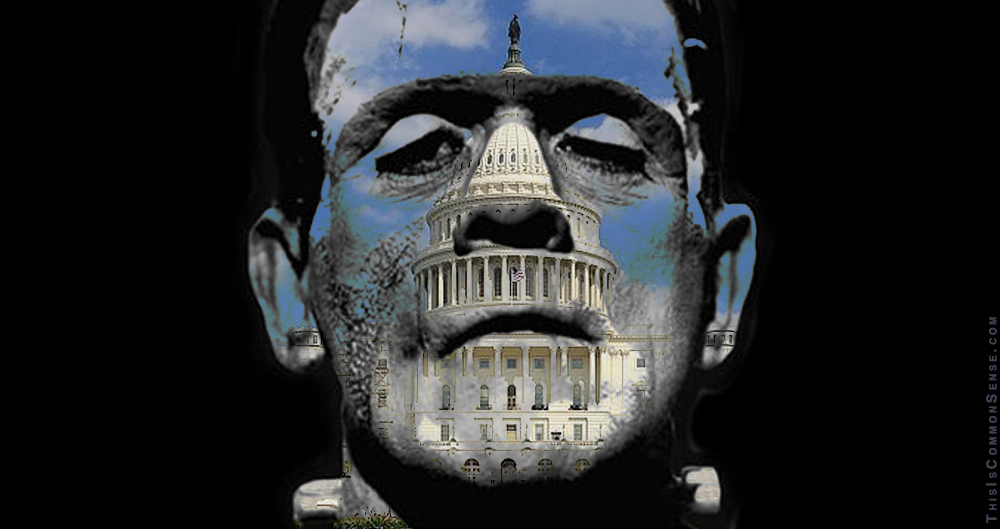
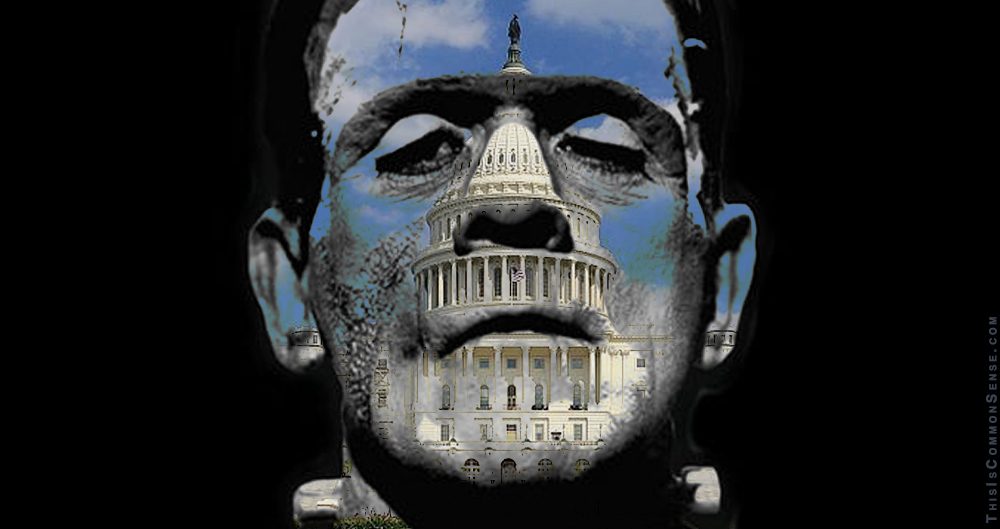
Then, early this week, Senate holdouts caved, allowing a short-term fix to bring the federal government fully back to life, like the monster in Dr. Frankenstein’s lab given a defibrillator jolt.

Usually these government shutdowns are caused by Republicans not playing along — Obamacare being the sticking point most recently — but this time the desperate negotiators were Sen. Chuck Schumer (D -NY) and his Democrat gang, whose “heroic” stance was all about immigration reform and “the Dreamers.”

After they folded, and the Monster was bequeathed new life, CNN’s Brooke Baldwin asked former Democratic National Committee chair Rep. Debbie Wasserman Schultz what her party had gained from its temporary obstructionism.

Her answer? “Potential for momentum.”

That had to be one of the more bizarrely drawn happy faces over complete and utter failure that we have witnessed since . . . well, the last one.

Even Ms. Baldwin was incredulous.*

The Democratic Party’s disarray is astounding. If any party has momentum on its side, it is the party of Andy Jackson and William Jennings Bryan, the party of the elitist media, insider government and the Deep State, and the resistance to Trump.

So why its current pathetic fortune? Because the Democrats have rested so long upon their “momentum.”

Inertia can sure have its downside.

On the “bright side,” Democrats will have occasion to revisit this, for no real budget has been established. All Congress even tries to do these days is provide temporary fix after temporary fix.

Call it potential for catastrophe.

This is Common Sense. I’m Paul Jacob.


* The CNN anchor may have been nonplussed by the specter of entropy in the odd Newtonian metaphor.


PDF for printing


Categories
Accountability crime and punishment First Amendment rights general freedom government transparency local leaders moral hazard Regulating Protest too much government U.S. Constitution

Lock Her Up

“Who Are We?” I asked Sunday at Townhall.com.

Today’s question: What have we come to?

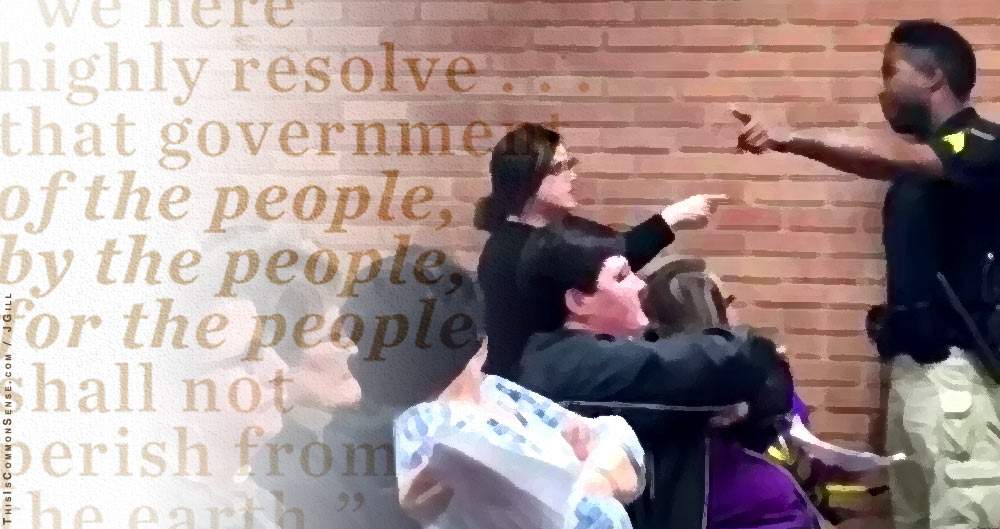
Under a seemingly click-bait headline in The Atlantic, “Can Government Officials Have You Arrested for Speaking to Them?” Garrett Epps examines last week’s outrageous handcuffing and arrest of a Louisiana teacher, Deyshia Hargrave, for speech displeasing to the Vermilion Parish school board at a public meeting.

The elementary school teacher complained about a $30,000 raise the board was giving the superintendent, noting that teachers had not seen an increase in nearly a decade. After asserting that the raise would be “basically taken out of the pockets of teachers,” she was ruled out of order by the school board president and then asked to leave the premises. She calmly left the meeting room . . . only to be forced to the floor, handcuffed and arrested once in the hallway.

Police claimed the arrest was for “remaining after having been forbidden” and “resisting an officer.”

The school district announced it won’t press charges. Very funny. Anyone can see from the video that her treatment was excessive.

Next month, the U.S. Supreme Court will hear oral arguments in Lozman v. Riviera Beach, Florida, where an arrest was clearly retaliatory, but the city is newly claiming another violation it could have used to arrest Mr. Lozman.

Does this after-the-fact adding on of charges provide governments with an escape clause? As Epps argues, a Lozman decision “could either rein in, or embolden, the tiny-handed tyrants who rule county buildings and city halls around the country.”

If respectfully challenging our so-called public servants in meetings designed for that can lead to being arrested, handcuffed and dragged off, we no longer live in ‘the land of the free.’

This is Common Sense. I’m Paul Jacob.


PDF for printing


Categories
Accountability folly government transparency local leaders moral hazard porkbarrel politics responsibility too much government

Babylon Goes Broke

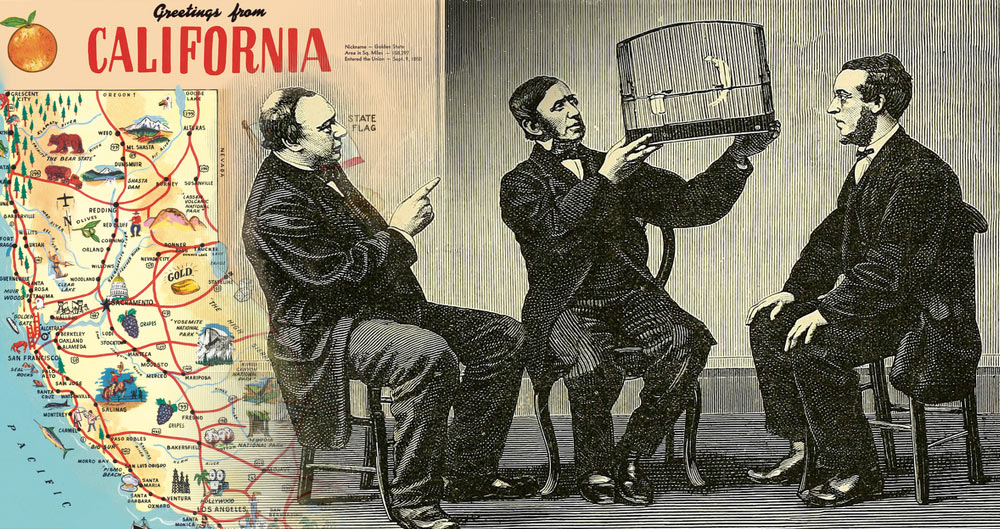
A few Babylonian, er, California cities going bankrupt — Stockton, Vallejo, and Bell — should be seen as more than dead canaries in a coalminer’s care.

Indeed, you don’t need special prophetic gifts to see the dangers posed by over-promising cushy pensions to government workers. Californians are coming around. And the state’s governor, Jerry Brown, appears to be “calling for reductions in gold-plated, unsustainable public-sector pensions,” as Nick Gillespie informs us at Reason.

But statewide reforms will not be easy. The problem is huge, presenting grave costs. “Absent the ability to alter pensions, states and localities have to devote more and more of their taxes to simply covering the costs of retired workers,” Gillespie explains. “Worse still, they often raise taxes to cover rising costs, typically at the expense of providing basic services such as police and road maintenance.”

Yes, over-promising defined-benefit pension packages effectively distributes wealth away from basic government services and into the pockets of the people with whom politicians work most closely.

Unfortunately, the courts long ago decided that politicians’ promises to employees outweigh basic government duties. That is, the courts determined that “public-sector employees at all levels of government had an inviolable right to the pension benefits that existed on the day they were hired.”

But the courts seem to be lightening up on this “California Rule,” and the governor has dared mention that, come “the next recession,” some headway might be possible.

No matter what you may think of this rather desperate hope, the writing is on the wall. And it is in red ink and numbers, not Babylonian.*

As America’s Babylon is finding out.

This is Common Sense. I’m Paul Jacob.


* And not “Mene, Mene, Tekel, Upharsin.”


PDF for printing


Categories
Accountability crime and punishment general freedom moral hazard nannyism national politics & policies Second Amendment rights too much government U.S. Constitution

Government Control

When do we say enough is enough?” asked California Senator Kamala Harris after Devon Patrick Kelley murdered 26 churchgoing Texans in cold blood, last Sunday.

“The terrifying fact is that no one is safe so long as Congress chooses to do absolutely nothing in the face of this epidemic,” argued Connecticut Senator Chris Murphy.

President Trump, on the other hand, not only pointed out that criminals will violate gun laws to acquire weapons, he speculated that had Stephen Willeford, the former National Rifle Association instructor, not come upon the scene, armed, “instead of having 26 dead, you would have had hundreds more dead.”

After previous mass shootings, Democrats pushed legislation that, even if it had been the law, would not have prevented that particular killer from obtaining the weapons. This time it’s different, since the killer should not, by current law, have been allowed to purchase the firearms he used. Kelley’s conviction for domestic violence, while serving in the Air Force, disqualified him.*

But the Air Force did not do its job, failing to report his record to the FBI. So the background check found . . . nothing.

The Pentagon has known for at least two decades about failures to give military criminal history information to the FBI,” the Associated Press informed, “including the type of information the Air Force didn’t report about the Texas church gunman.  . . .”

The Obama administration, through its command of the military, failed to execute the law designed to keep guns out of dangerous hands. And it sounds like this failure dates back to Bush and Clinton days.

Where does the buck stop?

We don’t need gun control; we need government control.

This is Common Sense. I’m Paul Jacob.


* Note also that the murderer, as Ben Shapiro recounted at National Review: “escaped from a mental institution in 2012, threatened his superior officers and attempted to smuggle weapons onto a military base to carry out those threats, cracked the skull of his infant stepson, beat his wife, abused a dog.”


PDF for printing


Categories
Accountability crime and punishment free trade & free markets general freedom ideological culture moral hazard nannyism national politics & policies property rights responsibility too much government

The Owners of Twitter Have Rights

Roger Stone is suing Twitter for kicking him out.

Without saying exactly why they booted him, Twitter implies that the reason is abusive language. For his part, Stone accuses the social media giant of targeting right-wing tweeters while letting left-wing tweeters off the hook for the same or worse alleged wrongdoing.

I’ll stipulate that Stone is justified in accusing Twitter of rank, ideologically motivated hypocrisy in applying its micro-blog policies. But he’s wrong to sue.

As I have argued before — indeed, just yesterday — government should not regulate Internet forums and should not compel Twitter or other firms to provide a soapbox for anybody else. The only relevant legal issue here is whether Twitter has violated a contract. But Twitter does not agree to let anyone use its services unconditionally. And I don’t think that Stone is alleging any violation of contract.

Our right to freedom of speech does not include the right to force others to give us access to their property in order to exercise that freedom. Nor do the rights of any individuals to use and dispose of their own property disappear if they happen to create a very big and successful enterprise. There are many ways to try to make Twitter pay for bad policies without using force against the company, including boycott and direct competition.

I agree with the guy who said that one’s right to freedom is not contingent upon a guarantee “that one will always do the right thing as others see it.”

This is Common Sense. I’m Paul Jacob.


PDF for printing


Photo by Nigel on Flickr


Categories
Common Sense

The Immovable Non-movers

You can’t suspend the law of gravity. Nor, apparently, the laws of bureaucratic lethargy and inertia.

Diana Rickert was a policy analyst with the Illinois Policy Institute who accepted a job with the administration of Illinois Governor Bruce Rauner.

She lasted six weeks.

The assignment: combine and streamline several governmental departments. After years of “railing against government,” she felt she must accept this opportunity to improve government from the inside. Or else forever wonder whether she might have made a difference.

She’s learned her answer. She could not. Not as an insider. Not without the authority, at a minimum, to fire useless employees, who abound in Illinois’s state government.

And whose uselessness doesn’t always preclude outrageous expectations about salary and position.

Whether trying to get working computers or to get workers to work on simple but unfamiliar tasks, Diana and the few others eager to get stuff done were constantly thwarted by the apathy and sense of entitlement of the majority — and by endless arcane and senseless rules. Rather than imply tacit acceptance of such a broken, unfixable system, she resigned.

All this sounds familiar, an inevitable feature of government bureaucracy with its glued-in vested interests and lack of market-style profit incentives. Old news if you’ve ever been to the DMV.

So what’s the answer? Give up?

No. Illinois is “ready for change,” Diana Rickert says. But it’s outsiders who will have to change it — from the outside . . . “because the insiders never will.”

This is Common Sense. I’m Paul Jacob.


PDF for printing


Categories
Accountability ballot access general freedom government transparency ideological culture initiative, referendum, and recall insider corruption local leaders national politics & policies property rights Regulating Protest responsibility too much government U.S. Constitution

The Great Faction

Politics isn’t a pretty business.

Frédéric Bastiat called the beast it serves “that great fiction” not because it doesn’t exist — intrusive state power sure persists — but rather because what it promises cannot really happen: “everyone living at the expense of everyone else.”

What can we do? How do we counteract a game that is rigged to increase the insanity, not reduce it?

Last week I indicated one thing a minor party with that goal in mind could do: use its power of spoiling elections to change major party behavior, and thus give citizens a fighting chance to restrain governmental metastasis.

Cancer.

I also suggested “blackmailing” the major parties into setting up a system of voting that . . . ends the power to blackmail! I believe that system — ranked choice voting — holds many positives, not the least of which is ending strategic voting, wherein voters are tempted to “falsify” their own preferences and support candidates they might dislike. This is as corrupting to the citizenry as the Great Fiction itself.

Let’s hope a savvy minor party leverages the major parties, gaining reforms to improve the system. Regardless, we can all — independently — push two other limits on political power:

  1. term limits at all levels, and
  2. initiative and referendum rights in all the states, not just the 26 that have it now.

Initiative and referendum rights would give ordinary citizens the leverage to possibly restrain the mad rush to live at each others’ expense. With the initiative, citizens can gain term limits, which produce more competitive legislative elections and lead to fewer legislators captured by the interests loitering in the capitol.

This is Common Sense. I’m Paul Jacob.


PDF for printing


Categories
Accountability general freedom national politics & policies responsibility too much government

It Didn’t Last

“September 11 is one of our worst days but it brought out the best in us,” proclaimed Tennessee Senator Lamar Alexander.

Today is the 16th anniversary of that terrible day . . . arriving as Hurricane Irma smashes into Florida and with fresh memories of so many acts of kindness and heroism by first responders and minuteman citizen volunteers alike rescuing folks from the recent flooding in Houston caused by Hurricane Harvey.

“These acts of mass murder were intended to frighten our nation into chaos and retreat,” then-President George W. Bush told the American people that frightful evening. “But they have failed. Our country is strong. A great people has been moved to defend a great nation.”

He was correct about the people of this country. All kinds of folks stepped up in a myriad of ways to help.

But what about the government?

Well, the “public’s trust in government,” according to Pew Research, “which was mired in the 30% range through much of the past decade, doubled in the wake of the attacks.”

That uptick wasn’t to last. Public disgust with the federal government reverted to form. By 2015, reports Pew, “Only 19% of Americans today say they can trust the government in Washington to do what is right ‘just about always’ (3%) or ‘most of the time’ (16%).”

What happened?

Well, have you met the Washington politicians?

And can our country really be “strong,” as Mr. Bush declared, if government cannot earn the trust of even one of every five Americans?

This is Common Sense. I’m Paul Jacob.


PDF for printing


Categories
Accountability folly free trade & free markets general freedom ideological culture moral hazard nannyism national politics & policies too much government

ObamaCare’s Casualties

We all know the truth: Partisan “warfare” yields the usual war casualty, truth itself. Now, because of the increasing weight of federal government presence in healthcare markets, partisan untruth incurs medical costs.

Take the goofy Republican plan(s) to “repeal and replace” ObamaCare — pushed with so many half-truths and downright lies that one wonders where to begin. But before die-hard Republicans get too incensed about this judgment, let’s note that the supporters of the mis-named “Affordable Care Act” are no better.

Probably worse.

“Fact-checking,” writes David Harsanyi on the media mishandling of ObamaCare, “has evolved from an occasionally useful medium to an exercise in revisionism and diversion.” Journalists now seem more like spin doctors.

And their patient? The reputation of ObamaCare’s namesake.

One journalist, for example, insists that “Obama didn’t lie or ‘mangle facts’ or mislead anyone,” Harsanyi writes.

What does this journalist claim Obama did in repeatedly promising “if you like your doctor you can keep your doctor”?

Well, “he gave a ‘misguided . . . pledge.’ The word ‘misguided’ intimates that Obama wasn’t misleading anyone on purpose.”

It helps the former president save face if he accidentally got us in this fix. He had the best intentions, you know.

Worse yet, as both sides snipe about these little untruths, they lose sight of the biggest truth, which I wrote about this weekend: that “government-run” means “government-decided,” and that, in turn, means

government deciding matters of your life and your death.

It would be helpful if our leaders took this all a bit more seriously, daring to speak truth . . . to us . . . as well as to themselves and each other.

This is Common Sense. I’m Paul Jacob.


Printable PDF