Categories
Accountability education and schooling general freedom ideological culture national politics & policies

Parents in Context

Consider the intersection of freedom and decontextualized fragments.

The specific “decontextualized fragments” in question appear in great and not-so-great works of literature, assigned in public schools for young adults to read: a graphic rape scene in Toni Morrison’s Beloved; racial slurs in Huckleberry Finn; sex, violence.

“Virginia regulators are drafting rules that would require school districts to red-flag objectionable teaching material and make it easier for parents to control what books their children see in the classroom,” reports the Washington Post.

Those regulations won’t be finalized for a year or more (because government bureaucracies are painfully slow). Yet an “earlier version of the language released on a state website drew hundreds of comments from the public,” the Post informs.

“Most parents were supportive of the change. . . .”

Teachers? Against.

Stafford County Public Schools literacy coordinator Sarah Crain worries about literature being wrongly labeled “sexually explicit.” To “reduce a book or a work down to something that is a mere decontextualized fragment of the work,” she argues, “actually impedes the ability for teachers and parents to have informed conversations.”

What about freedom?

Well, public schools aren’t primarily about freedom.

Teachers have a job to do; students follow instruction.

And it is pretty easy to see one reason for the opposition by “the professionals”: the new rules would entail more work.

Nonetheless, parents and their kids deserve as much choice as can be provided. And in every context.

Here, freedom means acknowledging the right of parents to decide. Not experts. Parents.

This is Common Sense. I’m Paul Jacob.


Printable PDF

education, parents, children, Virginia, freedom


Original photo credit: wealhtheow on Flickr


Categories
crime and punishment general freedom ideological culture media and media people Second Amendment rights

The Truth About Gun Control

Confucius said that our first task is to “rectify the language.”

That amounts to word control, but we probably should not take that too literally. We cannot “control the language.” Instead, we should take caution: error often rests upon improper word choice.

Take as an example not word control, but . . .

Gun control.

Which, Thomas Sowell reminds us, isn’t what it seems to be. “The fatal fallacy of gun-control laws in general is the assumption that such laws actually control guns,” Sowell wrote on the first day of winter. “What such laws actually do is increase the number of disarmed and defenseless victims.”

A new wisdom? No. Sowell, in 2016, is disabusing The New York Times for its inanities regarding the bearing of arms. In 1925, H. L. Mencken took on The Nation.

Gun control, Mencken wrote, “would not take pistols out of the hands of rogues and fools; it would simply take them out of the hands of honest men.”

Sowell argues that, no matter how irrational spree and mass murderers may seem, they “are usually rational enough to attack schools, churches, and other places where there is far less likelihood of someone being on the scene who is armed.”

Mencken noted that the gunman of his day “has great advantages everywhere. He has artillery in his pocket, and he may assume that, in the large cities, at least two-thirds of his prospective victims are unarmed. But if the Nation’s proposed law (or amendment) were passed and enforced, he could assume safely that all of them were unarmed.”

Maybe, following Confucius*, we should call laws against concealed carry not “gun control” but “citizen disarmament.”

This is Common Sense. I’m Paul Jacob.

* “Confucius” is the Western name for Kong Qui (551-479 B.C.E.), the great Chinese sage. He was often referred to by the honorific Kong Fuzi, meaning “Grand Master Kong,” which Jesuit missionaries to China in the 16th-century Latinized to “Confucius.”


Printable PDF

gun, control, gun control, freedom, Confucius, disarm, defense, Mencken, illustration
Categories
Accountability general freedom ideological culture media and media people nannyism Regulating Protest responsibility too much government

Tyranny’s Days Are Numbered

Fidel Castro, the Cuban dictator for half a century, died Friday night.

“Although Castro was beloved by a legion of followers,” The Washington Post acknowledged, “detractors saw him as a repressive leader who turned Cuba into a de facto gulag.”

Many on the American left — especially in Hollywood — have been surprisingly enamored of Castro, and the supposed “accomplishments” of better education and healthcare delivery in his socialist paradise.

I guess we must all weigh whatever policy advances were made against Mr. Castro’s faults.

As the New York Times detailed: “Foreign-born priests were exiled, and local clergy were harassed so much that many closed their churches. . . . a sinister system of local Committees for the Defense of the Revolution that set neighbors to informing on neighbors. Thousands of dissidents and homosexuals were rounded up and sentenced to either prison or forced labor. . . . jailing anyone who dared to call for free elections. . . . imprisoning or harassing Cuban reporters and editors.”

Fidel Castro’s death reminds me of Irving Berlin’s jazz tune about Adolf Hitler, When That Man is Dead and Gone:

What a day to wake up on

What a way to greet the dawn

Some fine day the news’ll flash

Satan with a small mustache

Is asleep beneath the lawn

When that man is dead and gone

Saturday morning, that news finally flashed for Cuban Americans in south Florida. Followed by jubilation. Horns honking. Smiles, cheers and songs. Jigs were danced.

Fidel Alejandro Castro Ruz — that dictator, the person who imprisoned and murdered many seeking freedom — is dead and gone.

For now, sadly, his brand of tyranny continues through brother, Raúl Castro. But its days, too, are numbered.

This is Common Sense. I’m Paul Jacob.


Printable PDF

Castro, death, Cuba, Communism, freedom, illustration


Categories
general freedom individual achievement

Crybaby

I’m not a crybaby. “Believe me” . . . as one fellow running for president is fond of saying.

Yesterday, however, at the San Francisco Freedom Forum, I was admittedly glad that the ballroom was dimly lit. Listening to speakers from across the globe tell their stories of struggling for freedom, I became . . . well, verklempt.

The event, organized by the Human Rights Foundation, is an expansion of the long-running Oslo Freedom Forum. It featured speakers such as:

  • Hyeonseo Lee, who not only escaped from North Korea, the world’s most totalitarian regime, but later returned to help her family get out as well.
  • Yulia Marushevska, the Ukrainian anti-corruption crusader, whose powerful YouTube video, entitled “I Am a Ukrainian,” helped the world see the Euromaidan protests.
  • Anjan Sundaram, the journalist with chilling tales of the totalitarian regime of Rwanda’s President Kagame, who recently overcame term limits through a referendum wherein 98 percent of the country supposedly voted to allow him to stay in power until 2034. Embarrassingly, Kagame spoke at Harvard and Yale on democracy and human rights. Sundaram recalled a Rwandan who explained, “We don’t know where the state ends and we begin.”
  • Zineb El Rhazoui, who co-authored the comic book The Life of Mohamed with slain Charlie Hebdo editor Stéphane Charbonnier, and now lives facing an ISIS death sentence.

And many more.

For me, Rosa María Payá, with the Cuba Decides campaign, was the biggest tear-jerker. She spoke about the murder of her activist father, Oswaldo Payá, at the bloody hands of the Castro regime.

As a father, it made me . . . (give me a moment) . . . think about how important freedom is.

This is Common Sense. I’m Paul Jacob.

Printable PDF

San Francisco Freedom Forum, Paul Jacob, Common Sense, Illustration


Categories
general freedom ideological culture moral hazard national politics & policies The Draft U.S. Constitution

Equal or Free?

On Tuesday, the Senate voted to force American women, in their early years, to register for the draft.

Just like men have been required to do since 1980.

The White House threatens to veto the bill, though perhaps on other grounds, since the bill also, in the words of Richard Lardner (AP), “authorizes $602 billion in military spending, bars shuttering the prison at Guantanamo Bay, Cuba, and denies the Pentagon’s bid to start a new round of military base closings.”

The Senate’s social conservative ranks made the whole process leading up to the vote difficult for the mainliners, like Sen. John “Maverick” McCain, who is enthusiastic about registering women. Sen. Ted Cruz expressed alarm at the direction “sexual equality” is taking, and didn’t want to see “girls drafted onto the front lines.”

Decades ago, the Supreme Court had nixed a challenge to draft registration on discrimination lines, reasoning that since women weren’t allowed onto the front lines, there was no cause to force them to register for military conscription.

But now there are women in combat positions. So the old ruling no longer applies. If draft registration isn’t expanded to women, it’s likely to be struck down for men.

We have no draft, we are reminded, mere registration — which our government keeps in place mainly to remind men that they may be drafted.

In the House version of the bill, there’s no draft registration amendment. So there will be negotiations. Maybe a compromise can be reached where neither young men nor women face a military draft* or, likewise, signing up for one.

This is Common Sense. I’m Paul Jacob.
 

* For more on why to oppose the draft, see my essay “The Draft Is Slavery” in J. Neil Schulman, The Rainbow Cadenza, pulpless.com edition (1999).


Printable PDF

draft, conscription, women, servitude, military, illustration


Categories
general freedom individual achievement

Jefferson’s Achievements

In 1743, on April 2, Thomas Jefferson was born. But the old Julian calendar was superseded in 1752, so we now mark his birthday as April 13.

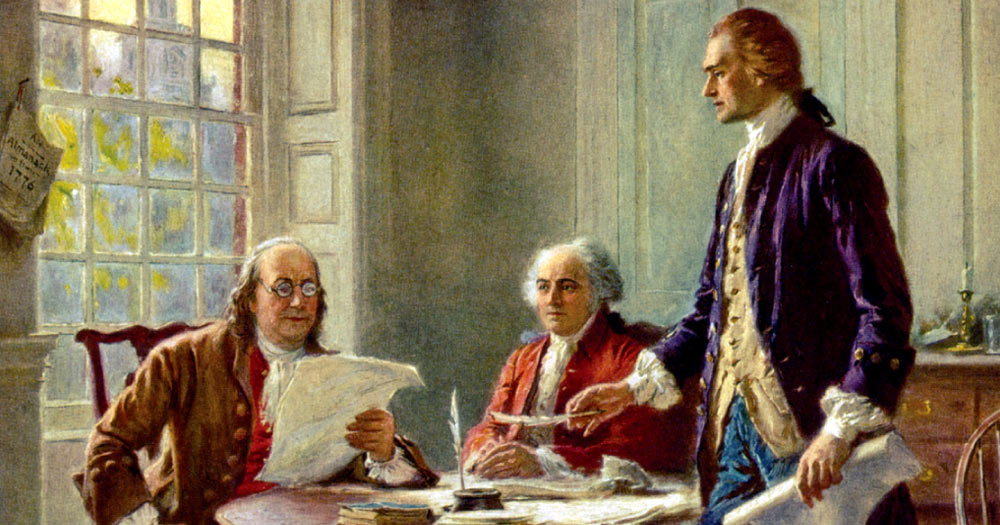
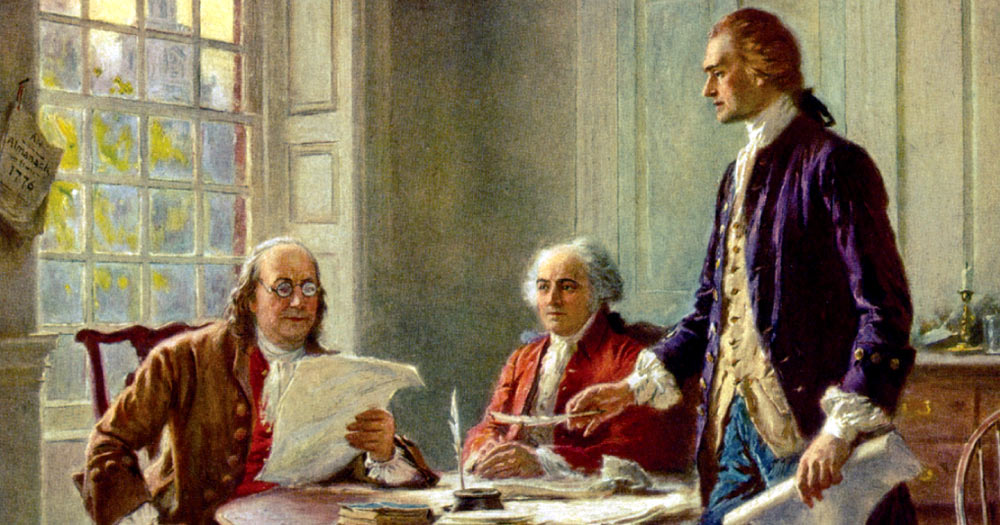
Thomas Jefferson wrote the first draft of the United States’ Declaration of Independence. He authored the State of Virginia’s Statue of Religious Freedom, which disestablished the Episcopalian Church, thus officially beginning the long process of what he referred to as “building a wall of separation between Church and State.”

He followed Patrick Henry as Governor of Virginia, and was in that position when it was attacked by British forces (led by Benedict Arnold and Gen. Cornwallis). He later served as the first Secretary of State of the new union, and then as its second Vice President and third President. He wrote one book, Notes on the State of Virginia (1785), and translated several others, including Volney’s Ruins of Empires (1802) and Destutt de Tracy’s A Treatise on Political Economy (1817). He designed the first campus of the University of Virginia, and managed its founding.

Thomas Jefferson was a man of achievement, yes; but mostly he is associated with the idea of freedom.

Yet, he was also a slave-owner. His several attempts to limit the severity and extent of slavery were mostly beaten back. And his personal involvement with slaves (he likely sired several children with his late wife’s half sister, a slave) was even more tangled.

Some people say this disqualifies Jefferson from current praise.

I’m not in that camp. It seems to me less than honest not to esteem him for helping us declare that “all men are created equal” . . . and outright foolish to ignore Mr. Jefferson’s lifelong agitation for a more equal freedom under law.

This is Common Sense. I’m Paul Jacob.


Printable PDF

Thomas Jefferson, birthday, slavery, freedom


Common Sense Needs Your Help!

Also, please consider showing your appreciation by dropping something in our tip jar  (this link will take you to the Citizens in Charge donation page… and your contribution will go to the support of the Common Sense website). Maintaining this site takes time and money.

Your help in spreading the message of common sense and liberty is very much appreciated!


Categories
free trade & free markets general freedom ideological culture moral hazard nannyism national politics & policies too much government

Socialist Stasis, Disturbed

As the President of the United States treads ground previously trod by such a personage nearly ninety years ago — Calvin Coolidge was the last U. S. Commander in Chief to make the trip to Cuba — we are understandably inundated with coverage.

Obama’s Cuba trip is Big News.

We see that Cuba is backwards — it is socialist, after all, so no surprise there — but slowly opening up to American travel and trade. The nation’s voluntary sector squirms under the omnipresent, oppressive feet of its regulators.

What we see now is the result of socialist repression. Cuba shows, perhaps, socialism’s best-case-scenario result, stasis. The island dystopia is in many ways a time capsule. Some of its current charm is that stuck-in-timed-ness.

But there is also endemic hopelessness in the country. The people are held back. Infantilized. Ruled.

And there is no disputing the fact that this is all the result of an excess of socialism. As I have argued before, the old standby, the Blame the US Embargo ploy, is one that socialists wield with devastating results — to their own ideology. Socialism is the suppression of free trade; pure socialism abolishes all trade, along with all private property. Blaming an embargo shows how important private property and capitalism itself are to socialism’s few successes.

Barack Obama is, right now, demonstrating the best case against socialists in his own party, by opening up Cuba to the wonderfully corrosive processes of the market.

This is Common Sense. I’m Paul Jacob.


Printable PDF

Cuba, stasis, Obama, visit, illustration


Categories
ballot access Common Sense general freedom initiative, referendum, and recall national politics & policies responsibility term limits U.S. Constitution

The Quadrennial Distraction

As the leading Republican candidate for the presidency ascends into the air in a helicopter filled with kids, and makes his most astute declaration yet — “I am Batman” — it becomes clearer than ever how distracting these presidential campaigns are.

Much of American Big League politics is theatrics, with some pandering for good measure. Of course, all people running for the presidency are by definition over their heads, at best . . . posturing attention-seekers at worst. Fretting about what they believe and “would do” if voted in as President of these United States is mostly a waste of time. Experience tells us that what they promise is perhaps the least likely outcome of all.

What is more effective? Affecting the political environment by getting together with like-minded folk to advance principled causes closer to home. As a side effect of your activism, a successful issue in a single city or region — especially one that spreads — can have a dramatic influence on present and future presidential wannabes.

With organization and consistent activity at the local level, your voice can be heard. But you have to do something. That activity doesn’t have to be to “run for office”; you can turn up the volume by proposing (and sometimes opposing) ballot initiatives, constitutional and charter amendments in the state, county and city where you live.

There is so much to be done at this level that could create political climate change, which in turn would invariably make federal-level candidates better, that it seems a shame to see us so focused on long shot bets.


Printable PDF

Citizen Action


Categories
free trade & free markets general freedom individual achievement

Call for Great Communicators

Money can’t buy me love. So, the $10,000 first prize in the Second Annual Great Communicators Tournament doesn’t matter to me at all. Nor does the $5,000 second prize entice me, and certainly not the $2,500 for third place.

You, however, may be fond of money.

And if you can effectively communicate the freedom message, this contest is well worth joining. But the deadline — THIS FRIDAY, August 7 — is fast approaching.

The tournament’s “goal is to identify . . . and promote individuals who can effectively and persuasively discuss and defend the free market and the founding principles.”

It’s the brainchild of the folks at Think Freely Media — the good souls who sponsor this Common Sense program. They know that liberty advocates must take the moral high-ground in making the case for freedom, and not merely argue by empirical analysis.

The competition is easy to enter. No later than midnight this Friday provide a 1-3 minute video of yourself addressing one of several issues listed on the contest website.

“Videos should be . . . clear and concise, make sure . . . that you use moral, not material, arguments,” contestants are informed. “We’re looking for solid arguments and messages, not flashy production value.”

Your video will be posted, so a combination of public voting and deliberations by the Think Freely staff and judges will identify twelve semi-finalists. These twelve will then compete in person for the top prizes at the State Policy Network’s Annual Meeting in Grand Rapids, Michigan, in September.

Why not see just how talented a communicator you are? And perhaps get even better . . . at growing liberty.

This is Common Sense. I’m Paul McCart . . . er, Paul Jacob.


Printable PDF

Great Communicators Tournament


Categories
Common Sense crime and punishment general freedom

Ultra Anti-Civilization

The stabbing event at a Thursday “Gay Pride” march in Jerusalem reveals an element of the much-talked-about “clash of civilizations” not often discussed any longer. But it used to dominate the conversation.

Why? It was not a Muslim jihadist who stabbed six people and ultimately killed one of them, a 16-year-old girl (she died in the hospital this weekend).

It was an Orthodox Jew.

That is, the man arrested at the event, identified as Yishai Schlissel, certainly looked Orthodox, when I saw him on TV, briefly, in an early report. The BBC now refers to him an “ultra-Orthodox Jew” (“ultra” theirs; emphasis, mine). He had previously carried out a similar attack in 2005.

“Israel’s government would have ‘zero tolerance’ for Jewish extremists, Prime Minister Benjamin Netanyahu said at a security cabinet meeting on Sunday,” according to a BBC report.

What suspect Schlissel shares with other terrorists is not merely a rock-hard belief that certain other people are sinful and corrupt, etc. He somehow also believes that he may assume the role of judge and executioner . . . of people he only knows by their differences.

This is beyond “ultra.” Schlissel repudiates not only the rule of law (since he acts outside it), but a basic idea that has grown in Western civilization — from roots found in his own religion.

Liberty.

The essence of liberty? Leaving peaceful people you disagree with alone.

It is more than possible for the religiously orthodox to get along with the un-orthodox. We can all get along if we respect each others’ rights, regardless of our differences.

This is Common Sense. I’m Paul Jacob.

Printable PDF

Against tolerance