
Categories
national politics & policies partisanship

Our Rules or Theirs?

Last Thursday, President Biden signaled “that he would be willing to consider supporting the elimination of the filibuster,” CBS News reported following his first news conference, “if Senate Republicans use it to block Democratic legislative priorities from receiving a full vote on the Senate floor.”

“If”? Stopping the majority party from taking its legislation to a floor vote without a 60-vote supermajority to end debate is what the filibuster does.  

The president, a Democrat, is saying the filibuster is OK . . . as long as Republicans don’t use it.

You will of course not be shocked to learn that Biden has been a longtime, adamant supporter of the filibuster. In 2005, he gave an impassioned defense, arguing, “At its core, the filibuster is not about stopping a nominee or a bill — it’s about compromise and moderation.”

Biden called the GOP attack then a “fundamental power grab” and said his oration “may be one of the most important speeches for historical purposes that I will have given in the 32 years since I have been in the Senate.”

Yet, the filibuster is not in the Constitution. 

It is simply a Senate rule. And the majority party in the Senate can thereby fiddle with it. 

I’m not so much wed to the filibuster as I am wed to the idea that the rules with which Washington insiders wield power serve us and not just themselves. 

The filibuster should be made official in law or Constitution precisely so politicians cannot change it on whim or passion. 

Or it should be ended. But not before one party (or both) actually campaigns to end it, so that the American people can weigh in. Because these must be our rules if it is to be our government. 

This is Common Sense. I’m Paul Jacob.


PDF for printing

See all recent commentary
(simplified and organized)
See recent popular posts

Categories
First Amendment rights media and media people

Misinformed … or Worse?

“For the third time in less than five months,” journalist Glenn Greenwald writes at Substack, “the U.S. Congress has summoned the CEOs of social media companies to appear before them, with the explicit intent to pressure and coerce them to censor more content from their platforms. On March 25, the House Energy and Commerce Committee will interrogate Twitter’s Jack Dorsey, Facebooks’s Mark Zuckerberg and Google’s Sundar Pichai at a hearing . . .”

A joint statement by Democrat committee and subcommittee chairs declares: “This hearing will continue the Committee’s work of holding online platforms accountable for the growing rise of misinformation and disinformation.”

Wait — the constitutional authority of Congress does not stretch to holding social media “accountable” for political speech. The First Amendment clearly states that “Congress shall make no [such] law . . .”

And what Congress is forbidden to do, it cannot threaten and intimidate private companies into doing, instead.

“For the same reasons that the Constitution prohibits the government from dictating what information we can see and read . . . ,” Greenwald points out, “it also prohibits the government from using its immense authority to coerce private actors into censoring on its behalf.”

Consider longtime Hillary Clinton aide Jennifer Palmieri’s response to President Trump’s banning by Twitter and Facebook: “It has not escaped my attention that the day social media companies decided there actually IS more they could do to police Trump’s destructive behavior was the same day they learned Democrats would chair all the congressional committees that oversee them.”

Many on the left — and even some libertarians — continue to argue that Congress plays no role in the censorship being carried out by these private Tech Giants. 

They are mistaken — whether because misinformed or disinformed, we can leave to another day.

This is Common Sense. I’m Paul Jacob. 


PDF for printing

See all recent commentary
(simplified and organized)
See recent popular posts

Categories
insider corruption partisanship

Member-Directed Funding

“Congress is about to bring back its secret weapon,” CNN headlined a column yesterday.

Congress? Weapon

Be afraid. 

Be very afraid. 

“Earmarks are back,” Chris Cillizza immediately informs readers . . . you know, “what is technically known as ‘member-directed funding.’” 

Before you can say “terrible idea,” the cable channel’s editor-at-large does admit that “members securing money for pet projects in their districts could go wrong.”

Yeah. Right. Has gone wrong. Will go wrong. Is wrong.

“This is a sneaky big deal,” offers Cillizza nonetheless. “And a massive win for party leaders of both parties.”

Cillizza argues that it was a big mistake for Speaker John Boehner and the GOP leadership in Congress to take away their ability to reward individual congresspeople by stuffing a couple multi-million-dollar pet projects into the budget. What’s not to like for an incumbent politician? They get to hand out money right in their districts, with their name attached to it. 

As long as a member of Congress plays ball.

The way the party bosses say.

In return, that incumbent can likely stay in this nation’s heralded leadership for years, decades.

When “you realize that in taking away earmarks,” explains Cillizza, “Boehner robbed party leaders of their most potent weapon to keep their rank-and-file in line on key votes.”

Is it even plausible for the functioning of our democratic republic that “party leaders” — nowhere mentioned or given any power in our Constitution — leverage our tax dollars to essentially buy off our representatives in order to keep our representatives “in line” on other important votes?

No.

This is Common Sense. I’m Paul Jacob.


PDF for printing

See all recent commentary
(simplified and organized)
See recent popular posts

Categories
initiative, referendum, and recall national politics & policies term limits

Why Congress Can’t Read

They don’t read.

No one reads the legislation Congress passes, not the staffers and lobbyists who write “the packages” and congresspeople least of all, as again illustrated by the recent 5,593-page, $2.3 trillion pandemic-relief-plus-kitchen-sink bill just passed by Congress. 

They haven’t for decades. 

Nor do they care to.

James Bovard, expert reporter on the excesses of the modern individual-stomping state, says the new monster-bill “is another warning that know-nothing, no-fault legislating will be the death of our republic unless Americans can severely reduce Congress’s prerogative to meddle in their lives.”

Correct. Problem is, it’s Congress that must enact reform — on itself. Talk about a conflict of interest! That’s why the citizen initiative process has been so important at the state level. Without democratic checks — initiative, referendum, recall — at the federal level, what major reform is even possible? 

All big, necessary reforms hit a roadblock on that issue alone.

That goes for limiting the page-length of bills or requiring legislation be posted online for days if not weeks before a vote. 

Same for congressional term limits, which would de-insulate Congress from us. 

And, just so, with the late columnist Bob Novak’s proposal of smaller districts, maybe increasing the number of U.S. representative to 2,000. (It wouldn’t cost taxpayers anything more if we cut their pay.) More politicians might be better than fewer by decreasing the power of individual politicians — diminishing marginal power, you might say.

We find ourselves in a trap. These ideas amount to ways to avoid the trap once we are out of it.

But it is getting out of the trap that’s the hard part.

Any ideas? Please advise. You can be sure your good ideas will be read — not by Congress, of course, but by those of us who want a way out.  

This is Common Sense. I’m Paul Jacob.


PDF for printing

See all recent commentary
(simplified and organized)
See recent popular posts

Categories
Accountability incumbents

When More Is Better

On Monday, we considered how to get better representation in Congress for the 700,000 folks residing in our nation’s capital city, Washington, D.C.

Today, let’s tackle how the rest of us get any semblance of representation. We are sliced up into 435 congressional districts, each comprised of roughly 700,000 people electing a “representative” supposedly doing our business in Washington. 

Are they doing our business? 

The nearly universal and long-standing public disapproval of Congress answers that question.*

As the framers of the Constitution saw it, Congress would be the first and most powerful branch of government, as it would be closest to the people. The original idea was to create in members of Congress a “fidelity to their constituents,” James Madison wrote in Federalist No. 57, which “would be found very insufficient without the restraint of frequent elections. Hence . . . the House of Representatives is so constituted as to support in the members an habitual recollection of their dependence on the people.”

Madison goes on to say that congresspeople “will be compelled to anticipate the moment when their power is to cease.”

Yet well-funded congressional incumbents sporting 90 percent-plus re-election rates cycle after cycle, decade after decade — serving 20 and 30 and 50-plus years — cannot plausibly feel either compelled or dependent.

Looming large over the problem? Huge population districts. 

The more voters in a district, the more expansive and expensive campaigns must be . . . and the bigger the need for help from special interests . . . and the more powerful those groups’ influence.

Conversely, the smaller a district is, the more influence constituents individually have on their representative.

It may seem paradoxical, but it isn’t: citizens will wield more power when there are more representatives in Congress.

This is Common Sense. I’m Paul Jacob.


* In April, after sending stimulus checks to the entire country, Congress did more than double its approval rating, though it is still seen unfavorably by a lopsided two-to-one margin.

PDF for printing

See all recent commentary
(simplified and organized)
See recent popular posts

Categories
Accountability national politics & policies too much government

A Funny Thing Happened on the Way to a Quorum

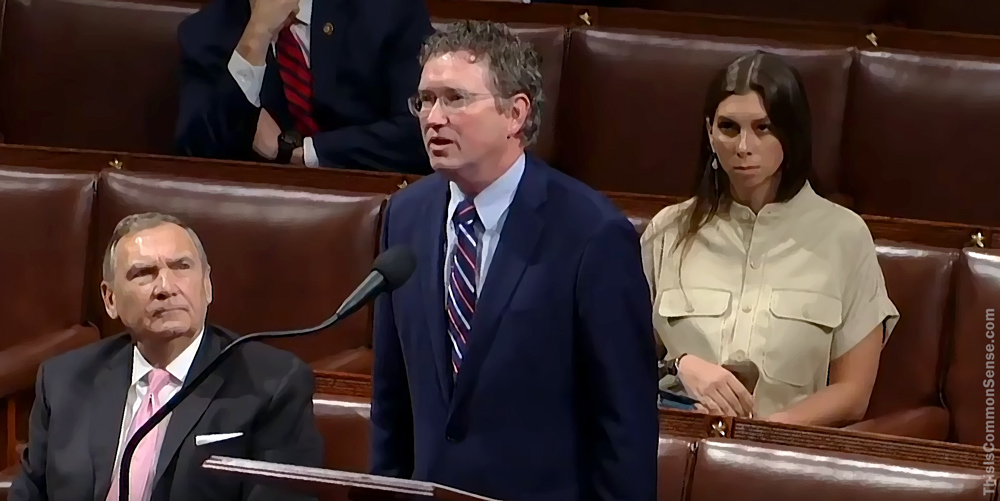
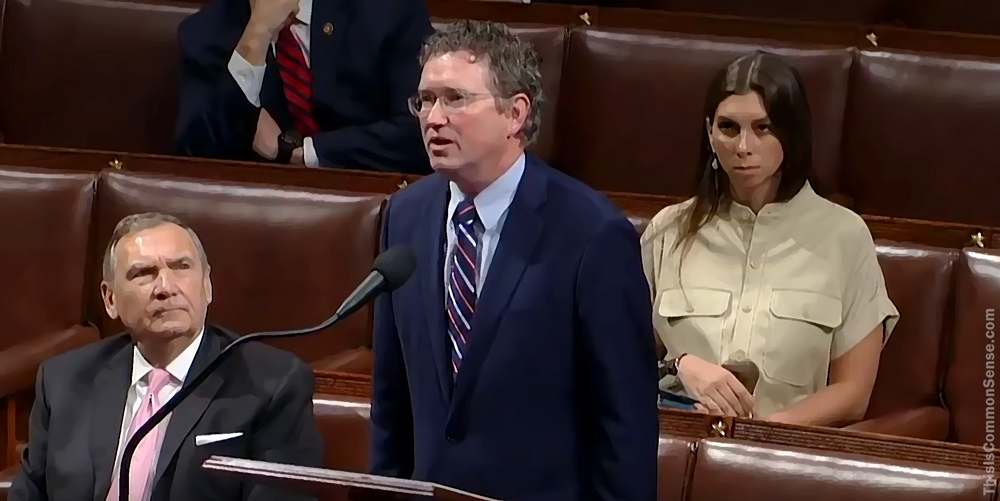
On Friday, the talking heads and Twitterati excoriating Rep. Thomas Massie (R-Kent.) were so scandalized that they couldn’t quite get to telling us what terrible thing he had done.

“GOP’s Massie outrages House,” screamed The Washington Post headline. The paper informed that “the Republican from northern Kentucky has frequently voted no on issues large and small, even against the wishes of GOP leaders.” 

Wow, is that allowed?

With Congress poised to shovel $2.2 trillion to citizens and businesses by unanimous consent, i.e., without a recorded roll call vote, Mr. Massie balked, thereby requiring a quorum to physically come to the capitol to vote on the relief package. 

“I came here to make sure our Republic doesn’t die by unanimous consent in an empty chamber,” Massie declared on the House floor, “and I request a recorded vote.”

President Trump urged the “third rate Grandstander” be tossed out of the Grand Old Party. And former U.S. Senator and 2004 Democratic presidential candidate John Kerry noted — of all things — his complete agreement with Trump, tweeting that “Massie has tested positive for being an a**hole. He must be quarantined to prevent the spread of his massive stupidity.”

Rep. Max Rose (D-N.Y.) offered that Massie was “disgusting” and “inhumane,” and that if the vote was pushed “back 24 hours there will be blood on [his] hands.”  

Speaker of the House Nancy Pelosi (D-Calif.) boasted of having asked the congressman, “Why don’t you just back off?”

Facing the biggest spending bill of all time, Massie’s notion of Congresspeople voting on the record? Hardly radical. But in the face of the COVID-19 threat, bringing legislators back to the capitol entailed real risk. 

Yet come back they did. And just to show Massie how wrong he was in alleging a cover-up, they agreed to a roll-call vote so that there was full accountability. 

Take THAT, Massie! 

Wait . . . Congress didn’t go on the record?! 

They came back and yet, as Massie pointed out, “they still refused to have a recorded vote.”

This is Common Sense. I’m Paul Jacob.


Note: One spending item, which Massie had specifically complained about, was $25 million for the Kennedy Center. Then, mere hours after President Trump signed the legislation, the Kennedy Center honchos fired the National Symphony Orchestra, informing them “that paychecks would end this week.”

PDF for printing

Thomas Massie, Coronavirus, pandemic, virus, House of Representatives, Congress,

See all recent commentary
(simplified and organized)
See recent popular posts


Categories
Accountability insider corruption local leaders national politics & policies Voting

Bring the Bozos Home

“Sen. Rand Paul (R-Ky.) announced Sunday he has covid-19,” The Washington Post reports, “and four other GOP senators are quarantined. Sen. Amy Klobuchar (D-Minn.) disclosed Monday that her husband, too, is infected with the virus.”

Social media was not uniformly brimming with support for the Kentucky senator, of course, and some folks noted, in earnest horror, that the Republican who had been shot at by a Bernie Bro and blindsided by his deranged Democrat neighbor had dared work six days in the Senate after being tested but before receiving his diagnosis.

He should have been sequestered!

To let the big “stimulus” packages sail through Congress?

But there are work-arounds.

“We should not be physically present on this floor at this moment,” argued Sen. Richard Durbin (D-Ill.) yesterday, urging the Senate to facilitate social distancing by allowing remote voting. Asked about it at his Sunday news conference, President Trump gave thumbs up: “I would be totally in favor of it on a temporary basis.”

I say, let’s take this a step further: do it permanently

Remote voting makes sense in an emergency. Sure. But it also makes sense all the time, because legislators voting from their home states and districts rather than within the Washington swamp would hear more from constituents than special interest lobbyists and, therefore, likely represent us better. 

Plus, not tethered to life in Washington, or the confines of the capitol, we might reduce the size of congressional districts from over 700,000 people to more like 70,000 and see real representation return to our land. 

This is Common Sense. I’m Paul Jacob.


PDF for printing

telecommute, Rand Paul, Congress, Senate, Coronavirus, Corona Virus,

Original photo by Manuel Bahamondez H

See all recent commentary
(simplified and organized)
See recent popular posts


Categories
ideological culture national politics & policies Popular

They Aren’t Lying Now?

“You lie!”

When U.S. Representative Joe Wilson (R-SC) shouted this at President Barack Obama during 2009’s State of the Union — scandal!

How dare he?

At issue was whether federal tax dollars would aid illegal immigrants under Obamacare. Democrats denied that any such thing would happen. Indeed, the very idea constituted a calumny, a mere paranoid Tea Party delusion.

This came to a lot of people’s minds after last week’s televised Democratic Party presidential candidates’ debates. 

On Thursday, all ten on-stage candidates assented, with hands held proudly high, to giving undocumented aliens free health care. And several from the previous night’s debate are also on record for the same thing, none of them more insistent than Senator Elizabeth Warren, who proclaims that health care is a right.

Democratic opinion leaders now eagerly assert what they took offense at a mere ten years ago. 

There are two very basic things we can learn from this.

First, what politicians say about what they want changes over time.

A decade ago, Democrats took offense when called socialist; now they revel in the term. So what are we to make of Democrats’ current s-word usage? Now they insist they don’t want to nationalize the means of production — but will they tomorrow?

Second, the debate over immigration is not really between restrictionists and open borders supporters. It is between proponents of restricted immigration, on the one hand, and those who demand subsidized immigration, on the other.

A true open borders policy could look very different from what Democrats now push.

Less socialistic.

This is Common Sense. I’m Paul Jacob.


PDF for printing

you lie, Obama, Pelosi, Biden, Congress, Speech,

See all recent commentary
(simplified and organized)
See recent popular posts

Categories
national politics & policies Popular term limits

Dousing the Dumpster Fire

“Congress is less popular than traffic jams, root canals, and hemorrhoids,” U.S. Term Limits Executive Director Nick Tomboulides explained yesterday at a Senate Judiciary Subcommittee on the Constitution hearing

“You’re beating head lice,” he added, “but the lice have asked for a recount.”

Mr. Tomboulides and U.S. Term Limits support Senate Joint Resolution 1, introduced by Sen. Ted Cruz (R-Texas), which calls for a three-term, six-year House limit and a two-term, 12-year Senate limit.

“Governing is incredibly hard,” argued R Street Institute Senior Fellow and term limits opponent Casey Burgat earlier on C-Span’s Washington Journal. “There is no school for this.”

The real world, perchance?

“Right now, we have the most experienced, professionalized, careerist Congress in American history,” Tomboulides countered, “and the results are a dumpster fire.”

“When I came to Congress, I supported term limits in theory,” former U.S. Representative and Senator Jim DeMint (R-South Carolina) testified. “Now I support it after seeing what really happens here.” 

“Over 80 percent of Americans want term limits to happen,” Tomboulides offered. “Donald Trump and Barack Obama want it.” 

“The only impediment,” as Sen. Cruz pointed out, “is the United States Congress.”

That’s why U.S. Term Limits is working to convince 34 state legislatures to bypass Congress by passing bills for a convention under Article V of the Constitution, which can consider and propose an amendment for congressional term limits.

It’s the people’s path to putting out the dumpster fire.

This is Common Sense. I’m Paul Jacob.


PDF for printing

dumpster fire, term limits, Congress,

See all recent commentary
(simplified and organized)
See recent popular posts
Categories
Accountability national politics & policies

Salty Tears of the Guilty

The Mueller report has not calmed the partisan enmity roiling Washington.

Many in Congress complain about Mueller not reaching a prosecutorial decision on the issue of obstruction of justice, thus leaving Attorney General William Barr to determine that actions by President Trump did not reach a criminal threshold. 

But who wrote the rules for such investigations?

“If Congress does not like the decision, because it was made by the attorney general,” explained Jacob Frenkel, an attorney who formerly worked in the independent counsel’s office, “Congress has only itself to blame for not renewing the independent counsel statute.”

“Analysts noted that lawmakers, in effect, gave Barr authority over Mueller when they let the independent counsel law expire in 1999,” reports The Washington Post. “That law created a prosecutor position with even more autonomy than Mueller, who was appointed under more restrictive special counsel regulations.”

Of course, in 1999, Republicans controlled both houses of Congress. Had they a crystal ball to see 20 years into the future, for partisan reasons they might celebrate that they allowed that law to lapse. 

Then again, Democrats have controlled both houses since then, even sporting a filibuster-proof Senate majority in 2009. Yet did nothing to legislate a solution to the problem they see today.

My point isn’t to bemoan the special counsel or independent counsel statute, about which good people might disagree. Instead, let us acknowledge the essential role our system reserves for Congress. Yes, again and again, from tariff policy to foreign policy to these current issues, Congress punts its power away to the executive and judiciary branches. 

And then cries about it.

Well, wipe your eyes, solons: it’s We the People who feel the pain.

This is Common Sense. I’m Paul Jacob.


PDF for printing

crying smiley, Congress, Independent Counsel, Willam Barr, The Mueller Report,

See all recent commentary
(simplified and organized)
See recent popular posts