Categories
national politics & policies Popular

A Congress-Proof Wall?

When members of Congress run for the Presidency, they often talk a good game about acting within the boundaries set by the Constitution . . . but maybe we should roll our eyes, at least a bit, when senators like Elizabeth Warren and Corey Booker complain about President Trump’s Executive Order plan for building his infamous Wall. 

A workaround like that seems like an overstepping of constitutional bounds, sure. But, as Peter J. Wallison wrote for the Wall Street Journal on Saturday, congressional protest suffers from a rather big problem. 

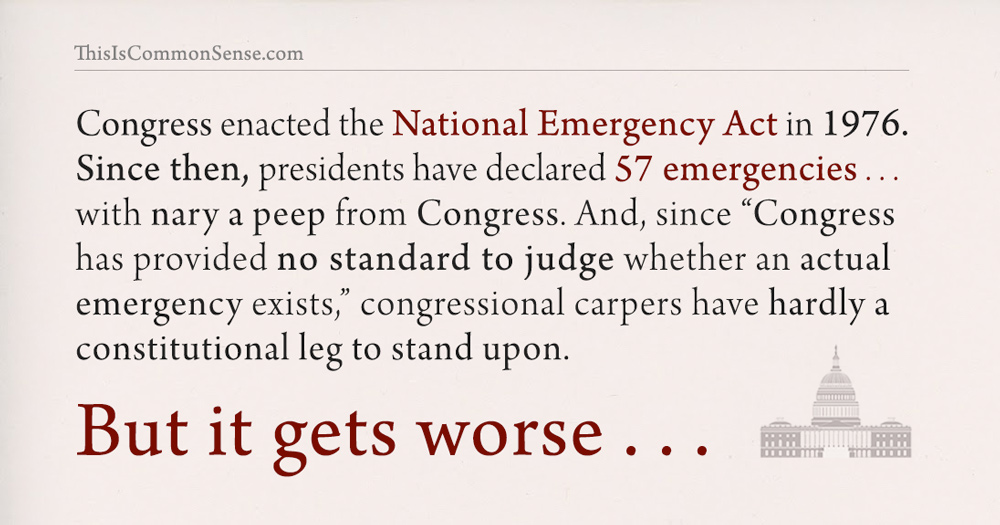
Congress enacted the National Emergency Act in 1976. Since then, presidents have declared 57 emergencies . . . with nary a peep from Congress. And, since “Congress has provided no standard to judge whether an actual emergency exists,” congressional carpers have hardly a constitutional leg to stand upon.

But it gets worse.

Congress doesn’t even have much leverage in the “power of the purse” — for it has given much of that away, too.

For example, when “a Democratic Congress created the Consumer Financial Protection Bureau in the Dodd-Frank Act of 2010,” writes Wallison, “it provided that the agency would be funded entirely by the Federal Reserve, not through annual appropriations from Congress.”

This interests me, especially, since I quoted Senator Elizabeth Warren ballyhooing her support for this very program at Townhall last weekend. She thinks she did something smart in supporting that regulatory body. 

But like so much other ultra-clever legislative conniving, she placed it outside of congressional control.

With genius moves like this, congressional Democrats may have great difficulty restraining President Trump.

Serves them right, of course. But not us — it does not serve the people at all.

We need constitutional limits.

This is Common Sense. I’m Paul Jacob.

PDF for printing

NEA, 1976, National Emergenncy Act, Congress, standards,

See all recent commentary
(simplified and organized)
See recent popular posts

Categories
First Amendment rights national politics & policies too much government

First Things First

Surely there’s something good in the first legislation put forth by the brand-new Democratic House majority — though nothing jumps to mind. 

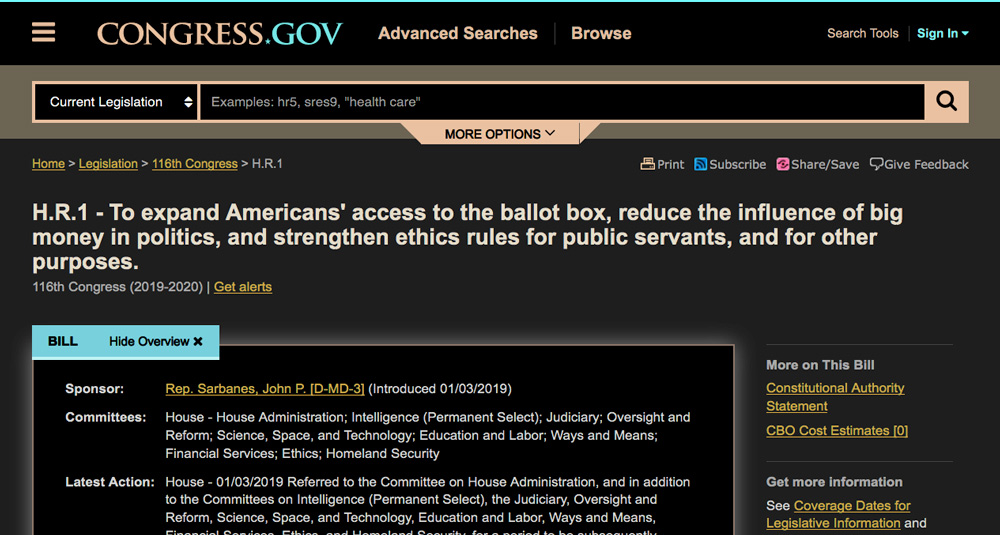
The 571-page smorgasbord bill “addresses voting rights, corruption, gerrymandering and campaign finance reform,” writes Thomas Edsall in The New York Times, “as well as the creation of a Select Committee on the Climate Crisis — a first step toward a ‘Green New Deal.’” 

H.R. 1 would mandate that states adopt automatic voter registration, a step too far. It establishes a system of public subsidies for candidates running for Congress, with taxpayers forking over a six-to-one match on donations of $200 or less. 

The legislation also empowers* the Federal Election Commission, including by ending its supposedly “neutral” composition, i.e. an equal number of Democrat and Republican commissioners. This would either allow the FEC to be more “decisive” or unleash the dogs of partisan political witch hunts . . . depending on the case and/or your politics.**

Speaker Nancy Pelosi (D-Calif.) and Rep. John Sarbanes (D-Md.), the lead sponsor of the legislation, bill it as the best way “to rescue our broken democracy.” 

“It should be called the Democrat Politician Protection Act,” argues Senate Majority Leader Mitch McConnell in the Washington Post

David Keating, president of the Institute for Free Speech, tells NPR, “A lot of [H.R.1] looks to be unconstitutional.”

No problem, for one provision calls for a constitutional amendment to partially repeal the First Amendment, so to authorize Congress to regulate campaign spending and speech.

Remember: the First Amendment is a single sentence, a mere 45 words.

Succinct and effective.

The former does not apply to this new bill, and the latter, I hope, does not apply to this new Congress.

This is Common Sense. I’m Paul Jacob.


* Let’s not give greater power to the FEC, which, according to a federal judge, “acted arbitrarily and capriciously and contrary to law” in the 2016 election.

** Of course, for Ross Perot in the 1990s or Libertarians, Greens and independents today, that “bipartisan” make-up isn’t neutral but stacked like a Star Chamber


PDF for printing

See all recent commentary
(simplified and organized)
See recent popular posts

Categories
Accountability term limits

None Dare Call It Careerism

Let’s build a wall, I said last week, between the Office of the President and all these emergency powers our Congress has recklessly given away to the chief executive.

After admittedly “scrambling to figure out” the emergency powers possessed by POTUS, the Washington Post’s editorial board lamented its discovery “that Congress has delegated a surprising amount of emergency or quasi-emergency power to the executive branch over the years, possibly too much.”

Possibly? Well . . . it is the Post.

Yet, the paper acknowledges, “The implications for constitutional government are potentially serious.”

The federal government currently operates under “31 presidentially declared national emergencies,” informs Post columnist Charles Lane. “[I]f Trump evades Congress’s refusal to fund a border wall by declaring a national emergency at the border . . . it would not be the first time a president took advantage of the inherent elasticity of the term.”

Congress last legislated on emergency presidential powers in 1976, a mere two years after Richard Nixon became the first president in U.S. history to resign in disgrace. Yet, even then, the law left presidential authority largely unchecked, and the term “emergency” completely undefined.

Why has Congress simply handed away so much power, writing laws with so little accountability? Has Congress been saddled with inexperienced rookies? No. There are no term limits. This is the product of very experienced career politicians.

Read between the lines. 

“Only Congress can reclaim the emergency powers it has granted the president,” Lane writes, adding . . . “assuming, of course, that lawmakers want the responsibility back, too.”

They don’t. They prefer their cushy careers.

This is Common Sense. I’m Paul Jacob.


PDF for printing

Congress, Emergency, Presidential,

See all recent commentary
(simplified and organized)
See recent popular posts

Categories
ideological culture too much government

Worse Than Her Faux Pas

“If we work our butts off to make sure that we take back all three chambers of Congress,” stumbled U.S. Representative Alexandria Ocasio-Cortez (D.-N.Y.), “uh, rather, all three chambers of government: the presidency, the Senate, and the House. . . .”

The Daily Wire, where I encountered this particular snippet of inanity, could be caught gloating between her lines. And it is funny (amidst the fear) when politicians prove themselves ignorant, clueless, unprepared. Politicians rarely come across as masters of their subject.

But we who are subjected to their lack of mastery should worry about their substantive flubs more than their trivial technical errors.

As the newly elected solon herself had the wit to notice.

“Maybe instead of Republicans drooling over every minute of footage of me in slow-mo, waiting to chop up word slips that I correct in real-tomd [sic],” she went on, “they actually step up enough to make the argument they want to make: that they don’t believe people deserve a right to healthcare.”

I am not a Republican, but I’m here to help. The only rights we “deserve” are those we can have without enslaving and exploiting others. My right to freedom requires only your duty to leave me alone, not systematically taking from others or running their lives. But a right to “healthcare”? The corresponding duties are vague and ominous, potentially limitless.

And thus oppressive. 

A government big enough to give Ocasio-Cortez everything she wants is too big to leave any freedom for the rest of us.

This is Common Sense. I’m Paul Jacob.


PDF for printing

Alexandria Ocasio-Cortez

See all recent commentary
(simplified and organized)
See recent popular posts

Categories
Accountability general freedom government transparency incumbents insider corruption local leaders moral hazard national politics & policies term limits

“Dorky” Doesn’t Define It

“Term limits,” said Daniel McCarthy, editor of The Modern Age, in a recent podcast conversation with historian Tom Woods, “was one of the dorkiest ideas of the 1994 so-called Newt Gingrich revolution.”

He characterized it as not having really gone anywhere.

Huh?

Granted, Congress is still not term-limited. But Americans in 15 states — including California, Colorado, Florida, Michigan, and Ohio, and representing 37 percent of the nation’s population — do enjoy term-limited state legislatures.*

And it sure wasn’t Newt Gingrich’s idea. Gingrich opposed it.

McCarthy repeats the old chestnut that what term limitation “winds up doing is actually weakening Congress and congresspeople in particular — relative to their own staff, who stay in Congress and become sort of experts and learn how to manipulate their congressman, and also relative to the executive branch who have people rotate in from time to time.”

Nifty theory — one very popular with politicians, who know that voters fear unelected influences on legislation.

The reality, however, is that Congress, designed by the Constitution’s framers to be both most powerful and closest to the people‚ is, today, the weakest branch.

And legislators are not term limited.

Ditch the “manipulation theory”; adopt a “collaboration theory”: legislators with Methuselah-long careers learn, sans “rotation in office,” to feather their own nests and those of the interest groups that fund their re-elections (and insider trading schemes).

Term limits remain popular with normal Americans because voters intuitively grasp the reality of such everyday corruption, which is directly tied to Congress having sloughed off so much constitutional responsibility.

We need term limits to restore a Congress sold out by professional politicians.

This is Common Sense. I’m Paul Jacob.


* Nine of the ten largest cities in America likewise have termed-limited their elected officeholders. For more information, see the links to the column from which this episode of Common Sense is condensed.

PDF for printing


Categories
Accountability general freedom incumbents insider corruption local leaders moral hazard political challengers Regulating Protest term limits

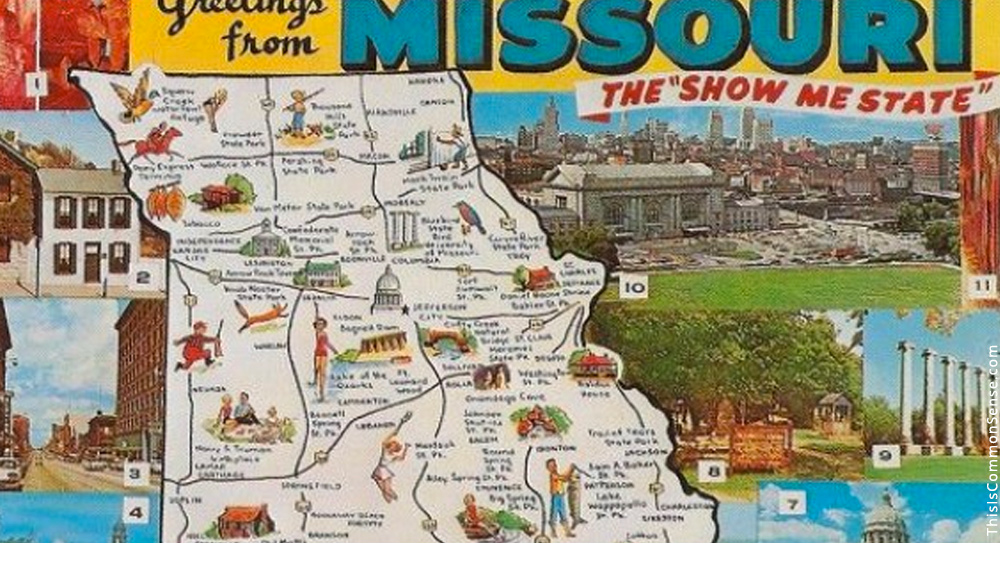
Missouri Shows Article V Action

There’s good news and there’s good news from the Show Me State.

First the good news. The Missouri House declined to follow the lead of the Missouri Senate during its recent legislative session in advancing a ballot measure to make a travesty, mockery and sham of state legislative term limits.

The proposed weakening of the limits would have doubled maximum legislative tenure from eight years to 16 years. Further, it would also have excluded terms already served from counting toward the new limit.

Had the measure ultimately been enacted, some incumbents would have been able to sit in a single seat for up to 24 years. This assault on term limits is dead . . . at least until next year.

Now the good news. The lawmakers deserve high praise for issuing a formal call for an amendment convention to consider the single subject of congressional term limits, making Missouri the third state to do so (after Florida and Alabama). In mid-May, the resolution for a Term Limits Convention easily passed in both chambers.

Thanks to a provision in Article V of the Constitution, if two thirds of the states (34 states) submit a similar application to convene a term limits amendment convention, the convention must be convened. The amendment that the convention produces would then be submitted to the states for ratification. Three fourths (38) are required to ratify.

We’re only in the first-steps stage here, but first steps are crucial.

Thanks for showing us how to do it, Missouri.

This is Common Sense. I’m Paul Jacob.


PDF for printing

Missouri, show me, Article V, term limits, legislature, congress,


Categories
Accountability crime and punishment general freedom ideological culture moral hazard nannyism national politics & policies privacy too much government U.S. Constitution

Hooray for Congress!

When Congress behaves badly, I criticize. When it works well, I applaud.

I’ve waited a long, long, long time to put my hands together in polite applause.

It happened yesterday.

The U.S. House of Representatives passed a Senate bill, largely along party lines, to give those facing a terminal illness the “right to try.” That is, the right to try experimental drugs and treatments that haven’t yet been approved by the federal Food & Drug Administration (FDA). 

Of course, Congress doesn’t actually give us rights. We have always had the common law right — indeed, the human right — to freely seek a path to wellness when we are ill.

From time immemorial. Even before the FDA.

So, this legislation was, more correctly put, a way to announce that the congressionally-created FDA would stop blocking our freedom . . . provided we are dying and the government-approved medical establishment has no more licensed hope to offer.

The bill now goes to President Trump. “People who are terminally ill should not have to go from country to country to seek a cure,” he declared in his last State of the Union, “I want to give them a chance right here at home.”

Democrats overwhelmingly disagreed. 

“This will provide fly-by-night physicians and clinics the opportunity to peddle false hope and ineffective drugs to desperate patients,” argued Rep. Frank Pallone (D-N.J.).

Rep. Jan Schakowsky (D-Ill.) likewise charged that the legislation “puts patients at risk by allowing the sale of snake oil.”

But of course these patients are dying. That’s already as “at risk” as it gets. Our right to live includes a right to try to live.

This is Common Sense. I’m Paul Jacob.


PDF for printing


Categories
Accountability general freedom media and media people moral hazard national politics & policies responsibility too much government U.S. Constitution

Matter-of-After-the-Fact

“For some time now,” writes Sen. Rand Paul for The American Conservative, “Congress has abdicated its responsibility to declare war.”

Kentucky’s junior senator knows how unconstitutional this is. “The Founders left the power to make war in the legislature on purpose and with good reason,” Rand Paul explains — correctly. “They recognized that the executive branch is most prone to war.”

So, Washington Senators Bob Corker and Tim Kaine are here to help?

This bipartisan pair has retrieved — from deep within the bowels of congressional R & D — a new Authorization for Use of Military Force (AUMF). This would, explains Paul, give “nearly unlimited power to this or any other president to be at war whenever he or she wants, with minimal justification and no prior specific authority.”

The wording of the new AUMF “would forever allow the executive unlimited latitude in determining war, and would leave Congress debating such action after forces have already been committed” — allowing Congress only carping rights.

Shades of the Roman Republic, in which the Senate appointed dictators in tough times.*

These days, all times are tough times.

Meanwhile, Bob Corker is in the news for having just received the “George Washington University Institute for Public Diplomacy and Global Communication’s first annual Walter Roberts Award for Congressional Leadership in Public Diplomacy.”

And Kaine just a few weeks ago made a big deal about his no vote for Trump’s Secretary of State nominee: “We have a president who is anti-diplomacy and I worry that Mike Pompeo has shown the same tendency to oppose diplomacy.”

How does making a foreign policy dictator out of Trump (or any future president) advance diplomacy?

This is Common Sense. I’m Paul Jacob.


* Arguably Congress’s open-ended AUMF’s are much worse than ancient Roman practice, since today’s crises are not specified and the dictator is not forced to step down after the problem is solved — or a term limit of six months reached.


PDF for printing


Categories
crime and punishment folly general freedom moral hazard national politics & policies Popular privacy responsibility The Draft too much government U.S. Constitution

Leave Those Kids Alone

Congress created The National Commission on Military, National, and Public Service “to consider and develop recommendations concerning the need for a military draft, and means by which to foster a greater attitude and ethos of service among American youth.”

Is it possible that Congress and the commissioners have never considered the inherent contradiction between forcing people into the military against their will and fostering an “ethos of service”?

Today, I will get perhaps two minutes to address this commission at a hearing in Denver, Colorado, answering* these questions it has posed:

Is a military draft or draft contingency still a necessary component of U.S. national security?

The military draft has never at any time in the history of this country been a necessary component in U.S. national security.  

Are modifications to the selective service system needed?

No. The Selective Service System, the people who force very young men into the military against their will, needs to be ended. Not modified. Not expanded to women. End draft registration. Close the agency.

The United States should forswear any use of conscription. A free country need not force people into the military to defend it.

Is a mandatory service requirement for all Americans necessary, valuable, and feasible?

Necessary? Not on your life. Americans have always stepped forward — not only to defend their own country, but also in hopes of defending people across the globe.

Valuable? That’s a bad joke. People forced to kill and die in Vietnam and other conflicts and those imprisoned for refusing to take part in such a system fail to see any value. The draft has been disastrous.

What is valuable are the lives and rights of the young. They are free citizens, not Congress’s pawns.

Feasible? No. Because too many of us will fight you, refusing to go along. Even if it means our imprisonment.** Plus, a conscripted army is a poor substitute for the All Volunteer Force.

The draft is unnecessary, divisive and dangerous.

How does the United States increase the propensity for Americans, particularly young Americans, to serve?

Be worthy of the voluntary service of the American people.

If the government is responsible, then people will respond to protect it.

Commit to raising an army of soldiers and service providers by persuading citizens to freely serve their communities and their country. In short, this commission and this Congress should commit to freedom.

That would be truly inspiring.

This is Common Sense. I’m Paul Jacob.


* I will also be submitting a longer, more formal statement in testimony.

** As regular readers know, I was one of 20 young men prosecuted for refusing to register for the draft in the 1980s.


PDF for printing


Categories
Accountability crime and punishment folly free trade & free markets general freedom media and media people moral hazard nannyism national politics & policies property rights Regulating Protest too much government U.S. Constitution

That Something You Do

Congress grilled Facebook CEO Mark Zuckerberg, last week, and as usual ended up roasting itself.

“Zuckerberg has already experienced the worst punishment of all,” quipped comedian Trevor Noah on The Daily Show. “He had to spend four hours explaining Facebook to senior citizens.”

Utah Sen. Orrin Hatch, retiring after his 42nd consecutive year in Washington, asked, “How do you sustain a business model in which users don’t pay for your service?”

“Senator,” Zuckerberg incredulously replied, “we run ads.”

Inc. magazine reported the obvious: “several of our elected leaders asked questions that were highly uninformed, or in some cases just plain weird.”

Uninformed. Weird. That’s them, alright.*

Still, the Washington establishment seems to seriously think these same congressmen ought to be re-writing privacy rules.

“Elected officials know the public wants them to do something to protect their privacy,” announced Chuck Todd, host of NBC’s Meet the Press. “The question now turns to what is that something?”

“Americans are largely together on this issue,” Todd said, citing a recent poll where a similar “66 percent of Democrats and 68 percent of Republicans say they want more control over the information companies have about them.”

But Democrats and Republicans are together on something else: Only 21 percent of Democrats and a tiny 14 percent of Republicans “trust the federal government” to act on the issue.

The senators, though obviously “confused about basic topics,” Emily Stewart wrote at Vox,  “seem to agree they want to fix something about Facebook. They just have no idea what.”

Please Congress: DON’T “do something.” Don’t do that thing you do.

This is Common Sense. I’m Paul Jacob.


* Reason TV has a very funny video on the Zuckerberg hearing.


PDF for printing