Categories
crime and punishment general freedom media and media people moral hazard nannyism national politics & policies privacy too much government U.S. Constitution

Unlovely Congress

If you recently tried to post a personal ad on Craigslist, the popular classified-ad site, you were in for a shock. Craigslist has suddenly discontinued all personals. You can still sell your used rototiller, but forget about telling the world you’re lost in Louisville looking for love.

The company doesn’t want to be prosecuted for helping people find each other en route to becoming partners in outlawry.

Congress has just passed legislation subjecting site publishers to criminal and civil liability when their users “misuse online personals unlawfully.” The president’s signature is expected. Craigslist doesn’t want all that open-ended liability. “Any tool or service can be misused,” it observes.

Indeed. If the principle underlying this law were consistently applied, any good or service that facilitates communication (or other human activity!) would expose providers to liability for any illegal conduct abetted by their products. Would curtain manufacturers be exempt? We all know how bad guys plotting evil pull their curtains. Freedom of speech, freedom of casual encounters, freedom of curtain-trafficking, it’s all at risk.

What about Congress’s goal of discouraging prostitution?

Will all U.S. prostitutes now retire?

Not if the last several thousand years are any clue. Especially as other sites follow Craigslist’s lead, prostitutes who had escaped the streets thanks to online means of client-hunting will tend to return to those streets. If so, neighborhoods less seedy and less dangerous thanks to Craigslist etc. will now tend to reacquire such unlovely qualities.

Thanks to (unlovely) Congress.

This is Common Sense. I’m Paul Jacob.


PDF for printing


Categories
national politics & policies Second Amendment rights tax policy too much government

Was the Line Crossed?

Everybody has a limit, a point after which they reach for the nearest weapon and fire.

Or, in normal politics, withdraw support and go on the attack.

But it is not normal politics right now.

In mid-March, a Congressman from Long Island expressed his frustration with the Trump administration by saying, “This is where the Second Amendment comes in, quite frankly, because you know, what if the president was to ignore the courts?”

Days after this pol darkly implied insurrection, attacking gun rights became, on our Democratic Congressman’s end of the spectrum, a cause célèbre. Obviously, there remains a strong tension between politically opposing gun rights and the commonsense acknowledgment of the vital political function of the Second Amendment.* Lines are drawn all over the place.

But last week a very different line was crossed.

Donald Trump signed the latest Omnibus whopper. And a few of the gonzo president’s biggest Internet supporters — including the oddest, anarchist Stefan Molyneux — could take no more. Trump’s fatal flaw, Molyneux stated, “is his desire to shovel the money of the unborn into the Great White Shark maw of the military-industrial complex.” Molyneux identifies “the largest military budget in human history” as what Trump wanted in exchange for betraying his base.

So, you can see where Mr. Molyneux draws the line of support.

Meanwhile, others are wondering about Trump’s own line on trade policy. With much ballyhoo and bluster, he raised tariffs on steel — and then, quietly, exempted most of America’s steel trading partners.

Crazyman? Or genius?

The line between those two concepts is notoriously gray.

This is Common Sense. I’m Paul Jacob.


* In my weekend column I noted that “when the populace is armed sufficiently to realistically repel tyranny, the calculations of self-interested politicians per what they can get away with changes.” Guns can remain holstered, most of the time.


PDF for printing


Categories
Accountability incumbents media and media people moral hazard national politics & policies term limits

Like Motel Matches

When President Trump announced he was slapping a 25 percent tariff on imported steel and 10 percent on aluminum, a friend asked me how the president could possibly possess such unilateral authority. 

That was my first thought, too, before surmising that Congress had again given away its constitutional power, as its habit, thoughtlessly — like motel matches.*

Writing in National Review, Jay Cost confirmed my suspicion, “Over the past 80 years, authority over tariffs, as well as over all manner of properly legislative functions, has migrated to the executive branch, away from the legislative.”

When FDR sought greater power over trade, Cost explained, “It was as if Congress threw up its hands in exasperation and said to the president, ‘We cannot handle our authority responsibly. Please take it off our hands, for we will screw things up and lose reelection.’”

Ah, the laser-like focus of modern career politicians . . . on what’s most important . . . to them.

“Nobody looks to Congress for redress of grievances anymore …” Cost wrote. “Congress has systematically shrugged power off its shoulders over the past 80 years, and it inevitably screws up the handful of authorities it retains . . .”

Why? What has led our first branch of government, over the last 80 years or so, to surrender its authority?

Congress has become much more “experienced,” evermore a career destination. And a lucrative one.

We desperately need term limits. And we need smaller districts where individual citizens matter more than money and special interests.

Save Congress from itself — before it sets the country afire.

This is Common Sense. I’m Paul Jacob. 


* My mind jumped to Elvis Costello’s song, Motel Matches: “Giving you away, like . . .” what, precisely, in this case? The authority in Article 1, Section 8 of the Constitution: “The Congress shall have the Power to lay and collect Taxes, Duties, Imposts and Excises….”


PDF for printing


Categories
Accountability government transparency insider corruption moral hazard national politics & policies term limits too much government

Captured Congress

“Do you think party leaders exert too much control over members of Congress and over the agenda,” Full Measure host Sharyl Attkisson asked retiring Rep. Darrell Issa, “in a way that might be motivated by donations and corporate influence and special interests?”

Winner of five Emmys, as well as the 2012 Edward R. Murrow Award for Excellence in Video Investigative Reporting, Attkisson’s “exit interview” with Congressman Issa (R-Calif.) is illuminating.

It happens every day,” he replied, “that a lobbyist calls the majority leader, the minority leader, the speaker, and some chairmen or ranking member gets a call saying, ‘hey go light on that.’”

Issa pointed out that the committee chairs “really don’t control the committees. More and more it’s controlled out of the speaker’s office and out of the minority leader’s office. You know, they pick who gets the committees and then they pick really what you get to do.”

And it’s getting worse, he said.

As chairman of the House Oversight Committee, Issa has led a number of very high-profile investigations. His investigation of Countrywide, Attkisson noted, “revealed that federal public officials and their staffers, both Democrats and Republicans, had quietly received lucrative VIP loans from Countrywide as the company sought to influence their decisions.”

“It was much more effective than political giving,” Issa offered.

He also accused Republican leaders of removing the Benghazi investigation from his committee to a select committee to “keep it from going too far.”

“I have seen the defense-related committees that take money from defense contractors go easy on defense oversight,” Attkisson explained, prompting the congressman to agree “that happens every day here.”

Between the party bosses and the special interests, our Congress has been captured.

This is Common Sense. I’m Paul Jacob.

N. B. Full Measure is broadcast every Sunday on 162 Sinclair Broadcast Group stations reaching 43 million households in 79 media markets.


PDF for printing

Categories
Accountability ideological culture media and media people moral hazard national politics & policies responsibility term limits too much government

The Politics of Inertia

Congress’s failure to establish, last week, any semblance of budgetary responsibility led to one of those “government shutdowns” that the press likes to yammer about so breathlessly.

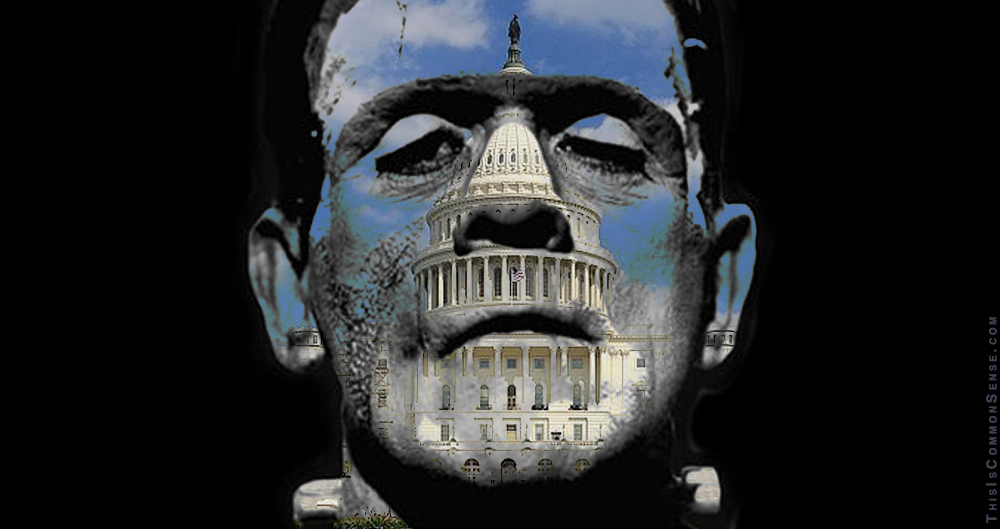
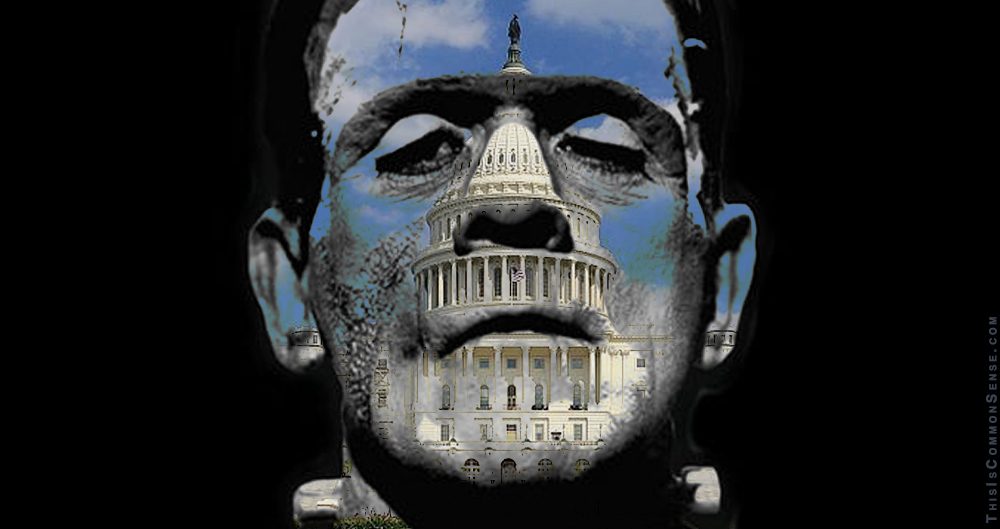
Then, early this week, Senate holdouts caved, allowing a short-term fix to bring the federal government fully back to life, like the monster in Dr. Frankenstein’s lab given a defibrillator jolt.

Usually these government shutdowns are caused by Republicans not playing along — Obamacare being the sticking point most recently — but this time the desperate negotiators were Sen. Chuck Schumer (D -NY) and his Democrat gang, whose “heroic” stance was all about immigration reform and “the Dreamers.”

After they folded, and the Monster was bequeathed new life, CNN’s Brooke Baldwin asked former Democratic National Committee chair Rep. Debbie Wasserman Schultz what her party had gained from its temporary obstructionism.

Her answer? “Potential for momentum.”

That had to be one of the more bizarrely drawn happy faces over complete and utter failure that we have witnessed since . . . well, the last one.

Even Ms. Baldwin was incredulous.*

The Democratic Party’s disarray is astounding. If any party has momentum on its side, it is the party of Andy Jackson and William Jennings Bryan, the party of the elitist media, insider government and the Deep State, and the resistance to Trump.

So why its current pathetic fortune? Because the Democrats have rested so long upon their “momentum.”

Inertia can sure have its downside.

On the “bright side,” Democrats will have occasion to revisit this, for no real budget has been established. All Congress even tries to do these days is provide temporary fix after temporary fix.

Call it potential for catastrophe.

This is Common Sense. I’m Paul Jacob.


* The CNN anchor may have been nonplussed by the specter of entropy in the odd Newtonian metaphor.


PDF for printing


Categories
Accountability crime and punishment government transparency media and media people moral hazard national politics & policies privacy Snowden

Clapper into the Clink?

Lying to Congress is a strange crime. A number of people have been prosecuted for it over the years, but Congress isn’t a court of law and, more to the point, Congress may present the densest source of lies in the United States.

The idea that it would be illegal for a citizen to lie to a den of liars is, well, a bit amusing.

But it is illegal, and definitely should be illegal, for government functionaries to give false testimony before Congress.

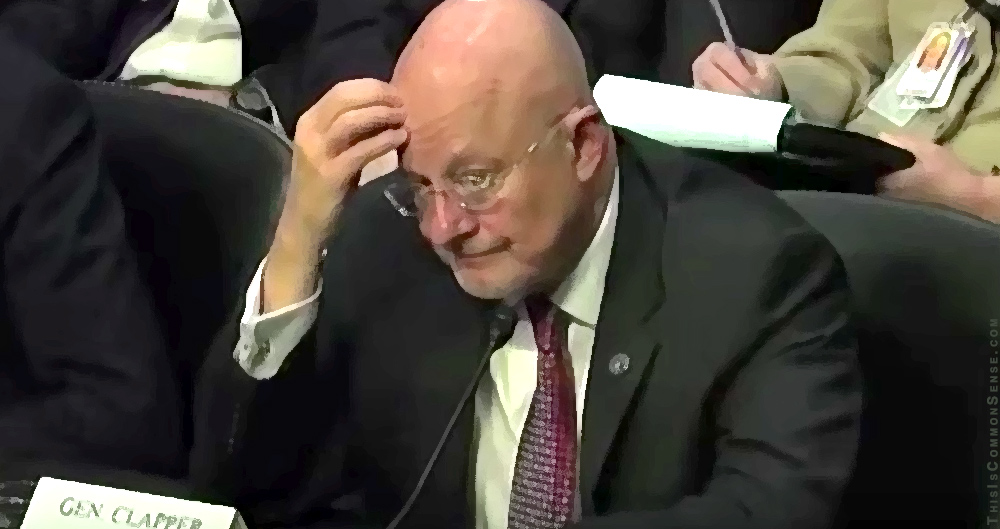
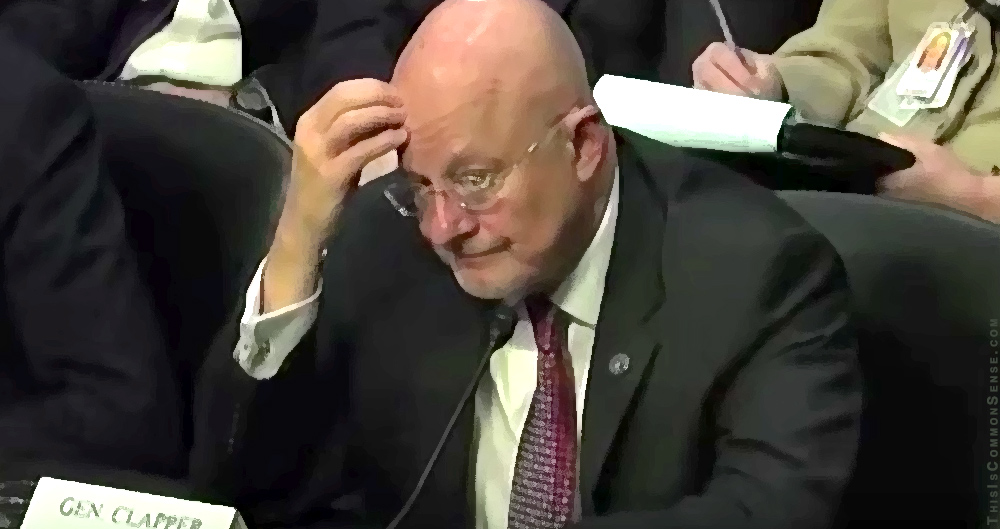
That’s why the case of the admittedly “untruthful”* James Clapper is so aggravating. When asked by Senator Ron Wyden, on the Senate floor, about data collection of phone calls by the U.S. federal government, he — the director of national intelligence under President Barack Obama from 2010 to 2017 — lied through his teeth.

And had not Edward Snowden leaked information on the National Security Administration’s metadata collection program, we would not have learned anything about it.

No wonder, then, that several congressmen want to prosecute Clapper before March 12, when the Statute of Limitations runs out on his crime. Steven Nelson at the Washington Examiner quotes Rep. Ted Poe (R-Tex.), Rep. Thomas Massie (R-Ky.), Rep. Louie Gohmert (R-Tex.), and Rep. James Sensenbrenner (R-Wis.) as all being in favor of siccing federal prosecutors on the forked tongue spymaster.

Senator Wyden warns that letting lies such as Clapper’s go unaddressed encourages Americans to be cynical about government, and “makes it possible, even probable, for hucksters and authoritarians to take power.”

Too late?

This is Common Sense. I’m Paul Jacob.


* Clapper’s March 2013 whopper at the Senate Intelligence Committee hearing was that the NSA was “not wittingly” collecting “any type of data at all” on millions of Americans. Later, to MSNBC, he characterized his artful dodge as having been “the least untruthful” way for him to respond.


PDF for printing


Categories
Accountability government transparency insider corruption moral hazard national politics & policies porkbarrel politics too much government

Earmark This Bad Argument

With President Trump endorsing a return to earmarks, House Republicans too are reportedly “reconsidering” their usefulness and pondering “how they might ease back into the practice.” Lawmakers fret that they have lost too much power by giving up this instrument of corruption. (Not their characterization.)

Wikipedia defines “earmark” as a budgetary provision that “directs funds to a specific recipient while circumventing the merit-based or [competitive] allocation process.” An earmark is a taxpayer-funded goodie bestowed on a congressman’s constituent, the sort of crony willing to contribute to the bestower’s next election campaign in return.

Quid pro quo, pay-for-play, bribery. Whatever you call it, there’s darn good reason why political leaders who fight corruption have fought to end earmarks.

Congressional Republicans imposed a ban on earmarks in 2011 to show that they were anti-corruption. So why relapse? Well, “the time is right,” according to GOP Representative John Culberson, for Congress to prove it can use earmarks responsibly. His bad argument is that the “excesses” of a decade ago were committed by “knuckleheads [who] went overboard.”

Somebody alert Culberson to the fact that many of the same knuckleheads are still in office. Ahem. Congress is not yet term-limited, remember?

The more basic point is that earmarks are by nature corrosive of sound government. President Trump’s only metric is apparently “getting [things] done” as opposed to obstructionism, preferring “the great friendliness” when we had earmarks. Sure, stuff got done — a lot more spending, a lot more bad stuff.

To the extent they’re gone, earmarks should stay gone. The only appropriate action is to make it even harder to bring them back.

This is Common Sense. I’m Paul Jacob.


PDF for printing


Categories
Accountability folly ideological culture local leaders national politics & policies term limits

The Great Dood Drain of ’17

How can we expect the federal government to continue to function at its usual peak efficiency without the awesome 52 years of experience and institutional knowledge supplied by Michigan Congressman John Conyers?

American government faces a congressional brain drain, Conyers’s resignation in the wake of accusations of sexual harassment not being anything like unique. Yesterday, Senator Al Franken (D-Minn.) announced his impending resignation, as did Rep. Trent Franks (R-Ariz.) — before allegations against him had even hit the news.

Also imperiled? The talents of an unknown number of other eminent gropers and experienced molesters, a treasury of firsthand knowledge of how government really works.

Sure, the nation survived back when George Washington stepped down after two terms as president; when Congress lost Daniel Webster and Henry Clay and John C. Calhoun, the institution carried on. 

But just think of the complexity of modern governance, and the great expertise and finely crafted statesmanship exhibited by someone like Congressman Conyers. Are we being sent up the proverbial Detroit River sans oar?

If only someone could step forward with the same skill-set as the iconic Conyers! Well, in announcing his resignation, and that his “legacy can’t be compromised or diminished in any way by what we’re going through now,” the congressman endorsed his son, John Conyers III, as his replacement.

Qualifications? you dare ask.

Back in 2010, the III tweeted, “My dad’s a f*cking player and reckless as hell! He just got at this doods wife super low-key.” Earlier this year, the young Conyers was arrested (but not prosecuted) on a domestic abuse charge.

Indeed, the “dood” appears more than able to carry on.

This is Common Sense. I’m Paul Jacob.


PDF for printing


Categories
Accountability crime and punishment insider corruption media and media people moral hazard national politics & policies responsibility too much government

Congress Bites Taxpayers

Is it even humanly possible to be sleazier and more disgusting than the Harvey Weinsteins of Hollywood?

Sadly, and clearly . . . yes. There is the U.S. Congress.

In 2011, after 175 years in operation, the House page program — whereby young people came to work and learn in the capitol — was shut down. Why? For Weinsteinian reasons, because pages were being sexually propositioned and harassed.*

Now, once again, Congress leads the way . . . downward . . . not only into a culture rife with sexual coercion, but also into one with few options for victims and plenty of protections for victimizers. Members of Congress have given more effort to keep complaints quiet and protect misbehavior than to stop misbehaving.

And there’s more . . .

“Between 1997 and 2014,” the Washington Post reports, “the U.S. Treasury has paid $15.2 million in 235 awards and settlements for Capitol Hill workplace violations, according to the congressional Office of Compliance.” That’s shelling out nearly $1 million a year, though the information doesn’t detail how many complaints were for sexual misconduct.

It is despicable when individuals or companies pay hush money to silence accusers, hiding the criminal sexual behavior of powerful men. But, for goodness sake, at least we don’t have to pay for it!

Conversely, Congress’s sexual abuse slush fund comes from you and me, taxpayers.  

Regarding the swirling allegations against Alabama GOP Senate candidate Roy Moore, Sen. Cory Gardner (R-Colo.) argued that Moore “does not meet the ethical and moral requirements of the United States Senate.”

Well, then, he will fit right in.

This is Common Sense. I’m Paul Jacob.


* The program ended several years after the Mark Foley scandal — and there were others. The official rationale? A tight budget (stop laughing) and technology, which purportedly made the work pages were doing unnecessary. But note that the Senate continues its use of pages.


PDF for printing


Categories
Accountability Common Sense incumbents initiative, referendum, and recall local leaders moral hazard national politics & policies responsibility term limits

Agreeable America

Americans actually agree on a lot of things; it’s a pity that today’s media and political debates play up the discord.

Or so argues A. Barton Hinkle at The Richmond Times-Dispatch. Sure, he admits, “[a] lot of people seem willing to tear your head off over the smallest thing.” But “on some topics, the public is of one mind, or as close to that as you can get.”

Hinkle notes that “Nine out of 10 Americans think a background check should be required for every firearm purchase.”  A few percentage points fewer wish to keep “Dreamers” in the country; a mere one point fewer disapprove of civil asset forfeiture. Medical marijuana is approved of by 83 percent of Americans.

Not on Hinkle’s list? American agreement on term limits. A year ago, a Rasmussen Poll found support for limiting congressional terms at 74 percent of likely voters, with only 13 percent opposed and 13 percent undecided. This overwhelming public support has been consistent for many decades.

But consistently ignored by Congress. Not so surprisingly.

Can Americans put their united oomph behind their overwhelming agreement? U.S. Term Limits thinks so.

The group isn’t depending on cajoling the Congress, either. They’re mobilizing concerned citizens to convince 34 state legislatures to call a Term Limits Convention.* The convention’s purpose is to propose a constitutional amendment for congressional term limits, which then still requires 38 states to ratify it.

Rather than brewing up a civil war over tweets and “microaggressions,” join the Term Limits Team.

Let’s agree to agree. And make our representatives agree, too.

This is Common Sense. I’m Paul Jacob.

* As Article V of the U.S. Constitution states, “The Congress . . . on the application of the legislatures of two thirds of the several states, shall call a convention for proposing amendments, which, in either case, shall be valid to all intents and purposes, as part of this Constitution, when ratified by the legislatures of three fourths of the several states . . .


PDF for printing