Categories
Accountability incumbents insider corruption local leaders moral hazard national politics & policies responsibility term limits

Our Experience with Experience

It seems exceedingly plausible that the longer one serves as a legislator, the better legislator one would become.

Yet voters back home have noticed something: the longer in office, the less representative their so-called representative tends to become.

No wonder that in those states where Americans have been permitted to vote on congressional terms limits, that vote has been a resounding, “Let’s limit ’em!”

In a Washington Post op-ed, Greg Weiner, associate professor of political science at Assumption College, praised Senators Jeff Flake (R-Ariz.) and Bob Corker (R-Tenn.) as “voices for congressional power” and “defenders of congressional prerogative.” He worries their departure weakens Congress as an institution, further eroding a critical check on the president and the executive branch.

“The problem pertains far less to opposition to this president,” Weiner points out, “than to the long-range erosion of congressional resistance to the presidency as an institution.”

This caught my attention because we desperately need Congress to function as a co-equal branch of government and because opponents of state legislative limits* often assert a similar argument: term-limited legislatures are less able to check the power of the governor and executive branch agencies.

“Congress has been in decline for generations,” Weiner acknowledges. What else has been happening over this time? Politicians have been loitering in Congress longer and longer, term after term after term. 

Hmmm. The correlation is between a weakened Congress and more experience, not less.

Let’s further note that Flake is only in his first Senate term and Corker his second.

After nearly four decades in office, is, say, doddering Sen. Thad Cochran (R-Miss.), providing better oversight?

This is Common Sense. I’m Paul Jacob.


* The 15 states that have them — Arizona, Arkansas, California, Colorado, Florida, Louisiana, Maine, Michigan, Missouri, Montana, Nebraska, Nevada, Ohio, Oklahoma, South Dakota — contain 37 percent of us.


PDF for printing


Categories
Accountability Common Sense folly general freedom media and media people moral hazard nannyism national politics & policies responsibility term limits too much government

It’s the Stupid Spending

These United States are approaching a crisis. Mounting debt seems increasingly unpayable. Sovereign default and financial chaos are “in the offing” — drifting from the (future) horizon to the (present) shore.

The costs of our debt load have been accommodated as astute economists predicted, with the weakest recovery in American history.

Seven years ago I wrote:

According to increasing numbers of Americans, it’s the level of spending by government that must decrease. We must balance budgets. Soon.

One could play sloganeer and say “It’s the spending, stupid”; or, twist that, to say “It’s the stupid spending.” But however you formulate the problem, what the new Republican House must do is find a way to cut spending.

They haven’t. Is there any reason, even with super-duper businessman Donald Trump riding herd, that they will make net cuts?

We can expect gross spending to increase and the debt to balloon even bigger.

Why?

Well, we are trapped.

Even the politicians themselves feel trapped.

You see, once the government begins a program, a constituency comes to depend upon it, and resists being “betrayed.” And the media supplies a steady stream of sob stories about the brutality of “austerity.” Politicians fear the passion of voters reacting to a specific hyped human need more than the general desire for less spending. So politicians increase the stupid spending.

Well, if the politicians are trapped, release them. Free them.

How? Term limits.

Congressional term limits would un-trap not just the pols — it’d free the voters, too. Let’s end the pretense that sending the same politicians to Washington term after term can produce local prosperity. Oh, the power of incumbency may lavish benefits on career congressmen, but it doesn’t pay off for the rest if us.

This is Common Sense. I’m Paul Jacob.
 

* It was President Harry Truman who said that term limits would “help to cure senility and seniority — both terrible legislative diseases.”


PDF for printing


Illustration: Gustave Doré, Avaricious and Prodigal”


Categories
Accountability media and media people moral hazard national politics & policies responsibility

Asleep at the Constitution

Are we at war in Niger, too? Do our “representatives” in Congress know?

The answer to the first question is, obviously, yes. The answer to the second is, admittedly, no

Yesterday, Meet the Press host Chuck Todd asked hawkish Sen. Lindsey Graham (R-S.C.) what the four U.S. soldiers ambushed and killed weeks ago were doing in Niger. “I can say this to the families,” Sen. Graham offered, “they were there to defend America,” before conceding that, “[W]e don’t know exactly where we’re at in the world militarily and what we’re doing.”

Oh.

Graham acknowledged he had been unaware U.S. military forces were even in the African country. And still hasn’t “been briefed.” Later in the program, Senate Majority Leader Chuck Schumer (D-N.Y.) also confessed his profound ignorance . . . before reading in the newspaper about the deaths of four soldiers there.

Still, Sen. Graham expressed great hope that Sen. John McCain (R-Ariz.) could “create a new system” to ensure that “if somebody gets killed there, that we won’t find out about it in the paper.”

Huh?

Doesn’t Congress’s job description include something about debating and deciding on policies, providing funding, and checking executive power?

Not, surely, cuddling in ignorance and burping up pablum.

Cradled in their long-term careers, our congressional delegates neither debate, deliberate, nor oversee much of anything.

In any case, we can be sure that Congress’s role in our constitutional system is not to scoop reporters to war news.

This is Common Sense. I’m Paul Jacob.


PDF for printing


Categories
Accountability folly ideological culture national politics & policies responsibility

Politics as Painfully Usual

The crazed nature of our leaders’ willingness to spend beyond revenue, and accumulate debt, is not limited to one party. Both Democrats and Republicans are responsible for their outrageously perverse fiscal policies.

Their irresponsibility hides in plain view, and can be seen in most of the major policy discussions of our time. Take two:

  1. the Democrats’ idea of putting every American on Medicare and
  2. the Republicans’ current tax reduction bill.

Though the Republicans often pretend to be all about something called “fiscal conservatism,” their murky tax plan is not fiscally sound. Not yet, anyway — after all, it is “evolving.”

And I expect it to get worse, not better.

“The current plan proposes about $5.8 trillion in tax reduction offset by about $3.6 trillion in base-broadening offsets, meaning that it would result in a $2.2 trillion deficit increase over the next decade,” Peter Suderman summarizes over at Reason.

They have a number of cuts in the works, but also plan to spend more on defense and the like. The debt would go up.

But if the Republicans are hypocritical and irresponsible, the Democrats add sheer insanity to their irresponsibility.

“Medicare for All” is pushed by Senator Bernie Sanders, who serves Vermont, where a similar universal system was enacted, only to be repealed after it proved unaffordable even with huge tax increases. All single-payer/socialized medicine proposals would require whopping tax increases to work, and the increases in spending would inevitably yield greater deficits.

Besides, Medicare is heading for financial Armageddon. Adding more burdens to a system that they cannot (or simply will not) now make solvent?

Only a politician could consider such a “solution.”

This is Common Sense. I’m Paul Jacob.


PDF for printing


Art by John Goodridge on Flickr


Categories
Accountability general freedom local leaders term limits too much government

Term Limits for the Memories

Opponents say term limits destroy “institutional knowledge.”

Imagine legislatures where unsophisticated solons blindly fashion public policies lacking any knowledge of the pluses or minuses of past legislation.

Well . . . actually that explanation bears a striking resemblance to the status quo in our career-dominated Congress. Who wants that?

Now comes an interesting real-world example of such institutional memory: term limits itself.

Back in 1991, residents of Jacksonville, Florida, petitioned a limit of two consecutive terms for city council members onto the ballot — after the city council voted not to place it before voters. When voters had their say, a very loud 82 percent endorsed term limits.

The Florida Times Union called it a “landslide decision.”

That was 26 years ago.* Last month, Councilman Matt Schellenberg proposed that the voter-enacted two-term limit should be replaced by a more politician-friendly three-term limit. He wants to stay in office for 12 years, rather than just eight.

“I think we restrict democracy when we put limits on us,” he declared. “I find the position of being on the council for 12 years is a perfect number . . .”

That’s when Councilman John Crescimbeni offered a dose of outside-the-institution memory, explaining that council members who voted against placing term limits on that 1991 ballot were run over.

“Six of the ten people who voted against [term limits] didn’t come back to office,” Crescimbeni warned. “If you want to push the green button tonight, I suspect that’s going to seal your fate.”

Suddenly, the city council decided to push off making any decision . . . until this week’s meeting. **

This is Common Sense. I’m Paul Jacob.

 

* A new poll commissioned by U.S. Term Limits shows  that Jacksonville voters oppose weakening their term limits law by a better than four-to-one margin.

** Your displeasure can be communicated to the Jacksonville council by calling (904) 630-1377.


Printable PDF


Illustration based on a photograph by Mark Bonica


Categories
Accountability crime and punishment folly local leaders media and media people national politics & policies responsibility

The Early Vote Worm

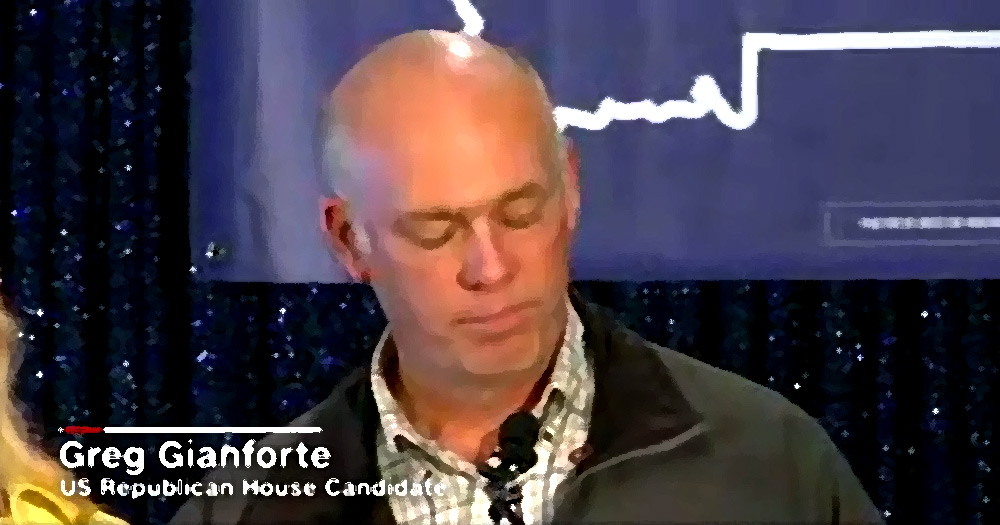
Last week was consequential for Greg Gianforte. Awfully.

The Republican businessman won the special election for Montana’s lone seat in the U.S. House of Representatives. He also body-slammed a reporter. He now faces misdemeanor assault charges.

For which Gianforte apologized publicly . . . as he was declaring victory. Welcome to modern American politics.

Democrats claimed victory, nonetheless — with media cover to boot. “Republicans’ 7-point win in last night’s Montana election is great news for Democrats,” the progressive Vox headlined their report.

At Townhall.com on Sunday, I explained why that claim misses both the forest and the trees. Yes, Trump won Montana by 20 percentage points against Hillary Clinton’s mere 35.4 percent back in November, while Gianforte won last week by only 7 points. But Trump was lucky to be opposed by a very unpopular Hillary.

Moreover, at that same election wherein Trump trounced Secretary Clinton, Gianforte lost the governor’s race to a Democrat. Indeed, Gianforte performed 11 points better last week than back in November — winning, instead of losing.

How does that show Republican support slipping?

The message from the Montana special election is that early voting periods are far too long. Montana’s early voting began nearly four weeks before Election Day. The assault by Gianforte, with criminal charges, hardly mattered, because roughly two-thirds of Montanans had already voted when it occurred.*

Rather than a nearly month-long process, whereby a candidate can bank a majority of the vote before the campaign is over, let’s make Election Day a three or five-day period. Make it easy to vote, but let’s all vote together, with the same information.  

This is Common Sense. I’m Paul Jacob.

 

* This means not only that Gianforte may have “gotten away” with his violent outburst, but that those voters did not have time to adequately appraise Gianforte on information they would have possessed and been able to act upon, with a shorter voting period.


Printable PDF


Categories
Accountability moral hazard national politics & policies responsibility U.S. Constitution

The Chicken-Ostrich Congress

Those who work for the president must tell the POTUS hard truths — on matters of war, most of all. Citizens must also be told hard truths. After all, we are, at least theoretically, the ultimate decision-makers . . . the president works for us.

That was my point yesterday.

But when it comes to life-and-death decisions about war and peace, there is also a congressional check on executive power.

Well, theoretically.

The big problem isn’t chicken-hawks in Congress, but chicken-ostriches. Bird-brained members of Congress implant their heads deep into the sand when it comes to foreign policy.

Where is the congressional debate over what to do in Afghanistan, our nation’s longest war? Rather than helping shape policy, Congress gladly lets the commander-in-chief control every aspect of foreign and military policy.

This gives the president unitary war-making power, anathema to the original character of our Republic, but it also means precious members of Congress are never held accountable for the disasters. After all, they didn’t do anything.

When mistakes are made or policy fails, the legislative branch can hold hearings to carp and moan and pontificate for the TV cameras.

American citizens, on the other hand, cannot so easily dodge the consequences of unaccountable foreign policies. In addition to engaging in military action in seven countries at present, the U.S. Government has pledged to defend another 50 countries, about one-fourth of the world.

Should more conflicts erupt, Congress won’t fight them. But our sons and daughters will.

This is Common Sense. I’m Paul Jacob.


Printable PDF


Categories
Accountability crime and punishment government transparency moral hazard national politics & policies U.S. Constitution

Feckless, Indeed

Last night, House Oversight Committee Chairman Jason Chaffetz (R-Utah) appeared on Fox News’ Tucker Carlson Tonight, where Chaffetz was asked how he would know if the Justice Department fully complied with subpoenas issued by his committee for documents.

“Look, we have a storied and horrific background on this,” explained the Utah representative, retiring after this, his fifth term in Congress. “You can go from everything from Fast and Furious to the Benghazi investigation, email, IRS, anything pretty much over the last eight years, which I’ve served in Congress, and I don’t believe we ever got a full production out of the Department of Justice or the State Department.”*

“I can issue a subpoena unilaterally. It’s part of my constitutional responsibility to provide that check and balance,” argued Chaffetz. “But that subpoena is only as strong as its ability to be enforced.”

Problem? Enforcement requires Congress to work through the DOJ, part of the executive branch. Tricky . . . when the Department of Justice** itself is being subpoenaed.

“You’ve seen, for instance, Judicial Watch,” Rep. Chaffetz noted. “Tom Fitton has much more power using a Freedom of Information Act, because he can get to the courts and the courts can force them.”

“The Department of Justice is afraid of a court; they’re not afraid of Congress.”

He added, “And we don’t use the power of our purse; we don’t beat it over their head and we don’t enforce it. And so it’s somewhat feckless, and it’s very frustrating as somebody who is chairman of the oversight committee.”

“Congress should have an expedited way to get to the courts to enforce those subpoenas,” Chaffetz offered.

Why, then, doesn’t Congress enact such a process?

This is Common Sense. I’m Paul Jacob.

 

* “And that continues, by the way,” Chaffetz added. “One of my frustrations, with all due respect to the Trump administration, is that they have not loosened up the documents that we have been requesting for years.”

** Or, for that matter, any another executive branch agency.


Printable PDF


Categories
Accountability incumbents term limits

Calling Hatch Home

Back in 2012, U.S. Senator Orrin Hatch pledged that, if elected, his current six-year term would be his last. On Election Day 2018, Hatch will be 84 years old — and have spent more than half his life in Washington.

Still, Utah’s senior senator just announced he intends to run for re-election for an eighth term.

Why? Our newly-elected president, Hatch told a Salt Lake City TV station, “is all over me to run again.” And so is the leadership in the Republican Senate — and even in the House. Or so he says.

But what about the people of Utah? A poll this past January found that 78 percent of Utahans “definitely” or “probably” did not want Hatch to seek re-election — with 58 percent in the “definitely” camp.

“Hatch’s bid for an eighth term is an endorsement of term limits,” argued Richard Davis, a political science professor at Brigham Young University, yesterday in the Deseret News.

“For many years, I opposed term limits because I felt legislators needed the time to gain knowledge and handle the long-standing bureaucracy and the power of interest groups,” Davis wrote. “However, I have concluded that such knowledge can be gained relatively quickly and would become more effective if there were not highly senior politicians, like Hatch, who dominate a legislative body for many years.”

In 1976, Hatch challenged an incumbent with the line: “What do you call a Senator who’s served in office for 18 years? You call him home.”

Today, having spent over 40 years in power, Hatch only wants more . . . and calls Washington home.

This is Common Sense. I’m Paul Jacob.


Printable PDF


Categories
Accountability folly incumbents national politics & policies term limits

Authority and Accountability

Roll, Founding Fathers, roll over. The situation with Congress is grave.

You designed three branches of government, each to check the others’ power. The first branch, and the most essential, is Congress. It not only controls the purse strings, but also the power to declare war.

But today’s Congress cannot even muster the courage to regulate the use of military force through legislation such as the War Powers Act or by passing an AUMF — an Authorization for the Use of Military Force.*

Yesterday on NBC’s Meet the Press, host Chuck Todd raised the issue of whether a new AUMF was necessary after the attack on Syria, especially for any further action. And would Congress dare to debate a new AUMF? 

“I don’t think anybody wants a vote on this,” remarked Danielle Pletka, a defense and foreign policy expert at the American Enterprise Institute. She pointed out that any action would put Congress in line for blame should problems arise. “Look, the problem for Congress is . . . There’s no percentage for them.”

“If Congress doesn’t exert its authority here,” Todd offered, “then they’re ceding it.”

“Yes,” agreed National Review Editor Rich Lowry. “This is something the founders never counted on, that you’d have one branch of government that didn’t want to protect its prerogatives because too much accountability would be involved.”

Must the very foundation of our Republic always take a backseat to the personal political interests of professional politicians? Career congressmen disdain leadership, preferring to lead the cheers when things go well and criticize when they don’t.

Another important reason for term limits.

This is Common Sense. I’m Paul Jacob. 

 

*The AUMF passed after 9/11 gave the president authority to go after Osama Bin Laden and al-Qaeda. It has become a catch-all authorization due to congressional fear of being held accountable for authorizing — or not — any new use of military force. Instead, Congress has simply pretended that President Obama’s regime-change military intervention in Libya and the military actions against the Islamic State fit under the post-9/11 AUMF. 


Printable PDF


Illustration includes photo by Petras Gagilas on Flickr