
Categories
ideological culture national politics & policies political challengers Voting

Good Night, Mr. Fetterman

In popular political culture, it’s the Republican Party that’s historically been fettered with the moniker of “The Stupid Party.” 

That’s what liberal philosopher and economist John Stuart Mill called Britain’s Tories, and affixing the “stupid” label to conservatives has been important for intellectuals ever since: it’s one way they feel good about themselves. 

We can argue about the (in)justice of the accusation till the cows come home and go out to pasture again, but it’s the Democrats who are pushing brain-damaged leaders, not Republicans.

I’m not just referring to President Joseph Robinette Biden’s many out-of-mind moments. I’m also talking about Pennsylvania Lt. Gov. John Fetterman’s run for the U.S. Senate.

The man suffered a stroke last spring, and has mostly been hiding out in the proverbial Biden Basement ever since. But on Tuesday he appeared on stage to debate his Republican opponent Dr. Mehmet Oz

Fetterman’s mental impairment? Obvious.

He began with the immortal clumsiness of “Good Night” rather than “Good Evening,” and stumbled through question after question. His handling of the minimum wage issue was slow-witted, and his awkward and robotic — and so obviously deceptive — repetitions regarding fracking sent shivers down my spine.

It’s not my purpose to make fun of people with brain injuries. But it is my role to call attention to the apologetics by Democrats (and the center-left/far-left news media) for their candidate, and their pretense that Fetterman’s just fine. 

He isn’t. Biden isn’t. 

And this says something about where Democrats are — intellectually; spiritually.

Very not fine.

This is Common Sense. I’m Paul Jacob.

US Capitol Building, brain damage

On Rumble: 


PDF for printing

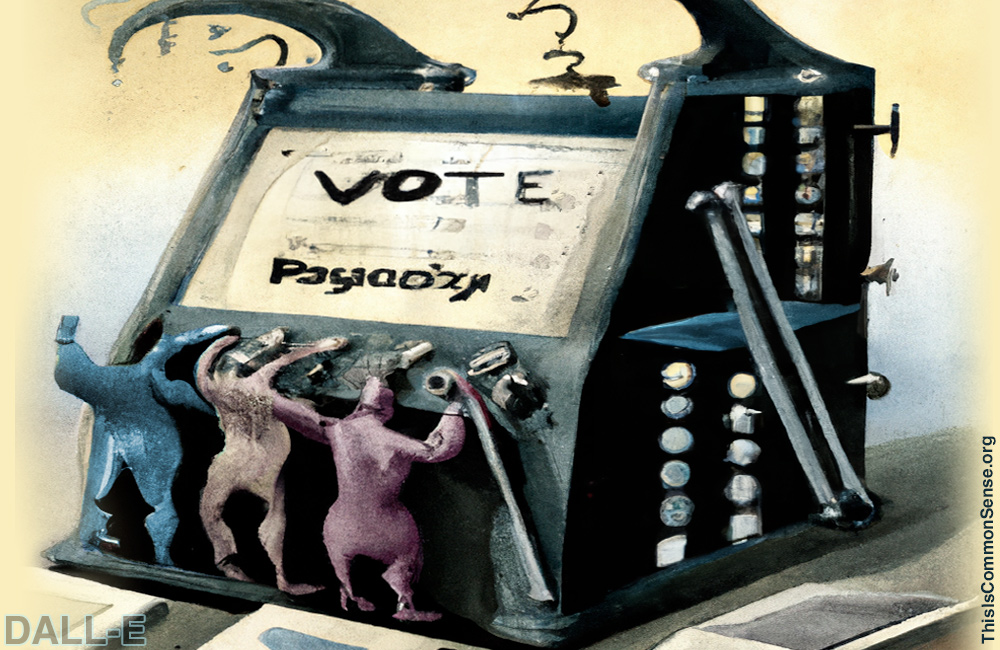
Illustrations created with DALL-E

See all recent commentary
(simplified and organized)
See recent popular posts

Categories
ideological culture national politics & policies

The 7 Percenters

Forget “the one percent.” I want to know about the seven percent.

Last month, the Gallup polling outfit asked Americans about our confidence level in Congress. Did we have “a great deal, quite a lot, some or very little”?

Unlike the 93 percent of us with firing brain synapses, there appeared an enigmatic seven percent, folks who actually confessed to harboring “a great deal” or “quite a lot” of faith in that cabal of corrupt careerists legislating loquaciously in our nation’s Capitol.

It takes all kinds, I guess. The shadowy, slow-witted, and ill-informed must show up in statistics somewhere, right?

Granted, only five percent of Republicans expressed that much cockeyed confidence; it was six percent a year ago. Trusting Democrats hit double-digits, with ten percent believing congressional bull, a fall from the 17 percent hornswoggled in 2021.

Gullible independents came in at the overall average — seven percent — a decrease of five percentage points from last year, when 12 percent clutched a false sense of security regarding our federal legislature.

Among a long list of American institutions, Congress roused the absolute least confidence. Odd that we feel worse about the people we elect to represent us than those we have little if any direct responsibility for or control over.

This must change.

We desperately need term limits. And the competitive elections brought by creating smaller districts where grassroots campaigns employing shoe-leather can compete with the big money and special interest power behind professional politicians.

This is Common Sense. I’m Paul Jacob.


PDF for printing

Illustration assist from DALL-E

See all recent commentary
(simplified and organized)
See recent popular posts

Categories
government transparency partisanship term limits

A Bazooka to Congress

It is “like bringing a bazooka to a sword fight,” complains an anonymous long-serving Democratic congressional aide.

“Democratic leaders are hammering Republicans,” Mike Lillis explains in The Hill.

At issue? The House Republican caucus is “considering term limits,” Punchbowl News was first to report, “on committee leaders of both parties if the GOP flips control of the House next year.” 

Republicans, since taking Congress back in the 1994 term limits wave, have mostly imposed a three-term limit on committee chairmanships, when in the majority, and on a committee’s ranking opposition member, when in the opposition. What may be different in the next Congress is that Republicans are looking to impose term-limits on committee leaders of both parties. 

Democrats, too. By House rule.

Though Democratic Party bigwigs won’t like it . . . especially current committee chairs who would get the heave-ho next year, such as Representatives Frank Pallone (D-N.J.) now in his 34th year in Congress; Bobby Scott (D-Va.), in his 30th year; Adam Smith (D-Wash.) in his 26th year; Bennie Thompson (D-Miss.), in his 26th year; and Maxine Waters (D-Calif.), in her 32nd year.*

Some younger congressional Democrats, on the other hand, see term limits . . . as an opportunity.

“High functioning organizations become so by building strong benches and limiting the tenure of leaders,” tweeted Rep. Dean Phillips (D-Minn.), now in his 4th year. “No matter which party controls Congress in ’23, we should adopt term limits for committee chairs & get serious about developing a new generation of leaders.”

Lillis calls it “a recurring predicament for Democratic leaders.”

But no fuss at all for the rest of us: we’re for term limits. On committee leadership as well as Congress membership.

This is Common Sense. I’m Paul Jacob.


* Even without this change, these Democrats would lose their chairmanships in the next Congress, should the GOP gain a majority in this November’s elections. But with this change they would also be denied the position of ranking member and thus would lose their hold on the chairmanship if Democrats won back the majority in 2024.

PDF for printing

See all recent commentary
(simplified and organized)
See recent popular posts

Categories
Accountability deficits and debt national politics & policies subsidy

What a Relief

Based on a quick look at the Edward M. Kennedy Institute for the United States Senate’s splash page, I wasn’t immediately sure what, precisely, the institute’s raison d’être might be. On the top menu bar there’s a slogan: “Just Vote.” Big clue? 

On the About page, though, we are told its mission: “educating the public about the important role of the Senate in our government, encouraging participatory democracy, invigorating civil discourse, and inspiring the next generation of citizens and leaders to engage in the civic life of their communities.”

As for the vision thing, that’s supplied by its namesake, Ted “I Survived Chappaquiddick” Kennedy: “To preserve our vibrant democracy for future generations, I believe it is critical to have a place where citizens can go to learn first-hand about the Senate’s important role in our system of government.”

I guess that explains why the institute’s Boston location sports a replica room of the U.S. Senate chambers.

Which costs serious money, of course.

Paid for entirely by the ultra-rich Kennedys?

Fact check: no. 

Some of it is paid for by you and me — courtesy of Congress and COVID!

You see, part of last year’s $350 billion in pandemic relief went to Boston’s memorial outfit for its once-favored now-deceased multi-millionaire politician. Five million bucks, it turns out, was used (the AP tell us) to pay off the institute’s debt. 

But don’t worry: the Kennedy Institute wasn’t singled out. Relief funds — which you might think would focus on struggling local libraries, community centers, and the like — also went to building a posh hotel and a minor league baseball stadium. And much, much more.

While politicians are good at spending money, especially for “emergencies,” they aren’t good at spending it well.

This is Common Sense. I’m Paul Jacob.


PDF for printing

See all recent commentary
(simplified and organized)
See recent popular posts

Categories
national politics & policies subsidy

Maxine and Nancy Sure Need Joe

“We thought that the White House was in charge,” explained Rep. Maxine Waters (D-Calif.), after the Democratic majority had failed to act on a key pandemic subsidy.

 “Action is needed,” implored a panicky Speaker Pelosi in a statement also signed by the Democratic House leadership, “and it must come from the Administration.”

“The Centers for Disease Control and Prevention-imposed moratorium [on home evictions] lapsed Sunday — five weeks after the Biden administration said it would extend the measure ‘one final month’ to July 31 and four weeks after the Supreme Court let the ban stand but signaled any new extensions would require Congress to act,” The Washington Post explained.

“But Congress didn’t act.”

Then, yesterday, President Biden responded to exhortations from his party’s left flank by announcing the CDC would extend the federal moratorium regardless of the unmet constitutional requirement.

“The bulk of the constitutional scholarship,” the president acknowledged, “says that it’s not likely to pass constitutional muster.” 

You don’t need to be a constitutional scholar to conclude that this sort of thing is wholly Pelosi’s bailiwick. But forget the Constitution, spending is the supreme law.

Also forgotten are the landlords devastated by the moratorium. They likewise have bills to pay. 

“Congress set aside nearly $50 billion to help families . . . pay the back rent they owe and avoid eviction,” National Public Radio reported. “But that money flowed to states and counties, which . . . have managed to get just a small fraction of the money to the people who need it.”

While the political “need” for bailouts directly resulted from government action — the pandemic lockdowns — blame for the current unconstitutional mess lies squarely with the Democratic Congress.   

This is Common Sense. I’m Paul Jacob.


PDF for printing

See all recent commentary
(simplified and organized)
See recent popular posts

Categories
free trade & free markets national politics & policies

First, Fire All the Freelancers

Congress is about to make the lives of an awful lot of people an awful lot harder.

So what else is new?

But the legislation in play does seem new — in suddenness and scope. 

It would impose massive newfangled regimentation on how we make a living. And it would kill the livelihoods of millions of people.

I refer to people who do gigs and freelance assignments for a living. One might ask why Democrats have it in for this kind of worker. Is it to appease unions? Is it the result of the same ideological forces that drove Karl Marx to despise the professional classes, needing to turn everyone into a prole? 

After all, this anti-freelancer agenda is not new. Similar legislation, called AB5, was tried a few years ago in California, instituted at the behest of activists eager to reduce competition with union work and remove chances for non-9-to-5 ways of making a living.

The premier target was ride-share companies Uber and Lyft. But many were caught in the net. AB5 created havoc throughout the state. Even socialist freelancers hated its mass murder of options and opportunity.

AB5-style congressional legislation to outlaw gig or freelance work except under very restricted circumstances is now being discussed in the U.S. Senate after having passed the U.S. House. It would also give unions many ugly new weapons to use to impose themselves on employees and employers.

In California, AB5 was mostly repealed by a citizen initiative.

Will there be a national citizen initiative to also promptly repeal the Protecting the Right to Organize Act? Unlikely, since Americans currently lack the right to enact national citizen initiatives.

This is Common Sense. I’m Paul Jacob.


PDF for printing

See all recent commentary
(simplified and organized)
See recent popular posts

Categories
local leaders term limits

Term Limits Trek

Izzy Israel lost his job. He had been working in Nashville’s music industry, but the coronavirus pandemic upset those plans. In the induced depression of the pandemic lockdowns, he decided to try to make a wider impact. He went walkabout.

Or, more properly, trek.

He set out to walk from the Florida Keys across country to Cape Flattery in Washington State . . . for a cause.

The cause?

Term limits. “We have people in Congress that are making policies and laws for their entire lifetimes,” he argues. “I think that’s highly corruptible. Big money is guiding our policies. You can see it. I think it’s time for term limits and I wanted to be a part of that change.”

According to the account in Alabama’s Pike County newspaper, The Messenger (troymessenger.com), “He began his cross-nation odyssey on Dec. 22, 2020, and hiked up the Florida panhandle solo until he reached Tallahassee. While generating some publicity for his cause, he attracted the attention of the national organization, U.S. Term Limits.”

Specifically, my old colleague Jeff Tillman.

“Once I met this guy,” Jeff says of Izzy, “I was amazed at how dedicated he was.”

The Messenger goes on to relate how Tillman’s support has made Izzy’s long march for limits on politicians easier and more effective.

Izzy points out that Congress is “having a hard time” term-limiting “itself.” Thankfully, explains Jeff, the Constitution provides a path for 34 states (two thirds) to call a convention to propose an amendment, bypassing Congress.

Four states — Alabama, Florida, Missouri, West Virginia — have passed an application for the single-subject convention advocated by U.S. Term Limits. Another 15 states have passed calls for a multi-subject convention, which includes term limits.

Let’s . . . enact some Common Sense. I’m Paul Jacob.


PDF for printing

See all recent commentary
(simplified and organized)
See recent popular posts
Categories
national politics & policies too much government

The Audacity of the Swamp

A crony anti-infrastructure plan.

That, writes Veronique de Rugy at Reason, is “the best description of the Biden administration’s proposed $2.3 trillion infrastructure plan.”

Democrats are the masters of favoring a select few at the expense of the electorate and calling it the Public Good. Their woke moralism, egalitarianism, and other pieties effectively mask their party’s accomplished crony scheming.

Right now, though, the heady audacity of spending trillions of dollars we do not (yet) possess is all the mask the Democrats appear to need. 

Does anyone talk about the Swamp anymore?

Never drained, it is back with a vengeance:

  • “A large share of the plan . . . is a massive handout to private companies. The proposal includes $300 billion to promote advanced manufacturing, $174 billion for electric vehicles, $100 billion for broadband, $100 billion for electric utility industry, and more.”
  • “Biden’s plan also includes hundreds of billions that have nothing even remotely to do with infrastructure.”
  • “To the extent that Democrats are trying to pay for this spending with taxes, they’re doing it in a way that belies their claim that this plan will result in a boost in quality infrastructure.”

The tax increase in the plan is to eliminate established tax “preferences” for fossil fuel companies. This would be politically popular with Democratic Party supporters, feeding their enviro-lust to lash out at what are commonly perceived as destroyers of the planet. But tax something more, get less. And a huge part of our infrastructure relies upon — indeed, consists in — the fossil fuel industry. So there will be less infrastructure investment in that realm.

But that doesn’t hurt the cronies. It hurts other folks.

This is Common Sense. I’m Paul Jacob.


PDF for printing

See all recent commentary
(simplified and organized)
See recent popular posts

Categories
national politics & policies partisanship

Our Rules or Theirs?

Last Thursday, President Biden signaled “that he would be willing to consider supporting the elimination of the filibuster,” CBS News reported following his first news conference, “if Senate Republicans use it to block Democratic legislative priorities from receiving a full vote on the Senate floor.”

“If”? Stopping the majority party from taking its legislation to a floor vote without a 60-vote supermajority to end debate is what the filibuster does.  

The president, a Democrat, is saying the filibuster is OK . . . as long as Republicans don’t use it.

You will of course not be shocked to learn that Biden has been a longtime, adamant supporter of the filibuster. In 2005, he gave an impassioned defense, arguing, “At its core, the filibuster is not about stopping a nominee or a bill — it’s about compromise and moderation.”

Biden called the GOP attack then a “fundamental power grab” and said his oration “may be one of the most important speeches for historical purposes that I will have given in the 32 years since I have been in the Senate.”

Yet, the filibuster is not in the Constitution. 

It is simply a Senate rule. And the majority party in the Senate can thereby fiddle with it. 

I’m not so much wed to the filibuster as I am wed to the idea that the rules with which Washington insiders wield power serve us and not just themselves. 

The filibuster should be made official in law or Constitution precisely so politicians cannot change it on whim or passion. 

Or it should be ended. But not before one party (or both) actually campaigns to end it, so that the American people can weigh in. Because these must be our rules if it is to be our government. 

This is Common Sense. I’m Paul Jacob.


PDF for printing

See all recent commentary
(simplified and organized)
See recent popular posts

Categories
First Amendment rights media and media people

Misinformed … or Worse?

“For the third time in less than five months,” journalist Glenn Greenwald writes at Substack, “the U.S. Congress has summoned the CEOs of social media companies to appear before them, with the explicit intent to pressure and coerce them to censor more content from their platforms. On March 25, the House Energy and Commerce Committee will interrogate Twitter’s Jack Dorsey, Facebooks’s Mark Zuckerberg and Google’s Sundar Pichai at a hearing . . .”

A joint statement by Democrat committee and subcommittee chairs declares: “This hearing will continue the Committee’s work of holding online platforms accountable for the growing rise of misinformation and disinformation.”

Wait — the constitutional authority of Congress does not stretch to holding social media “accountable” for political speech. The First Amendment clearly states that “Congress shall make no [such] law . . .”

And what Congress is forbidden to do, it cannot threaten and intimidate private companies into doing, instead.

“For the same reasons that the Constitution prohibits the government from dictating what information we can see and read . . . ,” Greenwald points out, “it also prohibits the government from using its immense authority to coerce private actors into censoring on its behalf.”

Consider longtime Hillary Clinton aide Jennifer Palmieri’s response to President Trump’s banning by Twitter and Facebook: “It has not escaped my attention that the day social media companies decided there actually IS more they could do to police Trump’s destructive behavior was the same day they learned Democrats would chair all the congressional committees that oversee them.”

Many on the left — and even some libertarians — continue to argue that Congress plays no role in the censorship being carried out by these private Tech Giants. 

They are mistaken — whether because misinformed or disinformed, we can leave to another day.

This is Common Sense. I’m Paul Jacob. 


PDF for printing

See all recent commentary
(simplified and organized)
See recent popular posts