Categories
Thought

Thomas Jefferson

[T]he horrors of neologism, which startle the purist, have given no alarm to the translator; where brevity, perspicuity, and even euphonium can be promoted by the introduction of a new word, it is an improvement of language. It is thus the English language has been brought to what it is; one half of it having been innovations, made at different times, from the Greek, Latin, French, and other languages — and is it the worse for these? Had the preposterous idea of fixing the language been adopted in the time of our Saxon ancestors, Pierce, Plowman, of Chaucer, of Spencer, the progress of ideas must have stopped with that of the progress of the language. On the contrary, nothing is more evident than that, as we advance in the knowledge of new things, and of new combinations of old ones, we must have new words to express them.


From the Prospectus to the English language translation of
Destutt de Tracy’s A Treatise on Political Economy, authored presumably by former President Thomas Jefferson (Georgetown, D.C.: Joseph Milligan; W. A. Rind & Co. Printers 1817).

Categories
free trade & free markets general freedom meme moral hazard nannyism national politics & policies Popular too much government

Is Denmark Socialist?

First… some definitions:

Socialism advocates the public ownership (or control) of business and industry in service of a more equal distribution of wealth.

Bernie Sanders and his version of “democratic socialism” places emphasis on redistribution and downplays the public ownership and control part of the system.

However… Bernie seems never to have met a government monopoly he didn’t love, or a free market enterprise he didn’t distrust or despise.

What are the problems (dangers) of socialism?


It idealizes envy.


It rationalizes theft.


It idealizes state power.


It penalizes accomplishment.


It rewards indolence.


It promotes obedience to the state.


It encourages dependence on the state by treating citizens as children.

It dismisses the protection of individual rights with a vague appeal to the “collective good” or “public good.”


It has repeatedly led to economic collapse, oppression, poverty and starvation. So how have Scandinavian democratic socialists managed to overcome these problems?

Quote from the current Prime Minister of Denmark:

“I know that some people in the US associate the Nordic model with some sort of socialism. Therefore I would like to make one thing clear. Denmark is far from a socialist planned economy. Denmark is a market economy.”
Speech, Harvard Institute of Politics


From “Scandinavian Unexceptionalism” (from the Institute of Economic Affairs):

Today the Nordic economies are again growing, following a return to broadly free-market policies that served them well before policies changed during the 1960s and 1970s.

The countries are changing in the face of serious long-term problems that have developed over the last 30 years.

Finland, Sweden and Denmark have…introduced far-reaching market reforms. These changes include greater openness to trade, clear reductions in the tax burden, private provision of welfare services, the introduction of personal retirement accounts and, in Denmark, even a shift towards a liberal labour market.

—Scandinavian Unexceptionalism (highly recommended!)

And the moral hazards?

The development of Scandinavian welfare states has led to a deterioration in social capital.

Nordic societies have for hundreds of years benefited from  a strong Lutheran work ethic, a strong sense of individual responsibility and high levels of trust and civic participation.

In the early stages of their transition to “democratic socialism”, safety nets DID exist, but few used them. Over time, an increasing share of the population became dependent on government transfers. The welfare states moved from offering services to the broad public to transferring benefits to those who did not work.

The situation that exists in Nordic societies today is one in which ethics relating to work and responsibility are not strongly encouraged by the economic systems. Individuals with low skills and education have limited gains from working. This is particularly true of parents of large families, which gain extra support if on welfare.

It is true that welfare systems have reduced poverty. However, especially in the second generation, they have also created a form of social poverty of the same type that is apparent in the countries from which many of the admirers of the Scandinavian systems come. Detailed research clearly shows that welfare systems have formed a culture of dependency which is passed on from parents to children.

MUCH MORE HERE on the moral and economic capital that preceded the welfare state, and its gradual disintegration over time… 


Do you believe that socialism is a good idea that has simply been corrupted by ruthless dictators? Consider the story of the Chinese Cultural Revolution. . .  a mass movement of Chinese youth dedicated to eradicating capitalism and advancing socialism. Its bloody history tells us quite a lot about the logic of this flawed political philosophy. . . “Socialism’s Idealistic Youth”


 Useful References

Scandinavian Unexceptionalism (Institute of Economic Affairs)
This paper is especially valuable because it was written by someone who actually favors a large welfare state. His willingness to concede the problems inherent in such a state are refreshingly honest… and useful for anyone interested in the issues.

What Can the United States Learn from the Nordic Model? (CATO Institute)

Myth: The Scandinavian countries are proof socialism works (Being Classically Liberal)

The Myth of the Scandinavian Model

Economic Freedom of the World: 2013 Annual Report

International government spending (Wikipedia)

Index of Economic Freedom (Heritage Foundation)


A healthy democracy depends on the spreading of good ideas. If you found this article useful,  please share it with friends by clicking on any of the social media icons below.

Also, please consider showing your appreciation by dropping something in our tip jar  (this link will take you to the Citizens in Charge donation page… and your contribution will go to the support of the Common Sense website). Maintaining this site takes time and money. Your help in spreading the message of common sense and liberty is very much appreciated!

Categories
by Paul Jacob video

Liberty Under Trump

Here is a fairly long interview with This Is Common Sense’s Paul Jacob, from a recent radio show:

The first 33 minutes give a pretty coherent picture of the politics of common sense today. If you stop there, no one would think ill of you.

Categories
Thought

Herbert Spencer

The current opinion that science and poetry are opposed is a delusion. . . . Think you that a drop of water, which to the vulgar eye is but a drop of water, loses any thing in the eye of the physicist who knows that its elements are held together by a force which, if suddenly liberated, would produce a flash of lightning? Think you that what is carelessly looked upon by the uninitiated as a mere snow-flake does not suggest higher associations to one who has seen through a microscope the wondrously varied and elegant forms of snow-crystals? Think you that the rounded rock marked with parallel scratches calls up as much poetry in an ignorant mind as in the mind of a geologist, who knows that over this rock a glacier slid a million years ago? The truth is, that those who have never entered upon scientific pursuits know not a tithe of the poetry by which they are surrounded.


Herbert Spencer, “What Knowledge is of Most Worth,” The Westminster Review (July 1859) volume CXL

Categories
Today

Against Slavery

On January 14, 1514, Pope Leo X issued a papal bull against slavery. On the same date in 1639, the first written constitution to create a government, the “Fundamental Orders,” was adopted in Connecticut.

Categories
Common Sense general freedom ideological culture moral hazard too much government

A Tree Fell In a Forest

It’s neither “iconic” nor “ironic.”

Storm fells one of California’s iconic drive-through tunnel trees, carved 137 years ago,” Travis M. Anderson’s title informs us. Calaveras Big Trees State Park is famous for its hollowed-at-the-trunk Pioneer Cabin Tree, a sequoia you have seen in hundreds of photos.

It fell, almost certainly, because of a storm. The ground got wet, undermining the sturdiness of the tree’s root system. And the winds got fast, sending the tree crashing to the ground.

But that’s not the hole — er, whole story.

The obvious reason it fell down is that the “hollowed-out” tunnel amounted to a huge cut. It is almost as if loggers started the felling job nearly seven score ago, and it took all that time to fall.

That is not “ironic,” in case you were wondering. It’s to be expected. The real wonder is that it stayed up so long.

Which should remind us: more than one cause can contribute to a singular effect. We are always tempted to focus on only one factor when we argue about an event. But in society, as in trees and forests, multiple influences are always at work.

Life isn’t monocausal, to put it in professor-speak.

Anderson dubbed the tree “iconic.” Now, an icon is an image used to stand in for other things that look similar. That tree didn’t stand in or represent, did it, other trees in the forest? It stood in memory by standing out as different, distinct — one of a very few hallowed, hollowed California sequoias. The opposite of “iconic.”

Still, in using the tree’s toppling as an object lesson in complexity, the fallen timber might be iconic. It stands for a common sense view of how tragedies happen.

This is Common Sense. I’m Paul Jacob.


Printable PDF

Calaveras Big Trees State Park is famous for its hollowed-at- the- trunk Pioneer Cabin Tree, a sequoia


Categories
Accountability government transparency ideological culture insider corruption meme moral hazard national politics & policies

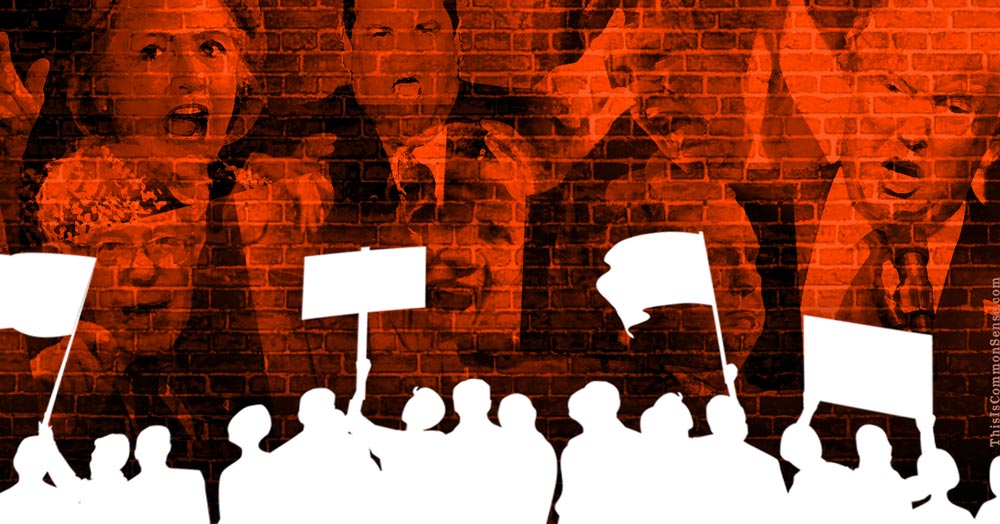
Corporate influence. . .

Corporations can buy unfair favors from government…because government has unfair favors to sell.

Big Government is the problem.


Click below for a high resolution version of this image:

corporations, influence, corporation, democracy, power, government, big government, meme, Common Sense, illustration


Categories
Common Sense

Thomas E. Woods, Jr.

Nullification begins with the axiomatic point that a federal law that violates the Constitution is no law at all. It is void and of no effect. Nullification simply pushes this uncontroversial point a step further: if a law is unconstitutional and therefore void and of no effect, it is up to the states, the parties to the federal compact, to declare it so and refuse to enforce it. It would be foolish and vain to wait for the federal government or a branch thereof to condemn its own laws. Nullification provides a shield between the people of a state and an unconstitutional law from the federal government.


Thomas E. Woods, Jr., Nullification: How to Resist Federal Tyranny in the 21st Century (Regnery, 2010), p. 3.

Categories
Today

Nullification?

On January 13, 1833, United States President Andrew Jackson (pictured, top left) wrote to Vice President Martin Van Buren (pictured, top right) expressing his opposition to South Carolina’s defiance of federal authority in the Nullification Crisis. Jackson insisted that “the crisis must be now met with firmness” and “the modern doctrine of nullification & succession put down forever.”

South Carolina had blamed protectionist high tariffs for the severity of the economic slump of the time, and Andrew Jackson’s compromise Tariff of 1832 was still too much special-interest “protectionism” for South Carolina, which threatened to nullify the law as unconstitutional. Jackson, a nationalist at heart, had no sympathy for dissidents in the southern states. (The tariffs were designed by northern politicians to encourage the growth of industry. The belief among most economists of that time was that such high “protective” tariffs favored certain businesses at the expense of the general consumer, particularly farmers and agricultural producers.) After the crisis subsided, tariffs were further reduced from the 1832 level, much lower than of 1828’s “Tariff of Abominations,” which had been signed into law by President John Quincy Adams — and written mainly by Martin Van Buren as a way to precipitate the election of Jackson.

Since the somewhat ambiguous end to the Nullification Crisis, the doctrine of state prerogatives — “states’ rights” — has been asserted by opponents of the Fugitive Slave Act of 1850, proponents of California’s Specific Contract Act of 1863 (which nullified the Legal Tender Act of 1862), opponents of Federal acts prohibiting the sale and possession of marijuana in the first decade of the 21st century, and opponents of implementation of laws and regulations pertaining to firearms from the late 1900s up to 2013. State opposition to ObamaCare has also recently conjured up the issue.


On January 13, 1898, Émile Zola’s J’accuse exposed the Dreyfus affair.

Categories
crime and punishment free trade & free markets general freedom meme moral hazard national politics & policies too much government

Which is more dangerous?

Corporations cannot and do not tax, conscript, and kill under claim of legal authority to do so.
Only governments do that. 

Click below for a high resolution version of the image:
corporations, government, power, danger, government vs. corporation, which is more dangerous, law, corruption, meme, illustration, Jim Gill, Paul Jacob, Common Sense