Oh, Elizabeth!
Categories
Parodying the Self-Parodic
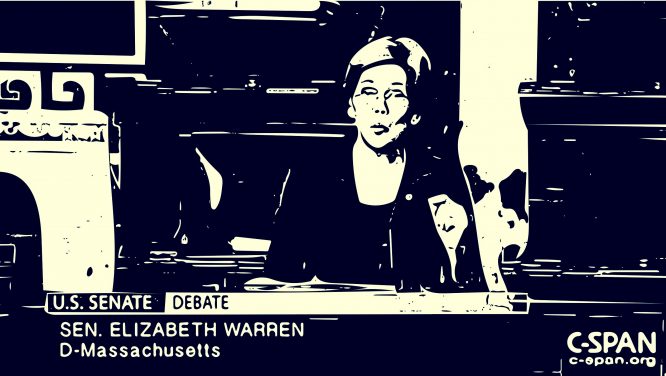
Oh, Elizabeth!

For all the talk of the evils of the American system of health care, at least we promote freedom of choice, and give as many options to people for their care as they can afford. As the doctor who offered experimental treatment [to Charlie Gard] said, in court, ‘if Charlie had been ill at any institution in the United States, they would have immediately begun the treatment.’ But in the U.K., a socialized medicine country, where individual needs come second to the preservation of the system, there’s less concern with parental rights. In the U.S., we are so interested in the freedom to obtain care that we insist on releasing a legally brain-dead girl to her mother so long as her mother wishes to keep her hooked up to a ventilator. In the U.K., they are insistent on withdrawing the opportunity for life-saving care because it is better to kill the child than keep it alive. While this case became a court proceeding, every single day the National Health Service (the NHS) makes decisions about how to ration care. Bernie Sanders tweets about how nobody should be denied care because they can’t afford it? But that’s what happens all the time under socialized medicine — the difference being, it’s not about you not being able to afford it, it is about the government not being able to afford it.
Ben Shapiro, on The Ben Shapiro Show, June 29, 2017, discussing the case of Charlie Gard, whom the government would not release to his parents to take him to America for an innovative treatment that might have saved his life — for which they had privately raised a small fortune.

Susan Rice, National Security Advisor in President Barack Obama’s administration (2013 – 2017), is being picked on, she speculates, for reasons pertaining to her race and gender.
Handy evasion.
At issue is not her infamous prevarication in the Benghazi affair. We are used to being lied to about foreign policy, so that was barely a shock.
What is news now? The Trump-Russia story.
Background: Ever since her defeat to Donald Trump, former Secretary of State Hillary Clinton has provided the very model of how to deflect attention from one’s own defects. She’s blamed FBI Director James Comey, the vast right wing conspiracy, and, of course, Russia.*
Amusingly, the Russia biz still boils down to how Russian hackers, apparently directed from high in the hierarchy of the Eastern warlord state, illegally liberated information from private servers. Those revealed emails showed Mrs. Clinton and her campaign in a negative light. Excuse-makers call this “hacking the election.”**
It turns out, the biggest crimes committed during the campaign, and somewhat regarding Russia, were engaged in by the Obama Administration, perhaps especially by Rice herself. She is accused of illegally surveilling the Trump campaign and those around it by “unmasking” their identities in the course of surveillance reports, which are legally required to be anonymous . . . when catching in the net folks tangential to the target.
The law requires FISA court go-aheads for such identifications. And the Obama administration was roundly reprimanded by a FISA court for not following protocols.
In any case, the idea that only women and African-Americans are hounded by opposition parties and the press does not hold up to scrutiny.
Nixon, anyone?
This is Common Sense. I’m Paul Jacob.
* Her team has also blamed President Barack Obama
** A private server was hacked, not an election.


On June 30, 1801, Frédéric Bastiat was born. Bastiat became one of the most important French Liberal School economists, following Condilliac and Jean-Baptiste Say, best known for his books Economic Harmonies and Economic Sophisms and two monographs, “The Seen and the Unseen,” and “The Law.” He was a brilliant stylist and perceptive critic of state-managed trade. His influence on conservative, libertarian and “limited-government thought” has been vast.
The emergency number of “999” was introduced in London, June 30, 1937, the first of its kind — arguably the best innovation in better government service in modern times.
Tolerance only extends as far as the Left wants it to extend, which is not to say ‘very far.’
Ben Shapiro, on The Ben Shapiro Show, June 26, 2017, summarizing an LGBT march organizers’ attitudes towards “the Juden,” upon the occasion of their disallowing gay and lesbian Jews from parading with a rainbow flag featuring a Star of David on it.

Do politicians have any idea what they are doing?
In Oregon, Senate Bill 828 just passed the Senate and is now being favorably reviewed in the House. The law would require “large employers in specified industries to provide new employee[s] with estimated work schedule and to provide current employee with seven days’ notice of employee[’s] work schedule.”
But will the measure help employees? Really?
The notion is called the “Fair Work Week.” Pushed by Democrats, it has gained bipartisan support. The basic idea: allow time (under full force of law) for workers to manage their own schedules and personal economies.
Trouble is, in the name of making work easier to manage, it attacks flexibility.
Which is something many workers want. More than notification.
Indeed, the study commissioned by the City of Seattle for their similar regulatory scheme acknowledged that reducing flexibility is not necessarily a godsend for workers.
“A more predictable schedule,” the report noted, “is not always one that an employee would prefer. A schedule known with certainty is a cold comfort if it yields too little income to survive.”
The report went on to explain that many of the labor market’s scheduling inconveniences are themselves the result of other government regulations, such as ObamaCare.
Christian Britschgi, writing at Reason, predicts that passing the Oregon law would mean “a fairer worker week” for some, but for others, “no work week at all.”*
Meanwhile, the Seattle study noted that it was workers in small businesses who are most likely to be discomfited by last-minute scheduling changes. The Oregon law applies only to big businesses.
This is Common Sense. I’m Paul Jacob.
* A standard, negative consequence of most “well-intended” legislation.


Iris Murdoch, Sartre: Romantic Rationalist (1953), Ch. 9, p. 137.
The role of philosophy might be said to be to extend and deepen the self-awareness of mankind.

On June 29, 1914, the day after the shooting of the Archduke Ferdinand and his wife, Austrian interrogations confirmed that the Serbian government was behind the assassination. Serbia denied involvement.
Thus continued the series of events that led to “The Great War,” now known as “World War I.”

It should shock no one: forcing businesses to pay steep minimum wages ends up pushing some businesses out . . . of business. Yesterday I looked at what minimum wage laws can do to low-skilled workers. Today, consider the employers. When we make it harder to turn a profit, it becomes harder to profit. Businesses that can’t at least break even close their doors.
Many business owners are inclined to promote, politically, politicians who in turn support minimum wage hikes. Do they change their minds when mugged by reality? Alas, the trauma alone won’t convert a person to principled allegiance to free markets.
I was reminded of this fact by a story about business owners in Minneapolis who stress their Sandernista credentials.
“I’m a bleeding-heart liberal and I’m a big Bernie Sanders supporter,” says businesswoman Jane Elias, an art store owner. “But this whole flat-out, $15, one-size-fits all is just wrong.” Another victim, restaurant owner Heather Bray, says she’s a “proud, proud progressive.” But: “The arithmetic doesn’t work. People will not continue to go to budget-conscious restaurants when they’re no longer budget-conscious.”
So . . . arbitrary minimum-wage demands don’t add up in light of the demands of running their businesses under their particular circumstances. Well, no disagreement here. But take it further, please. Keep doing the math. The bottom line is that everybody, not just you — and always, not just sometimes — has the right to make his own decisions about his own life and property.
And profit by it.
This is Common Sense. I’m Paul Jacob.

“Is the majority morally supreme, or are there moral rights and moral laws, independent of both majority and minority, to which, if the world is to be restful and happy, majority and minority must alike bow?”