Categories
crime and punishment education and schooling folly general freedom moral hazard privacy responsibility too much government U.S. Constitution

Ecstatic with Independence

Utah’s legislature unanimously passed it; the governor signed it — the nation’s first measure protecting what’s become known as “free-range parenting.”

It was once known simply as “parenting.”

Certain activities are now exempt from a state law criminalizing child neglect. Children may legally “walk, run or bike to and from school, travel to commercial or recreational facilities, play outside and remain at home unattended” — thereby allowing “a child, whose basic needs are met and who is of sufficient age and maturity to avoid harm or unreasonable risk of harm, to engage in independent activities . . .”

Back in the day, we apparently played outside in a sort of statutory limbo.

Do we really need a law saying kids can walk on a public street?

Sadly, yes: government agencies across the country are grossly violating the most basic rights of parents to rear independent children.

Regular readers may recall my 2015 defenses* of the Meitiv parents against the absurd charge of “unsubstantiated neglect” leveled against them by Montgomery County (Maryland) Child Protective Services. Ultimately, Maryland authorities acknowledged that permitting one’s kids (in the Meitivs’ case, a 10- and a 6-year-old) to walk on a public sidewalk (from a local park) wasn’t prima facie evidence of a crime. 

The current free-range parenting movement was launched in 2008 when Lenore Skenazy publicly admitted — to mass shock and condemnation — to allowing her 9-year-old son to take a trip alone on New York City’s subway.

“My son got home,” she wrote in the New York Sun, “ecstatic with independence.”

Notice how rare it is to find anyone ecstatic with dependence.

Lesson? An old one: Happiness must be pursued with freedom.

This is Common Sense. I’m Paul Jacob.


* My writings on the Meitivs’ battle to keep their kids:


PDF for printing


Categories
Accountability general freedom ideological culture media and media people moral hazard nannyism responsibility too much government U.S. Constitution

The Abortionists’ Cartoon Advice

Let it not be said that Planned Parenthood lacks for principles.

When Donald Trump offered a deal, last year, to fund Planned Parenthood only if the organization would stop doing abortions, the company immediately clarified the situation. “Offering money to Planned Parenthood to abandon our patients and our values is not a deal that we will ever accept,” said the outfit’s executive vice president. “Providing critical health care services for millions of American women is nonnegotiable.”

And, for Planned Parenthood, abortion is indeed critical. “The Trump administration needs to stop playing political games that would put access to the full range of safe reproductive care at risk,” said Senator Kirsten E. Gillibrand (D-NY), “or they will get the fight of their lives.”

Well, that fight was won by Planned Parenthood. The politician who once said he would “shut down the government” over the abortionist enterprise has caved after various roadblocks. Trump signed a stopgap omnibus spending bill, last week, which continues to funnel $500 million towards the outfit.

So, as if to celebrate, a Pennsylvania branch of the abortion mill — er, “reproductive care” service — engaged in a bit of ebullience, a “light-hearted” tweet:

We need a disney princess who’s had an abortion

We need a disney princess who’s pro-choice

We need a disney princess who’s an undocumented immigrant

We need a disney princess who’s actually a union worker

We need a disney princess who’s trans

This caused a firestorm.* And not because its Disney obsession was silly. The problem? The tweet showed that Planned Parenthood is really, really committed to valorizing the killing of fetuses. And that its agenda is far, far left.

The outfit should be left without taxpayer funds.

This is Common Sense. I’m Paul Jacob.


* The Tweet was quickly removed.


Printable PDF


Categories
crime and punishment free trade & free markets general freedom moral hazard national politics & policies too much government U.S. Constitution

High on Hemp?

Hemp is not marijuana.

And yet it is.

Earlier this week, Senate Majority Leader Mitch McConnell announced he will introduce legislation to legalize industrial hemp.

He is not concerning himself with marijuana, which is what we call the plant Cannabis sativa when cultivated for its Tetrahydrocannabinol (THC) content, the principal chemical in the plant that makes it ideal for “recreational” uses. Industrial hemp is Cannabis sativa, too, just with minuscule THC.

Hemp products are actually legal to buy and sell in the United States.

Sort of.

But growing it is murky, considering that ingestible hemp is a Schedule 1 drug no matter how little THC it has — despite the fact that Congress has allowed states to regulate the growth of low-THC hemp for “industrial” purposes.  

A complicating factor is that industrial hemp contains an oil, Cannabidiol (CBD), which is neither an ecstatic nor a hallucinogenic drug, but is widely believed to have many therapeutic powers. And is widely sold all over the country, wherever states have allowed for medical marijuana.

Nevertheless the DEA objects to it as much as to THC, saying that all ingestible forms of hemp are illegal.

Because of all this murkiness, McConnell’s bill might seem to be welcome step towards clarity.

Trouble is, since industrial hemp is indistinguishable from cannabis with THC — to look at; to smell; to touch — officials hoping to crack down on marijuana-as-a-psychoactive-drug would be much hampered were industrial hemp commonly and legally grown.

What a mess. The only real solution is to de-list all forms of Cannabis sativa from the War on Drug’s Schedule of Drugs It Unconstitutionally Proscribes.

This is Common Sense. I’m Paul Jacob.


PDF for printing


Categories
crime and punishment general freedom media and media people moral hazard nannyism national politics & policies privacy too much government U.S. Constitution

Unlovely Congress

If you recently tried to post a personal ad on Craigslist, the popular classified-ad site, you were in for a shock. Craigslist has suddenly discontinued all personals. You can still sell your used rototiller, but forget about telling the world you’re lost in Louisville looking for love.

The company doesn’t want to be prosecuted for helping people find each other en route to becoming partners in outlawry.

Congress has just passed legislation subjecting site publishers to criminal and civil liability when their users “misuse online personals unlawfully.” The president’s signature is expected. Craigslist doesn’t want all that open-ended liability. “Any tool or service can be misused,” it observes.

Indeed. If the principle underlying this law were consistently applied, any good or service that facilitates communication (or other human activity!) would expose providers to liability for any illegal conduct abetted by their products. Would curtain manufacturers be exempt? We all know how bad guys plotting evil pull their curtains. Freedom of speech, freedom of casual encounters, freedom of curtain-trafficking, it’s all at risk.

What about Congress’s goal of discouraging prostitution?

Will all U.S. prostitutes now retire?

Not if the last several thousand years are any clue. Especially as other sites follow Craigslist’s lead, prostitutes who had escaped the streets thanks to online means of client-hunting will tend to return to those streets. If so, neighborhoods less seedy and less dangerous thanks to Craigslist etc. will now tend to reacquire such unlovely qualities.

Thanks to (unlovely) Congress.

This is Common Sense. I’m Paul Jacob.


PDF for printing


Categories
Accountability crime and punishment education and schooling folly general freedom ideological culture moral hazard nannyism Second Amendment rights too much government U.S. Constitution

Insufferable Common Sense

Sometimes common sense and open discourse can’t be suffered — or won’t be, anyway.

So discovered Timothy Locke, a popular teacher at Cherry Hill High School East in New Jersey, after discussing the possibility of arming teachers to help protect adults and kids from would-be mass-murderers. Locke also suggested that he’d be among those bearing arms if allowed.

Most of Locke’s students were okay with his opining. But one student was bothered enough by the viewpoint to complain to administrators.

Without further ado, the school — the “Home of the Cougars,” which proudly proclaims its promotion of “a welcoming environment, community, diversity . . . participation . . . growth mindset, grit. . . ,” so forth — searched Locke’s belongings, subjected him to mental and physical evaluations, and suspended him.

Mental evaluation? Wasn’t that a ploy in the old Soviet Union: dissenters must be crazy, hence ought to be carted off to the loony bin? Let’s go nowhere near such sanctions against independent thinking here.

“The bottom line,” Locke summaraized, “is that I was very concerned about security at my school.”

Through an online petition and otherwise, hundreds of students have protested the shabby way that a teacher who inspires them has been treated.

Students less enthusiastic about Locke lament the teacher’s tendency to digress — still legal in all 50 states.

So what now? After a futile school board meeting deflecting questions on Locke’s fate, a second, special meeting is scheduled for tonight, March 6, at 7 pm in the Cherry Hill High School West Auditorium.

Let’s hope sanity prevails.

This is Common Sense. I’m Paul Jacob.


PDF for printing


Categories
Accountability media and media people national politics & policies U.S. Constitution

Jokesters in Power

Ronald Reagan was known to make a jest or two. After being shot, he joked with his surgeons about their partisanship. In front of a hot mic, he shocked the media by saying he had “signed legislation to outlaw Russia forever,” and that bombing would begin “in five minutes.”

The down-homey half-quips of George W. Bush turned malaprop into something almost endearing — to some. And Barack Obama’s appearances on talk shows were often well-crafted comedy routines.

So, let’s not take President Donald Trump’s recent quip in honor of China’s President Xi Jingping too seriously.

Let’s not freak out just yet.

Sure, he seemed to favor Xi’s moves to remove the constitutional term limits placed upon him. But, not reported in much of the coverage, was the tone.

Trump was joking.

“He’s now president for life. President for life. No, he’s great,” Trump said. “And look, he was able to do that. I think it’s great. Maybe we’ll have to give that a shot some day.”

That is supposed to be funny. Trump does have good comic timing and delivery. Hillary Clinton not so much.* That may be one of the reasons he squeaked into the White House.

But to take it all seriously for a moment. What Trump is talking about is basically an elected king. Which is precisely what Alexander Hamilton first pitched in Philadelphia, so long ago. It was struck down — along with most of his nationalist agendaby the convention. But he did “give it a shot.”

And was it entirely unrelated that Thomas Jefferson’s first Vice President later gave Hamilton a shot?

Too soon?

This is Common Sense. I’m Paul Jacob.


* Just compare how Barack Obama killed with UFO material, and how Hillary seemed to be several degrees too clumsy at it.


PDF for printing


Categories
Accountability crime and punishment general freedom ideological culture media and media people nannyism national politics & policies responsibility Second Amendment rights too much government U.S. Constitution

Self-Defense, Implausible?

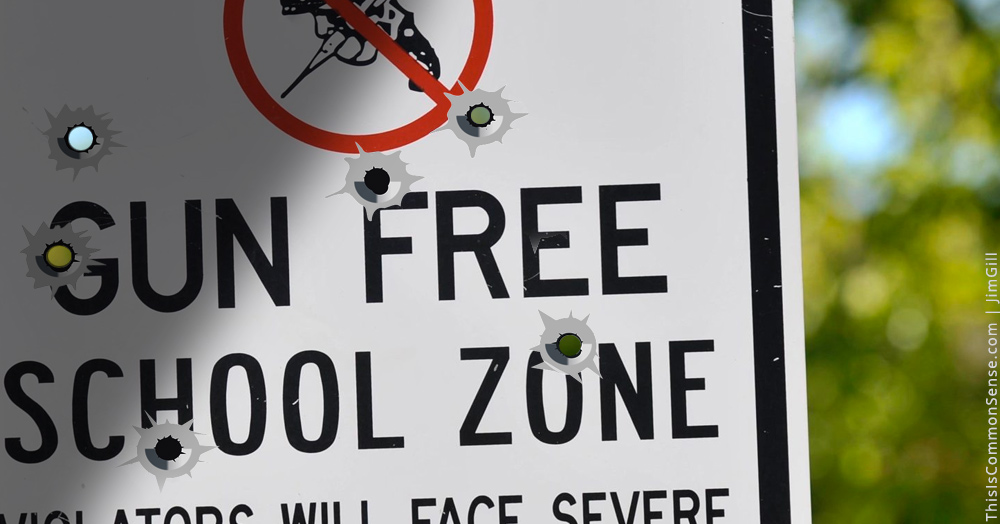
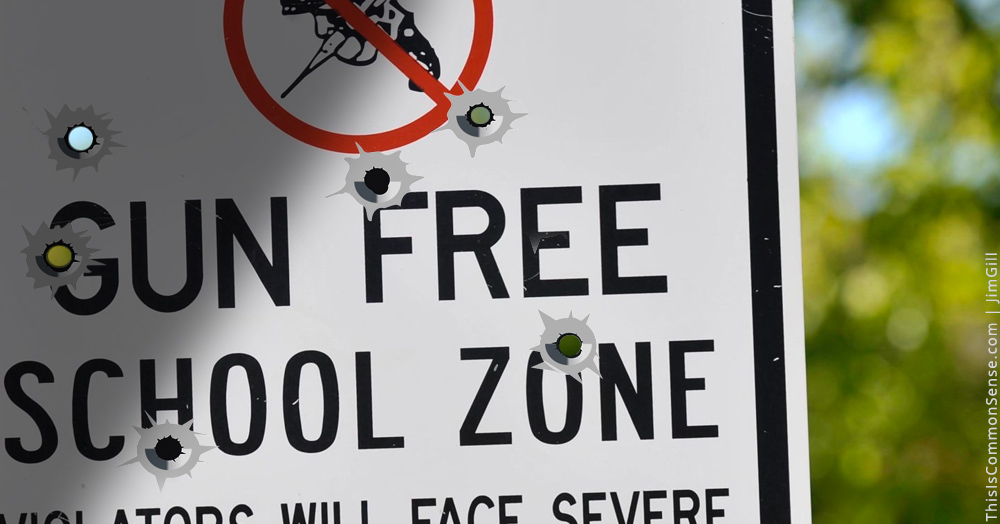
Don’t take a GUN-FREE ZONE sign to a gun fight.

Whenever there’s a horrific incident of mass murder, advocates of citizen disarmament blame the right to protect oneself against armed attackers. The thinking seems to be that if we make it illegal for all civilians to have guns, bad guys willing to kill people will also refrain from using guns as they try to kill people.

This is implausible.

And if you do not see its implausibility immediately regarding firearms, consider drugs. Not taking them, but the war on same. Drugs didn’t vanish upon prohibition. Neither would guns if prohibited.

President Trump argues that students would be safer were schools a harder target. Why not arm well-trained teachers? “If you had a teacher who was adept with the firearm, they could end the attack very quickly.” He’s right.

Not a new idea, of course. It’s been argued, for example, by the NRA, whose chairman says that the way to stop a bad guy with a gun is with a good guy with a gun.

This idea is being practiced right now — in Israel.

As Tzvi Lev argues at the Arutz Sheva 7 site, Israel proves the NRA’s point.

Even Israel — where Arab communities are “rife with illegal weapons” despite their illegality — has not always been quick to recognize that it’s better to have lots of armed civilians when terrorists start shooting at civilians. But after terrorists attacked a school in 1974, the government began arming and training teachers — somehow failing to defer to the terrorists’ preference for gun-free zones.

In both of the only-two school shootings in Israel since then, teachers killed the attackers.

This is Common Sense. I’m Paul Jacob.


PDF for printing


Categories
crime and punishment general freedom ideological culture media and media people moral hazard nannyism national politics & policies privacy responsibility Second Amendment rights too much government U.S. Constitution

He Applied Himself

“I need to make this count,” wrote a young man in Everett, Washington.

Unfortunately, it looks like he wasn’t attempting a big career-oriented project. He was planning a mass shooting.

“I need to get the biggest fatality number I possibly can,” is one of many damning journal passages the police have made public. Apparently he had settled on attacking the high school he attended. “I’ve been reviewing many mass shootings/bombings (and attempted bombings) I’m learning from past shooters/bombers mistakes.”

Ambition and rigor: missapplied.

Fortunately, his grandmother read his journal and discovered a rifle in his guitar case. She turned him into the police the Tuesday before the Florida shooting I wrote about last week. And maybe just in time.

Meanwhile, last week’s Parkland, Florida, shooting dominates the headlines. Fellow students and neighbors of the Florida shooting victims have ramped up their condemnations and demands — including at a horrorshow “town hall” on CNN.

Yet the nature of the difficulties in preventing such atrocities has become lost in the rhetoric and anger.*

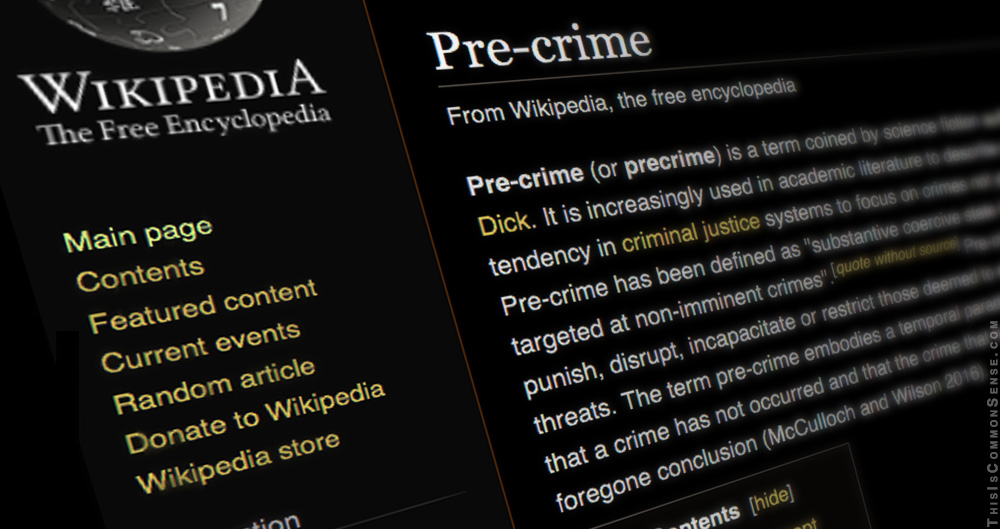
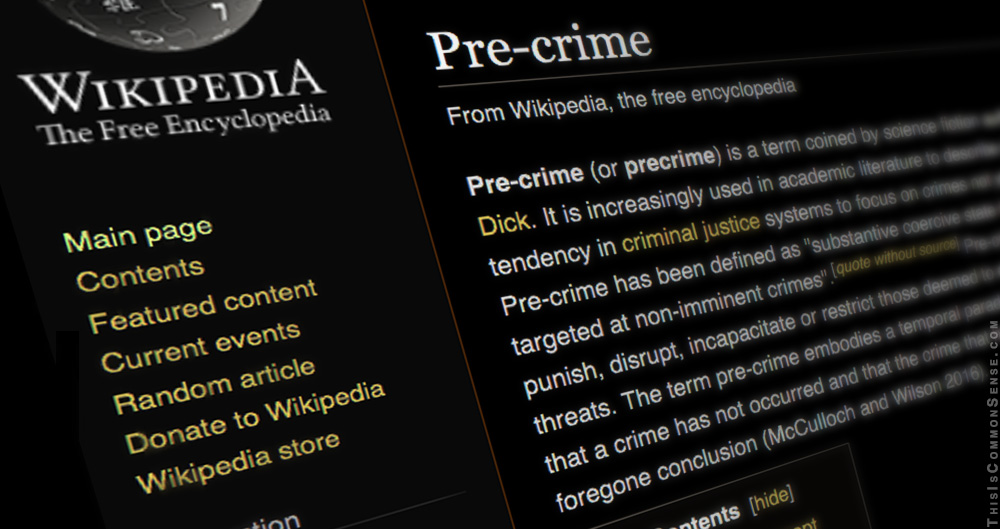
In a free society, we cannot arrest people before they commit a crime. In the Everett case, officials were “lucky”: despite the young man’s lack of a criminal record, they were able to charge him with a burglary they allege he committed the day before arrest — and his extensive planning notes are being taken as evidence for intent. He’s also been charged with attempted murder.

We should be in inquiry mode, right now. It could be helpful to know the exact motivations for both the Florida shooter and the Everett wannabe — and similar cases.

This is Common Sense. I’m Paul Jacob.


* Law enforcement is tasked with uncovering spree shooting plots today — and to protect, too. But the armed, uniformed school resource officer at the Parkland high school failed to protect. He heard the gunshots but never entered the building, while the shooter killed 17 innocents.


PDF for printing


Categories
Accountability folly general freedom government transparency ideological culture moral hazard national politics & policies responsibility too much government U.S. Constitution

Not Even with a Straight Face

Is American foreign policy so foreign to our values that even those who have served at the very pinnacle of national intelligence agencies have trouble telling the truth?

“Have we ever tried to meddle in other countries’ elections?” Laura Ingraham, host of Fox News’ The Ingraham Angle, asked James Woolsey, director of the Central Intelligence Agency (CIA) from 1993 to 1995.

“Oh, probably,” Mr. Woolsey replied. “But, uh, it was for the good of the system, in order to avoid communists from taking over. For example, in Europe in ’47-’48-’49, the Greeks and the Italians, we, the CIA—”

“We don’t do that now, though?” Ingraham interjected. “We don’t mess around in other people’s elections, Jim?”

“Well . . . urrrrr, yum, yum, yum, um, um,” the old spymaster offered to laughter from both Ingraham and her studio cameramen. “Only for a very good cause,” he added with a sly grin, “and the interests of democracy.”

Interests. Of. Democracy.

Ha. Ha ha. Laughing yet?

Foreign Policy tells us that documents declassified in 2017 “shed light on the Central Intelligence Agency’s central role in the 1953 coup that brought down [elected] Iranian Prime Minister Muhammad Mossadegh . . . poisoning U.S.-Iran relations into the 21st century.”

Need more? There’s a handy database that lists undemocratic and illegal* shenanigans going on and on through the ’60s, ’70s, ’80s, up through President Obama to today.

“This broader history of election meddling has largely been missing from the flood of reporting on the Russian intervention . . .” noted the New York Times last December.

Of course, our government’s interference doesn’t justify Russian government interference. But, we can only (possibly) control our politicians.

This is Common Sense. I’m Paul Jacob.


* “Meddling in other’s elections is a violation of international law,” Steve Baldwin writes in The American Spectator. “More importantly, U.S. law prohibits the use of tax dollars to influence foreign elections.”


PDF for printing


Categories
Accountability crime and punishment general freedom government transparency moral hazard national politics & policies privacy property rights too much government U.S. Constitution

Thwarting Cops Who Are Robbers

“Carrying cash is not a crime,” Institute for Justice attorney Dan Alban informs us, “yet too often the government treats it like one.”

Musician Phil Parhamovich learned that the hard way. He was porting his life savings, almost $92,000 — earmarked for a down payment on a recording studio — when cop-robbers of the Wyoming Highway Patrol stopped him for not wearing a seat belt.

It turned out to be an extremely expensive infraction. The officers intimated that it was illegal to travel with so much cash and pressured him to hand it over. Scared and believing that his alternative was jail, Phil signed a preprinted waiver letting them grab his life savings.

Preprinted waiver? This means it’s routine for these guys to try to legitimate their actions as they premeditatedly intimidate and rob people.

The state of Wyoming tried to keep the money. Fortunately, the Institute for Justice took Phil’s case, and a judge accepted the facts presented by Phil and his IJ lawyer. After months of tribulation and suspense, the robbery victim got his money back.

Another win for the good guys.

Thankfully, the Institute for Justice’s freedom-defenders have won a great number of such cases. Yet, IJ lawyers certainly cannot litigate all the forfeiture injustices being committed by government  authorities all across the country.

That’s why the group is pushing to reform civil asset forfeiture laws, requiring a criminal conviction before property can be forfeited. 

And you can help. How? Launch efforts in your town or state, or work to push infant efforts to a higher level. Take the initiative. 

This is Common Sense. I’m Paul Jacob.


PDF for printing