Categories
education and schooling general freedom national politics & policies

The Explosion in Alternatives

“Across the country, we’re in the midst of an unprecedented explosion in homeschooling and alternative education,” Sharyl Attkinson reported last Sunday on her weekly news program, Full Measure, citing a “mass exodus from America’s public schools.”

And it’s not just about pandemic measures like mask mandates. In February, San Francisco voters overwhelmingly recalled three school board members over their fixation on wokeness to the exclusion of in-person education. And the school board’s antics in liberal Loudoun County, Virginia, turned last year’s race for governor into a referendum on whether parents have any say-so at all. 

They do, apparently

Though I have covered the enormous growth of alternative education during the pandemic — here and here, for instance — I have been looking for more specifics. 

“Relative to pre-pandemic levels,” Corey DeAngelis with the American Federation for Children told Attkisson, “homeschooling has at least doubled,” and now accounts for “closer to 4 million students.”

Too good to be true? I double-checked. The U.S. Census Bureau used the same language as Attkisson and DeAngelis: “the global COVID-19 pandemic has sparked new interest in homeschooling and the appeal of alternative school arrangements has suddenly exploded.”

At the end of the 2019-2020 school year, “about 5.4% of U.S. households with school-aged children reported homeschooling,” according to their Household Pulse Survey. “By fall, 11.1% of households with school-age children reported homeschooling.”

The increase was five-fold for “respondents identified as Black or African American,” with 16.1% homeschooling.

“Still more students have left for religious schools,” reminds DeAngelis, “or other private schools.”

Attkisson also pointed to a jump in support for school choice.

Parents of the world unite. 

This is Common Sense. I’m Paul Jacob.


PDF for printing

See all recent commentary
(simplified and organized)
See recent popular posts
Categories
Accountability deficits and debt national politics & policies subsidy

What a Relief

Based on a quick look at the Edward M. Kennedy Institute for the United States Senate’s splash page, I wasn’t immediately sure what, precisely, the institute’s raison d’être might be. On the top menu bar there’s a slogan: “Just Vote.” Big clue? 

On the About page, though, we are told its mission: “educating the public about the important role of the Senate in our government, encouraging participatory democracy, invigorating civil discourse, and inspiring the next generation of citizens and leaders to engage in the civic life of their communities.”

As for the vision thing, that’s supplied by its namesake, Ted “I Survived Chappaquiddick” Kennedy: “To preserve our vibrant democracy for future generations, I believe it is critical to have a place where citizens can go to learn first-hand about the Senate’s important role in our system of government.”

I guess that explains why the institute’s Boston location sports a replica room of the U.S. Senate chambers.

Which costs serious money, of course.

Paid for entirely by the ultra-rich Kennedys?

Fact check: no. 

Some of it is paid for by you and me — courtesy of Congress and COVID!

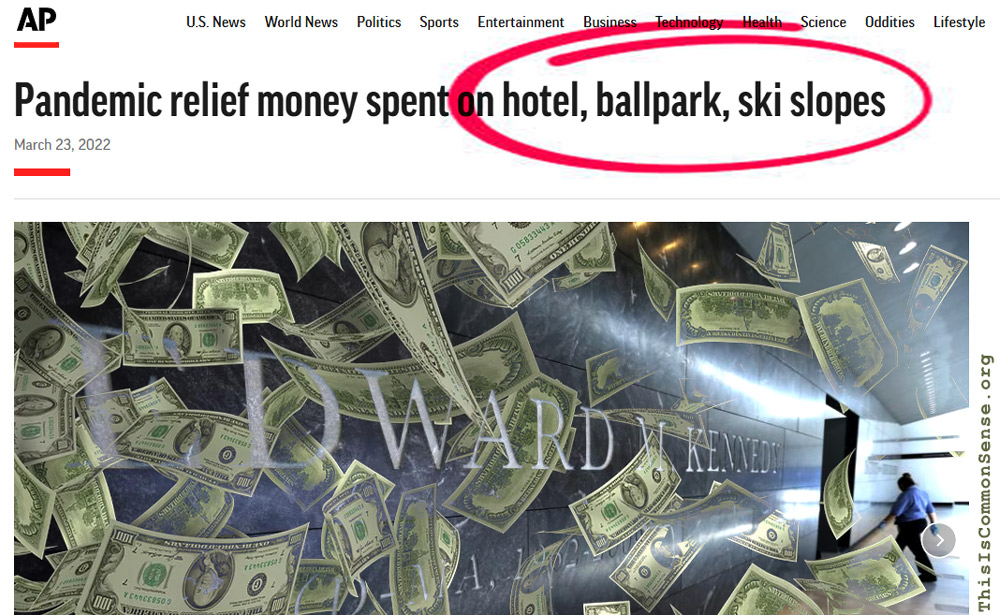
You see, part of last year’s $350 billion in pandemic relief went to Boston’s memorial outfit for its once-favored now-deceased multi-millionaire politician. Five million bucks, it turns out, was used (the AP tell us) to pay off the institute’s debt. 

But don’t worry: the Kennedy Institute wasn’t singled out. Relief funds — which you might think would focus on struggling local libraries, community centers, and the like — also went to building a posh hotel and a minor league baseball stadium. And much, much more.

While politicians are good at spending money, especially for “emergencies,” they aren’t good at spending it well.

This is Common Sense. I’m Paul Jacob.


PDF for printing

See all recent commentary
(simplified and organized)
See recent popular posts
Categories
media and media people national politics & policies

Shut Up, Spouse

“Stand down and let your better half do the job,” was the specific advice syndicated-columnist Kathleen Parker recently offered a woman, explaining that this woman’s “biggest mistake is that she thinks she’s important.”

Adding for emphasis: “She is not.”

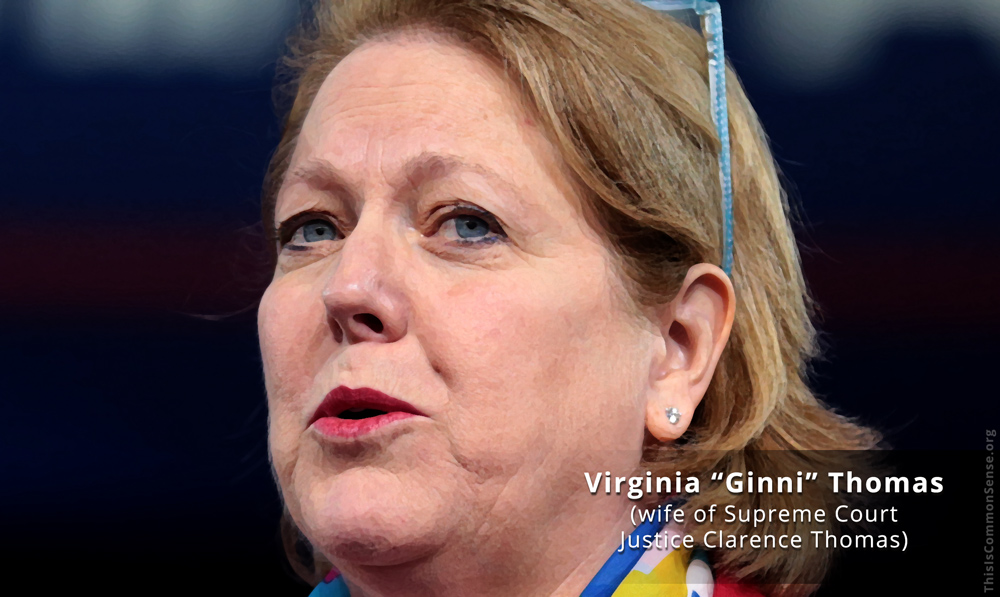
Parker is not writing about Hillary Clinton, Michelle Obama, or Dr. Jill Biden. Her subject? Virginia “Ginni” Thomas, the wife of Supreme Court Justice Clarence Thomas.

Recollecting Ginni attending her writing seminar decades ago, Parker describes Ginni then as a “sweet, eager-to-learn 40-something,” who was “quite likable.”  

“But,” claimed Parker, “something has happened to the Ginni Thomas whom I knew then.”

What exactly

“Today,” we are told, “she’s entrenched with various hard-right conservative groups” and is “anti-feminist, anti-affirmative action, and, perhaps worst of all to her critics, pro-Donald Trump.”

Lions and tigers and bears, oh my! . . . seems Ginni Thomas dares to hold opinions with which Parker disagrees.

Moreover, explained the columnist, Ginni “has not been idle in politics, advocating for issues that, importantly, could come before the court on which her husband serves” — as virtually any issue under the sun could. Parker connected Ginni’s political participation to calls “on Clarence Thomas to recuse himself from cases in which his wife has been active.”

Every spouse of a Supreme Court justice has (or arguably should have) political views of his or her own. And the right — and propriety — to act on them. 

Though Parker’s whole column is rich, the cream of the irony has to be first listing Ginni Thomas as an “anti-feminist” and then suggesting she shut up and leave politics to her husband.

This is Common Sense. I’m Paul Jacob.


PDF for printing

See all recent commentary
(simplified and organized)
See recent popular posts
Categories
national politics & policies

Bipartisan Daylight?

Is there a case for switching back and forth to “save daylight”? To me, it seems a typically dumb thing governments do.

I can quote experts who argue that Daylight Saving Time doesn’t save much, and causes no small amount of harm, while others could quote experts saying the opposite.

It really comes down to holding to respectable standards. The reason to oppose Daylight Saving Time is that our time zones should have a touch of truth about them. 

Before railroads stretched across America, words like “noon” and “midnight” and “ante meridiem” and “post meridiem” possessed clear meanings in every locality. The morning ended when the Sun was directly overhead (solar noon), and the afternoon began just after. 

The hours of the day corresponded to this.

But with railroads, traveling quickly west or east engendered chaos as engineers’ pocket watches provided no real manageable time to schedule trains and keep them to schedule. So time zones were invented, grouping longitudinal neighbors together to make it easy to know when to adjust moving clockwork mechanisms. Still, there was a connection between clocks’ noontime and true noon somewhere in each time zone.

Anyway, Daylight Saving Time (which I’ve written about before) was invented to nudge us to get to work earlier, allowing us more leisure time at day’s end. 

On Tuesday, the U.S. Senate voted unanimously to extend Daylight Saving Time the whole year around. No more “Spring forward/Fall back” nonsense.

But also: no more true noon anywhere in America, ever again. Well, considering how gerrymandered the time zones are: far fewer true, solar noon locations.

Another chasm between Man and Nature, courtesy of Government.

This is Common Sense. I’m Paul Jacob.


PDF for printing

bird and red

See all recent commentary
(simplified and organized)
See recent popular posts

Categories
general freedom international affairs national politics & policies

How to Avoid World War III

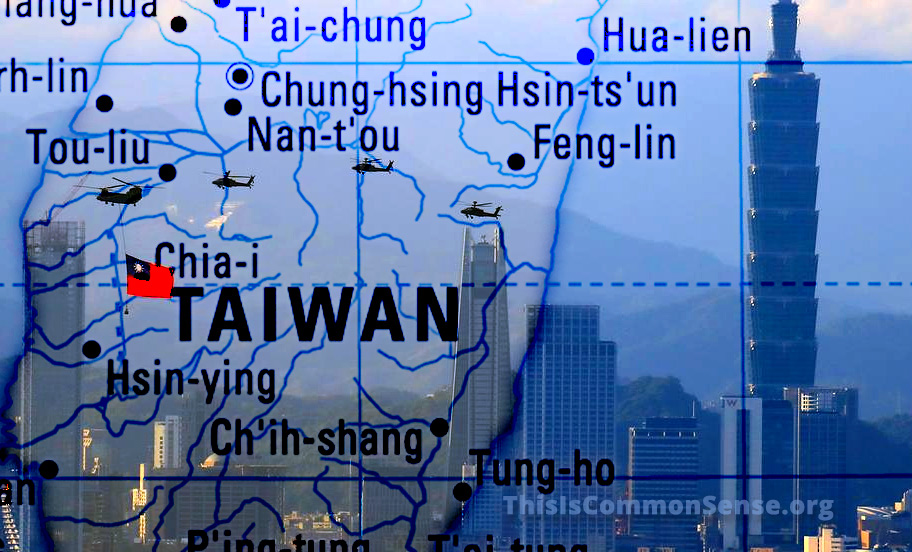
Last week, when I heard about a power outage across Taiwan, my first thought was the possibility of a Chinese cyberattack which might precede a military attack.

It was not that. Thank goodness.

But what if it had been? Many have speculated that the Russian invasion of Ukraine might distract the U.S. and thereby encourage Xi Jinping and his People’s Liberation Army to launch an assault against Taiwan. 

How should the U.S. react to a Chinese invasion? Even with our silly policy of “strategic ambiguity,” most in Asia expect the U.S. to defend the island nation. The Washington Post and others argue the U.S. has committed to fight with Taiwan.* 

That’s not the case with Ukraine.

Like Ukraine, Taiwan will defend itself, but is over-matched. Geographically important as part of the first island chain, Taiwan is, as former Secretary of State Mike Pompeo points out, “right in the middle of our defensive parameters, from Japan to Korea to the Philippines in the South China Sea.”

And the island is economically nearly essential. “Ninety percent of the most advanced [computer] chips are made in Taiwan,” reports The New York Times

The United States should not be the world’s policeman, which dilutes our strength, needed not only for our own defense and the defense of navigable trade routes but also the defense of hundreds of millions of currently free people with whom we are allied — especially in Asia. 

Most urgently in Taiwan.

As a country, it’s time to start doing some homework, and push-ups. Economically. Militarily. Being weak doesn’t help anyone. Being strong is our best chance to avoid World War III.

This is Common Sense. I’m Paul Jacob.


* The USA has pledged military assistance to 67 countries in all, including the Republic of China (Taiwan), but not Ukraine. It’s a list the American people have every right to re-configure. But until then, one Pentagon planners should get busy with.

PDF for printing

See all recent commentary
(simplified and organized)
See recent popular posts
Categories
deficits and debt free trade & free markets national politics & policies too much government

Inflation Evasion…Depression

Going into the lockdowns and bailouts, a consensus of politicians and their court wizards, the economists, had belittled the specter of inflation.

Nowadays, when folks use the term “inflation,” they really mean upward movement on the consumer price index (CPI). Some economists, who have a sense of history,* reserve the word not for price level increases, but for increases in the supply of money. And the two concepts are tightly linked. 

But a whole lot of people seek to blame CPI rate increases on anything but monetary policy, as Veronique de Rugy notes in an article at The American Spectator.

“Theories for why we shouldn’t worry abounded,” de Rugy writes. “It was caused by a base-effect price increase, supply-chain restraints, a drought in Taiwan — everything but the Fed’s expansionary policies and Congress’ overspending, in part because some of these experts had cheered for these actions all along.”

And then inflation came back.

Big time.

While expressing some humility and an unwillingness to make predictions, de Rugy insists that “the amount of money printed, borrowed, and spent during the last few years led to a one-time price level rise, and we may have a way to go until we are done.” 

She also insists that the Pollyanna phrase “transitory inflation” is no comfort: “inflation was always going to be transitory. Even the inflation of the 1970s ended in the ’80s. What mattered is whether transitory inflation meant a few weeks, months, or years.”

And, I cautiously add, how de-stabilizing it is. Consumers rightly worry about rising prices, but inflation doesn’t hit all sectors the same. Credit expansion leads to imbalances that are hard to correct. 

And the correction is “depression.”

This is Common Sense. I’m Paul Jacob.


* Including the history of their own discipline. Readers of Austrian economists such asF.A. Hayek get a better sense of past debates than from other economists.

PDF for printing

Categories
general freedom nannyism national politics & policies paternalism

Self-Inflicted Death — by Vax?

It’s been disheartening how little alarm has been raised about the rise of suicide (along with drug use, obesity, and other markers for despair) in reaction to the lockdowns and de-humanizing mask mandates — especially among the young.

But there’s another way suicide has become an issue with the pandemic. It’s a little roundabout.

Adverse effects of the vaccines have been severely under-reported. A number of maladies are associated with the various vaccines, including micro-clotting and myocarditis — that latter up especially in younger people who have been vaccinated.* 

But some adverse reactions are fatal — those up 40 percent in the adult population, says the CEO of one life insurance company. 

Our leaders and vaccine promoters don’t talk about this: if they admitted fatal side-effects, the push for universal, mandatory vaccination might be generally considered inhumane,even monstrous. But insurance companies have a more pressing concern.

Last month, a Frenchman with a large life insurance policy died of the jab. His family cannot sue the drug company — legal immunity having been granted during the emergency — so his heirs and assigns sued to collect on the insurance. The court denied the claim. 

“The side effects of the experimental vaccine are published and the deceased could not claim to have known nothing about it when he voluntarily took the vaccine,” the court’s logic runs. “There is no law or mandate in France that compelled him to be vaccinated. Hence his death is essentially suicide.” 

And suicide is not covered in most term life insurance policies. 

The message: you take your chances with the vaxxes. 

If more such cases come to light, this may be the issue that fatally undermines the Vaccine Mandate Narrative.

This is Common Sense. I’m Paul Jacob.


PDF for printing

See all recent commentary
(simplified and organized)
See recent popular posts
Categories
government transparency national politics & policies partisanship

Pandemic Second Opinion

U.S. Senator Ron Johnson’s aim, in moderating a panel discussion last week, was to provide, in his words, a “long-overdue second opinion” on the coronavirus pandemic. The senior senator from Wisconsin gathered a wide variety of experts who offered up a lot of information. 

Included in the nearly five hours of material is some startling information — data derived from military personnel and their families.

You may remember that the current president has made the “vaccines” mandatory for the military. Well, Ohio attorney Thomas Renz “presented DOD medical billing data from the Defense Medical Epidemiology Database (DMED) that paints a shockingly disturbing picture of the health of our service members in 2021,” writes Daniel Horowitz for Blaze

What was found?

  • A massive 300% increase in DMED codes registered for miscarriages in the military
  • Cancer diagnoses: up nearly 300%
  • Diagnosis codes for neurological issues: up 1000%
  • Bell’s palsy: 291% increase
  • Female infertility: up 471%
  • Pulmonary embolisms: 467% increase
  • Congenital malformations: 156% rise

Now, these do not represent individual cases, but specific diagnoses, which can be multiple for each patient. Still: alarming.

And in case you might wonder about blaming COVID itself for some of these, consider the miscarriage rate: it was normal in 2020, before the vaccines, and it spiked in 2021, with the vaccines. 

These rate increases were based on data going back five years prior to 2021.

While these issues need to be fully addressed, the sad truth is that approved, official government personnel and the pro-vax “expert” authorities declined to participate in the Wisconsin Republican’s hearing.

More evidence that the pandemic has become a partisan issue, with Democrats pushing the official narrative.

This is Common Sense. I’m Paul Jacob.


PDF for printing

See all recent commentary
(simplified and organized)
See recent popular posts
Categories
folly insider corruption national politics & policies

Vax Con?

Is the mRNA “vaccine” push a “con job”?

“‘Confidence games’ (or ‘cons’)” are, according to scholars Barak Orbach and Lindsey Huang,* “a distinctive species of fraudulent conduct” perpetrated “to further voluntary exchanges that are not mutually beneficial.”

In their paper, Orbach and Huang list a number of typical cons, noting that many “cons succeed by inducing judgment errors — chiefly, errors arising from imperfect information and cognitive biases.”

This is not an extended analysis of how a major con could be pulled off, but inducing a “mass formation psychosis,” which I’ve talked about before, is key. Government lockdowns and mask mandates have been very effective in creating pandemic hysteria, leading to government vaccination mandates. 

But perhaps it is how government officials deal with data that we most clearly see the confidence game aspect. 

The province of Alberta has just been caught using misdirection and disinformation to keep up the fear levels, distracting us from considering the negative impact of the vaxxes. Government officials “claim very impressive vaccine effectiveness by following the fraudulent standard set by the drug manufacturers in the pantomime clinical trials,” as the Metatron Substack page explains, “to ignore the adverse outcomes in the first two weeks post administration.”

The beneficial effects of the vaxxes, we are told, take a fortnight to go into effect. But when governments place all hospitalizations and deaths for those 14 days under the rubric of “unvaccinated,” they misinform — effectively burying negative side-effects of the promoted therapeutic. And the switcheroo is not insignificant: Alberta had counted more than half of its vaccinated deaths as unvaccinated.

Tellingly, the province took off its website the data that showed all this.

This is Common Sense. I’m Paul Jacob.


* “Con Men and Their Enablers: The Anatomy of Confidence Games,” 85 Social Research 795 (2018), Arizona Legal Studies Discussion Paper No. 18-27).

PDF for printing

See all recent commentary
(simplified and organized)
See recent popular posts
Categories
media and media people national politics & policies

Who’s the Stupid S.O.B.?

President Joe Biden called Fox reporter Peter Doocy a “stupid s.o.b.,” sans the abbreviation.

Biden had balked at answering questions about Ukraine, so Mr. Doocy asked him about inflation: “Do you think inflation is a political liability ahead of the mid-terms?”

“That’s a great asset: more inflation,” Biden mumbled into the hot mic. “What a stupid . . .”

Now, had I said that, I would hasten to explain that I was being sardonic. Of course inflation is a liability. Dubbing it a “great asset” was certainly sarcasm. It could be nothing other. Inflation is a horror show.

But the negative characterization of Doocy that immediately followed undermines that Irony Interpretation. Does it sound ironic? And if the insult is earnest, does it not suggest that the preceding declaration about inflation is not only earnest, but in the Contempt Mode that Democrats have been adopting to criticism in recent years?

Of course inflation is great! 

For them.

After all, inflation does help a few at the expense of the many. It helps insiders at the expense of the outsiders. This is ancient wisdom.

Insiders in government gain through inflation, getting to “spend first,” while we on the outside — in society — suffer from decreased purchasing power.

After the event, Biden contacted Doocy. “It’s nothing personal, pal.” 

But the objective issue is whether Biden was being sarcastic about inflation.

While we may argue over who will have the last word on monetary policy, it was Doocy who had the last laugh . . . at himself: “nobody has fact-checked [Biden] yet and said it’s not true.”

But then, fact-checkers ain’t what they used to be.

This is Common Sense. I’m Paul Jacob.


PDF for printing

See all recent commentary
(simplified and organized)
See recent popular posts