Categories
meme moral hazard too much government

How to Know

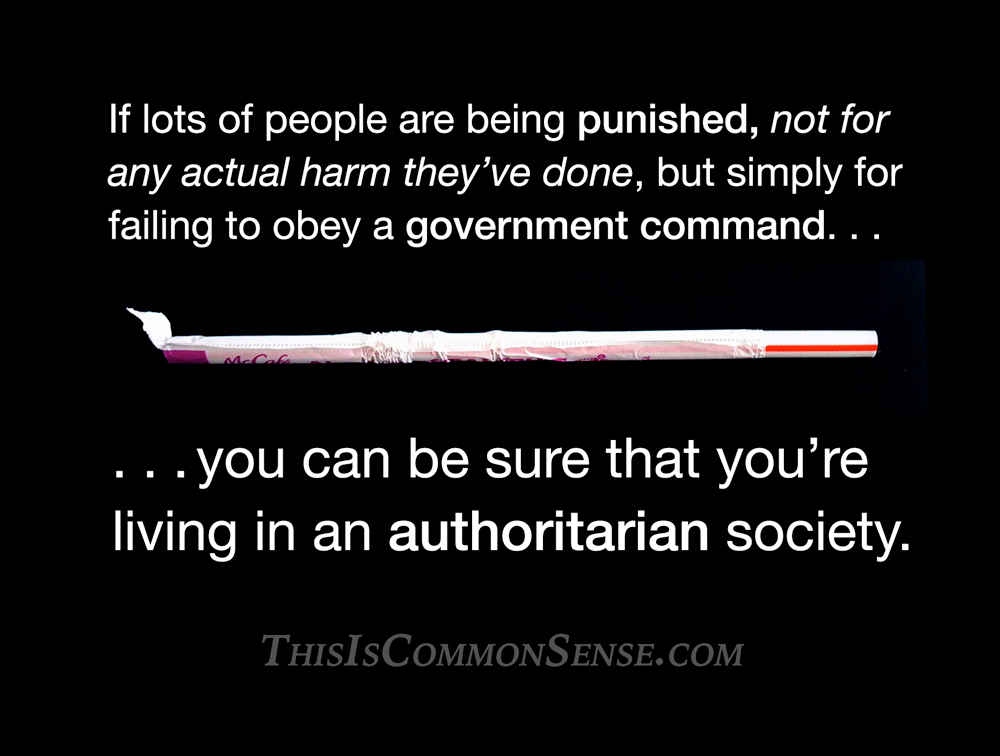
Many people don’t seem to realize that a prohibition (banning something) is AUTHORITARIAN BY DEFINITION. Whether it’s drugs, guns, alcohol, offensive language, dangerous ideas, texting while walking(!), plastic straws(!)… authoritarians are perfectly happy to use government violence to force the rest of us behave as they wish. Because they think they know what’s right for everybody else. They are the authorities. They are the keepers of the truth. For the rest of us, the message is clear: obey or be punished.

The spectacle of people screaming about Trump’s “authoritarianism” while simultaneously demanding more regulations, more bans, more restrictions… would be funny if it weren’t so dangerous.


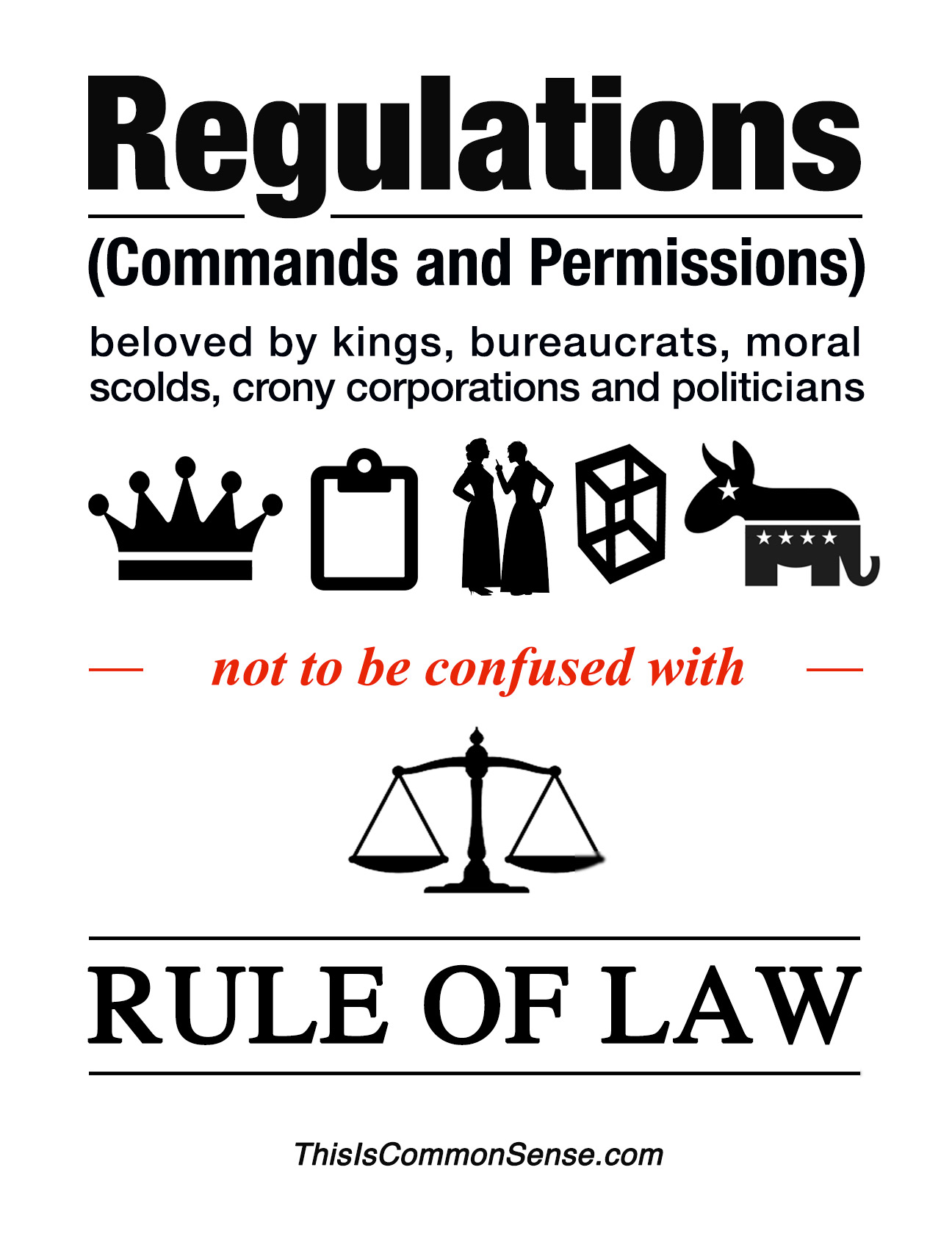
A “rule of law” is based on general principles, and makes room for — or, better yet, is based upon — the protection of individual rights.

It used to be common to say, “a rule of law, not of men”; it was even as common in political oratory as was spouted out over drinks at the Rotary. But as the modern Regulatory State has grown in scope and power, most folks seem to have lost track of the notion. It is now not even a cliché. Few even of our most educated folks can explain this idea. Vast swaths of the mis-educated public appear not to “get” the idea of limiting government to the enforcement of a few general principles; instead, they cry for more “regulations” (along with additional spending and maybe even a whole new division of the executive government) every time a crisis, tragedy or atrocity occurs.

So we are left with a political culture in which the words of Tacitus seem to a majority as implausible at best, evil at worst: “The more the laws, the more corrupt the State.” Contrary to today’s trendy prejudice, we do not need “more laws” — edicts legislated by representatives, or regulations concocted by bureaucracies — we need Law.

As in, “a rule of Law.”
regulations, rule of law, control, freedom

See all recent commentary
(simplified and organized)
See recent popular posts

Categories
Accountability general freedom meme moral hazard national politics & policies

Madison on Perpetual War

“Of all the enemies to public liberty war is, perhaps, the most to be dreaded, because it comprises and develops the germ of every other. War is the parent of armies; from these proceed debts and taxes; and armies, and debts, and taxes are the known instruments for bringing the many under the domination of the few. In war, too, the discretionary power of the Executive is extended; its influence in dealing out offices, honors, and emoluments is multiplied; and all the means of seducing the minds, are added to those of subduing the force, of the people. The same malignant aspect in republicanism may be traced in the inequality of fortunes, and the opportunities of fraud, growing out of a state of war, and in the degeneracy of manners and of morals engendered by both. No nation could preserve its freedom in the midst of continual warfare.”


James Madison, Political Observations, Apr. 20, 1795 in: Letters and Other Writings of James Madison, vol. 4, p. 491 (1865)

Categories
crime and punishment moral hazard responsibility

Reforming Crime, Not Criminals?

“The D.C. Council gave final approval this week to a measure decriminalizing Metro fare evasion,” The Washington Post reports, “paving the way for fare-jumping to become a civil offense punishable by a $50 fine in the District.”

Talk about stopping crime “in its tracks.” Jumping the turnstile won’t be classified a “crime.” Problem solved.

Nassim Moshiree, policy director for the local ACLU, declared it “a significant victory for criminal justice reform here in the District.”

Jack Evans argued, unsuccessfully, that scofflaws will quickly figure out the “civil citation . . . is largely unenforceable.” He added, “We have a big problem with fare evasion at Metro.”

Non-paying riders cost the bus and subway system in the nation’s capital $25 million annually. The worst bus route “has had 560,000 incidents of fare evasion since January, nearly 37 percent of its 1.5 million trips,” informs the Post.

Metro officials complained “that lessening the penalties would only exacerbate the problem and lead to more crime,” but supporters of the change posited that “decriminalization was an important step toward addressing disproportionate policing of African Americans who use the transit system.”

In recent years, according to a Washington Lawyers’ Committee for Civil Rights and Urban Affairs report, “91 percent of Metro Transit Police citations and summons for fare evasion were issued to African Americans.”

“I’m sad that’s Metro’s losing money,” offered Councilmember Robert White Jr., “but I’m more sad about what’s happening to black people.”*

Penalties can be too severe or too severely applied. And enforcement can be racially biased. But stealing transportation services is a crime. Pretending otherwise is not a victory.

This is Common Sense. I’m Paul Jacob.


* Is “that’s” a typo? Did the councilmember say, “that”? All I know is the quotation as I have it here is exactly as it appears online, in both text and headline, and also as it appeared in the dead-tree edition delivered to my home.

PDF for printing


» See popular posts from Common Sense with Paul Jacob HERE.


Categories
ideological culture media and media people moral hazard

Sexism and Isn’tism

Is physics sexist against women?

Professor Alessandro Strumia, of Pisa University, argues to the contrary. At a presentation in Geneva, in front of mainly female physicists, Strumia offered evidence that showed, if anything, that it is men who are being discriminated against. 

Specifically, he compared male and female hirings to male and female scientific citations. Being cited for one’s work is the academic gold standard, the main test scientists have for quality of work. Strumia found a pattern of women being hired over men who had higher citations rates.

Now, Alessandro Strumia is not a social scientist, and this explanation — like any scientific work — is open to criticism.

But was scientific debate the notable reaction to his presentation?

No. He was “suspended with immediate effect” from his job at CERN, Europe’s premiere nuclear science research facility.

Some folks were obviously offended — perhaps most with his characterization of physics as having been “invented and built by men.” That is true but not directly relevant to the issue. His higher-ups at CERN called his statements “unacceptable,” and insisted, perhaps with a slight tone of panic, that the nuclear science research center “always strives to carry out its scientific mission in a peaceful and inclusive environment.” 

The outfit’s official statement did not mention Strumia’s name, but instead referred to “the scientist” and cited his talk for its “attacks on individuals.”

Really? Or merely an attack on an explanation that some individuals found . . . heretical?

Strumia himself offers the perfect characterization of the mini-scandal: “the truth does not matter, because it is part of a political battle coming from outside.”

Merely by suspending him and undertaking an “investigation,” has not CERN proved his point?  

This is Common Sense. I’m Paul Jacob.


PDF for printing


Illustration: The Large Hadron Collider/ATLAS at CERN


Categories
crime and punishment media and media people moral hazard national politics & policies

Not an Accusation

Brett Kavanaugh’s weekend confirmation as an Associate Justice of the U.S. Supreme Court, by a 50-48 Senate vote, didn’t settle the allegations of his past sexual conduct in a judicial manner.

Wild disagreement remains.

Many on the Left continue to believe our newest justice repeatedly lied under oath, having abused at least three women when in high school and college. Many on the Right will view all “three” of these female accusers as political players or pawns, who probably should be punished in some way for lying about such a fine man.

While I doubt we can know for certain about a number of the accusations, there should be less doubt on the exact number of accusations. Which were not three but only two.

“I cannot specifically say that he [Brett Kavanaugh] was one of the ones who assaulted me,” Julie Swetnick told NBC News. But she went on to offer a maybe, a could have, some might haves, an I don’t know . . . and more, none of which amounted to an accusation. What she offered was a chain of suppositions: “Because if Brett Kavanaugh was one of those people that did this to me, there is no way in the world that he should go scot-free on this and that he should be on the Supreme Court. . . . If he does, I, uh — there’s no justice in the world.”

As long as this sort of nonsense is treated seriously in the media and among partisans, there can, indeed, be no justice in the world.

This is Common Sense. I’m Paul Jacob.


PDF for printing


Categories
First Amendment rights general freedom ideological culture media and media people moral hazard privacy

Google Goes Bad

Good Google’s evil twin, Bad Google, is at it again.

In addition to doing bad things to advance its political agenda, Google is willing to work with bad governments do bad things. 

For example, the authoritarian Chinese government.

Google is working on a mobile version of its search engine, code-named Dragonfly, which would censor search results the way the Chinese government wants. The company is doing so even though it shut down its Chinese-mainland search engine back in 2010 because it “could no longer continue censoring our results” in China. At the time, I praised Google for moving in the right direction.

Now it’s regressing.

And more than regressing. The Intercept reports that Dragonfly goes beyond censorship. How? By linking a user’s search results to his phone number. Critics note that this would abet human rights violations, since users could easily be detained and even jailed for searching for the “wrong” terms.

At least five Google employees have resigned in protest. One, Jack Poulson, a research scientist, says that he regards “our intent to capitulate to censorship and surveillance demands in exchange for access to the Chinese market as a forfeiture of our values and governmental negotiating position across the globe.”

Google no longer promotes what used to be its motto and guide: “Don’t be evil.” 

To be sure, that motto did not put a very positive spin on the company’s moral stance. “Always be good” might be better. But I agree with both. 

Be good, not evil.

This is Common Sense. I’m Paul Jacob.


PDF for printing


Categories
general freedom ideological culture moral hazard nannyism national politics & policies too much government

An Evil Ism

With “democratic socialism” again on the rise, a refresher course in history seems apt: socialism has demonstrated the strong tendency to end up in totalitarian tyranny, poverty, and genocide.

As I mentioned on Monday, Reason’s Nick Gillespie suspects that this response is not very convincing to people tempted by socialism. But really, why not? What about a history of horror could be appealing?

Which is why the question “Do Socialists Mean Well?” as answered by Grant Babcock, might help. Babcock answers in the negative.* “Socialism is not ultimately an end but a means. And as a means, socialism is evil.”

With an evil means, one’s chosen end is irrelevant, because of other results. “If I told you I wanted to end homelessness, you might say I had good intentions,” Babcock explains. But if he confessed to seek that end “by conscripting the homeless into the army . . . [n]ot only should you say I have bad intentions, you shouldn’t give me any moral credit for saying I want to end homelessness.”

True. But Babcock has to engage in his extended argument about means because, for purposes of his essay, anyway, he began with the premise that while fascists are evil because they seek directly to harm some people, socialists do not.

Uh, really? Most socialists make much of taking from “the rich,” however they define the rich — as “the one percent” or “the privileged,” etc.

Call it expropriation; call it theft: that’s a lot of anger and ill will directed to one group of people.

In that way, the appeal of socialism is too much like the appeal of fascism.

This is Common Sense. I’m Paul Jacob.


* Babcock, by the way, denies the label “socialist” to social democrats who call themselves “democratic socialists” — by definition. On this matter, see “Bernie’s Slippery Definition of Democratic Socialism” and “Is Denmark Socialist?” on this site.

PDF for printing


Categories
folly ideological culture moral hazard

Mass Murderers Are Cool?

If you have a lick of sense, you wouldn’t emblazon images of Ché Guevara on your chest or your wall — and yet Ché t-shirts and posters have been a pop culture hit for decades now.

He is cool, we are told, because he was ¡Viva la Revolución! and all that.

But it could get worse. You could be emblazoning a hammer and sickle.

Walmart’s website is there to help. Under “men’s sleeveless,” for example, we see an artistic rendering of the old Communist symbol, frankly identified as a “Soviet Hammer and Sickle,” white on black for $14.97.* Walmart files it under “Pop culture.”

Aren’t men’s sleeveless shirts called “wife beaters”? Should we now call them Kulak Killers?

It’s hip to murder millions!

No wonder Lithuania and several other Baltic countries — who suffered greatly under Soviet rule — object. Indeed, many of these countries go too far in actually banning the symbols. Now, they have contacted Walmart requesting a cessation in hawking the offensive merchandise. “You wouldn’t buy Nazi-themed clothing, would you?” Lithuania’s foreign minister Linas Linkevicius tweeted. Or sell such items.

But a few people might. Certainly, a lot of people do buy stuff that others regard as “Nazi.” Sometimes to be “cool”; other times to make a controversial political point.

At the Uhuru Store, Gavin McInnes’s “ProudBoys Official” sells a “Pinochet Did Nothing Wrong” t-shirt for twice the price of Walmart’s Hammer and Sickle shirt — and that surely has annoyed leftists who have seen it.

I’m waiting for the death of cool.

This is Common Sense. I’m Paul Jacob.


* The shirts also come in Navy, Royal and Gray. I guess to get a red commie shirt you have to go for the sleeves.

PDF for printing


Categories
Accountability ideological culture moral hazard national politics & policies term limits

The Self-Neutered Congress

Last week, the Senate Judiciary Committee again demonstrated why Congress’s approval ratings bob about in our toilet bowls. Amid the spectacle of Judge Brett Kavanaugh’s confirmation hearings, one senator spoke not about judicial philosophy, but political reality.

“What’s the hysteria coming from?” asked Sen. Ben Sasse (R-Neb.), noting the circus-like atmosphere. His answer? The Supreme Court “is increasingly a substitute political battleground,” because “the Congress has decided to self-neuter.”

Blunt assessment.

“In our system, the legislative branch is supposed to be the center of our politics,” Sasse argued, adding dejectedly, “It’s not.”

Why not? 

“What we mostly do around this body is not pass laws,” he offered. “What we mostly do is decide to give permission to the secretary or administrator of bureaucracy X, Y, or Z to make law-like regulations.” 

“More and more legislative authority is delegated to the executive branch every year. Both parties do it,” explained the senator. “The legislature is impotent, the legislature is weak, and most people here want their jobs more than they really want to do legislative work . . .”

Sasse continued, “The real reason, at the end of the day, that this institution punts most of its power to executive branch agencies is because it’s a convenient way for legislators to be able to avoid taking responsibility for controversial and often unpopular decisions.”

Better to blame the bureaucracy.

“If your biggest long-term thought around here is about your own incumbency,” he said dismissively, “then actually giving your power away is a pretty good strategy.”

But “when Congress neuters itself,” warns the Cornhusker State solon, “it means the people are cut out of the process.”

A powerful case for term limits.

This is Common Sense. I’m Paul Jacob.


PDF for printing


Categories
general freedom ideological culture media and media people moral hazard

Until the Fat Lady Offends

We live in a new Age of Offense. A whole lot of people make a whole lot of fuss about what other people say and listen to, view and experience.

Then again, some things are enormously offensive.

One of the latest offense-takings takes place in Israel, where a classical music station played music by Richard Wagner. And so of course had to apologize.

The music played was from the final opera in Wagner’s Ring Cycle. Not my cup of tea. Or coffee. Or latte. As those who follow me on Facebook know, I have varied musical tastes, but more classic rock than classical.

Israelis who listen to classical tend to be none too fond of Wagner not because he was an especially bad composer (I’m told he is a “Great”) but because he was very much an anti-Semite, and Hitler’s favorite composer.

“While there is no law in Israel banning the German composer’s works from being played,” The Telegraph informs us, “orchestras and venues refrain from doing so because of the public outcry and disturbances accompanying past attempts.”

Understandable.

Still, some Israelis do like Wagner’s music. But since the radio station is State-owned and -controlled, the Israel Wagner Society’s president’s admonishment that “Whoever doesn’t want to hear the music can always turn the radio off,” doesn’t quite work.

That would apply only were the station owned by the Israel Wagner Society — willing to bear the loss of customers one might expect in Israel.

In America, of course, Wagner is often on the air. 

And those who object . . . turn the dial. 

This is Common Sense. I’m Paul Jacob.


PDF for printing