
Categories
international affairs

First-Class Freedom Fighting

Just seven years ago today — March 18, 2014 — Taiwanese students began a 23-day occupation of the country’s legislature, in what became known as the Sunflower Student Movement. They were protesting the rushed and opaque passage of a Cross-Strait Service Trade Agreement with China.

Trade deals usually aren’t so explosive, but China is a neighbor 58 times larger than Taiwan’s 24-million population and one that regularly threatens military invasion. Furthermore, the agreement was negotiated in secret and initially passed by the Legislative Yuan in 30 seconds. 

Obviously without debate.

Opponents of the deal argued it would allow China to effectively “purchase” Taiwan, and to economically leverage and then strangle Taiwan’s vibrant democracy, which like Hong Kong’s aspirations constitutes a terrible affront to the anti-democratic Chinese Communist Party (CCP) ruling over more than a billion silenced, disenfranchised Chinese. 

The students’ concerns for transparency and safeguards connected with the Taiwanese public, which put enormous pressure on the government. 

Ultimately, the spring Sunflower Movement in Taiwan helped influence the autumn Umbrella Movement protests in Hong Kong as well as energizing the 2016 win for Taiwan’s Democratic Progressive Party and far less Beijing-friendly President Tsai Ing-wen (who won a second term last year).

In these last seven years, the world has come a long way in recognizing the threat posed by totalitarian China. For that I give those students in Taipei a lot of credit. Their standing up kept Taiwan free — and helped us all begin to stand up to the Chinazis (as Hong Kongers call the CCP). 

The other aftermath? Le Monde’s report on students finally leaving the Yuan, noted it was “not without having thoroughly cleaned the building.”

This is Common Sense. I’m Paul Jacob.


PDF for printing

See all recent commentary
(simplified and organized)
See recent popular posts
Categories
international affairs

Now Safe to Blame?

Is it safe yet for big media to tell the truth about China’s virus? 

“Beijing’s efforts from the very start of the crisis to hide information, silence whistleblowers, put out false data and thwart any real outside investigation are too extensive to fully recount,” Washington Post columnist Josh Rogin wrote over the weekend, pointedly adding, “the Chinese government’s actions were both reckless and deliberate.”

Leading to many more deaths — the official tally being 2.6 million souls worldwide. So far. 

Yes, the Chinese Communist Party leaders are actually “bad folks.” 

Last year, though, the media treated candidate Trump’s attacks on China as just so much posturing and blame-shifting. The Post, for example complained of “too much political heat” regarding the pandemic — “some generated by China” and “some by Donald Trump in his attempt to distract attention from his catastrophic pandemic response as president.”

A month ago, a World Health Organization team traveled to China to finally look for the source of the contagion. “International experts investigating the origins of Covid-19,” the BBC reported at the time, “have all but dismissed a theory that the virus came from a laboratory in China.” 

It turns out, as the Post explained, “the team lacked the training and forensic skills required to investigate this possibility” and “were under strong pressure from China to steer clear of the subject altogether.” The editorial urged the WHO to renew their investigation and “forcefully insist that China not stand in its way.”

“Donald Trump’s victory in 2016 shattered a fragile understanding between Washington and Beijing,” Rogin had informed readers at the outset of his essay, “and put the most important relationship of the 21st century in the hands of a novice.”

I call that a reprieve.

But the fact that our current prez is an old political pro? 

Worrisome.

This is Common Sense. I’m Paul Jacob.


* There is “no going back to the stance that the Obama administration had taken toward China in 2016,” Rogin argued, “when . . . most uncomfortable issues were swept under the rug.”

PDF for printing

See all recent commentary
(simplified and organized)
See recent popular posts
More on the Wuhan Lab angle: “Twelve Monkeys in Charge

Categories
education and schooling international affairs

Subsidizing Chinese Attacks on American Ideals

Should the federal government fund organizations working at the behest of China and the Chinese Communist Party?

Democrats on the House Education and Labor Committee have blocked an amendment sponsored by Representative Elise Stefanik (R-NY) that, in her words, would have banned funding of academic institutions “if they have a partnership with any entity owned or controlled, directly or indirectly, by the government of the People’s Republic of China or organized under the laws of the Chinese Communist Party.”

The entities being referred to are so-called Confucius Institutes, which, in addition to promoting innocuous educational goals, help spread the propaganda of the misnamed CCP. (The Chinese Communist Party should really now be called the Chinazi Party. Post-Mao, the Chinese have stopped trying to communize everything and now permit markets to function to a significant extent — but, as in the fascist Nazi version of totalitarianism, always subject to sweeping interference and oppression.)

The current number of active Confucius Institutes in the U.S. is uncertain, but the National Association of Scholars counts at least 55, including 48 at colleges and universities.

Meanwhile, as part of a freeze on regulations issued toward the end of the Trump administration, President Biden has withdrawn a proposed rule that would have required schools to reveal any ties to Confucius Institutes.

Is it a bad idea to find out which schools are facilitating Chinazi propaganda? 

Is it a good idea to directly or indirectly fund Chinazi propaganda? 

No and no.

This is Common Sense. I’m Paul Jacob.


PDF for printing

See all recent commentary
(simplified and organized)
See recent popular posts
Categories
international affairs

The China Syndrome

Is the Chinese government under Xi Jinping becoming as murderously totalitarian as it was in the time of Mao?

Since Mao was responsible for the slaughter of tens of millions, today’s China is not, at least yet, Maoist bad. But as Doug Bandow reports in a recent overview (“China’s Terrifying Return to Maoism”), it is indeed awful.

The scuttling of presidential term limits is the merest tip of a titanic iceberg of tyranny. 

Beneath the surface is China’s intensified repression of the Uyghurs, Tibet, and Hong Kong; prolific use of torture; a rise in coerced televised confessions; increased censorship and detaining of foreign journalists; massive expansion of the surveillance state with the help of technology firms like Huawei; and new crackdowns on practices of religion.

A few years ago, churches in many provinces of China could carry on without interference as long as they steered clear of politics. Hardly a minor restriction. But today, writes Bandow, “ministers are arrested, churches are closed or destroyed, members are barred from bringing their children and forced to display communist agitprop, and the [Chinese Communist Party] even wants to rewrite Scripture. Islam, Buddhism, and Daoism are also under sustained attack.”

Bandow bases his observations in part on a Human Rights Commission report just published by the UK Conservative Party.

Too often, journalists, politicians and others ignore or whitewash what the Chinese regime is doing at home and abroad. Whatever our policies toward China should be, they should be based on eyes-wide-open reality.

This is Common Sense. I’m Paul Jacob.


PDF for printing

See all recent commentary
(simplified and organized)
See recent popular posts

Categories
deficits and debt education and schooling general freedom international affairs

The Great School Reset

A reset is going to happen; the status quo is not an option.

The major institutions of the modern welfare state were unsustainable before COVID-19, which is why Klaus Schwab had been talking up The Great Reset for years. He and his Davos crowd — convening right now, virtually, at the 2021 annual meeting of the World Economic Forum — want to fix everything with a huge heaping helping of intrusive government.

The pandemic panics have merely forced the technocrats to speed up their timeline.

Which may be one reason why Deep State aficionados in the Biden administration and in the media have set their eyes upon squelching the populist movements that increasingly want to chuck them along with their globalist policies.

But populism isn’t their only problem. For a real education, look at “education.”

“We are witnessing an exodus from public schools that’s unprecedented in modern U.S. history,” writes Corey A. DeAngelis in the December Reason. “Families are fleeing the traditional system and turning to homeschooling, virtual charters, microschools, and — more controversially — ‘pandemic pods,’ in which families band together to help small groups of kids learn at home.”

All these new ways around the failed centralized institutions of government schooling that DeAngelis discusses are increasingly seen as liberatory. Will a people accustomed to increasing freedom and excellence in one realm easily succumb to a pitch to decrease freedom and increase government in all others?

Seems a tough sell. Which suggests a small sliver of hope that we might get a Freedom Reset instead of a technocratic one.

This is Common Sense. I’m Paul Jacob.


PDF for printing

See all recent commentary
(simplified and organized)
See recent popular posts

Categories
international affairs

Continuity Against the Chinazis?

With Joe Biden now in the White House, will the U.S. continue former President Trump’s hardline toward China?

Especially regarding Taiwan, regularly threatened with invasion by Chinese leader Xi Jinping.

Or will President Joe Biden — dubbed “Beijing Biden” by some Trump supporters during the campaign — return to the softer approach of previous administrations toward the Chinazis?*

Mr. Trump “approved weapons sales to Taiwan totaling more than $15 billion,” reported The Washington Post last October, “including coveted F-16 jets that frustrated Taiwanese hawks say Presidents Barack Obama and George W. Bush withheld.”

In that same article, a Taiwanese foreign policy scholar voiced alarm that Biden’s advisors, including Antony Blinken, now Biden’s pick to be Secretary of State, “still view Taiwan as a problem that needs to be handled within the greater U.S.-China relationship. . . . The lack of deeper understanding on the issue of Taiwan . . . is something that causes a lot of concern here.”

When then-Secretary of State Mike Pompeo announced the removal of all “self-imposed restrictions” on contact between the U.S. and Taiwanese governments, weeks ago, a Washington Post headline declared: “Trump upsets decades of U.S. policy on Taiwan, leaving thorny questions for Biden.” 

Perhaps not so prickly, however: Taiwan’s representative to the U.S. was soon invited to Biden’s inauguration . . . the first official invitation since the 1979 severing of diplomatic ties.

Not only that, “President Trump was right in taking a tougher approach to China,” Secretary of State nominee Blinken told The Epoch Times

“Nuclear-capable Chinese bombers and fighter jets,” Reuters informed on Saturday, “entered the southwestern corner of Taiwan’s air defence identification zone.”

Unified, bi-partisan opposition to the genocidal ‘Butchers of Beijing’ remains more critical than ever.

This is Common Sense. I’m Paul Jacob.


* The term “Chinazi” springs from 2019 Hong Kong protesters. It seems the most accurate label for the totalitarian state inflicted on the Chinese people for the last 70 years by the Chinese Communist Party, especially in more recent times.

PDF for printing

See all recent commentary
(simplified and organized)
See recent popular posts

Categories
international affairs

Desperate Times, Measures

Desperate times call up desperate politicians who demand desperate measures which require desperate counter-measures.

But while you might be thinking of Donald Trump, COVID, riots, and Biden-Harris, desperation isn’t just an American problem.

“Italy Government on Verge of Collapse as Renzi Party Quits,” Bloomberg informed us last week. What precipitated Renzi’s exit from the coalition government? The persistence in that government of an anti-immigrant party. Sounds familiar.

In Estonia, “Prime Minister Juri Ratas resigned over an inquiry into a property development,” according to U.S. News & World Report. In the 2019 elections, the Reform Party had won a plurality of seats, but Ratas had to put together a coalition with other parties to form a government. Now Reform will lead a coalition, but, we are told the new coalition will not likely “include the far-right EKRE party, whose leaders denounced the U.S. election result as rigged and called President-elect Joe Biden ‘corrupt.’”

In the Netherlands, the whole government resigned because of a scandal involving government-provided child-care funds. Bureaucrats had “wrongly accused thousands of working families of fraud and ordered them to repay childcare benefits between 2013 and 2019.” But the resignation is somewhat hollow, since officials still hold a “caretaker status” while the country goes through another lockdown.

To cause even more chaos, here’s a fourth example: Belarus. The International Ice Hockey Federation just stripped the nation from hosting its world championship because, as Politico reports, “Belarusian President Alexander Lukashenko has used the country’s security forces to violently oppress protesters since his disputed election victory in August last year.”*

The crisis appears worldwide. And the answer in each case — including in the USA — is for citizens to have to more constitutional and democratic checks on government.

This is Common Sense. I’m Paul Jacob.


* In a leaked audio tape to Radio Free Europe, a senior government official can be heard discussing “plans to build an internment camp — complete with barbed wire — for political prisoners.”

PDF for printing

See all recent commentary
(simplified and organized)
See recent popular posts
Categories
international affairs

Slow on Subjugation

Latest: China opposes democracy!

When Great Britain turned Hong Kong over to China in 1997, the half-capitalist, ninety-nine-percent-totalitarian mainland government promised, scout’s honor, to preserve “one country, two systems” for 50 years. Hong Kong was to be mostly autonomous.

Almost immediately, China began interfering in Hong Kong’s democracy with the help of puppet officials on the island. 

In 2003, China tried to impose a “national security law” to squelch the Hong-Kong-system part of the two systems. Criticism of the Chinese government would be treated as sedition. Five hundred thousand Hong Kongers marched in protest. Not wanting to send bombs and tanks, China retreated.

Hong Kongers blunted other assaults in 2012, 2014, and 2016.

But this last year, with the help of pandemic-rationalized restrictions on civic life, China has been making great leaps forward with its agenda. Recently, it detained 53 Hong Kongers for the terrible crime oftrying to run candidates in local elections.

Observing this, Victoria Hui, a political science professor at the University of Notre Dame, has reached an insight. 

“This is a total sweep of all opposition leaders,” she says. Why, if it is judged “subversion” just to run for office in Hong Kong, then the true purpose of the new security law is “the total subjugation of Hong Kong people.”

This goal has been blatant at least since 2003; longer, to anyone who knows China’s history. Sounds like Ms. Hui is only now catching on. 

This is Common Sense. I’m Paul Jacob.


PDF for printing

See all recent commentary
(simplified and organized)
See recent popular posts
Categories
First Amendment rights international affairs

The Censors’ Conceit

Is it okay to stop people from talking to prevent them from saying things that are possibly incorrect?

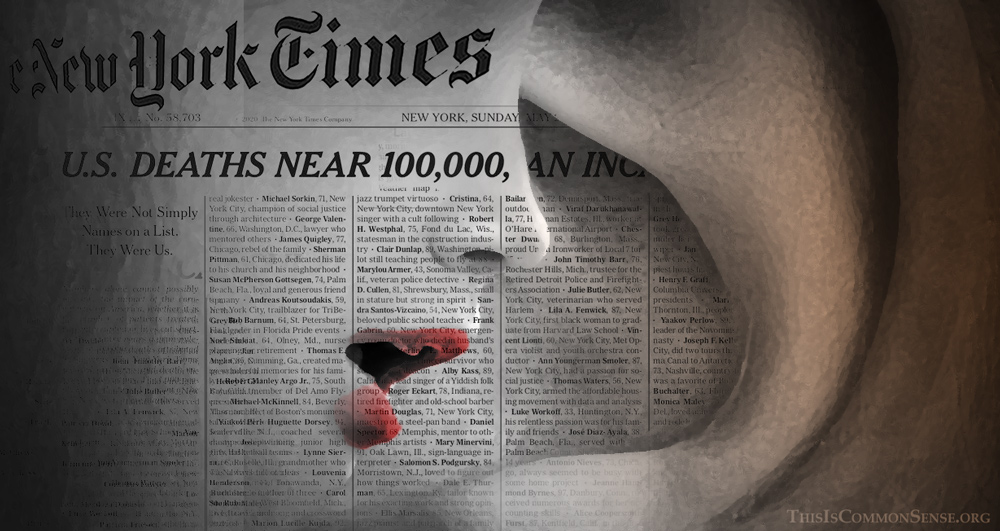
A New York Times article about Chinese censorship of discussion of COVID-19 seems to imply that the Chinese government would have been justified in choking off discussion to “debunk damaging falsehoods.”

A mass of government documents recently obtained by hackers “indicate that Chinese officials tried to steer the narrative not only to prevent panic and debunk damaging falsehoods domestically. They also wanted to make the virus look less severe — and the authorities more capable. . . .”

The government’s efforts included hiring hundreds of thousands of people to publish party-line posts on social media as well as detaining people “who formed groups to archive deleted posts” about the death of Dr. Li Wenliang, who had warned about COVID-19.

The Chinese government has also issued endless instructions to providers of nominally private social-media platforms to control what people say about the pandemic.

Thank the Gray Lady for the report confirming the known details about Chinese censorship. But how do you draw a line between censorship “only” to “debunk falsehoods” and censorship to spread official lies and suppress the very appearance of truth? You can’t.

Discussion itself helps us determine what is true and what is false.

The notion that the government (or any society-wide institution obeying the government) can neatly and unilaterally shape discussion to prevent only “bad” discussion — without inflicting massive damage on “good” discussion — is itself false.

This is Common Sense. I’m Paul Jacob.


PDF for printing

See all recent commentary
(simplified and organized)
See recent popular posts

Categories
international affairs scandal

Two Conspiracies Unearthed

Two huge stories broke this week.

The first is that the “People’s Republic” of China guided American policy for decades using “old friends” who had “penetrated the highest levels of the U.S. government and financial institutions before the Trump administration.” 

Bill Gerz, writing in The Washington Times, reported that “Di Dongsheng, a professor and associate dean of the School of International Studies at Renmin University in Beijing, also suggested in a Nov. 28 speech that China’s Communist Party helped Hunter Biden, a son of presumptive President-elect Joseph R. Biden, obtain Chinese business deals.” 

These remarks were posted as a video on the professor’s Weibo account (think “Chinese Facebook”). Though quickly removed, copies went viral.

The second story? “Did Donald Trump Nearly Confirm Existence of Aliens? Israeli Ex-Space Chief Makes Bizarre Claim,” by Jeffrey Martin, writing at Newsweek. “Professor Haim Eshed, who served as the head of Israel’s space program from 1981 to 2010 spoke to the Hebrew newspaper Yediot Aharonot on Sunday. On Tuesday, the Jerusalem Post published some of Eshed’s quotes in English and they contained the most incredible claims made about Trump, who has long [been] the center of conspiracy theories—some of which he has actively encouraged.”

Eshed claims that both the U.S. and Israel have had contact with extraterrestrial civilizations (a “Galactic Federation,” no less) and that President Trump was about to go full-on Full Disclosure but — somehow — the aliens stopped him.

Quite a yarn, not unfamiliar to science fiction readers and moviegoers. But note: quite a few de-classified Pentagon, FBI and CIA documents suggest something very much like this. And in the last few years we’ve covered the U.S. Government’s trickling admissions that the UFO phenomenon is not all fakery, but real and odd.

Both stories hail from professors with close ties to foreign governments. Both point to actual conspiracies. Both present “epistemic” problems for us: they are neither easily proved or disproved.

Both, also, are too eerily plausible.

This is Common Sense. I’m Paul Jacob.


PDF for printing

See all recent commentary
(simplified and organized)
See recent popular posts