Categories
education and schooling general freedom ideological culture moral hazard nannyism national politics & policies too much government

Grading Democracy on the Curve

Voters, we are told, are amazingly ignorant. So, what to do?

“Ultimately, the ideal democracy is one in which as many citizens as possible vote,” writes Dambisa Moyo at The Guardian, “and the voters are armed with the most objective information. Yet today only a fraction of the electorate are voting, and many are armed with a diet of hyped-up statistics and social media propaganda.” Among her proposals is a voting booth access test: “why not give all voters a test of their knowledge?”

I can think of a whole bunch of reasons, as can Ilya Somin, over at Volokh Conspiracy, who considers just a few. One of the more interesting is this: whereas Moyo has no wish to shove poor people out of the voting booth, and so envisions public schools to teach to the test — “the knowledge needed should be part of the core curriculum” — Somin quotes John Stuart Mill about the very political dangers of the very idea of public schooling: “A general State education,” wrote Mill in On Liberty, would inevitably be devised to please and serve “the dominant power in the government, whether this be a monarch, an aristocracy, or a majority of the existing generation” and must constitute “a despotism over the mind.”

Though Moyo does observe incumbency and political careerism as big problems, she is innocent of the more fundamental issues.

Indeed, she does not consider the obvious: today’s voter ignorance of politics and government is in no small part the result of government schools.

For politicians, general ignorance is not a bug, it’s a feature.

Let’s look for solutions to political problems that do not give politicians more power.

This is Common Sense. I’m Paul Jacob.


PDF for printing


Categories
education and schooling folly ideological culture media and media people moral hazard privacy

The Propriety of Cultural “Appropriation”

Young Keziah Daum committed a terrible crime. She wore a traditional Chinese dress and displayed it online.

No wonder she was chastised by hordes of frothing guardians of cultural purity.

Many Chinese themselves say they find the criticism baffling. Perhaps they are burdened by common sense. They are probably not sociologically sophisticated enough to mind when an American orders Chinese takeout, either.

“Puritanism is the haunting fear,” H.L. Mencken once explained, “that someone, somewhere, may be happy.”

Cultural appropriation” is the currently favored bludgeon wielded by today’s “puritans” to ruin enjoyment. According to this misbegotten notion, it is somehow wrong-souled to enjoy somebody else’s culture.

The very idea is hard to pin down. It is unduly fuzzy. How? Well, borders between countries or groups are pretty arbitrary as cultural boundaries. To try to be consistent, enemies of culture-grabbing would have to berate any partaking of culture not strictly one’s own.

Alas, the amount of culture a person can produce single-handedly is paltry.

Nor can anybody create any unit of culture without being influenced by — “appropriating” — the creations of others. Cultural creators have shamelessly “appropriated” each other’s stuff for millennia, a process that accelerated with improvements in travel and communication.

Should all seven billion of us live our lives in separate cubicles?

Enemies of “cultural appropriation” subscribe to every kind of silliness when they attack watching foreign films or wearing socks, dresses or Halloween costumes that evoke the culture of another country, state, town, or block.

No matter from whom they stole the idea of “cultural appropriation,” they should give it back.

This is Common Sense. I’m Paul Jacob.


PDF for printing


Categories
Accountability crime and punishment education and schooling First Amendment rights general freedom ideological culture moral hazard Regulating Protest

The Shallow State

Amidst all the talk of The Deep State, we are in danger of losing track of a parallel problem: the Shallow State — which, despite lack of depth, is very wide.

I am referring to government employees who increasingly abandon any pretense of impartiality. And the public institutions that protect them.  

Consider the case of the University of Illinois at Urbana-Champaign and its 39-year-old lecturer Tariq Khan, who is a member of an Antifa-affiliated group called the Black Rose Anarchist Federation. Mr. Khan had been angrily shouting and chanting at a campus anti-Trump rally when he was mildly challenged by a non-nut student journalist. Khan went on a rampage, screamed at and pushed the young journalist, and deliberately broke the smartphone of a fellow journalist who had been recording the fracas.

Khan was charged with destruction of property. But the story doesn’t stop there.

“I was told that if I wanted the ‘situation to improve,’” wrote a third journalist, “that I should stop writing about Khan.”

The university placed a restraining order on the three, to squelch news and dissent.

So the trio sued on First Amendment grounds.

Here we have a teacher willing to abridge free speech the old-fashioned way, by playing the bully. And a public institution ready and willing to defend him, to take his petty criminality and raise it to a conspiratorial, Big Brother level.

Not only does this rob Americans of rights, taxpayers are being forced to fund what they might justifiably regard as the destruction of the republican form of governance.

Root out the infamous Deep State?

Sure.

But limit and make transparent the Shallow State, too.

This is Common Sense. I’m Paul Jacob.


PDF for printing


Categories
ballot access education and schooling folly ideological culture media and media people Popular responsibility

Fiddling with the Franchise

In 2013, Tacoma Park, Maryland, became the first place in the U.S. to allow 16-year-olds to vote in local elections.* Now, Washington, D.C., Councilman Charles Allen, “inspired by the high-schoolers who are campaigning for gun control and filled D.C. streets last month in a massive protest that mesmerized the country,” reports the Washington Post, wants to follow suit.

“It’s pretty hard for anyone to watch the events of the last couple of months,” claims Councilman Allen, “and not understand the pure power and maturity of incredibly young voices.”

Well, they do use adult words.

One has to wonder: would the “maturity” of these young adults equally amaze this politician, were they advocating opinions** with which he disagreed?

But wait a second . . . wasn’t one of the demands of the “March for Our Lives” to raise, not lower, the age when a person would be deemed mature enough to legally purchase a scary-looking rifle?

Lowering the voting age seems odd, at best, with society lurching in the other direction — raising the age of adulthood for everything else. Decades ago, the legal age to purchase alcohol was 18 in some places; today it is 21 everywhere. In Virginia, one may still drive at 16, as I could back in the day . . . but now there are limits on other young people riding in the car unless the driver is 18.

More ominously, facilitation by many public schools of the recent student walkouts and marches present the strongest argument against lowering the voting age: So long as government schools act in a partisan manner, indoctrination and intimidation would be rampant.

Who wants a captive audience of would-be voters most?

Unscrupulous ideologues.

This is Common Sense. I’m Paul Jacob.


* Greenbelt and Hyattsville, Maryland, as well as Berkeley, California, have since joined Tacoma Park in allowing 16- and 17-year-olds to vote in local elections.

** Term limits, say. Or school vouchers. Or the rights of gestating humans.


PDF for printing


Categories
crime and punishment education and schooling ideological culture media and media people moral hazard national politics & policies

Bias and Blindness

Neither stretching the truth nor ignoring it helps beat back implicit or explicit racism.  Yesterday, my Townhall.com column took the Washington Post to task for misstating the results of a recent GAO report.

The GAO noted wide discrepancies between the percentage of students facing disciplinary actions who are black, male and disabled and the relative percentages of these groups in the overall student population. Yet, the report also specifically stated: “Our analyses of these data, taken alone, do not establish whether unlawful discrimination has occurred.”

Nonetheless, the Post headline told readers: “Implicit racial bias causes black boys to be disciplined at school more than whites, federal report finds.” The article claimed that “a government analysis of data . . . said implicit racial bias was the likely cause of these continuing disparities.”

The same discrepancies regarding boys of all races? And students with disabilities? Even the crickets had no comment.

In the Post’s Outlook section, yesterday, readers were treated to further edification on race — this time via C. Nicole Mason with the Center for Research and Policy in the Public Interest. “I feel alienated and slightly betrayed by the reboot” of the sitcom Roseanne,” she writes.

The title of her piece proclaims why: “‘Roseanne’ was about a white family, but it was for all working people. Not anymore.”

The “not anymore” refers to Roseanne’s support of (and Mason’s derangement syndrome over) President Trump. Interestingly, a more legitimate “not anymore” angle was completely missed — or ignored. The Connors now have a black granddaughter. The new show isn’t “about a white family,” but a racially mixed family.

When racism is finally extinguished from this planet, someone remember to tell the race-hustlers.

This is Common Sense. I’m Paul Jacob.


PDF for printing


Categories
crime and punishment education and schooling folly general freedom moral hazard privacy responsibility too much government U.S. Constitution

Ecstatic with Independence

Utah’s legislature unanimously passed it; the governor signed it — the nation’s first measure protecting what’s become known as “free-range parenting.”

It was once known simply as “parenting.”

Certain activities are now exempt from a state law criminalizing child neglect. Children may legally “walk, run or bike to and from school, travel to commercial or recreational facilities, play outside and remain at home unattended” — thereby allowing “a child, whose basic needs are met and who is of sufficient age and maturity to avoid harm or unreasonable risk of harm, to engage in independent activities . . .”

Back in the day, we apparently played outside in a sort of statutory limbo.

Do we really need a law saying kids can walk on a public street?

Sadly, yes: government agencies across the country are grossly violating the most basic rights of parents to rear independent children.

Regular readers may recall my 2015 defenses* of the Meitiv parents against the absurd charge of “unsubstantiated neglect” leveled against them by Montgomery County (Maryland) Child Protective Services. Ultimately, Maryland authorities acknowledged that permitting one’s kids (in the Meitivs’ case, a 10- and a 6-year-old) to walk on a public sidewalk (from a local park) wasn’t prima facie evidence of a crime. 

The current free-range parenting movement was launched in 2008 when Lenore Skenazy publicly admitted — to mass shock and condemnation — to allowing her 9-year-old son to take a trip alone on New York City’s subway.

“My son got home,” she wrote in the New York Sun, “ecstatic with independence.”

Notice how rare it is to find anyone ecstatic with dependence.

Lesson? An old one: Happiness must be pursued with freedom.

This is Common Sense. I’m Paul Jacob.


* My writings on the Meitivs’ battle to keep their kids:


PDF for printing


Categories
crime and punishment education and schooling general freedom media and media people national politics & policies responsibility Second Amendment rights

Good Guy With Gun

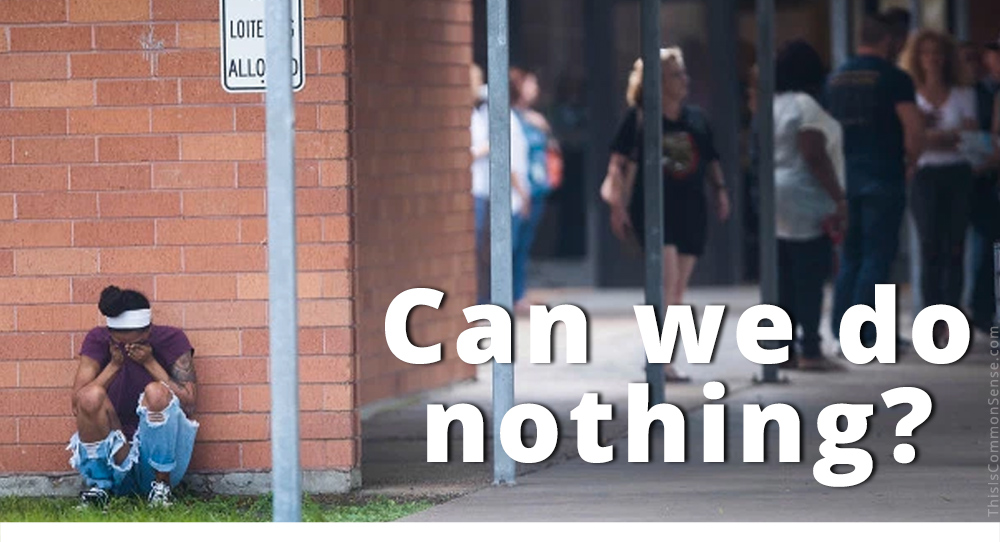
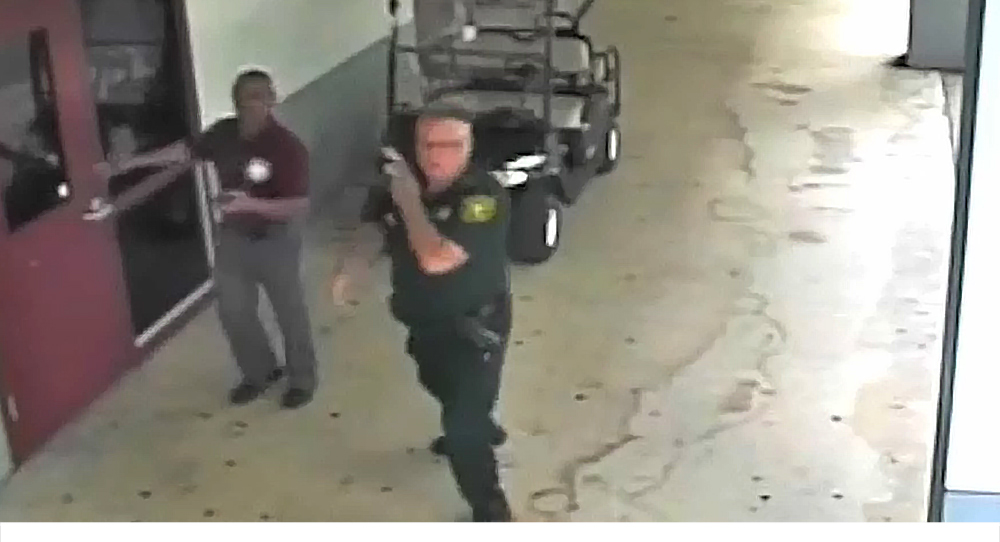
Short version of the story: a good guy with a gun at a Maryland high school stopped a bad guy with a gun. In less than a minute. How? Because the good guy had a gun and was inside the school with the gun.

The bad guy was able to shoot a 16-year-old female student, apparently someone with whom he had a previous relationship, as well as a 14-year-old male before an officer on site responded. This officer, Blaine Gaskill, was on the spot in less than a minute. Gaskill and the assailant fired simultaneously. The assailant fell dead. What exactly happened is still unclear; there has been some media speculation that the bad guy may have shot himself.

But the 17-year-old shooter is dead. The female victim, though still alive, is unfortunately in critical condition. The male victim is in stable condition.

The good guy was armed — with a gun. And he was on site. If you’re learning about the incident here first, it’s because the story isn’t being plastered all over the place 24-7 as it would have been had the shooter been able to wreak much more havoc because nobody could quickly counter him.

So, is it okay to let responsible, well-trained administrators, teachers and others in schools be armed?

Well, ask the question a different way. If you happened to be inside the school at the time, would it be okay to survive when some maniac with a gun starts shooting at you and others inside that school?

Let’s defend our loved ones.

This is Common Sense. I’m Paul Jacob.


PDF for printing


Categories
education and schooling general freedom ideological culture media and media people moral hazard national politics & policies Second Amendment rights too much government

Civic Engagement Activities

I love a good protest.

My first was in Mrs. Grubb’s third grade class, after a substitute teacher gave us a ton of math homework. During recess we organized and delivered a written statement  announcing a student strike against doing the math.

Believe it or not, the assignment was withdrawn, called an April Fools joke . . . but boy did we catch hell when Mrs. Grubb returned.

This week, with the school walkouts across the country to protest “gun violence” and demand “gun control,” some older kids finally got in the game. I may disagree with their public policy shibboleths and disdain their tone, but I would defend to the . . .

Well, you know.

The problem isn’t students or protests. It is the partisan government school system. The system’s taxpayer-paid agents — teachers, administrators — believe they can support student protest movements for changing laws they want changed, but block and punish protests on issues they do not favor.

And, especially, bring the hammer down on anyone who dares notice the double standard out loud.

Rocklin High School teacher, Julianne Benzel, “has been placed on paid administrative leave due to several complaints from parents and students involving the teacher’s communications regarding today’s student-led civic engagement activities,” the California school district said in a statement.

Benzel told CBS in Sacramento that she did not discourage her students from joining the protest — er, I mean, civic engagement activity. But in class, she did raise the issue of whether the school administration would similarly allow (much less facilitate, dare we say, encourage) student protests against abortion, instead of guns.

Let’s protest what we can actually change: public schools engaging in partisan political activity.

This is Common Sense. I’m Paul Jacob.


PDF for printing


Categories
education and schooling First Amendment rights folly ideological culture media and media people moral hazard national politics & policies

The Critique of Pure Intolerance

If you are older than 50, you probably remember when “liberal” meant free speech advocacy to the point of absolutism. “I may disagree with what you say,” stalwart liberals pledged back in the Sixties, “but I’ll defend to the death your right to say it.”

Nowadays, if you are under 30 and have gone to college, you may not even have encountered this saw.

Which has consequences.

Nine student groups protested, last week, the Federalist Society’s invitation of writer Christina Hoff Sommers to speak at Lewis & Clark Law School. The groups called it an “act of aggression and violence” and smeared the philosopher and Democrat as “a known fascist.”

Bari Weiss, writing in The New York Times, calls this “the moral flattening of the earth,” the “main effect is that these endless accusations of ‘fascism’ or ‘misogyny’ or ‘alt-right’ dull the effects of the words themselves. As they are stripped of meaning, they strip us of our sharpness — of our ability to react forcefully to real fascists and misogynists or members of the alt-right.”

While this “flattening” does prevent the flatteners (bullies) from even seeing any gradations of threat or error, let’s not pretend to be surprised. Their techniques do not merely echo, but replicate exactly, neo-Marxist postmodernist philosopher Herbert Marcuse’s proposal, in “Repressive Tolerance,”* to censor writing and speech “from the right.”

Ideas have consequences. Just as Marxian socialism led to Lenin, Stalin and Mao, these tyrants led to Marcuse, whose thinking set much of today’s Academia into full tyranny mode.

It’s time for liberals “on the left” to repudiate explicitly the methods of tyrants . . . to their left.

This is Common Sense. I’m Paul Jacob.


* See Herbert Marcuse and Robert Paul Woolf, A Critique of Pure Tolerance (1965). My college political theory professor, a proud communist, was a big fan of Marcuse.


PDF for printing


Categories
Accountability crime and punishment education and schooling folly general freedom ideological culture moral hazard nannyism Second Amendment rights too much government U.S. Constitution

Insufferable Common Sense

Sometimes common sense and open discourse can’t be suffered — or won’t be, anyway.

So discovered Timothy Locke, a popular teacher at Cherry Hill High School East in New Jersey, after discussing the possibility of arming teachers to help protect adults and kids from would-be mass-murderers. Locke also suggested that he’d be among those bearing arms if allowed.

Most of Locke’s students were okay with his opining. But one student was bothered enough by the viewpoint to complain to administrators.

Without further ado, the school — the “Home of the Cougars,” which proudly proclaims its promotion of “a welcoming environment, community, diversity . . . participation . . . growth mindset, grit. . . ,” so forth — searched Locke’s belongings, subjected him to mental and physical evaluations, and suspended him.

Mental evaluation? Wasn’t that a ploy in the old Soviet Union: dissenters must be crazy, hence ought to be carted off to the loony bin? Let’s go nowhere near such sanctions against independent thinking here.

“The bottom line,” Locke summaraized, “is that I was very concerned about security at my school.”

Through an online petition and otherwise, hundreds of students have protested the shabby way that a teacher who inspires them has been treated.

Students less enthusiastic about Locke lament the teacher’s tendency to digress — still legal in all 50 states.

So what now? After a futile school board meeting deflecting questions on Locke’s fate, a second, special meeting is scheduled for tonight, March 6, at 7 pm in the Cherry Hill High School West Auditorium.

Let’s hope sanity prevails.

This is Common Sense. I’m Paul Jacob.


PDF for printing