Categories
Accountability general freedom national politics & policies responsibility

A Threat We Can’t Refuse

“Recent days have shown me that the times when we could rely completely on others are over to a certain extent,” German Chancellor Angela Merkel told folks in a Munich beer hall last Sunday. “We also know that we Europeans must really take our destiny,” she said, on the heels of the NATO and G7 meetings, “into our own hands.”

Merkel may have designed her comments to elicit shock and dismay among the inhabitants of America. But my shock is that anyone would find anything shocking, at all.*

Merkel’s responding, of course, to President Donald Trump’s censure of European NATO members for not ponying up to their treaty obligations.** This is widely whispered as . . . rude. Mustn’t upset Germany and other allies, even if only five of NATO’s 28 nations have reached the agreed-upon two-percent of GDP goal.

The received wisdom seems to be: don’t embarrass the freeloaders.

I’m often not copacetic with Mr. Trump’s demeanor. But the “threat” that U.S. soldiers might somehow not be permitted to shed their blood to defend deadbeat countries against a feared Russian attack is . . . just not all that threatening.

What’s so scary about self-reliance?

It was also announced that German security agencies won’t share intelligence with the U.S. regarding alleged Russian interference in their upcoming election.

This, too, we can survive.

But, gee whiz, I hope we aren’t banned from the cool countries’ lunch table at the cafeteria in the brand new $1.23 billion NATO headquarters — for which the U.S. pays a disproportionately high 22 percent.

This is Common Sense. I’m Paul Jacob. 


* In my judgment, Merkel should have jettisoned “to a certain extent” and put a period after “over.”
** It’s worth noting that Trump is not the first president to marshal this complaint.

Printable PDF


Categories
Accountability crime and punishment folly local leaders media and media people national politics & policies responsibility

The Early Vote Worm

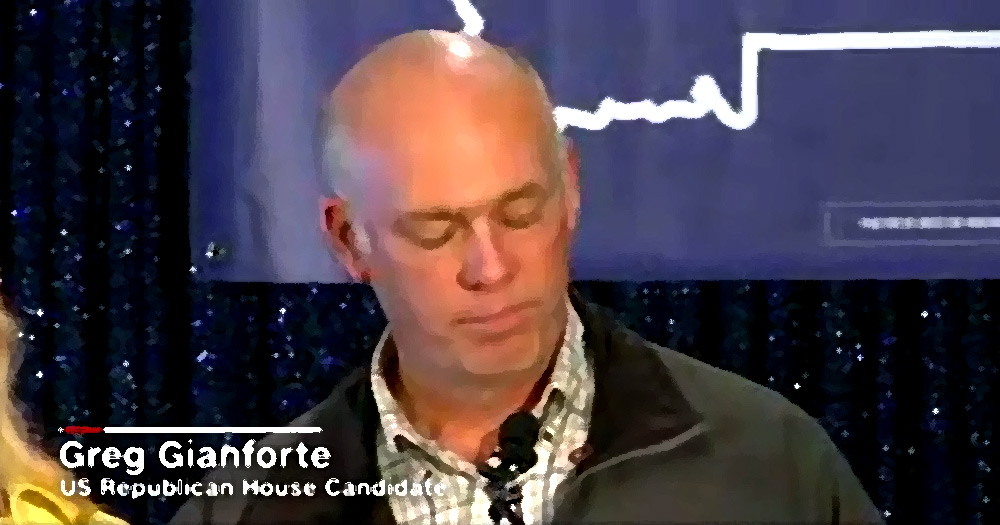
Last week was consequential for Greg Gianforte. Awfully.

The Republican businessman won the special election for Montana’s lone seat in the U.S. House of Representatives. He also body-slammed a reporter. He now faces misdemeanor assault charges.

For which Gianforte apologized publicly . . . as he was declaring victory. Welcome to modern American politics.

Democrats claimed victory, nonetheless — with media cover to boot. “Republicans’ 7-point win in last night’s Montana election is great news for Democrats,” the progressive Vox headlined their report.

At Townhall.com on Sunday, I explained why that claim misses both the forest and the trees. Yes, Trump won Montana by 20 percentage points against Hillary Clinton’s mere 35.4 percent back in November, while Gianforte won last week by only 7 points. But Trump was lucky to be opposed by a very unpopular Hillary.

Moreover, at that same election wherein Trump trounced Secretary Clinton, Gianforte lost the governor’s race to a Democrat. Indeed, Gianforte performed 11 points better last week than back in November — winning, instead of losing.

How does that show Republican support slipping?

The message from the Montana special election is that early voting periods are far too long. Montana’s early voting began nearly four weeks before Election Day. The assault by Gianforte, with criminal charges, hardly mattered, because roughly two-thirds of Montanans had already voted when it occurred.*

Rather than a nearly month-long process, whereby a candidate can bank a majority of the vote before the campaign is over, let’s make Election Day a three or five-day period. Make it easy to vote, but let’s all vote together, with the same information.  

This is Common Sense. I’m Paul Jacob.


* This means not only that Gianforte may have “gotten away” with his violent outburst, but that those voters did not have time to adequately appraise Gianforte on information they would have possessed and been able to act upon, with a shorter voting period.


Printable PDF


Categories
Accountability folly free trade & free markets general freedom initiative, referendum, and recall nannyism national politics & policies property rights responsibility too much government

Minimum Shock

“Three restaurants vacated the Bay this week, with Berkeley’s Bistro Liaison getting the most attention,” the San Francisco edition of Eater informs us. “It’s a bittersweet exit for the owners, who plan to start new careers.”

The week in question was in February. But this was not an isolated event. Sixty-four Bay-area restaurants and fast food joints closed their doors this last winter.

That is a lot of closures.

Why?

Every eatery has a different story, but the entry December 17* provides a big clue: minimum wage hikes.

Citizens should hardly be surprised. They got what they asked for. The minimum wage went up to $13.00 per hour last July, and will go up another two bucks next year. And this was the result of a citizen initiative. “On November 4, 2014, San Francisco voters passed Proposition J, raising the minimum wage to $15.00 by 2018,” the City Office of Labor Standards and Enforcement tells us.

And the thing about minimum wage laws is that they do not — either by magic or by law — directly raise any wages. They, by law and quite directly, prohibit wage contracts below the minimum established.

Businesses then react, struggling to accommodate the newly imposed costs. Sometimes they keep all their employees and economize on other inputs, but often they must re-arrange hours and workers and whole production schemes.

If hemmed in elsewhere, they just go out of business.

Just as one should expect, according to the law of supply and demand.**

Citizens might wish to reconsider. That is, initiate a measure to repeal a previously successful initiative . . . that gave us this unsuccessful policy.

This is Common Sense. I’m Paul Jacob.


* The entry reads thusly: “OAKLAND — alaMar Kitchen and Bar as you know it is shuttering on December 17, but will reopen in the new year with a fast casual format. The owner points to minimum wage raises and the cost of doing business in the Bay Area as the reasons cited for the closure/change.”

** It is often said that businesses just “raise prices” and “pass along the costs” to consumers in general, but, for reasons of supply and demand, they cannot do this without decreasing sales and thus revenue.


Printable PDF


Categories
Accountability initiative, referendum, and recall local leaders responsibility

The Maine Thing

Ranked Choice Voting (RCV) allows voters to rank electoral candidates and not “waste” their vote in cases where their most favored candidate is* unlikely to win. RCV also requires a majority for election, not merely a plurality of the vote.

Last November, Mainers passed Question 5 to begin using this voting system for statewide races, state legislative races and congressional contests. Voters in Portland, the state’s largest city, already use ranked choice voting for several city offices.

Nonetheless, Gov. Paul LePage, who has won twice for governor without ever capturing a majority, opposes RCV, as do many state legislators, also elected under a different first-past-the-post plurality system.

Because Maine’s state constitution specifically mentions plurality winners for statewide officials and state legislators (in the General Election), legislative leaders asked the Maine Supreme Court for an advisory opinion on the constitutionality of the ballot measure. Earlier this week, the court ruled that Question 5 was not constitutional when applied to those specific offices and elections.

However, the constitutionality of RCV was not challenged regarding congressional elections or primary elections for the state legislature.

Now some legislators are proposing a constitutional amendment to enact the RCV that voters supported. Others are urging that the entire law be repealed — even the parts not ruled unconstitutional. They claim the new system is too confusing if not used for every office.

But Portland city voters use RCV for some offices and not others, without confusion.

Legislators should follow the court’s decision, sure, but also respect the vote of the people for every part of the measure not addressed by the court.

This is Common Sense. I’m Paul Jacob.


* Ranked Choice Voting also prevents wasted votes in cases where a voter merely expects or fears (even inaccurately) that his or her favorite candidate does not have enough support to get elected.


Printable PDF


Original cc Photo by Tim Evanson on Flickr


Categories
Accountability moral hazard national politics & policies responsibility U.S. Constitution

The Chicken-Ostrich Congress

Those who work for the president must tell the POTUS hard truths — on matters of war, most of all. Citizens must also be told hard truths. After all, we are, at least theoretically, the ultimate decision-makers . . . the president works for us.

That was my point yesterday.

But when it comes to life-and-death decisions about war and peace, there is also a congressional check on executive power.

Well, theoretically.

The big problem isn’t chicken-hawks in Congress, but chicken-ostriches. Bird-brained members of Congress implant their heads deep into the sand when it comes to foreign policy.

Where is the congressional debate over what to do in Afghanistan, our nation’s longest war? Rather than helping shape policy, Congress gladly lets the commander-in-chief control every aspect of foreign and military policy.

This gives the president unitary war-making power, anathema to the original character of our Republic, but it also means precious members of Congress are never held accountable for the disasters. After all, they didn’t do anything.

When mistakes are made or policy fails, the legislative branch can hold hearings to carp and moan and pontificate for the TV cameras.

American citizens, on the other hand, cannot so easily dodge the consequences of unaccountable foreign policies. In addition to engaging in military action in seven countries at present, the U.S. Government has pledged to defend another 50 countries, about one-fourth of the world.

Should more conflicts erupt, Congress won’t fight them. But our sons and daughters will.

This is Common Sense. I’m Paul Jacob.


Printable PDF


Categories
Accountability general freedom national politics & policies responsibility

The First Casualty

Former Marine Lt. Gen. H.R. McMaster, President Trump’s current national security advisor, is the author of Dereliction of Duty, a look at how President Lyndon Johnson conducted the Vietnam War. 

Last Sunday, the Washington Post’s Carlos Lozada reviewed the 1997 non-fiction book, noting that McMaster hadn’t minced words. 

McMaster argues, for instance, that LBJ had a “real propensity for lying.” McMaster also takes Defense Secretary Robert McNamara and the Joint Chiefs of Staff to task for not telling Johnson hard truths about the war, and going along with what they knew were poor policies. 

Life-and-death policies. 

“McMaster explains how a culture of deceit and deference, of divided and misguided loyalties, of policy overrun by politics, resulted in an ever-deeper U.S. involvement in Vietnam,” Lozada reports. 

Lozada then compares the dishonest bubble within which LBJ made decisions about Vietnam to the people around President Trump today, fearing they too will fail to tell the president inconvenient truths or dare risk his wrath by opposing his policy whims. 

That tilted Trump focus is the 24/7 obsession of the national press corps.

But this problem isn’t new with Trump. It’s universal. 

The wise have long understood that truth is the first casualty of war. If not taken out before hostilities even begin.

It is critical to find people of integrity to work at the White House and tell presidents the unvarnished truth. And even more critical is to pick presidents with integrity to tell the American people — the ultimate decision-makers — the truth. 

It’s long past time that U.S. foreign policies be publicly discussed — and decided — by an informed electorate.

This is Common Sense. I’m Paul Jacob.


Printable PDF


Whisper cc photo by Jamin Gray on Flickr

Categories
Accountability folly national politics & policies

Weiner’s Place in History

As if to finalize the Great Derailment of 2016, disgraced former Congressman Anthony Weiner pleaded guilty in federal court to felony sexting: transferring obscene materials to a 15-year-old girl.

Prosecutors are asking he serve 21 to 27 months in federal prison, register as a sex offender and continue mental health therapy.

Also Friday, Huma Abedin, Weiner’s long-suffering wife, quietly filed an “Anonymous v. Anonymous” petition for divorce.

Though, apparently, not anonymously enough.

Personal train-wreck? Sure. But as I wrote yesterday at Townhall, because it so deeply affected last year’s presidential contest, the wreck is also very public.

Back in 2011, Anthony Weiner made Andrew Breitbart a hero, propelling Breitbart.com into the limelight. Weiner had tweeted a picture of his underwear-clad crotch to a woman . . . who was not his wife. Though quickly deleted from his Twitter account, a screenshot was shared with Breitbart, who ran with the story.

Weiner claimed a hack, challenging Breitbart’s credibility. This spurred Andrew Breitbart to commandeer a news conference called by Weiner — with more evidence to share. Soon, Rep. Weiner admitted his bad behavior and officially resigned his congressional seat.

Fast-forward to 2016, with wife Huma Abedin busy helping Hillary Clinton run for president. Weiner again becomes the subject of a sexting scandal — this time with an underage North Carolina girl. The FBI investigates, seizes Weiner’s laptop and discovers emails on it from Hillary Clinton to his wife, Huma. Then-FBI Director James Comey reopened his investigation of Hillary’s emails just ten days before Election Day.

Upshot? Trump is the 45th U.S. President, with Breitbart.com Editor Steve Bannon as key advisor.

Thanks to Weiner.

This is Common Sense. I’m Paul Jacob.


Printable PDF


Photo of “Anthony Weiner cut-out by the port-a-potties” by Katjusa Cisar on Flickr


Categories
Accountability insider corruption moral hazard national politics & policies porkbarrel politics too much government

Cronyism Pays

Daniel Mitchell, a senior fellow in fiscal policy at the Cato Institute, is a nice guy. But he’s sort of depressing, too.

Weeks ago, writing for the Foundation for Economic Education (FEE), Mitchell offered that “The Washington, DC Gilded Class Is Thriving.” He even provided a “depressing chart” graphing “median inflation-adjusted household income for the entire nation and for the District of Columbia.”

There is a graphic divide: while “the nation’s capital used to be somewhat similar to the rest of the nation . . . over the past 10 years, DC residents have become an economic elite, with a representative household ‘earning’ almost $14,000 more than the national average.”

Dan Mitchell highlights that “the entire region is prospering at the expense of the rest of the nation.” Among the nation’s counties, the top four wealthiest are in suburban Washington, D.C. The nation’s capital region boasts nine of the country’s top 20 richest counties.

Now Mitchell’s back with another FEE column exclaiming more bad news: “The ROI for Cronyism is Huge.” (ROI is “return on investment.”)

Mitchell cites a study entitled, “All the President’s Friends: Political Access and Firm Value,” conducted by University of Illinois professors Jeffrey R. Brown and Jiekun Huang. “Using novel data on White House visitors from 2009 through 2015,” they explain, “we find that corporate executives’ meetings with key policymakers are associated with positive abnormal stock returns. . . .”

The authors find a lot evidence showing that “political access is of significant value to corporations.”

None of this should surprise. Cronyism pays, and it sticks close to power, even geographically.

This is Common Sense. I’m Paul Jacob.


Printable PDF


Categories
Accountability crime and punishment government transparency moral hazard national politics & policies U.S. Constitution

Feckless, Indeed

Last night, House Oversight Committee Chairman Jason Chaffetz (R-Utah) appeared on Fox News’ Tucker Carlson Tonight, where Chaffetz was asked how he would know if the Justice Department fully complied with subpoenas issued by his committee for documents.

“Look, we have a storied and horrific background on this,” explained the Utah representative, retiring after this, his fifth term in Congress. “You can go from everything from Fast and Furious to the Benghazi investigation, email, IRS, anything pretty much over the last eight years, which I’ve served in Congress, and I don’t believe we ever got a full production out of the Department of Justice or the State Department.”*

“I can issue a subpoena unilaterally. It’s part of my constitutional responsibility to provide that check and balance,” argued Chaffetz. “But that subpoena is only as strong as its ability to be enforced.”

Problem? Enforcement requires Congress to work through the DOJ, part of the executive branch. Tricky . . . when the Department of Justice** itself is being subpoenaed.

“You’ve seen, for instance, Judicial Watch,” Rep. Chaffetz noted. “Tom Fitton has much more power using a Freedom of Information Act, because he can get to the courts and the courts can force them.”

“The Department of Justice is afraid of a court; they’re not afraid of Congress.”

He added, “And we don’t use the power of our purse; we don’t beat it over their head and we don’t enforce it. And so it’s somewhat feckless, and it’s very frustrating as somebody who is chairman of the oversight committee.”

“Congress should have an expedited way to get to the courts to enforce those subpoenas,” Chaffetz offered.

Why, then, doesn’t Congress enact such a process?

This is Common Sense. I’m Paul Jacob.


* “And that continues, by the way,” Chaffetz added. “One of my frustrations, with all due respect to the Trump administration, is that they have not loosened up the documents that we have been requesting for years.”

** Or, for that matter, any another executive branch agency.


Printable PDF


Categories
Accountability free trade & free markets general freedom local leaders media and media people nannyism national politics & policies porkbarrel politics responsibility tax policy too much government

Ballots & Books

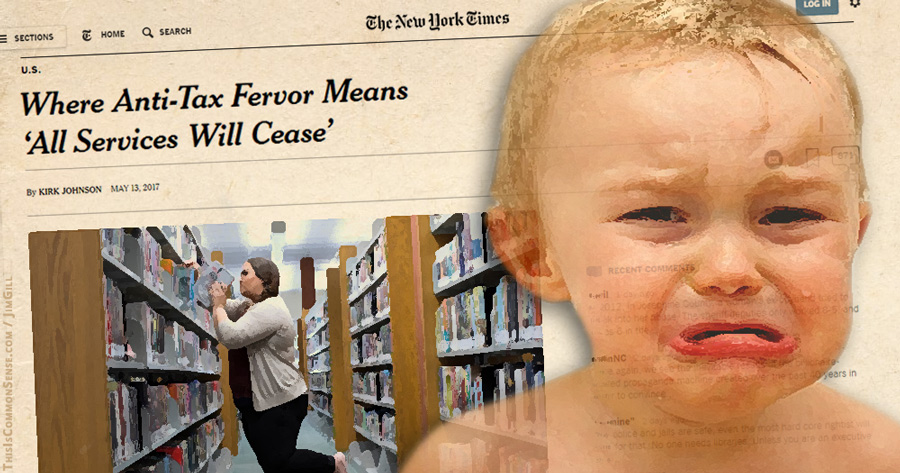
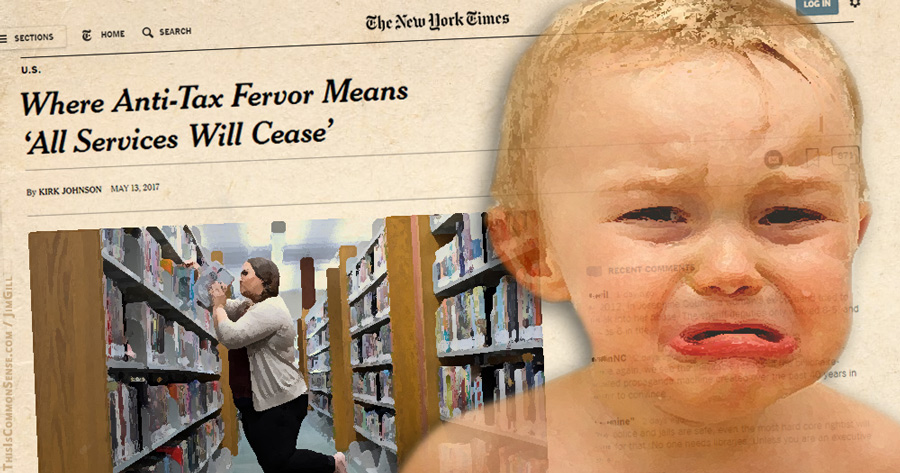
The people of Roseburg, Oregon, aren’t paying enough in taxes. That’s the upshot of Kirk Johnson’s recent New York Times article, “Where Anti-Tax Fervor Means ‘All Services Will Cease.’”

“For generations in America,” readers are informed, “small cities . . . declared their optimism and civic purpose with grand libraries that rose above the clutter of daily life and commerce.”

And then, the unthinkable: “last fall, Douglas County residents voted down a ballot measure that would have added about $6 a month to the tax bill on a median-priced home and saved the libraries from a funding crisis.”

How dare voters so vote? Didn’t they know the Times wanted those libraries fully funded? Where was the “optimism and civic purpose” of Roseburgians?

“We pay enough taxes,” said auto mechanic Zach Holly.

“The trust is gone from people who are paying the bills,” acknowledged an elected commissioner one county over.

Even Jerry Wyatt, who voted for the library tax, decried that, “There’s no end of waste” in government, adding, “We need less people on the county payroll.”

Meanwhile, the Times reporter explained that “few places” are confronting “the tangled implications . . . more vividly than in southwest Oregon.” It’s not merely “lights out, one by one, for the [library] system’s 11 branches.” There have also been “cuts to the sheriff’s budget . . . [ending] round-the-clock staffing.”

“If a crime is reported after midnight there,” Johnson wrote, “best not hold your breath for a response.”

This is “what happens when citizens push the logic of shrinking government to its extremes.”

To the extreme, eh? Hmmm. Doesn’t seem bad at all.

Douglas County voters made a free choice about libraries and taxes.

Close the book on it.

This is Common Sense. I’m Paul Jacob.


* There have also been worthwhile innovations in county government due to the budget cuts. Nearby Curry County combined its juvenile justice department with its parks department to save scarce funds. Then, the parks department began using juvenile offenders to clean up the parks. By engaging teenagers in meaningful work, the policy pushed recidivism rates way down and now Curry County has one of the lowest rates of youths committing a second offense.


Printable PDF