
Categories
Accountability national politics & policies too much government

A Funny Thing Happened on the Way to a Quorum

On Friday, the talking heads and Twitterati excoriating Rep. Thomas Massie (R-Kent.) were so scandalized that they couldn’t quite get to telling us what terrible thing he had done.

“GOP’s Massie outrages House,” screamed The Washington Post headline. The paper informed that “the Republican from northern Kentucky has frequently voted no on issues large and small, even against the wishes of GOP leaders.” 

Wow, is that allowed?

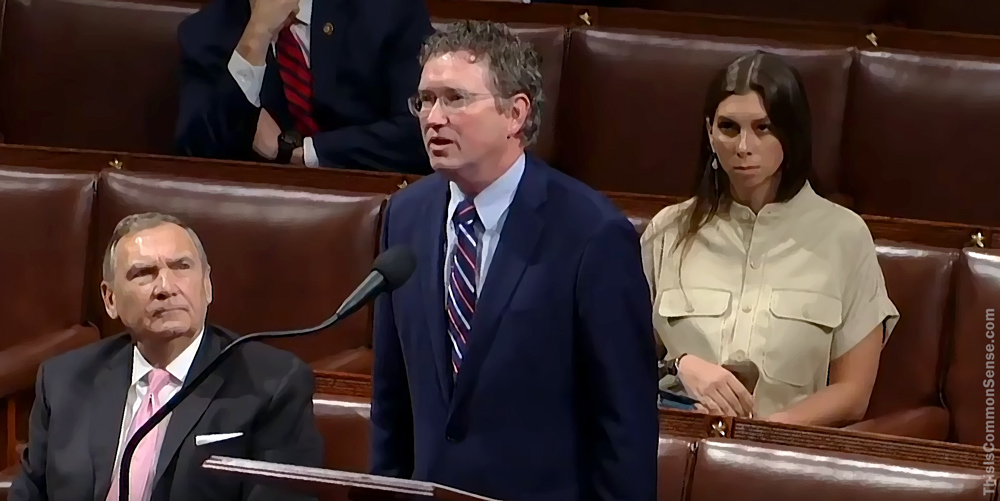
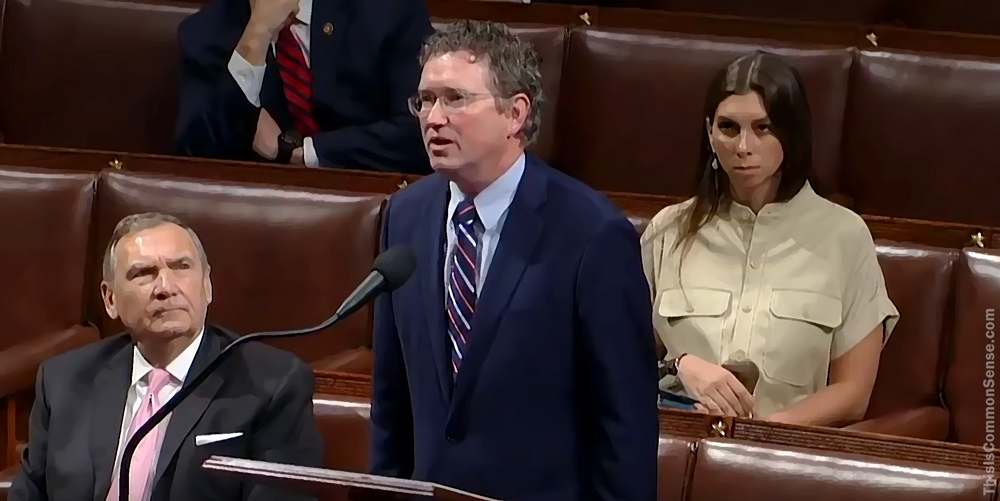
With Congress poised to shovel $2.2 trillion to citizens and businesses by unanimous consent, i.e., without a recorded roll call vote, Mr. Massie balked, thereby requiring a quorum to physically come to the capitol to vote on the relief package. 

“I came here to make sure our Republic doesn’t die by unanimous consent in an empty chamber,” Massie declared on the House floor, “and I request a recorded vote.”

President Trump urged the “third rate Grandstander” be tossed out of the Grand Old Party. And former U.S. Senator and 2004 Democratic presidential candidate John Kerry noted — of all things — his complete agreement with Trump, tweeting that “Massie has tested positive for being an a**hole. He must be quarantined to prevent the spread of his massive stupidity.”

Rep. Max Rose (D-N.Y.) offered that Massie was “disgusting” and “inhumane,” and that if the vote was pushed “back 24 hours there will be blood on [his] hands.”  

Speaker of the House Nancy Pelosi (D-Calif.) boasted of having asked the congressman, “Why don’t you just back off?”

Facing the biggest spending bill of all time, Massie’s notion of Congresspeople voting on the record? Hardly radical. But in the face of the COVID-19 threat, bringing legislators back to the capitol entailed real risk. 

Yet come back they did. And just to show Massie how wrong he was in alleging a cover-up, they agreed to a roll-call vote so that there was full accountability. 

Take THAT, Massie! 

Wait . . . Congress didn’t go on the record?! 

They came back and yet, as Massie pointed out, “they still refused to have a recorded vote.”

This is Common Sense. I’m Paul Jacob.


Note: One spending item, which Massie had specifically complained about, was $25 million for the Kennedy Center. Then, mere hours after President Trump signed the legislation, the Kennedy Center honchos fired the National Symphony Orchestra, informing them “that paychecks would end this week.”

PDF for printing

Thomas Massie, Coronavirus, pandemic, virus, House of Representatives, Congress,

See all recent commentary
(simplified and organized)
See recent popular posts


Categories
Accountability crime and punishment general freedom The Draft

A Policy Misadventure

The National Commission on Military, National and Public Service released its report today, advocating that Congress should force our daughters to register for the military draft.

“The commission recommended that the United States keep a draft option in place,” explains The New York Times. Commission chair and former Nevada Congressman Joe Heck called it a “low-cost insurance policy against an existential national security threat.” 

But that flies in the face of former Selective Service Commissioner Bernard Rostker’s testimony: “there is no need to continue to register people for a draft that will not come; no need to fight the battle over registering women, and no military need to retain the MSSA [Military Selective Service Act].”

And speaking of “an existential national security threat,” the scenario Heck put forth at one hearing was a simultaneous invasion from both Canada and Mexico.

Puh-leeze. 

“This is a necessary and fair step,” states the 255-page report, according to Politico, “making it possible to draw on the talent of a unified Nation in a time of national emergency.” 

It has always been possible to draw on the talents of the American people — both men and women. Just not to draft folks against their will.

Legitimate arguments for fairness and equality* must not obscure what we are talking about: A step closer to using force to fill the military’s ranks.

There is only one reason for a military draft: the inability of a nation to persuade citizens to voluntarily defend their country. Yet, as I told the commission last year, never have Americans failed to rise to their country’s defense. 

Conversely, too often our “leaders” have substituted foreign misadventures for actual national defense.

This is Common Sense. I’m Paul Jacob.


* More soon on the sort of “equality” being envisioned in the next military draft. 

PDF for printing

draft registration, women, female, soldier, selective service, draft,

See all recent commentary
(simplified and organized)
See recent popular posts


Categories
Accountability insider corruption local leaders national politics & policies Voting

Bring the Bozos Home

“Sen. Rand Paul (R-Ky.) announced Sunday he has covid-19,” The Washington Post reports, “and four other GOP senators are quarantined. Sen. Amy Klobuchar (D-Minn.) disclosed Monday that her husband, too, is infected with the virus.”

Social media was not uniformly brimming with support for the Kentucky senator, of course, and some folks noted, in earnest horror, that the Republican who had been shot at by a Bernie Bro and blindsided by his deranged Democrat neighbor had dared work six days in the Senate after being tested but before receiving his diagnosis.

He should have been sequestered!

To let the big “stimulus” packages sail through Congress?

But there are work-arounds.

“We should not be physically present on this floor at this moment,” argued Sen. Richard Durbin (D-Ill.) yesterday, urging the Senate to facilitate social distancing by allowing remote voting. Asked about it at his Sunday news conference, President Trump gave thumbs up: “I would be totally in favor of it on a temporary basis.”

I say, let’s take this a step further: do it permanently

Remote voting makes sense in an emergency. Sure. But it also makes sense all the time, because legislators voting from their home states and districts rather than within the Washington swamp would hear more from constituents than special interest lobbyists and, therefore, likely represent us better. 

Plus, not tethered to life in Washington, or the confines of the capitol, we might reduce the size of congressional districts from over 700,000 people to more like 70,000 and see real representation return to our land. 

This is Common Sense. I’m Paul Jacob.


PDF for printing

telecommute, Rand Paul, Congress, Senate, Coronavirus, Corona Virus,

Original photo by Manuel Bahamondez H

See all recent commentary
(simplified and organized)
See recent popular posts


Categories
Accountability crime and punishment national politics & policies

Protector Protection

Government organizations are here to help. How do we know this? They have names that say so!

Take the Consumer Financial Protection Bureau. Great name. It is all about protecting consumers, right?

Created as part of the Dodd-Frank legislation that was pushed through Congress following the 2008 financial implosion, the CFPB is tougher than the usual run-of-the-mill government agency, however. In the words of Cato scholar Ilya Shapiro, it is “the most independent of independent agencies.” It has a single director, who is almost impossible to remove, and it is empowered to make, enforce, and adjudicate its rules.

And punish violators.

The CFPB doesn’t have to answer to anybody, not even to secure funding.

If this does not raise at least a teensy sense of alarm, let me offer two words of caution: power corrupts.

We all know the ease with which regulatory agencies may abuse their power over us — and few are as insulated from the rule of law as is the CFPB; its near-immunity from oversight makes the ‘power-corrupts’ problem much worse.

The law firm Seila Law LLC — which helps clients deal with debt problems — has sued to challenge the constitutionality of how CFPB is structured. Although lower courts have not been sympathetic with Seila’s argument, the case has now been accepted by the U.S. Supreme Court.

A satirist once famously asked, who will watch the watchers?

In the United States, we should ask, who will protect us from the protectors?

By the Constitution that would be the Supreme Court.

This is Common Sense. I’m Paul Jacob.


PDF for printing

cfpb, watcher, eye, consumer, bureaucracy, power,

See all recent commentary
(simplified and organized)
See recent popular posts
Categories
Accountability government transparency national politics & policies

Deep State, Deeply Fake

Is there a good, presumptive reason to believe what the government tells us?

Not when it comes from the “intelligence” agencies.

One of the more breathtaking developments of recent years has been the transformation of Democratic Party politicians and activists from skeptics of alphabet soup intelligence agencies — CIA, NSA, FBI and many more — to becoming enthusiastic cheerleaders.

On the bright side, Republicans are drifting in the other direction, from their old-fashioned lockstep support of “intelligence agencies” to a new realism — the relentless Deep State “coup” attempts against the Trump Administration having proved . . . instructive.

While we might wish to think that, whew!, these agencies are comprised of loyal Americans, consider what Senator Chuck Schumer said earlier this year, almost approvingly: “You take on the intelligence community — they have six ways from Sunday at getting back at you.”

But more important than all this is the developing techniques the Deep State can marshal. I refer to Deepfake tech, where anything video can be faked, convincingly and completely. If not now, then very soon, technicians within the Deep State — and outside, too — will be able to videofake anything, from Trump cavorting with Moscow hookers to an Iranian “attack” to . . . UFO landings.

We shouldn’t have trusted intelligence agencies in the run-up to the Iraq conquest, now we have good reason to doubt anything and everything they tell us. 

Which means Congress should take very tight control of them, rein these agencies in — for Congress is indeed worried about deepfake tech.

How?

Well, de-classifying old secrets might be a good start. The last bit of the JFK assassination files? Maybe. UFOs? Maybe. But it’s what’s not on our radar that may be the most important.

This is Common Sense. I’m Paul Jacob.


PDF for printing

deep fake, Donald Trump, Young Frankenstein,

See all recent commentary
(simplified and organized)
See recent popular posts

Categories
Accountability

Sinkhole States

What do citizens lack most at all levels of government? Truth in accounting. 

So Sheila Weinberg really has her work cut out. This very morning, her Chicago-based research-tank called, not coincidentally, Truth in Accounting released its annual Financial State of the States report. The new data shows that “the total debt among the 50 states decreased by $62.6 billion in FY 2018 due to a prosperous economy.”

But that’s where the good news ends. “Every state, except for Vermont, has balanced budget requirements,” notes the report, “yet even with these rules in place, states have accumulated more than $1.5 trillion in debt.”

Almost entirely from unfunded pension and employee benefit liabilities. 

“At the end of the fiscal year (FY) 2018, 40 states did not have enough money to pay all of their bills. This means that to balance the budget . . . elected officials have not included the true costs of the government in their budget calculations and have pushed costs onto future taxpayers.”

Put another way: Your government is lying to you.

One interesting feature of the analysis is its top five “Sunshine States” —

  1. Alaska
  2. North Dakota
  3. Wyoming 
  4. Utah
  5. Idaho 

— and its bottom five “Sinkhole States” — 

  1. Hawaii
  2. Massachusetts
  3. Connecticut
  4. Illinois
  5. New Jersey

Fun fact: It just so happens that all five of the top states have a statewide process of voter initiative and referendum, while none of the “sinkhole states” have this democratic check. 

The new online State Data Lab has the skinny on every state. Compare your state against the rest. 

Be brave.

This is Common Sense. I’m Paul Jacob.


PDF for printing

Truth in Accounting, states, debt,

See all recent commentary
(simplified and organized)
See recent popular posts

Categories
Accountability ideological culture media and media people national politics & policies

Listen to the Warm

I like publicity stunts as much as the next activist. But haven’t we had enough of the whole Greta Thunberg bit yet?

On Wednesday, the 16-year-old Swede provided testimony on an apt stage, let us grant her that — the U.S. House of Representatives’ foreign affairs subcommittee joint hearing on the global youth climate change movement

She didn’t prepare any remarks, though. She merely “attached” the IPCC Special Report on Global Warming “as her testimony.” Her rationale? “I don’t want you to listen to me, I want you to listen to the scientists.” And “to unite behind science.”

You know, for “real action.”

It was what happened right after she demanded “real action,” though, where the stark reality of the situation became clear: a grown man in a suit, elected to Congress, asked, “Could you expand on why it’s so important to listen to the science?”

And then the non-scientist spoke . . . not very expansively.

 Forget that science qua science isn’t to be “listened to,” it is to be engaged in, with conjectures, research and refutations. (There was nothing like that at the hearing.) Forget also that the science is increasingly less clear on the severity of what warming we see. Remember only that an elected official used a girl to imbue a text (the IPCC report) with moral legitimacy, dubbing it “best available ‘united science’” — the better to push an unargued-for massive coercive government intervention into the life of our civilization.

Is no adult in the room ashamed of what they are doing . . . exploiting a cute youngster to subvert rationality?

This is Common Sense. I’m Paul Jacob.


Greta

See all recent commentary
(simplified and organized)
See recent popular posts


Categories
Accountability scandal

Dispatched

The 911 call released last weekend is . . . hard to forget. It is the one where, as The New York Times reports, “The dispatcher, Donna Reneau, repeatedly told a sobbing Ms. [Debbie] Stevens to calm down.”

With a tone — condescending and worse.

As television station KATV informs, the 911 operator “was working her last shift after previously resigning,” when she “answered Stevens’ call for help” and “can be heard yelling at her.”

Delivering newspapers at 4 am in Fort Smith, Arkansas, Stevens was caught up in rapidly rising flood waters and washed off the road.

The water is “all the way up to my neck,” Stevens desperately told dispatcher Reneau. “I’m the only one in the vehicle with all of my papers floating around me. Please help me. I don’t want to die.”

“You’re not going to die,” the dispatcher replied. “I don’t know why you’re freaking out.”

“This will teach you next time,” she lectured, “don’t drive in the water.”

Indeed, Ms. Stevens will never again “drive in the water.” 

She died. 

In fact, she had not driven into the water, but drowned in the rising flood water that overtook her SUV nonetheless.

Following release of audio from the 911 call, the Ft. Smith police acknowledged that the dispatcher sounded “calloused and uncaring at times.”

Dispatcher Reneau’s behavior wasn’t criminal, however, says her supervisor. And having already quit, she cannot be fired. 

Perhaps there is a lesson: More often than we know it folks don’t so much need a tongue-lashing or an eye-roll or a dismissive tone as much as they need some help.

Especially important if you work for 911.

This is Common Sense. I’m Paul Jacob.


911, flood, call, recording,

See all recent commentary
(simplified and organized)
See recent popular posts

Categories
Accountability initiative, referendum, and recall insider corruption

Representative or Reprehensible?

Seventy-seven million. 

That is the dollar amount of “financial errors” that North Dakota State Auditor Joshua Gallion discovered in the last year, after launching performance audits at twice the rate of his predecessor.* 

So, uncork the champagne! Huzzahs all around! Back slaps.

But the back-slappers in the state legislature took a much different tack. 

In the waning days of this year’s now-adjourned legislative session, in the opacity of a conference committee, a change somehow slipped into a bill. No future audits without legislative approval. 

As news hit of this handcuffing of the elected watchdog, taxpayers turned livid. And legislators started tap-dancing, claiming that “the legislation had nothing to do with the new aggressiveness Gallion brought to the job.”

Finally, Rep. Keith Kempenich, the author of the change, confessed: “A lot of legislators started having some issues with the way things were going and wanted to reel him in.” 

Kempenich added that the auditor’s work “isn’t supposed to embarrass people.” At his Minuteman Blog, Arthur Mason countered that such financial mismanagement is “worthy of embarrassment.”

Governor Doug Burgum, who has “felt the sting of a Gallion audit,” signed the bill; calls for the legislature to reverse their gutting of accountability have fallen on deaf ears.

Concerned citizens were already organizing to defeat the legislature’s proposed constitutional amendment giving themselves a veto on voter-initiated amendments, requiring a re-vote if politicians don’t like the people’s first vote. Now an additional effort is forming to petition a referendum or new initiative onto the ballot to stop the power-mad politicians from neutering the state auditor. 

Who do these legislators think they are? 

Seems North Dakota’s solons are in desperate need of still another reform measure: term limits. 

This is Common Sense. I’m Paul Jacob. 


* Prior to Gallion’s 2016 election, the state auditor post had for 44 years been a hereditary fiefdom, held by Republican Robert Peterson for 20 years and, before that, for 24 years by Peterson’s father.

North Dakota, State Auditor,

See all recent commentary
(simplified and organized)
See recent popular posts

Categories
Accountability national politics & policies

Salty Tears of the Guilty

The Mueller report has not calmed the partisan enmity roiling Washington.

Many in Congress complain about Mueller not reaching a prosecutorial decision on the issue of obstruction of justice, thus leaving Attorney General William Barr to determine that actions by President Trump did not reach a criminal threshold. 

But who wrote the rules for such investigations?

“If Congress does not like the decision, because it was made by the attorney general,” explained Jacob Frenkel, an attorney who formerly worked in the independent counsel’s office, “Congress has only itself to blame for not renewing the independent counsel statute.”

“Analysts noted that lawmakers, in effect, gave Barr authority over Mueller when they let the independent counsel law expire in 1999,” reports The Washington Post. “That law created a prosecutor position with even more autonomy than Mueller, who was appointed under more restrictive special counsel regulations.”

Of course, in 1999, Republicans controlled both houses of Congress. Had they a crystal ball to see 20 years into the future, for partisan reasons they might celebrate that they allowed that law to lapse. 

Then again, Democrats have controlled both houses since then, even sporting a filibuster-proof Senate majority in 2009. Yet did nothing to legislate a solution to the problem they see today.

My point isn’t to bemoan the special counsel or independent counsel statute, about which good people might disagree. Instead, let us acknowledge the essential role our system reserves for Congress. Yes, again and again, from tariff policy to foreign policy to these current issues, Congress punts its power away to the executive and judiciary branches. 

And then cries about it.

Well, wipe your eyes, solons: it’s We the People who feel the pain.

This is Common Sense. I’m Paul Jacob.


PDF for printing

crying smiley, Congress, Independent Counsel, Willam Barr, The Mueller Report,

See all recent commentary
(simplified and organized)
See recent popular posts