Categories
Accountability crime and punishment

Who is Responsible?

Breonna Taylor is dead. She was shot five times by Louisville police, who were returning fire after forcibly entering her apartment.

“[T]he department had received court approval for a ‘no-knock’ entry,” reports The New York Times, but “the orders were changed before the raid to ‘knock and announce,’ meaning that the police had to identify themselves.” There is disagreement as to whether police did so.

It appears that shortly after midnight on March 13, police knocked down Ms. Taylor’s front door and her boyfriend fired his gun at what he thought was an old boyfriend of Breonna’s.

That old boyfriend, Jamarcus Glover, who has a “2015 drug trafficking conviction” and “several pending drug and weapons cases against him,” Louisville’s WAVE-3 TV informs, “was named on the March 13 warrant that sent officers to Taylor’s apartment.”

But three lawmen came through the door instead. One was hit in the leg and they opened fire.

Another of them, already terminated by the Louisville Metropolitan Police Department, was charged yesterday with “wanton endangerment” for firing his weapon indiscriminately. But no charges for Breonna Taylor’s death.

While the apparent police misconduct must not be excused, it is too easy to blame police. Breaking down doors — whether after “no-knock” or a brief wee-hours rap on the door and yodeled announcement (when the target is likely asleep) — leads to gun battles and lost lives . . . of innocent citizens as well as police officers.* 

And the drug laws that ultimately brought Louisville’s battering-ram-wielding cops to Breonna’s door were not written by those policemen.

They were written by politicians, and it is they who must change the laws and the policies that led to Breonna Taylor’s death.

But they will never do it unless we make them.

This is Common Sense. I’m Paul Jacob.


* I remember Cory Maye in Mississippi, who was on death row for years after killing a policeman in a late-night no-knock raid on his home. No drugs found. Wrong house. Thankfully, Cory was finally released. But the policeman is still dead; his wife and kids lost a husband and father.

Note: As we put this commentary to bed, two Louisville policemen have been shot and a suspect arrested. Both officers are receiving treatment at a local hospital.

PDF for printing

See all recent commentary
(simplified and organized)
See recent popular posts

Categories
Accountability national politics & policies

The Obvious Itch

We are not idiots.

We can see where a political program is heading before it is actually unveiled, right?

I know, you know: we are supposed to wait for the first actual piece of legislation to see the light of day before we criticize the agenda.

But that puts us at a disadvantage. Insiders can spend a lot of time working up new mandates before they reach a critique-able form. And during that incubation period, the ideas are out there, developing, gaining momentum. Festering.

What am I talking about?

Well, this: our rulers wriggle in delight, contemplating shooting us all with the vaccine being cooked up for SARS-CoV-2. Mandatory vaccination! We repeatedly hear, from the respected elected, that we cannot fully “re-open society” until the vaccine.

I cannot help having doubts: folks with badges and guns may soon demand that we be prevented from traveling, going into restaurants, buying food at supermarkets, or going to a movie theater or baseball game or church (!) until we get vaccinated . . . these “folks” . . . the Nancy Pelosis and Donald Trumps and Anthony Faucis . . . they are part of a system that has been spending tax money and borrowing to spend more and more and in this cause have already racked up trillions and trillions in public debt. 

They didn’t bother protecting us from that.

The obvious itch to shoot hurriedly concocted biological agents into all our bloodstreams will definitely be pitched as “for our own good.”

But the pitchers who itch have no standing. Until they clean up their past messes, why would we trust them to accurately measure future consequences?

This is Common Sense. I’m Paul Jacob.


PDF for printing

See all recent commentary
(simplified and organized)
See recent popular posts
Categories
Accountability crime and punishment government transparency

Hit PLAY for Transparency

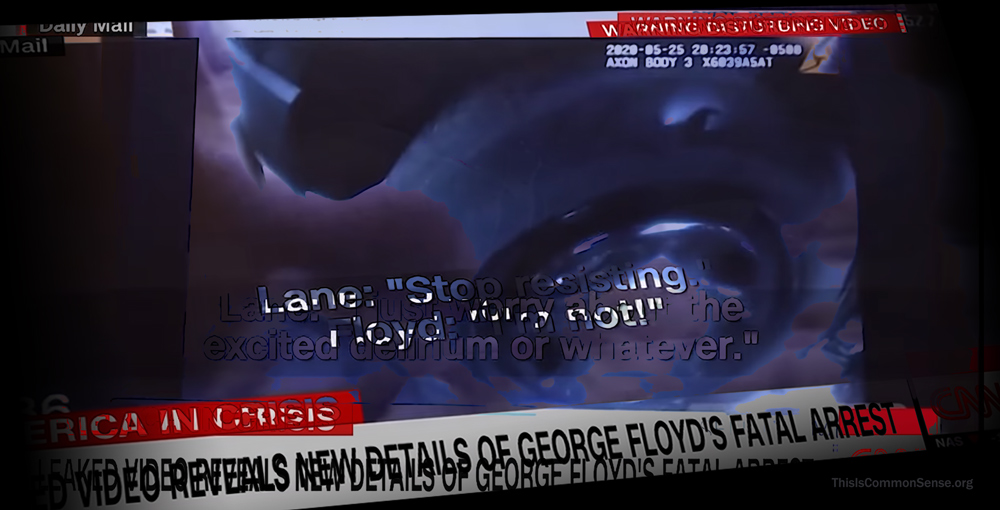
“[George] Floyd’s death changed everything,” Fox News’ Tucker Carlson told viewers two nights ago, calling it “a pivot point in American history.” 

Given “the significance of the event, it’s striking how little we really know months later about how exactly George Floyd died,” argued Carlson, before playing bits of the 18-minutes of police cam video obtained by Britain’s Daily Mail. “The official storyline . . . couldn’t be clearer. Established news organizations state as a matter of factual certainty that Floyd was . . . murdered by a Minneapolis police officer.”

“But does it reflect what really happened?” Carlson asked. 

“Floyd had a number of narcotics in his system, including enough fentanyl to die of an overdose,” the Fox host advised. “One of the best-known symptoms of fentanyl overdose, by the way, is shortness of breath. In the video, Floyd complains that he is having trouble breathing, famously, but says that long before the police officer kneels on his neck.”

Writers at The Wrap and The Huffington Post quickly took Carlson to task for suggesting that the new video evidence in any way altered the media narrative of events, pointing out that two separate autopsies determined Floyd’s death to be a homicide.* 

Neither a medical doctor nor a criminologist, Carlson is right about two things: 

(1) “The American people should have been allowed to see police body camera footage . . . much sooner than this week.”

(2) “You can decide for yourself what you think of that video.”

The point of police wearing body cameras is to give the public as clear a picture as possible. Had the full video been seen earlier, some of this summer’s violence may have been forestalled.

It should not take someone violating a court order to hit play for the public.

This is Common Sense. I’m Paul Jacob.


* Later in the program, Carlson expressed his opinion that the tape fails to exonerate Officer Derek Chauvin, who held his knee on Floyd’s neck for eight minutes.

PDF for printing

See all recent commentary
(simplified and organized)
See recent popular posts
Categories
Accountability crime and punishment ideological culture

Theft by Spray Paint

Graffiti is theft.

That is how Heather Mac Donald puts it. “To a conservative,” she writes at City Journal, “graffiti is self-evidently abhorrent, a spirit-crushing blight on the public realm, and a theft of property by feckless individuals who avenge their mediocrity by destroying what others have built.”

But that is not how “liberals” or “progressives” see it, she goes on to explain, for they regard marking up buildings and subways and streets and sidewalks as a “political statement,” referencing the New York Times recent characterization of spray-painting on property you don’t own as “a courageous strike against stultifying bourgeois values” representing “urban grit and resistance to corporate hegemony.” 

With each graffito, Ms. Mac Donald insists, progressives see an icon of “the city’s vibrant, anti-capitalist soul.”

An interesting political divide. But this rumination  on the “taggers’” art is not random. Mac Donald is aghast that New York Mayor Bill de Blasio has cancelled a graffiti-eradication program.

This, she insists, will lead to more crime, worse crime than mere trespass paintings. It’s the Broken Windows idea, and she’s probably right. Allowing small crimes to go unchecked demonstrates a lack of respect for persons and property, and that trains a city’s population to go on to do worse things.

But the program was cut for a reason. You see, de Blasio’s disastrous coronavirus response has put New York into the red. The city has to cut somewhere.

Mac Donald, however, calls the $3 million saved a “rounding error” on the city’s $88 billion budget. She imputes to de Blasio and others a preference for crime rather than fighting crime.

Maybe. And maybe we add law and order to health and commerce as casualties of the pandemic panic.

This is Common Sense. I’m Paul Jacob.


PDF for printing

See all recent commentary
(simplified and organized)
See recent popular posts
Categories
Accountability media and media people

Democracy Thrives in Out-of-Court Settlement

Nick Sandmann has won again. The Washington “Where Democracy Dies in Darkness” Post has agreed to settle out of court with young Mr. Sandmann — for an undisclosed amount. We learned this from Sandmann himself, on Twitter:

On 2/19/19, I filed $250M defamation lawsuit against Washington Post. Today, I turned 18 & WaPo settled my lawsuit. Thanks to @ToddMcMurtry & @LLinWood for their advocacy. Thanks to my family & millions of you who have stood your ground by supporting me. I still have more to do.

CNN settled in January. Suits against ABC, CBS, The Guardian, The Hill and NBC are still pending.

At issue?

The Washington Post falsely reported in 2019 that a group of Covington Catholic High School students, including Sandmann, harassed a man named Nathan Phillips with taunts and racial slurs,” explains Beckett Adams in The Washington Examiner. “The students did no such thing, as video evidence available at the time made clear. In fact, footage of the incident shows the teens were accosted not only by Phillips, who clearly sought out a confrontation, but they were also being harassed by a nearby gathering of members of the racist, anti-Semitic Black Hebrew Israelites. The Washington Post chose to give glossy, glowing news coverage to the Black Hebrew Israelites, a known hate group, all while portraying the Covington Catholic students (some of whom were black) as racists.”

Enflamed by the Post and CNN and other outlets, a self-righteously woke online mob jumped on Sandmann and other students — included were many calls for violence, and much harping on the fact the kids wore MAGA hats.

If ever a lawsuit of this kind made sense, this one did.

But will these media outfits learn their lesson?

This is Common Sense. I’m Paul Jacob.


PDF for printing

See all recent commentary
(simplified and organized)
See recent popular posts

Categories
Accountability incumbents

When More Is Better

On Monday, we considered how to get better representation in Congress for the 700,000 folks residing in our nation’s capital city, Washington, D.C.

Today, let’s tackle how the rest of us get any semblance of representation. We are sliced up into 435 congressional districts, each comprised of roughly 700,000 people electing a “representative” supposedly doing our business in Washington. 

Are they doing our business? 

The nearly universal and long-standing public disapproval of Congress answers that question.*

As the framers of the Constitution saw it, Congress would be the first and most powerful branch of government, as it would be closest to the people. The original idea was to create in members of Congress a “fidelity to their constituents,” James Madison wrote in Federalist No. 57, which “would be found very insufficient without the restraint of frequent elections. Hence . . . the House of Representatives is so constituted as to support in the members an habitual recollection of their dependence on the people.”

Madison goes on to say that congresspeople “will be compelled to anticipate the moment when their power is to cease.”

Yet well-funded congressional incumbents sporting 90 percent-plus re-election rates cycle after cycle, decade after decade — serving 20 and 30 and 50-plus years — cannot plausibly feel either compelled or dependent.

Looming large over the problem? Huge population districts. 

The more voters in a district, the more expansive and expensive campaigns must be . . . and the bigger the need for help from special interests . . . and the more powerful those groups’ influence.

Conversely, the smaller a district is, the more influence constituents individually have on their representative.

It may seem paradoxical, but it isn’t: citizens will wield more power when there are more representatives in Congress.

This is Common Sense. I’m Paul Jacob.


* In April, after sending stimulus checks to the entire country, Congress did more than double its approval rating, though it is still seen unfavorably by a lopsided two-to-one margin.

PDF for printing

See all recent commentary
(simplified and organized)
See recent popular posts

Categories
Accountability national politics & policies

Up, Up and Away?

The new U.S. Space Force wants “flexibility.” It has requested from Congress the ability to purchase and use satellites and other developing technology with agility.

That is, it wants permission to follow an “alternative acquisition system” — as explained in a “23-page report to Congress from the U.S. Air Force, the current parent of the Space Force,” according to Ed Adamczyk for United Press International. Adamczyk says that “Congress mandated a retooling of the Space Force acquisition system when it created the new branch of the military in December.”

What the new Space Force yearns for certainly looks like off-budget funding of technological assets. 

The official wording speaks of a reduction in “space portfolio constraints via incremental funding,” which Adamczyk explains as an “expanded ability to pay for space systems without regular oversight or constant requests for congressional approval.” 

That, he writes, “is a constant in the report.”

The point? To “rapidly leverage industry innovation to outpace space threats.” 

While it is popular in ‘paranoid’ circles to warn of ‘one world government’ threats to form a ‘new world order,’ this is transparently a push to effect a breakaway above-world government that sure would change the balance of world power.

Scurrying further down a long and winding rabbit hole, it might also be a way to legitimize currently unconstitutional military-industrial complex programs, perhaps part of the black budget Pentagon/HUD double-digit unaccounted-for spending and income. 

Space Force is ambitious. Good. But it craves scant constraint from Congress.

Not to mention the citizens of these earthbound United States. 

Not good.

This is Common Sense. I’m Paul Jacob.


PDF for printing

See all recent commentary
(simplified and organized)
See recent popular posts

Categories
Accountability crime and punishment

Minneapolis Burning

Minneapolis is up in smoke, after protests became rioting became looting became conflagrations became nightmare. At issue is the police killing of civilian George Floyd.

It was the biggest story in the news, this week, and you can see why. Watch the video of a white policeman with his knee on the neck of a black man, Mr. Floyd, as he pled for his life — as bystanders pled for his life.

It is harrowing.

Scott Adams notes that this became a race issue . . . in which everybody agrees that the police were in the wrong. The best kind of race issue?

Except it shouldn’t be merely a race issue. It should also be an issue of accountability. There are too many killings by police where the perpetrators face zero accountability. 

Jay Schweikert, a policy analyst with the Cato Institute’s Project on Criminal Justice, advocates a direct, practical approach for restoring police accountability: End what is known as “qualified immunity.” 

That’s where police and other public officials are held to a lesser legal standard when it comes to court cases charging them with violating our rights. This is the reason, argues Schweikert, that “members of law enforcement routinely get away with horrific misconduct.” 

There are several petitions currently pending before the U.S. Supreme Court that could lead to a legal reconsideration of the idea.* But without regard to any legal judgement, lawmakers in legislatures and citizens by petition can expressly repeal qualified immunity.

And should.

Without police accountability, what freedom is there?

This is Common Sense. I’m Paul Jacob.


* “[Q]ualified immunity is a legal doctrine that was invented from whole cloth by the Supreme Court,” Schweikert explains, “in open defiance of Congress’s decision to provide people with a federal remedy for the ‘deprivation of any right[]’ at the hands of a state actor.”

PDF for printing

Photograph by mpeake

See all recent commentary
(simplified and organized)
See recent popular posts
Categories
Accountability general freedom

Pandemic Turning Point

While reading an article in The Hill, about the loss of life that the lockdowns will cause — “millions of years of life” — I saw news anchor Judy Woodruff, on PBS News Hour, put on a dour face to intone the latest U.S. coronavirus death count: over 98,000.

But the United States is not just one unit. The United States are . . . very different. Fifty different. Most states have had few coronavirus deaths. Indeed, the map of mortality shows only a few hot spots, with New York City the worst. 

Why? One key factor appears to be population density, particularly housing density and living quarters crowding. Lots of that goes on in New York City — and, PBS tells us, on Navaho lands.

Yet not all crowded conditions are as worrisome as once thought. Many were much exercised about Florida’s Spring Break beachgoers, but no major outbreaks occurred there.

This may be the result of the virus not being spread as experts initially thought: by asymptomatic carriers — as “A study on infectivity of asymptomatic SARS-CoV-2 carriers” indicates.

Japan’s prime minister, Shinzō Abe, has withdrawn the nation’s state of emergency . . . with less than 900 dead. Back in the U.S., the states are responsible for the lockdowns, but President Trump urges an end to them, and the other day even Dr. Fauci acknowledged that lockdowns also kill.

Emile Phaneuf, writing at FEE.org, makes clear what has been foggy in popular discourse: it’s not “lives versus ‘the economy’” but “lives versus lives.” Mr. Phaneuf explains the economic logic of better policy regarding contagions.

Will our “leaders” listen in time for Round Two of the virus expected in the Fall?

This is Common Sense. I’m Paul Jacob.


PDF for printing

See all recent commentary
(simplified and organized)
See recent popular posts

Categories
Accountability general freedom The Draft

Of Honor and Horror

Last year, when the public relations wing of the U.S. Army asked, on Twitter, “How has serving impacted you?” the bulk of the responses were not what was hoped for. 

What came like tear drops and bursts of rage were thousands of horrific tales, expressions of sorrow, bitterness and despair.

No doubt the intention was to elicit, if not patriotic uplift, at least stories of learning, moral growth, centeredness, and personal victory out of sacrifice and suffering. Almost certainly the Army wanted what the promoters of “national service” now want.

The outcome was far messier.

Now, the Army handled the Twitterflak very well, with a tweet thanking people for their expressions. But a response by Mike Schmidt (@MikeSchmidt69) was probably as upbeat as could be expected, given the ‘writing on the wall’— er, Twitterfeed: “Some say this thread back-fired but this is just the thread that is needed each [M]emorial [D]ay so we remember the sacrifices military members and their families make and how we as a country need to understand the true cost of service and improve our support.”

Most of the tweets I read were decidedly not upbeat. The anger and pain over battle deaths, wounds, PTSD, mental illness, suicides, and so much indifference to it — it was deep and wide . . . and heartbreaking.

And needs to change NOW.

‘War is hell.’ In the defense of freedom, in self-defense, the brave soldier and general are honorable. But that honor is informed by the reticence that comes from actual knowledge of war’s true costs.

Maybe this Memorial Day President Trump and the Congress can also agree to review the use of military manpower around the world, looking to need to memorialize as few Americans as possible in the future. 

In fact, that sort of public policy debate is for all of us holding the hot dogs.

This is Common Sense. I’m Paul Jacob.


PDF for printing

See all recent commentary
(simplified and organized)
See recent popular posts