
Categories
regulation subsidy too much government

Flood and Fire

Tesla, the maker of some of the most popular, eye-catching, and prestige electric vehicles of our time, offers advice to folks who may experience “submersion events” with their automobiles. The company “recommends moving EVs to higher ground ahead of potential” unholy baptisms and warns owners to keep a safe distance as well as notify “first responders if one notices ‘fire, smoke, audible popping/hissing or heating coming from your vehicle,’” summarizes The Epoch Times.

This is sparked, I’m sorry to say (and pun) by hurricane victims in Florida, at least six of whom had their houses catch fire after their electric vehicles caught fire after their vehicles were submerged in water. Florida’s chief financial officer and fire marshal Jimmy Patronis put the number higher, at 16, of burning “EVs in the Tampa Bay area alone, including Pinellas County.”

“So far.”

When it floods, it burns.

“The governor had warned EV owners in Florida to get their vehicles to higher ground ahead of Helene’s arrival,” explains Jacob Burg, in the above-mentioned Epoch Times piece, “as contact with saltwater can short-circuit the batteries, causing a catastrophic chain reaction known as thermal runaway in which heat energy is released from the battery to cause a fire.”

I’ve been seeing quite a few reports that EVs don’t do well in extreme conditions. The cold, for one, where the batteries don’t work properly, and the heat, for another, when they can too easily catch fire. And now this “submersion” menace.

Electric vehicles sure do appear to demonstrate a technology still in its infancy. 

One the government shouldn’t be pushing on us.

This is Common Sense. I’m Paul Jacob.


PDF for printing

Illustration created with Midjourney

See all recent commentary
(simplified and organized)
See recent popular posts

Categories
regulation too much government

Wait, What?

The Federal Aviation Administration wants to fine Elon Musk’s spacefaring firm SpaceX $633,000 for various alleged infractions of FAA regulations. In response, Musk says he’s suing the agency for “regulatory overreach.”

One set of fines pertains to using an “unapproved control room” and failure to “conduct the required T-2 hour poll” during a June 2023 launch: 350,000 smackers.

Another set, totaling $283,000, is for using an “unapproved rocket propellant farm,” i.e., tanks for storing fuel until it’s pumped into the ships, back in July 2023.

Meanwhile, the Justice Department has sued SpaceX for hiring “only U.S. citizens and lawful permanent residents” (wait, what?) and failing to take into account currently prevailing political winds. Perhaps the FAA should sue the Justice Department for expecting SpaceX to focus on anything but its missions.

The initial reporting doesn’t make clear whether there’s any merit to the FAA’s complaints — wrong specs for fuel tanks or whatever. The mere deviation from some regulation is meaningless if what SpaceX did instead is as safe or safer than what the bureaucrats stipulated.

Large enterprises must navigate an infinite number of regulations, and federal agencies are certainly selective enforcers. If you’re Boeing, it seems you can get away with shoddy practices for years, at least until the fit hits the shan.

I’ll wait to hear more, but I suspect that the FAA’s attempt to grab hundreds of thousands of dollars from Musk is indeed a symptom of regulatory overreach.

And just possibly motivated by . . . politics.

This is Common Sense. I’m Paul Jacob.


PDF for printing

Illustration created with PicFinder and Firefly

See all recent commentary
(simplified and organized)
See recent popular posts

Categories
national politics & policies regulation subsidy too much government

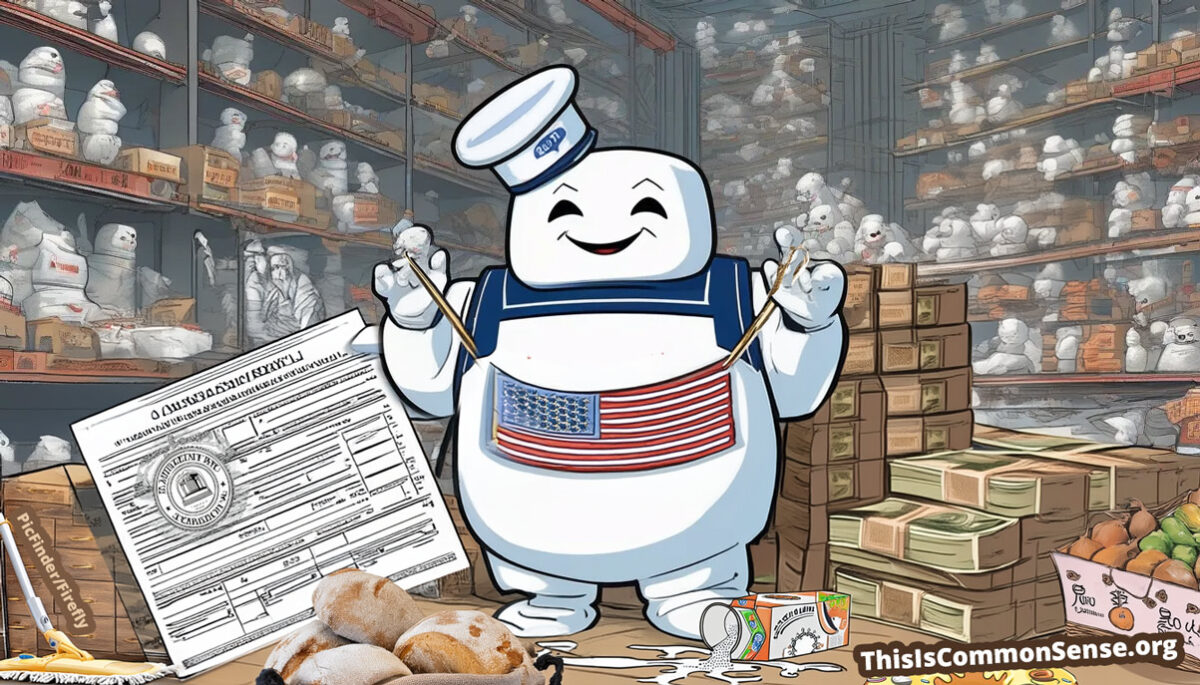
Stay Puft America

“It was perhaps just a matter of time before issues of health — not policies over health-care provision but actual human health — would enter into our politics,” surmises Jeffrey A. Tucker in The Epoch Times. “We look at pictures of people in cities or at the beach in the 1970s and compare them with today and the results are shocking. We have changed as people and for the worse.”

Jeff Tucker is trying to explain the background for a big policy-interest shift, as a result of the Robert F. Kennedy, Jr., endorsement of Donald J. Trump. Kennedy’s big issue is health, and Trump’s gone along with it, willing to make it a part of his agenda.

In “How Did Health Become a Political Issue?” Tucker focuses first on the COVID debacle, moving on to the real culprit: government.

Or, technically, government and industry, combined into one huge Stay Puft Marshmallow of Destruction. For behind our changing eating patterns and food habits are government tariffs, subsidies, researchstrategies, diet crazes, and much, much more. 

Perhaps even bigger than Big Pharma is Big Agribiz, a conglomerate of companies pushing lab-created additives and worse on a trusting public, or, as Tucker puts it, “many decades of heavy government subsidies for the worst food, and so much in the way of corn, soy, and wheat are produced that we’ve invented new ways to use it.”

But it’s not really “we’ve.” The Standard American Diet (SAD) wouldn’t have existed were it not for the USDA and the FDA and a whole alphabet soup of bureaus captured by the industries they were assigned to regulate, working together in a Big Biz/Gov partnership to create a Big Problem in the general population.

Somehow, though, when asked about the government causes of SAD, RFKj said he wouldn’t abolish anything. He merely wants “better regulations.”

Someone needs a fast . . .from Big Government.

That someone? Kennedy. 

And America.

This is Common Sense. I’m Paul Jacob.


PDF for printing

Illustration created with PicFinder and Firefly

See all recent commentary
(simplified and organized)
See recent popular posts

Categories
First Amendment rights too much government

Deep State in a Corner

Once upon a time, the CIA and allied agencies pushed free speech as a norm. 

Overseas.

The rationale? Without some free speech and press rights, it was too hard to organize a populace to overthrow their government. Our spooks exported freedom of speech abroad not because they were so gung-ho American; it was all about seeding revolutions.

But not here! 

The CIA couldn’t let others take advantage of American free speech like its agents leveraged free speech abroad. A change in government might mean . . . loss of jobs. Mission. Money.

What to do? Disinform at home. By corrupting journalism.

The Operation Mockingbird efforts in the 1960s helped intel insiders control information and manage “the consent of the governed,” and these early efforts grew into the close ties between the Deep State and credentialed journalists today. 

The connections, I’m told are many: it’s not just Anderson Cooper’s internship at the CIA. 

During the Cold War, the disinformation element found a plausible justification. Then, the Soviets had us at a disadvantage: we had trouble extracting reliable information from within the Iron Curtain, but they could grab all sorts of useful information from our open, comparatively free speech realm.

Disinformation: a strategic necessity. But the consequences?

 “We’ll know our disinformation program is complete,” William Casey explained to President Ronald Reagan, “when everything the American public believes is false.”

In the early days of the Internet, the Deep State pushed online speech platforms, the better to allow for foreign coups. Is there a social media space that hasn’t received surreptitious government subsidy? It’s hard to be sure. We’re supposed to assume our government protects us rather than controls us. 

But, increasingly, Internet-connected Americans see government officials chiefly as manipulators.

Which is why the Deep State’s most ardent partisans (neocons; Democrats; plutocrats) now routinely attack free speech here, and why allies overseas are so thoroughly cracking down on “de-stabilizing” opinions. It’s why Rumble is no longer available in Brazil and why Musk is pulling out Twitter personnel . . . and why France has arrested the CEO of Telegram.

Us catching on to the psy-op game places the Deep State in a corner. All the disinformation agents have left is censorship and repression.

This is Common Sense. I’m Paul Jacob.


PDF for printing

Illustration created with Midjourney and Firefly

See all recent commentary
(simplified and organized)
See recent popular posts

Categories
education and schooling general freedom too much government

The State vs. Homework

Oy, the stress. Of doing stuff. It’s nonstop.

If a California lawmaker gets her way, it will stop, though, at least in the schools. Or at least slow way down.

Consider the pressure, the horrible grinding pressure of having to practice math problems, peer at chemical formulas, read assigned readings, summarize, spell, grammarize, memorize names and dates and Spanish vocabulary, and on and on and on . . . en casa. . . .

It’s the kind of thing that can curdle a kid’s physical and mental health. Not to mention cut into playtime.

So is the legislation AB2999 justified?

Is Assemblywoman Pilar Schiavo warranted in hoping to require school boards to ponder the “reasonable amount of time spent on homework per student that should not be exceeded” or whether “homework should be assigned . . . in any elementary school grade, inclusive” or perhaps that homework be “optional and not graded,” et cetera?

Well, if we think about this, we must admit that there is one and only one reason to ever require students to spend time at home mastering what is introduced in class. Only to prepare them for earning a living and living life by helping them obtain knowledge and skills and realize their potential.

But that’s it. That’s the only reason.

Of course, individual teachers, if competent and conscientious, already think about what homework is appropriate to assign. They must, we hope, want their students to function capably in life. And maybe also to learn that learning is not torture.

This is Common Sense. I’m Paul Jacob.


PDF for printing

Illustration created with PicFinder and Firefly

See all recent commentary
(simplified and organized)
See recent popular posts

Categories
inflation and inflationism international affairs too much government

Is Milei Making It?

After libertarian economist Javier Milei surprised the rest of the world by winning the presidency of Argentina in 2023, the question became whether — or how quickly — he could slash government programs, privatize nationalized firms, and set free a flatlining government-controlled economy.

A president can do some things on his own. But Milei requires the cooperation of the legislature to institute many substantial reforms. And for months his legislative agenda has stalled.

Now some of it is being enacted. On June 28, the Chamber of Deputies passed a sweeping package of bills that Reuters dubbed Milei’s “first big legislative win” and Bloomberg’s Manuela Tobias characterized as “deregulat[ing] vast swaths of the economy and boost government revenues. . . .”

The enacted reforms include provisions to make it easier for employers to fire workers and to deregulate the oil and gas industry. Milei was able to privatize only a few of the dozens of state firms that he wanted the government to unload.

Tobias notes that the passage of Milei’s reform package, “albeit significantly watered down,” is impressive considering that members of Milei’s own party constitute less than 15 percent of the lower chamber.

Milei’s most obvious success has been fighting inflation, which according to Deutsche Welle is “down from around 25 percent per month last December to 4.2 percent this May.” This is a major achievement for a figure outside the mainstream of globalist standard opinion, who has called himself an “anarcho-capitalist” (of all things) and was labeled by the German paper “right-wing populist and economically liberal.”

Terms mean different things in different countries: it’s pretty obvious that Milei’s program has nothing to do with that of American “liberals” such as President Biden and his partisans.

This is Common Sense. I’m Paul Jacob.


PDF for printing

Illustration created with Midjourney and Firefly

See all recent commentary
(simplified and organized)
See recent popular posts

Categories
free trade & free markets general freedom too much government

Doctoring Malady

There is a doctor shortage. Economists who study such issues project that the shortfall will continue to grow.

That is, the pool of available professionals for advanced and general practice medicine is shrinking relative to demand.

A report last year at Definitive Healthcare provides a list of reasons:

  1. Shifts in physician and patient populations
  2. Most healthcare workers prefer not to work in rural hospitals 
  3. Medical school and residency programs are limited 
  4. Healthcare workers are burnt out 

What wasn’t mentioned? The COVID response debacle. When an elephant makes a deposit on the waiting room floor, don’t ignore it.

But, instead, the list of causes and cures was predictable: “too many administrative tasks” (need more assistants, or at least AI?); “poor work-life balance” (but that’s always been the case); “insufficient salary” (you could see that one coming a mile away, right?).

A study published in March, “The Complexities of Physician Supply and Demand: Projections From 2021 to 2036,” prepared for the Association of American Medical Colleges, dips its timid toes in that topic, but says little of significance. 

And as I scrolled through a report on the study, I thought: this is none of my business. Just as it’s none of my business to fret much about the supply and demand for toilet tissue or garbage trucks. This is all supposed to be taken care of by “the market.” 

Trouble is, we do not have a free market in medical care. We have an over-regulated, vastly subsidized healthcare system.

The key to the future supply of doctors is getting the government out of doctors’ business. Hesitating to turn that key, or saying that government “must do more,” merely makes the malady worse.

This is Common Sense. I’m Paul Jacob.


PDF for printing

Illustration created with PicFinder and Firefly

See all recent commentary
(simplified and organized)
See recent popular posts

Categories
free trade & free markets ideological culture political economy too much government

Sweden’s Electric Sense

Common sense in Sweden! Energy in Sweden!

Under the policy of Sweden’s current government, the Swedish people are to be allowed to illuminate and heat their homes and do all the other things they use electricity for. The Swedish parliament has formally relinquished the government’s former target of somehow reaching “net-zero” renewable energy by 2045.

Such unreliable means of generating power as erratic wind and erratic sunshine just don’t cut it, says Finance Minister Elisabeth Svantesson.

“We need more electricity production, we need clean electricity, and we need a stable energy system. In substantial industrialized economies . . . only a gas-to-nuclear pathway is viable to remain industrialized and competitive.”

The new energy policy is an about-face for Sweden, which decided in the ’80s to nuke nuclear power and pursue 100 percent “renewable” energy.

Sweden is now following the lead of Finland. After Finland’s latest nuclear power plant went on line in April, reports Peta Credlin, “wholesale power prices dropped 75%, almost overnight. The Olkiluoto 3 plant is . . . delivering 15 percent of the country’s power needs. Nuclear now provides around half of the country’s total electricity generation.”

Nuclear power has gotten a bad rap in many countries, including the United States. But if societies and governments are rightly or wrongly determined to retreat from reliance on fossil fuels while also not pulling the plug on industrial civilization, a steady supply of electricity has to be obtained somehow or other.

Nuclear power is one major way to do the job.

This is Common Sense. I’m Paul Jacob.


PDF for printing

Illustration created with ChatGPT 4o

See all recent commentary
(simplified and organized)
See recent popular posts
Categories
free trade & free markets general freedom too much government

Exemptions, Not Repeal

If you light the fuse of a bomb, after warnings that this will cause it to explode, you should not be surprised at the explosion.

California’s lawmakers and governor recently imposed super-high minimum wages for workers in fast-food restaurants ($20 an hour) and workers in healthcare facilities ($25 an hour). When the legislation was in process, the impact on companies, customers, and job applicants was deemed irrelevant. What mattered was appeasing the labor lobby.

Governor Newsom is suddenly “realizing” (he’d been warned) that these new costs will also burden the state government, currently facing a $45 billion budget deficit.

But this isn’t causing him to seek repeal.

No. Instead, he has signed legislation granting an exception to the new minimum for fast-food restaurants that are on government land. “Democrats don’t want the mandate interfering with government concession licenses,” The Wall Street Journal observes.

And Newsom also wants to defer the kick-in of the new minimum wage for workers in healthcare facilities — which he projects would cost the state $4 billion more annually because of the impact on Medicaid and state-paid health workers — until state revenue is in better shape. He would also permanently exempt state-owned facilities from having to pay the new minimum.

Carveouts and minor delays are as far as the governor and lawmakers are willing to go. Whatever gets them past the uncomfortable present — the next moment and the one after are things to worry about later. With any luck, with time the voters will have forgotten the issue, and who caused what.

Exemptions are the order of the day for politicians and bureaucrats. Private sector businesses must remain on the rack.

This is Common Sense. I’m Paul Jacob.


PDF for printing

Illustration created with PicFinder and Firefly

See all recent commentary
(simplified and organized)
See recent popular posts

Categories
local leaders too much government

Brave New Budgets

“Stay here and you will suffer.” 

That’s the message Denver’s Newcomer Communications Liaison Andres Carrera delivered to migrants last month, according to the city’s NBC 9 News.

“You don’t have to walk anywhere, we can buy you a free ticket,” Carrera offered. “You can go to any city,” he said, mentioning New York and Chicago, specifically. 

“We can take you up to the Canadian border, wherever!”

Denver is now preparing to spend $90 million on migrant programs this year. 

In the last fiscal year, New York City spent $1.5 billion “for asylum seeker shelter and services,” and those expenses are going up. Chicago’s “City Council is set to vote on spending another $70 million in city funds for migrant services,” Block Club Chicago reported last week, “just five months after Mayor Brandon Johnson’s 2024 budget allocated $150 million for new arrivals this year.”

We hear about the costs of the border crisis; these whopping numbers certainly clarify that matter. 

Still, something else caught my attention. 

Denver is making a 2.5 percent cut to most city agencies, while reducing the police department budget 1.9 percent, an $8.4 million dollar decrease for cops. Some charge that’s de-funding the police.

“The City of Denver’s adjustment to the Denver Police Department’s budget was carefully crafted with safety leaders and Mayor [Mike] Johnston,” a spokesperson explained, “to ensure there would be no impact to the department’s public services,” 

Crafted with care. And having precisely zero impact.

Imagine had you or I suggested to politicians and government officials that we slice millions of dollars from their budgets. We’d be accused of gutting education and undermining public safety . . . if not starving the children.

Who knew it could be so easy and painless for them?

This is Common Sense. I’m Paul Jacob.


PDF for printing

Illustration created with PicFinder and Firefly

See all recent commentary
(simplified and organized)
See recent popular posts