Categories
insider corruption national politics & policies too much government

The Trillion-Dollar Mark?

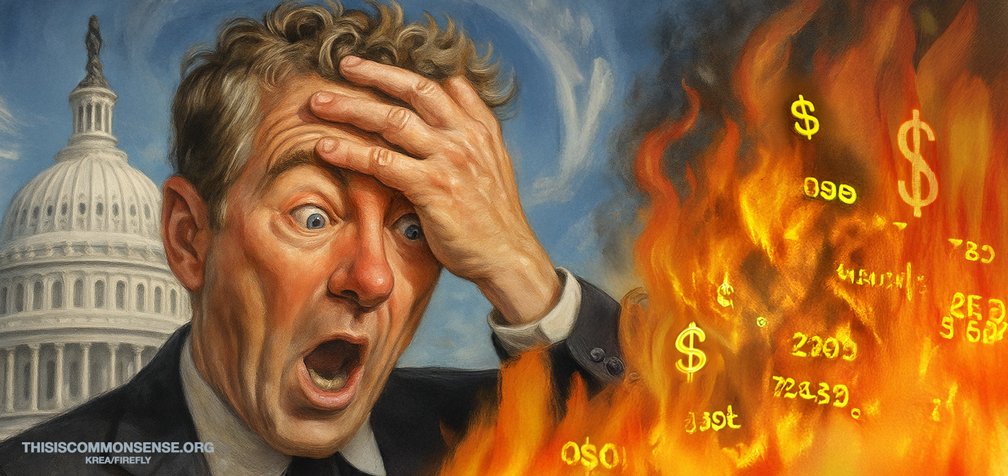
According to Fox News, Elon Musk “met with a small group of House Republicans on Wednesday evening to discuss the quest to find as much as $1 trillion in government waste.”

That would indeed be significant

But until then, the “Department of Government Efficiency,” popularly called DOGE, continues to find insane wasteful spending in the “mere” millions.

Consider the Small Business Administration, which “administers” loans to . . . well . . . “DOGE said it identified that the Small Business Administration (SBA) granted nearly 5,600 loans for $312 million to borrowers whose only listed owner was 11 years old or younger at the time of the loan,” reports Fox. 

Loans made in the pit of despair that was the COVID pandemic.

Children have no business taking out SBA loans — the obvious quip would be about “lemonade stands” — but Musk suggests there could be reasons for the practice, just not in the 5,593 cases DOGE specifies, because the wrong Social Security numbers were used in those applications.

But let no one say the federal government is not balanced, for “in 2020 and 2021 the SBA issued 3,095 loans for $333 million to borrowers over 115 years old.”

And speaking of the ancient, Bernie Sanders wrote to Newsweek to give the socialist view of the subject: “The person who is running the government right now is Elon Musk. Mr. Musk has taken it upon himself, with the support of President Trump, to virtually dismantle the United States government.”

Don’t get our hopes up, Senator.

Unlike Harry Enten at CNN, I’m not at all shocked to learn that DOGE has majority support in America at present. “I was truly surprised by this,” said Enten last Thursday, “but the numbers are the numbers.”

After all, it’s only common sense to seek to root out waste, fraud, and abuse.

Isn’t it?

This is Common Sense. I’m Paul Jacob.


PDF for printing

Illustration created with Krea and Firefly

See all recent commentary
(simplified and organized)
See recent popular posts

Categories
regulation too much government

How to Kill a Bureau

First, Trump fires the holdover director of the Consumer Financial Protection Bureau, a radically anti-business agency. He appoints the new treasury secretary, Scott Bessent, as acting director.

Bessent orders the agency to stop everything — “rulemaking, communications, litigation,” Bloomberg Law reported. “A source inside the bureau who asked to remain anonymous said the order appeared to shut down the CFPB altogether, for the time being.”

So far, so good.

Trump replaces acting director Bessent with Russ Vought, a former and also the new director of the Office of Management and Budget.

The CFPB’s website goes dark and the Department of Government Efficiency (DOGE) begins to audit the books.

Musk and his team will find bad things. But “efficiency” isn’t quite the issue. Suppose the Bureau proves to be extremely efficient and noncorrupt at the task of making businesses extremely inefficient?

The mission is bad.

This agency sets its own budget, is perversely cut off from congressional oversight, and, accordingly, has been able to run wild. One of its strokes of genius: treating video games as bank accounts, giving itself permission to do so with a quaint doctrine of “dormant authority.” 

Now we have oversight. Internal. “The calls are coming from inside the house”; it’s being gutted from within.

RedState expressed hope the CFPB’s “hyperaggressive regulation-writing and legal thuggery will be markedly reduced” and that the agency may even be closed.

Yes, end it, as critics have long argued

Existing only to harass and murder businesses and free enterprise, it is one of many federal agencies that must be put out of our misery.

This is Common Sense. I’m Paul Jacob.


PDF for printing

Illustration created with Krea and Firefly

See all recent commentary
(simplified and organized)
See recent popular posts
Categories
budgets & spending cuts too much government

How Audits Work in Real Life

Corrupt politicians and bureaucrats are panicking. 

O, the prospect of any significant shrinking of the federal behemoth!

Any significant rooting out of the corruption that benefits them. . . .

Many combat this horror by flinging every fallacy in the book. Like the notion that Elon Musk and his team are unqualified. They ask, is Musk a certified public accountant? 

He’s only a mega-successful serial entrepreneur, not an accountant.

Monster Hunter Nation’s Correia45 answers a slew of the fallacies, not in the most genteel manner. Cover your ears if you click in.

First, there’s nothing odd about an internal audit, which “is what Donald Trump (the man in charge) is doing now, by having his people (DOGE) audit the executive branch he runs. CEOs and owners do this all the time.”

Nor need you be a CPA to contribute. That’s essential for only certain types of accounting, which “isn’t even close to what DOGE is doing.”

Correia45, an accountant, has been on teams that included programmers, lawyers, machinists. Machinists because, when auditing a factory, “I could count the parts, but I couldn’t tell you if the parts were b******t or not.”

Another thing: I can certainly think of reasons to have smart energetic young people on an auditing team. 

But, contra some assumptions (based on the fact that 20-somethings are “who got doxxed first”), young people are not the whole team. Newsweek’s list of known DOGE staff includes persons ranging in age from 19 to 67.

And so DOGE goes. Godspeed. 

This is Common Sense. I’m Paul Jacob.


PDF for printing

Illustration created with Krea and Firefly

See all recent commentary
(simplified and organized)
See recent popular posts

Categories
First Amendment rights media and media people too much government

The Chirping Mockingbird

We are told that “there’s nothing to see” in the recent revelations about how USAID was subsidizing Politico

At Reason, Robby Soave pooh-poohed the story: “some critics of USAID have seized on a misleading claim: Namely, that the organization was funneling millions of dollars to Politico. In reality, it appears that government agents were paying for subscriptions to Politico‘s premium product. That may or may not be a worthwhile use of government funds (more on this in a moment), but at any rate, it does not represent some kind of direct subsidy to the news outlet.”

It could be, however, a subsidy with plausible deniability. 

The keyword may be: Mockingbird.

Remember the Church Committee investigations into the intel community, post-Nixon? One of the revelations was of Operation Mockingbird, which was (“allegedly”) the CIA training and subsidizing of — and coordinating stories to — scores (perhaps hundreds) of individual journalists. 

One of the many things we don’t know about Mockingbird is if it ever ended. But one thing we do know is that programs begun by one agency not irregularly get taken up by others.

And speaking of multiple agencies — with more than a dozen dedicated to intelligence, why is government paying the private sector for information?

For all their massive appropriations, the basic job of intel agencies to inform (not lie to) representatives, government executives, and functionaries appears to be one they’ve skimped on.

Meanwhile, USAID’s massive subsidies to New Zealand news outfits has somehow received little interest. “Last week, Wikileaks reported that 25 NZ mainstream media outlets were given funding from USAID,” explains The Daily Blog. “We need an immediate explanation from our Mainstream Media Owners if they changed any editorial stance that aligned us with America while taking this money.”

Inquiring minds should be skeptical of underplaying of these revelations. Don’t we need a wall of separation between press and state?

This is Common Sense. I’m Paul Jacob.


PDF for printing

Illustration created with Flux and Firefly

See all recent commentary
(simplified and organized)
See recent popular posts

Categories
insider corruption regulation too much government

Killing a Bureau

First, Trump fires the holdover director of the Consumer Financial Protection Bureau, a radically anti-business agency. He appoints the new treasury secretary, Scott Bessent, as acting director.

Bessent orders the agency to stop everything — “rulemaking, communications, litigation,” Bloomberg Law reported. “A source inside the bureau who asked to remain anonymous said the order appeared to shut down the CFPB altogether, for the time being.”

So far, so good.

Trump replaces acting director Bessent with Russ Vought, a former and also the new director of the Office of Management and Budget.

The CFPB’s website goes dark and the Department of Government Efficiency (DOGE) begins to audit the books.

Musk and his team will find bad things. But “efficiency” isn’t quite the issue. Suppose the Bureau proves to be extremely efficient and noncorrupt at the task of making businesses extremely inefficient?

The mission itself is bad.

This agency sets its own budget, is perversely cut off from congressional oversight, has been able to run wild. One of its strokes of genius: treating video games as bank accounts.

Now we have oversight. Internal. “The calls are coming from inside the house”; it’s being gutted from within.

RedState hopes the CFPB’s “hyperaggressive regulation-writing and legal thuggery will be markedly reduced” and that the agency may even be closed.

Yes, end it: as critics have long argued. Why does this agency exist except to harass and murder businesses and free enterprise? One of many federal agencies that should expire. 

This is Common Sense. I’m Paul Jacob.


Previously on the CFPB:

Give Them Credit — February 2, 2014
Invulnerable Government — November 28, 2017
Peel Back the Onion — November 30, 2017
Protector Protection — January 6, 2020

PDF for printing

Illustration created with Flux and Firefly

See all recent commentary
(simplified and organized)
See recent popular posts
Categories
regulation too much government

Control of Air Traffic Control

A terrible accident near Reagan National Airport reminds us that reform of our air traffic control system has been overdue for decades.

One story discusses the pilots’ longtime concerns about safety problems specific to Reagan National. But the decrepit state of air traffic control afflicts every airport.

John Tierney outlines some of the problems.

  • Too many controllers rely on outdated technology. Elsewhere, controllers use sophisticated computer systems to handle complicated hand-off (and other) tasks efficiently. But American controllers are “still using pieces of paper called flight strips” that must be carried around the control room.
  • U.S. controllers lack access to satellite technology that would enable them to more precisely guide and monitor planes. No infrared systems on runways either; controllers must look out the window to see what planes are doing, a big problem during bad weather.
  • Lousy politics has obstructed change. An independent corporation, not a “cumbersome federal bureaucracy,” should be operating the control towers, Tierney argues. But widely supported efforts to fix things have gone nowhere, partly because some lawmakers want to maintain congressional control.

Robert Poole of the Reason Foundation, who has been pushing for reform of U.S. air traffic control for five decades, thinks now something may happen.

“The public and opinion leaders now know a lot more about the FAA’s shortcomings,” he says. “With DOGE and the Trump administration shaking things up, perhaps the time for real reform has finally arrived.”

Let’s hope accountability has safely landed. 

This is Common Sense. I’m Paul Jacob.


PDF for printing

Illustration created with Flux and Firefly

See all recent commentary
(simplified and organized)
See recent popular posts

Categories
free trade & free markets regulation too much government

Unplugging the EV Mandate

Under the Biden administration, gas-powered vehicles were on a government-impelled road to decline.

In March 2024, the EPA finalized Biden’s “crackdown on gas cars” by issuing absurdly stringent emission standards. The idea was to advance the administration’s “climate agenda” by sending gas-powered modes of transportation to the junkyard.

Leaders of the petroleum industry were among those who saw that the scheme would “make new gas-powered vehicles unavailable or prohibitively expensive for most Americans.” The policy would “feel and function like a ban.”

This was just one of many examples of Biden-oppression pushing American voters who value at least their own freedom into the Trump camp.

Electric vehicles have pluses and minuses. In past columns, I’ve expressed much enthusiasm for the technology, but recognized that it must develop naturally, in a free market, rather than unnaturally, out of ideological hope and fear-ridden “need,” forced by government regulation and subsidy.

As James Roth has noted over at StoptheCCP.org, we’ve had a century and a half to fine-tune gas-powered vehicles, a mature technology that is “beloved by the public.” Why not let electric and gas cars compete fair and square in the market? And why give an artificial boost to totalitarian China’s heavily subsidized and promoted EV industry by crippling the gas-car industry here at home?

President Trump has heard the cry of those who prefer to step on the gas.

Section 2(e) of his sweeping executive order on “Unleashing American Energy” states that it is the policy of the United States to “eliminate the electric vehicle mandate . . . by removing regulatory barriers to motor vehicle access” and other thumb-on-scale interventions in the market.

Is the future of gas cars going to be great again?

This is Common Sense. I’m Paul Jacob.


PDF for printing

Illustration created with Flux and Firefly

See all recent commentary
(simplified and organized)
See recent popular posts
Categories
deficits and debt national politics & policies too much government

The Biggest

Trump’s riding high, in the first week of his second term — but not regarding the biggest problem he faces, inflation and economic instability.

“When bondholders don’t see a credible fiscal path to be repaid for current and future government debt,” writes Veronique de Rugy at Reason, “they expect that eventually the central bank will create new money to buy those government bonds, leading to higher inflation.

“Recent inflation wasn’t just about money supply; it reflected the market’s adjustment to unsustainable fiscal policy.”

Winning, for Trump, cannot equate to Spending.

While Ms. de Rugy tries to explain this all in terms of a big-picture economic analysis, she does not quite reach back in time far enough. We had stagflation way back when I was young. It was cured then not by decreased spending but by Paul Volcker of the Federal Reserve putting the brakes on money-and-credit expansion. He stopped inflation. 

A pure recession immediately followed, followed by recovery in the new administration, Ronald Reagan’s, who helped reduce the rate of growth of government (and not much else).

Inflation could, theoretically, be handled by the Fed alone, now, as then.

Except — the federal government can hardly now afford to service existing debt, which would skyrocket with the nitty-gritty of the Fed’s cure, higher interest rates. 

Today, debt service (paying just the interest) approaches One Trillion Per Annum. 

“A crucial tipping point was reached in 2024 when the interest expense on the federal debt exceeded the defense budget for the first time,” Nick Giambruno summarizes at The International Man. “It’s on track to exceed Social Security and become the BIGGEST item in the federal budget.” 

Increasing it yet more would cripple the government.

The only way out, if there is one, is a radical decrease in spending and deficits, as de Rugy advises. Trump’s path to success is somehow accomplishing that.

This is Common Sense. I’m Paul Jacob.


PDF for printing

Illustration created with Flux and Firefly

See all recent commentary
(simplified and organized)
See recent popular posts

Categories
First Amendment rights Internet controversy social media too much government

When Is Censorship Not Censorship?

Mark Zuckerberg says Facebook is returning to its free speech roots.

Can we believe him?

While the restrictions on what you can talk about on Facebook are still pretty extensive, Zuckerberg’s outfit, Meta, is apparently ending the reign of “fact-checkers” on Facebook and Instagram, as well as the platforms’ collusion with federal government “fact-checkers.”

On Monday, I discussed the federal government’s screaming fits that led Facebook to ramp up “content moderation,” which I identified with a less euphemistic c-word. But that word choice remains controversial. For example, a “global network of fact-checking organizations,” the International Fact-Checking Network, which includes Agence France Presse, objects to Zuckerberg’s assumption that Meta helped impose censorship.

“This is false, and we want to set the record straight, both for today’s context and for the historical record,” announced IFCN. The Network then “warned of the potentially devastating impact if the group were to end its worldwide programs. . . .”

If censoring in obedience to government demands is not censorship, what could be? The article doesn’t explain. AFP and IFCN are simply saying that they don’t want freedom of speech; it’s dangerous.

Of course, free speech can have costs. 

But censorship does too: suppression of truth and impeding the means of learning truth. 

The article doesn’t report on the costs of suppressing facts about, say, COVID-19, vaccines, U.S. policy, UFOs, or Hunter Biden’s laptop.

AFP and IFCN simply assume that gatekeepers like themselves, with a vested interest in excluding divergent reports and viewpoints, must be allowed to keep excluding differing views and inconvenient facts from the “safe spaces” that apparently include all the very biggest spaces on the Internet.

This is Common Sense. I’m Paul Jacob.


PDF for printing

Illustration created with Flux and Fireflly

See all recent commentary
(simplified and organized)
See recent popular posts

Categories
Accountability First Amendment rights national politics & policies too much government

GEC Bullet Ducked?

Last month, a mega-monstrous “continuing resolution” (CR) — allowing federal deficit spending over the set debt limit — was killed by public outcry, helped along by Donald Trump, Elon Musk, and others with megaphones or MAGAphones.

This CR was chucked to the great annoyance of champions of runaway spending and runaway violations of individual rights. They babbled about the autocratic interference of one “President Musk.” 

As if his complaints alone would have sufficed to kill it had nobody else in America cared.

The mega-monstrous CR was replaced by a mini-monstrous CR. The replacement sported many fewer pages, things like a pay raise for congressmen having been left out.

Also deleted? A part of the State Department devoted to censoring Americans.

Called the Global Engagement Center (GEC), it was designed to use indirect methods to censor Americans guilty of wrongthink. The plan was to give our tax dollars to creators of blacklists, like $100,000 to the Global Disinformation Index. American advertisers then would feel compelled to avoid dealing with listed companies — to remain on the good side of the U.S. government

Thanks to “President Musk” and his “obedient slave” Donald Trump, the GEC died. State’s website now says so itself.

Or did it? Has the GEC simply been rebranded?

The new thing is a so-called Counter Foreign Information Manipulation and Interference Hub; it looks like State will still be funding this GEC clone. 

The GEC, after all, was also supposed to focus only on foreign agitprop.

When will government agencies stop trying these kinds of anti-democratic, anti-constitutional end runs? 

Never. Not voluntarily.

This is Common Sense. I’m Paul Jacob.


PDF for printing

Illustration created with Flux and Firefly

See all recent commentary
(simplified and organized)
See recent popular posts