Categories
free trade & free markets too much government

San Francisco Obstructionism

Bob Tillman wants to build a 75-unit apartment building in San Francisco.

He owns the property — a laundromat. He just wants to convert it. But although there are no good reasons why he shouldn’t, city officials and activists opposed to the property rights of developers have been blocking the project. Tillman has spent years and hundreds of thousands of dollars just trying to get started.

His plight “encapsulates the political dysfunction that’s turning San Francisco . . . into an exclusive playground for the ultra-wealthy,” says Reason magazine.

Because of the government’s general antagonism to development, and specific policies such as rent control, much less housing is getting built in the city than would have been possible in a fully free market.

The population is growing quickly, but housing isn’t keeping up. Which results in unnecessarily high rents and housing prices.

None of this is shocking if you understand basic economics. The greater the supply of a good, the cheaper the price tends to be — all other things being equal. That qualification is important. If the supply of oranges doubles but everybody suddenly starts an all-orange-juice diet, orange prices may remain the same or even rise — but less than the price would have risen without the greater supply.

Many factors, including monetary factors, can affect the price of a good. All I’m saying is that if you want the benefits of more housing, including rents that are lower than they would have been without the new housing, you must build houses and apartment complexes.

Stop something from being built and, unfortunately, it won’t be there.

This is Common Sense. I’m Paul Jacob.


PDF for printing

San Francisco, homeless, zoning, housing, regulations
Photo by Mussi Katz

See all recent commentary
(simplified and organized)
See recent popular posts

Categories
international affairs meme Popular too much government

What Kind of Ice Cream Cone?

When I wrote about the Donald’s change of troop positions abroad last week, it was less than completely clear that the US President aimed to withdraw troops from Afghanistan as well as Syria. But multiple reports on the day I posted “Strategic Disengagement” make it clearer: about half of America’s 14,000 troops stationed there are scheduled to exit.

Why not all?

Well, you can see how entrenched foreign intervention is for American leaders. While most of the GOP policy establishment howled at Donald Trump’s betrayal of the cause (whatever that cause is, exactly), so, too, did many of the Democrats. And they seem awfully earnest. More earnest than one has reason to expect from the objectors to “George W. Bush’s wars.”

Even Noam Chomsky came out saying that the U.S. should stay in Syria to save the Kurds, and Howard Dean tweeted that American troops must remain in Afghanistan for the sake of women’s rights.

What we are witnessing are eternal programs that do not ever — and cannot ever — fulfill their basic purpose. No amount of occupation of Syria or Afghanistan or Iraq is going to give us what the neoconservatives promised: freedom and democracy and jubilation in the streets.

Freedom and democracy do not work that way.

There is a term for such impossible-to-win/impossible-to-stop policy messes: “self-licking ice cream cones.”

The term means a “self-perpetuating system that has no purpose other than to sustain itself,” which is just standard operating procedure for domestic bureaucracies.

But in foreign military action?

Awfully cold imagery, and too comic . . . for tragedy.

This is Common Sense. I’m Paul Jacob.


PDF for printing

self licking ice cream, war, foreign policy, government

See all recent commentary
(simplified and organized)
See recent popular posts

Categories
international affairs Popular too much government

Strategic Disengagement

The policy was announced in a Tweet: President Trump said it was time to pull out of Syria. We won, he explained. “After historic victories against ISIS, it’s time to bring our great young people home!”

There is, of course, much outcry among Republicans, Sen. Lindsey Graham (R-SC) and pundit Ben Shapiro making the same point: this is, in the senator’s words, “a huge Obama-like mistake.”

But not a few are supportive. “U.S. forces should not be engaged in Syria — or any country,” explained Rep. Justin Amash (R-Mich), “without legitimate military justification AND proper congressional authorization.”

And there is no doubt that after pulling out of the region — and yes, it looks like Trump is readying forces for a pull-out of the expensive and ridiculous Afghanistan occupation — there will be outrageous horrors. But are they America’s? 

Should they be?

The problem with trying to solve every worldwide conflict is clear: by intervening, we make those conflicts ours.

The idea that the American military can successfully micromanage conflicts around the world seems implausible. And increasingly counter-factual. 

The same logic against intervening in the domestic economy to “wisely” promote some businesses and demote others also applies against most foreign military intervention: “unintended” consequences get conjured up, and even blowback.

Also, somehow, almost no one ever consults Just War theory to test various proposed interventions. Instead, military interventionism is all audacious hope and lofty language.

No realism, despite “Mad Dog” Mattis’s protests to the contrary.

Foreign policy scholar Earl Ravenel had the perfect term for what Trump may be and should be doing: strategic disengagement. We have much to gain from a more restrained — and constitutional — foreign policy.

This is Common Sense. I’m Paul Jacob.


PDF for printing

Donald Trump, Trump, Syria

See all recent commentary
(simplified and organized)
See recent popular posts


Categories
government transparency too much government

Fill Up the Swamp Some More

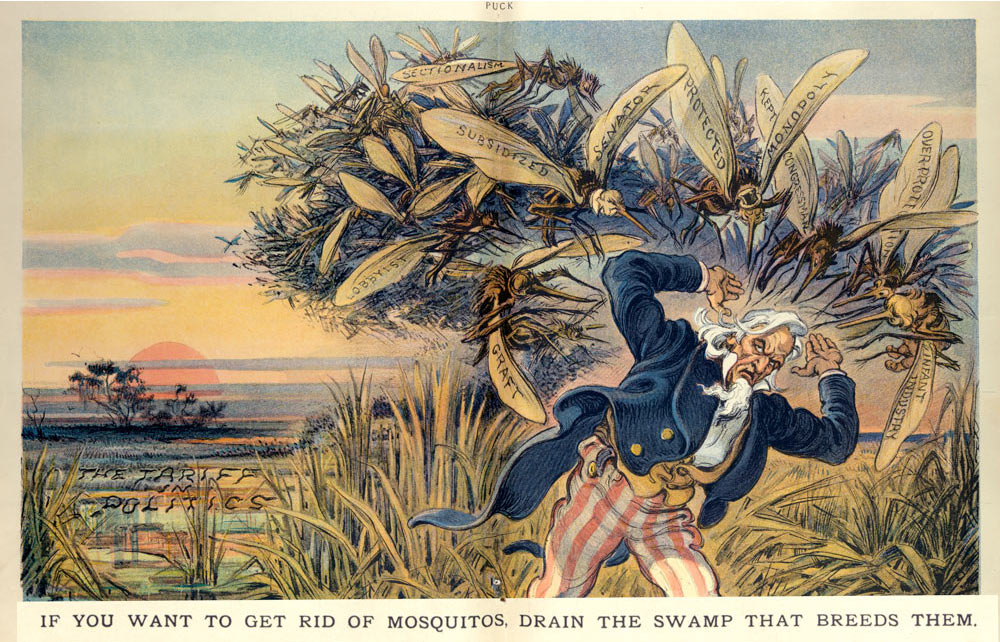
Donald Trump’s “drain the Swamp” promise was good rhetoric, great politics — because nearly everybody knows that the federal government just cannot restrain, constrain, or re-train itself.

So it would have to take an outside force.

Along comes said Outside Force — the current president — yet the Swamp remains.

Unfortunately, too few of the president’s most ardent supporters see the deepest part of the Swamp.

That is, the Department of Defense.

“Less than a week after calling the Pentagon’s $716 billion budget ‘crazy’ and indicating that he wanted to trim it, President Donald Trump is reportedly proposing to push America’s military spending to greater heights,” writes Eric Boehm at Reason. “Trump told Mattis to submit a $750 billion budget request for next year — well in excess of the $733 billion level that had been previously planned.”

And he does this despite the fact that just recently this military establishment failed to give a competent accounting of its spending.

Sadly, poor accounting is rigged into the Department of Defense, as demonstrated in an important exposé last month.

“For decades, the DoD’s leaders and accountants have been perpetrating a gigantic, unconstitutional accounting fraud,” The Nation explains, “deliberately cooking the books to mislead the Congress and drive the DoD’s budgets ever higher, regardless of military necessity.”

Even the imperiled Social Security juggernaut is not run as badly as the Pentagon. We at least know where its funds go and have gone.*

It may be that a real leader — with substantive ideas, reliable information, and a sense of the enormity of governmental carelessness — will inspire Americans and challenge the Deep Swamp, er, State, before catastrophe.

Unfortunately, Trump is looking less and less like that drainer.

This is Common Sense. I’m Paul Jacob.


* One recipient of Social Security “contributions” has been, in fact, the Pentagon, since budget deficits have been at least partially covered by congressional borrowing from Social Security’s “surpluses.”

PDF for printing

Photo credit: Puck, 1909


See all recent commentary
(simplified and organized)
See recent popular posts

Categories
ideological culture too much government

Fields of Schemes

Hopes, wishes and cinematic sentiment are not a business plan.

A baseball stadium in Camden, New Jersey is being shut down three years after the team for which it was built has left town.

At the groundbreaking in 2000, then-Governor Christine Todd Whitman said she’d “heard the message from the movie Field of Dreams: ‘If you build it, they will come.’ Well, soon we will see a field of dreams right here in Camden, and my prediction is ‘they will come.’”

So it’s the movie’s fault?

Officials had hoped that crowds would steadily come to see the Camden Riversharks play ball, boosting the local economy and enabling repayment of the taxpayers’ “investment” of $18 million.

Didn’t work out.

The minor-league team threw in the towel in 2015 after missing several lease payments. The Camden government bought the property. They couldn’t find a successor team, so now the stadium is going. It will cost another million in taxpayer dollars just to tear it down.

Lesson learned? Er, no. Another taxpayer-funded development will replace the stadium.

Of course, private investors can also err when spending their own money. But they’re less likely to throw millions at projects with little prospect of profit. When their investments do fail, companies tend to cut their losses much faster than government officials who are ladling out other people’s money.

Unlike many government planners, private investors of private capital are also not eager to keep repeating their worst blunders.

Meanwhile, perhaps best of all, when private investors misjudge a project, non-investors lose nothing.

This is Common Sense. I’m Paul Jacob.


PDF for printing


» See popular posts from Common Sense with Paul Jacob HERE.


Categories
free trade & free markets national politics & policies Popular too much government

Christmas Is Coming

When I was a kid, every December day was like a rocket-launch countdown ’til Christmas.

Republicans in the House of Representatives have fewer days to tick off: the days remaining to do something before Democrats take over. Days left in session? Eight.

We know what Trump wants them to do: pass his negotiated replacement for the North American Free Trade Agreement (NAFTA).

Last week, “Trump held a high-profile signing ceremony with Canadian Prime Minister Justin Trudeau and Mexican President Enrique Peña Nieto at the G-20 summit in Argentina,” Eric Boehm writes at Reason. “The leaders of the three countries put their signatures to the final version of the United States–Mexico–Canada Agreement (USMCA), but the deal must still be ratified by each domestic government.”

And some in the Republican House are uneasy, because they “disagree with the Trump administration on trade issues and correctly see the USMCA as moving North America further from free trade.”

Though Donald Trump has given us some reason to think he might have multilateral free trade in mind as his real goal, the current state of the USMCA does not bolster that.

But it could be worse — the Democrats could scuttle the rewrite, just to spite Trump. This would allow Trump to go “nuclear” and withdraw from NAFTA unilaterally without a replacement.

“This would be disastrous for the American economy,” Senator Pat Toomey (R-Pa.) says, “and would kick off a constitutional battle between the branches over trade power.”

That sounds like a lump of coal for Christmas. But I wonder: can a constitutional battle be all bad if it raises awareness of . . . the Constitution?

This is Common Sense. I’m Paul Jacob.


PDF for printing


» See popular posts from Common Sense with Paul Jacob HERE.

Categories
ideological culture meme national politics & policies Popular too much government

More of the More

Alexandria Ocasio-Cortez’s triumphant entry into Washington, DC, as a United States Representative-Elect, is quickly proving a cautionary tale for Democrats. She’s an enthusiastic socialist. Or “progressive,” to use the preferred euphemism. And thus Democrats see her as a fresh breeze to air out the stodgy, musty chambers of . . .

Nancy Pelosi’s office. 

Ocasio-Cortez showed up in the House office building last week, along with other protestors “flooding,” as Politico put it, the Minority Leader’s work area. 

But what she is proving to be is not a breath of fresh air. And she is not merely “more of the same” in leftist agitation. 

She may be “more of the more.”

Progressives cannot seem to formulate an upper limit to their ideology. Dr. Jordan Peterson, trying to be “precise,” warns that this is the main problem of the left today: a lack of any sense of “going too far.” 

If government growth is always good, then . . . all the way to the socialism of Stalin, Mao and the Castros? The result of “always more” is “most.”

Real socialism is the  trap. “Democratic socialism” is the bait.

Their usual rebuttal? “We just want to be more like Scandinavian countries.” But these countries have less regulation on markets than America does currently. We should believe the “Scandinavian Limit” precisely when progressives earnestly push to repeal some regulations. 

Ideology aside, this may be mainly . . . politics. Ocasio-Cortez proclaimed herself “looking forward” to “working together” with former and likely new Speaker Pelosi, and left the protest before the police began making arrests.

A statesperson in the making.

This is Common Sense. I’m Paul Jacob.


PDF for printing


» See popular posts from Common Sense with Paul Jacob HERE.

Categories
free trade & free markets Popular tax policy too much government

Socialists and Capitalism

New York Mayor Bill de Blasio helped snag Amazon for his city. Yes, the long-awaited destination of Amazon’s HQ2 has been determined. Amazon is not putting all its eggs into the Queens borough, though: there’s another headquarters . . . to be placed near Washington, D.C.

The mayor seems quite proud of the deal.

I’ve not been de Blasio’s biggest fan; too often he sounds like a socialist. But this deal? It’s crony capitalism.

So it is with some satisfaction that I can make common cause with a self-professed socialist, newly-elected Congresswoman Alexandria Ocasio-Cortez. Claiming that her Bronx constituency is “outraged” by the Amazon announcement — I doubt that — she expressed her outrage at the “billion-dollar company” receiving “hundreds of millions of dollars in tax breaks.”

Exactly. No company, big or small, should get special treatment from a government.

Want to attract business? Make generally good business policy. Apply liberally, that is, equally.

Alas, the socialist-elect went on to complain that “our subway is crumbling and our communities need MORE investment, not less.”

Well, Amazon is investing in the community, providing jobs.

Then came the busybodyism, demanding to know, “What’s the quality of jobs + how many are promised? Are these jobs low-wage or high wage? Are there benefits? Can people collectively bargain?”

Uh, wages will be high enough to attract workers from their current employment or out of unemployment. And so on.

Socialists feel a need to meddle.

New Yorkers, anyway, can breathe easier knowing they sent Ocasio-Cortez far away, to D.C. — de Blasio as mayor being bad enough.

This is Common Sense. I’m Paul Jacob.


PDF for printing


» See popular posts from Common Sense with Paul Jacob HERE.


Categories
general freedom ideological culture Popular Second Amendment rights too much government

Il Duce Cuomo

A federal judge has ruled that the National Rifle Association has a plausible case against New York Governor Andrew Cuomo; the NRA’s lawsuit, alleging that the organization’s rights have been violated by the governor, is going ahead.

As related by Jacob Sullum in two pieces over at Reason, Cuomo sure looks guilty. 

Indeed, the governor’s own words convict him: “If the @NRA goes bankrupt because of the State of New York, they’ll be in my thoughts and prayers. I’ll see you in court.” 

Precisely.

What has Cuomo done? “I am directing the Department of Financial Services,” he commanded, “to urge insurers and bankers statewide to determine whether any relationship they may have with the NRA or similar organizations sends the wrong message to their clients and their communities.”

Is this just regulatory business as usual, as defenders of Cuomo harrumph? Or is it a real violation of rights?

It can be both. 

This is more than “bully pulpit” power, it is actual, gun-under-the-table power — the kind you give to regulators when you set up regulatory bodies rather than establish general principles under a rule of law.

It is a problem on every level of our society, especially the federal government. But states like New York are obviously not immune.

And it reminds me of Mussolini’s method, of The Leader taking control and bullying businesses and groups to do his bidding. (For the “public safety” and to “end violence” — of course.) The essence of fascism.

It’s good to see Il Duce Cuomo get some legal pushback. 

In this Land of the Allegedly Free.

This is Common Sense. I’m Paul Jacob.


PDF for printing


Categories
general freedom ideological culture Popular too much government

Socialism Is Anti-Democracy

Common sense politics must peer beneath the superficial attractions of “democratic socialism.”

In “Civil Liberties and Socialism Don’t Mix,” Matthew Harwood explains why those who call themselves democratic socialists may “say they believe in civil liberties” nevertheless “will always be hostile to individual freedom.”

In this short Reason piece, Mr. Harwood starts out by showing that socialism cannot merely be “a more generous welfare state along Nordic lines.” For “socialism” to remain distinct socialists must offer a Unique Selling Proposition. You cannot plausibly push a “new” philosophy and stick to pushing the old liberal stand-bys of private property and markets.

Their own pretensions force them back to central planning, to economic planning for all by a few.

Which is not democratic, of course. It goes far further, to anti-majoritarian.

Actual economic planning requires micromanagement. Harwood quotes socialist economist and luminary Robert Heilbroner, who expresses this requirement as “the necessity to intervene deeply, and probably ruthlessly, into the economy in order to establish the socialist order in the first place.”  

But it cannot stop there. Once established, a socialist state must feel a “need to continue a policy of painful intervention” to adjust to “the constricting limits of the environment.”

“Democratic socialism is not freedom,” Harwood concludes. “It is authority paternalistically dressed up in the language of liberation and wielded on behalf of that fuzzy abstraction, ‘the people,’ regardless of what flesh and blood individuals want.”

Sure, democratic socialists may hope that majorities will allow their elites to plan for everybody. 

But once that handoff is made, the power obtained, then the tyranny.

Inescapably.

This is Common Sense. I’m Paul Jacob


PDF for printing