Categories
Accountability crime and punishment general freedom moral hazard national politics & policies privacy property rights too much government U.S. Constitution

Guilty of Innocence

If you are innocent of a crime, should you be punished as if guilty? Despite no arrest, no trial, no conviction?

If you say “Yes,” raise your hand.

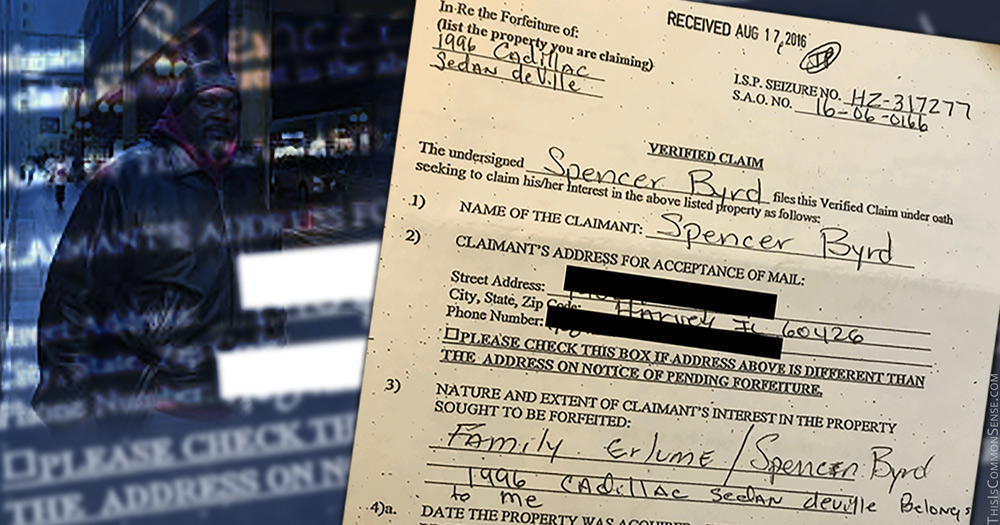
I see no raised hands among my regular readers. But my readers don’t include the wicked Chicago officials who impounded the automobile of Spencer Byrd.

Byrd’s case is reported in a Reason article by C.J. Ciaramella. The author relates how Chicago extracts money by grabbing the vehicles of innocent people. The drug war and asset forfeiture laws help make it possible.

Byrd is a carpenter and auto mechanic who sometimes gives rides to clients stuck without their cars. One night, when he was stopped on the road for an allegedly broken turn signal, police discovered that a new client riding with him was carrying heroin. Byrd was questioned but quickly released. He was never charged with a crime.

But his car was impounded; it’s been impounded for years. This has hurt his business. For one thing, he has $3,500 worth of tools in the trunk.

Byrd persuaded a judge to order that his car be returned to him. But the city still wouldn’t release it unless Byrd paid $8,790 in fees and fines (later reduced to $2,000). He is still struggling to retrieve his car, within a labyrinth the injustices of which I’ve barely touched on.

May I suggest . . . ? If you do ever recover your Cadillac, Mr. Byrd, put pedal to the floor and get the heck out of Dodge.

I mean, Chicago.

This is Common Sense. I’m Paul Jacob.


PDF for printing


Categories
folly general freedom ideological culture moral hazard national politics & policies

Include/Exclude

The right of free assembly is central to a free society. Not everyone understands this.

Last week, conservative/“cultural libertarian” provocateur Milo Yiannopoulis went into the Churchill Tavern in New York to dine with fellow gay journalist Chadwick Moore.

Also in the establishment? The New York City chapter of the Democratic Socialists of America. When the socialists noticed Milo they stood up, faced him, and shouted at him, chantingNazi scum, get out!

Milo is not a Nazi, but his past gentle treatment of the alt-right counts as “Nazi” on the left.*

The left has been pushing for an inclusivist** reading of the right of free assembly for decades. You see, state laws in the South, prior to 1964’s Civil Rights Act, allowed and enforced white business discrimination against African-Americans, such as refusing service and accommodations. Leftists argue that there is no right to refuse service or exclude customers; they strenuously criticize those libertarians and conservatives who argue that a right to associate implies a right not to associate . . . giving them no credit for long opposing laws requiring discrimination.

Yet now we see many on the left banding together to deny others their free association rights by exclusionary tactics.

This was a group of customers, of course, so this is more similar to antifa violence than business discrimination. But Brooklyn politicians echo the logic, now proudly denying free assembly rights to NRA members — on ideological grounds.

Mob action for exclusion? Politicians siding with the mob?

There’s a word for this — fascismo.

Or, in the vulgar tongue, “Nazi scum.”

This is Common Sense. I’m Paul Jacob.



* Cenk Uygur of The Young Turks articulates this point — Milo’s insistence that he is not alt-right carrying no weight, apparently.

** Rather than rule-of-law liberal, or libertarian.


PDF for printing


Categories
Accountability general freedom nannyism national politics & policies political challengers porkbarrel politics responsibility too much government U.S. Constitution

How Bernie’s Like Trump

Yesterday I made fun of Bernie Sanders’ jobs guarantee idea. Today, let’s take it seriously.

Not as policy, mind you. As propaganda.

It’s not worth talking about as a policy because there is no policy yet. “It is not clear when Sanders will announce the plan,” Fox News relates, “and a Sanders spokesperson told the Post that it was still being crafted.”

It is mere advocacy. A press release. Vaporware.

But that’s the key to it, really. The jobs guarantee isn’t policy.

It’s a ploy.

Bernie Sanders knows there is hardly a hope of passing such a bill. He probably understands that the current fiscal mess precludes it. He might even understand that it is literally a horrible notion, the worst policy idea in the world, and he would still have reason to pitch for it relentlessly.

Because what he is really after is the hiking of the national minimum wage to $15/hr. That is the next Democratic ratcheting up of government. And by insisting that the government guarantee $15/hr jobs, he is readying everyone to accept, as a compromise, the hiking of the minimum wage to that very figure.

Yesterday I noted a link between socialism and slavery. But minimum wages link up not with slavery but unemployment.

Which Bernie knows all too well. Before he got in politics, he was a layabout, a bum.

Not like President Trump at all, that way.

But by fixing on one key, “anchor” concept ($15/hr) and demanding the Moon, he might just get his mere lunacy, er, minimum wage hike.

And that is a Trumpian* ploy.

This is Common Sense. I’m Paul Jacob.



* Though Trump’s better. His “linguistic killshots” are far more memorable . . . because funny and (usually) visual.


PDF for printing


Categories
Accountability folly general freedom incumbents media and media people moral hazard nannyism national politics & policies political challengers porkbarrel politics responsibility too much government

Twirling Towards Freedom?

Does Bernie Sanders remind you of “Citizen Kang”?

Vermont’s [S]ocialist Senator is whipping up a new plan for America: to “guarantee a job with at least a $15-per-hour wage and health benefits to every adult American ‘who wants or needs one,’” we are told.

What was it that the slavering alien Kang promised* in The Simpsonseighth season opening episode? Well, we know how that episode ended, with Homer Simpson revealing the ’90s’-era presidential candidates to be aliens in disguise, Kang being elected, humanity enslaved, and Homer uttering the immortal words “Don’t blame me, I voted for Kodos.”

And then Kodos, in cahoots with Kang, cracking the whip on Homer.

One shouldn’t have to read George Fitzhugh, the antebellum sociologist who attacked the very idea of free markets and free labor, insisting that slavery is a good thing and the very best form of socialism, to know that socialism and slavery go together hand in glove, whip in hand.

In an age of handouts for nothing, at least Sanders’ socialist proposal suggests productivity. But paying for it by nixing corporate “tax breaks”** is absurd. “Republicans have long opposed a federal jobs guarantee,” Fox News tells us, “saying such a plan would be too expensive and impractical.” And it’s productive people who would pay for it, making them de facto slaves to the system . . . even more than they are now.

But when socialists talk about “jobs,” worry about a more direct form of slavery.

And yes, I can imagine Bernie, with his four houses, flicking the whip.

I won’t be voting for him, if he runs.

Or for Kodos.

This is Common Sense. I’m Paul Jacob.

 

* Actually, Kang was known not for a promise but for his campaign speech (as Bill Clinton), saying, “[W]e must move forward, not backward; upward, not forward; and always twirling, twirling, twirling towards freedom!”

** The only funding source mentioned in the reports I read.


PDF for printing


Categories
ideological culture incumbents local leaders media and media people political challengers too much government

The Centre Cannot Hold

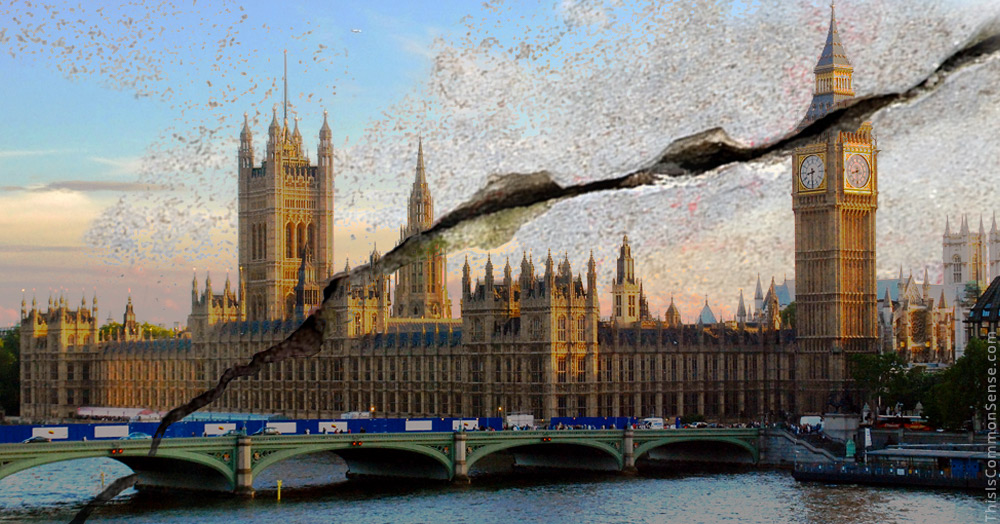
The British may spell their words in funny ways, but their political problems do not seem all that foreign. Their left-of-center party has gone far left, Marxoid left; their right-of-center party has gone ultra-incompetent.

A healthy majority of Brits disapprove of both parties. So, no wonder many Brits are looking to create a new one.

A new centrist political party, no less.

Over at The Economist, the columnist writing under the name “Bagehot” (pronounced “badget”) predicts that this hope will be dashed, for at least three reasons:

First, Britain already has a centrist party, and it is not doing very well.

Second, there sure are a lot of contenders — 35 new parties have been formed just this year, including one called, with humble brag, “Sensible” — and all that competition fractionalizes the vote.

Third, the country sports the same system of vote counting and elections as America does, first-past-the-post, which “is hard on startups.”

That last point is worth thinking about. In multi-candidate races, the British-American electoral system declares as winners those who obtain a bare plurality of votes — thus ignoring the preferences of those who vote for minor party candidates. This means that those who “waste” their votes not only hurt the candidacies they like as second-best but also insulate the second-best parties from those voters’ influence. So the parties become narrow-minded and unhinged from an interested group of voters.

Bagehot thinks Britain’s centrists need to rethink, conjure up some new ideas. But what they need to do first is fix a system that prods political parties away from new ideas. 

This is Common Sense. I’m Paul Jacob.


PDF for printing


Categories
general freedom ideological culture media and media people moral hazard

The Cuban Slavery-and-Freedom Sandwich

How easy is it to mix freedom with just the right amount of slavery?

New York Times reporter Azam Ahmed regards the attempt to mingle political opposites as noble or at least understandable. He doesn’t call Cuban Communism and its destructive effects “bad” — it’s a “unique tapestry.”

He wonders, instead, to what extent the Cuban government can fine-tune the contradiction.

According to the article, Cuba’s newest Dear Leader “will have to foster the growing private sector . . . while guarding against the income inequality it often brings. . . . Move too slowly and it risks economic collapse and widespread discontent. . . . Move too fast, and it risks unstitching the unique tapestry of Cuba’s social project.”

“Unique”? With or without cigars and salsa, the “social project” of repressing a hapless populace is as old as civilization. And as a “tapestry,” we’ve seen this warp and weft before.

Under freedom, inequalities are unavoidable.* On the other hand, nothing is wrong with inequality per se. Nature, human beings and economic outcomes are inherently unequal. Equality arrives only with the grave.

A government working to phase out slavery and phase in freedom may have legitimate problems in transition. But it is wrongheaded to seek just the right “balance” of both. How can any degree of freedom and markets fail to threaten a revolution, the purpose of which is a thoroughgoing assault on freedom and markets?

My advice to Cuban social engineers? Abandon Communism altogether and embrace prosperity and freedom instead.

This is Common Sense. I’m Paul Jacob.

 

* Speaking of inequality, Cuba’s head commies certainly have not lived like the masses they’ve kept down.


PDF for printing


Categories
Accountability general freedom government transparency initiative, referendum, and recall local leaders moral hazard nannyism national politics & policies

Principle and Compromise

Last Friday, Tim Eyman — the Evergreen State’s best-known ballot initiative practitioner — won an important court case.

But he also scuttled an amazingly impressive compromise between state legislators, police, and the proponents of Initiative 940.

The measure was written and promoted by De-Escalate Washington, a group that includes several relatives of deceased victims of recent controversial police shootings. I-940 would implement violence de-escalation and mental health training for police, and require law enforcement personnel to provide first-aid to save lives. Most likely Washington voters tell pollsters they approve.

De-Escalate Washington got the required signatures, sending this “indirect initiative” to Olympia. The Legislature was faced with three choices:

  • approve the initiative as written;
  • not act, letting the measure go to the ballot; or
  • approve an alternative and place both proposals on the ballot.

The Legislature tried to “create a fourth option”: it passed the measure with amendments.

And that’s what Thurston County Superior Court Judge Christine Schaller found unconstitutional. She sent the measure, un-amended, to the ballot for a vote of the people.

Interestingly, those amendments were the result of negotiations among the measure’s advocates, the police, and the Legislature. There had been many congratulations all around on the “historic” compromise. But, “historic” or no, legislatures must follow the law.

Tim Eyman is pleased that the court defended the constitutionally defined initiative process by definitively siding against the backroom compromise.

And voters will still get the chance to vote on the proposal.

This is Common Sense. I’m Paul Jacob.


PDF for printing


Categories
ballot access general freedom initiative, referendum, and recall moral hazard nannyism national politics & policies political challengers responsibility term limits

The Yellow and White Lines

If I’ve heard it one million times, I’ve heard it ten: “We already have term limits; they’re called elections.” A statement usually offered as the beginning and end of wisdom regarding the problems term limits are designed to tackle.

Equally “profound” is the collateral claim that “the only term limits we need are an informed electorate.”

Such generalities “prove” too much. Any formal restraint of government could be thus airily dismissed.

  • “The only Bill of Rights we need is an informed electorate.”
  • “The only checks and balances we need are an informed electorate.”
  • “The only prerequisites for running for office we need are an informed electorate.”

If formal rules don’t matter, why write these things down or try to enforce them in light of principle and precedent? Just get your informed electorate and let the informed electorate handle it.

To preserve and strengthen our republic and our liberties, we do need an informed electorate. We also need many other things, including well-known, widely accepted, consultable, objective limits on government power.

One such limit limits terms.

Term limits on legislators, executives and even judges combat political corruption, empower informed voters, and give informed and capable electoral challengers more opportunities to effectively present their ideas.

The fact that a given political or cultural factor is crucial to the commonweal doesn’t mean that no other factors are also crucial.

Don’t tell drivers of cars that all they need are skills and gas.  You also need lines on the road — limits to keep us out of the ditch, and from head-on collisions.

This is Common Sense. I’m Paul Jacob.

PDF for printing


Categories
crime and punishment folly general freedom moral hazard national politics & policies Popular privacy responsibility The Draft too much government U.S. Constitution

Leave Those Kids Alone

Congress created The National Commission on Military, National, and Public Service “to consider and develop recommendations concerning the need for a military draft, and means by which to foster a greater attitude and ethos of service among American youth.”

Is it possible that Congress and the commissioners have never considered the inherent contradiction between forcing people into the military against their will and fostering an “ethos of service”?

Today, I will get perhaps two minutes to address this commission at a hearing in Denver, Colorado, answering* these questions it has posed:

Is a military draft or draft contingency still a necessary component of U.S. national security?

The military draft has never at any time in the history of this country been a necessary component in U.S. national security.  

Are modifications to the selective service system needed?

No. The Selective Service System, the people who force very young men into the military against their will, needs to be ended. Not modified. Not expanded to women. End draft registration. Close the agency.

The United States should forswear any use of conscription. A free country need not force people into the military to defend it.

Is a mandatory service requirement for all Americans necessary, valuable, and feasible?

Necessary? Not on your life. Americans have always stepped forward — not only to defend their own country, but also in hopes of defending people across the globe.

Valuable? That’s a bad joke. People forced to kill and die in Vietnam and other conflicts and those imprisoned for refusing to take part in such a system fail to see any value. The draft has been disastrous.

What is valuable are the lives and rights of the young. They are free citizens, not Congress’s pawns.

Feasible? No. Because too many of us will fight you, refusing to go along. Even if it means our imprisonment.** Plus, a conscripted army is a poor substitute for the All Volunteer Force.

The draft is unnecessary, divisive and dangerous.

How does the United States increase the propensity for Americans, particularly young Americans, to serve?

Be worthy of the voluntary service of the American people.

If the government is responsible, then people will respond to protect it.

Commit to raising an army of soldiers and service providers by persuading citizens to freely serve their communities and their country. In short, this commission and this Congress should commit to freedom.

That would be truly inspiring.

This is Common Sense. I’m Paul Jacob.
 

* I will also be submitting a longer, more formal statement in testimony.

** As regular readers know, I was one of 20 young men prosecuted for refusing to register for the draft in the 1980s.


PDF for printing


Categories
Accountability crime and punishment education and schooling First Amendment rights general freedom ideological culture moral hazard Regulating Protest

The Shallow State

Amidst all the talk of The Deep State, we are in danger of losing track of a parallel problem: the Shallow State — which, despite lack of depth, is very wide.

I am referring to government employees who increasingly abandon any pretense of impartiality. And the public institutions that protect them.  

Consider the case of the University of Illinois at Urbana-Champaign and its 39-year-old lecturer Tariq Khan, who is a member of an Antifa-affiliated group called the Black Rose Anarchist Federation. Mr. Khan had been angrily shouting and chanting at a campus anti-Trump rally when he was mildly challenged by a non-nut student journalist. Khan went on a rampage, screamed at and pushed the young journalist, and deliberately broke the smartphone of a fellow journalist who had been recording the fracas.

Khan was charged with destruction of property. But the story doesn’t stop there.

“I was told that if I wanted the ‘situation to improve,’” wrote a third journalist, “that I should stop writing about Khan.”

The university placed a restraining order on the three, to squelch news and dissent.

So the trio sued on First Amendment grounds.

Here we have a teacher willing to abridge free speech the old-fashioned way, by playing the bully. And a public institution ready and willing to defend him, to take his petty criminality and raise it to a conspiratorial, Big Brother level.

Not only does this rob Americans of rights, taxpayers are being forced to fund what they might justifiably regard as the destruction of the republican form of governance.

Root out the infamous Deep State?

Sure.

But limit and make transparent the Shallow State, too.

This is Common Sense. I’m Paul Jacob.


PDF for printing