Categories
ideological culture media and media people nannyism national politics & policies privacy responsibility too much government

Women and Men for Life

At Townhall on Sunday, I applauded the Women’s March on Washington for being peaceful, despite Madonna’s F-bomb laden speech, culminating with her daydream of “blowing up the White House.”

We’ll never know how many more folks marched in that much-heralded event than attended last weekend’s pro-life march, because the mainstream media did not pay enough attention to the later, inconvenient-to-their-narrative event, and crowd-counters didn’t count.

The two marches did “intersect” (figuratively) when a pro-life group was kicked out as a “partner” to the women’s march.

“If you want to come to the march you are coming with the understanding that you respect a woman’s right to choose [abortion],” declared Linda Sarsour, one of four chairwomen for the women’s march, who was described by the New York Times as “a Brooklyn-born Palestinian-American Muslim racial justice and civil-rights activist.”

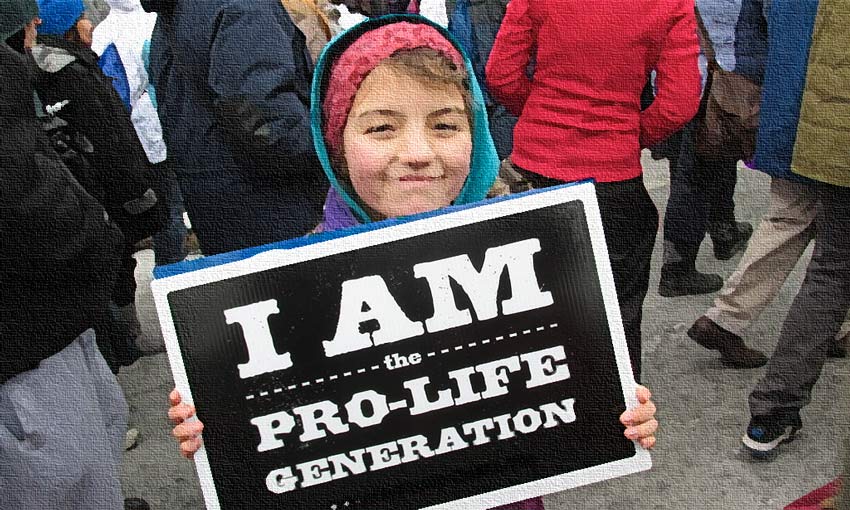
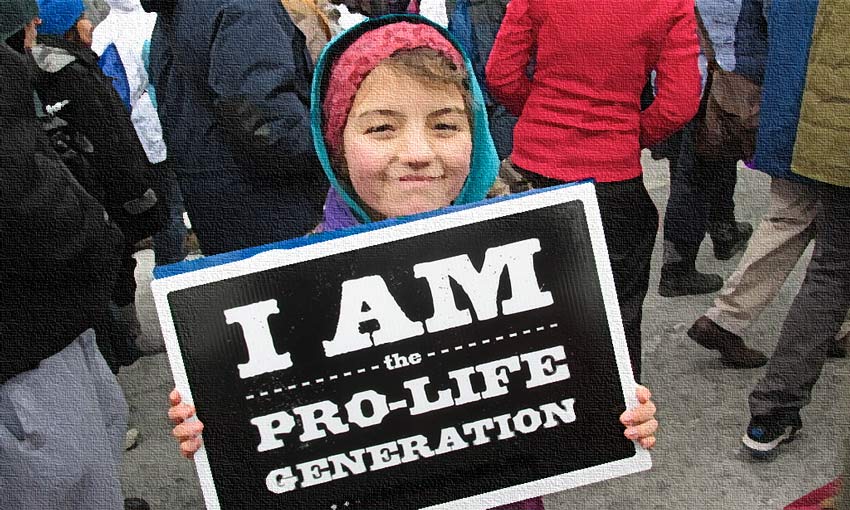
In its favor, the pro-life march, anti-celebrating the 44th year since the Roe v. Wade decision, had far more tasteful placards — despite the fact that pro-life protesters are often remembered for grisly signs picturing aborted fetuses. I particularly liked a sign held by a young women, reading:

“We are having a clump of cells.” — [said] No One Ever

Speaking of young people, Slate magazine reported that “the demographic outlook for the pro-life movement looks anything but bleak,” citing a 2015 poll wherein “52 percent of millennials said the label ‘pro-life’ describes them somewhat or very well.”

Remember, the pro-life movement has been marching all these years not to secure government benefits for themselves, but to protect others.

This is Common Sense. I’m Paul Jacob.


Printable PDF


Categories
folly general freedom moral hazard national politics & policies responsibility U.S. Constitution

Deplorable Distrust?

The United States is no longer a “full-fledged democracy.”

According to a New York Post story, our union is, instead, a “flawed democracy.”

Hmmm. Where to begin?

Despite the article’s featured photo of President Trump, the downgrading of America’s democratic status occurred prior to the billionaire’s swearing-in.

Technically, of course, the United States is not now nor has ever been a full-fledged (much less a flawed) democracy. We live in a republic . . . if we can keep it.

As is often the case, folks use the term “democracy” not to indicate it as a form of government — a pure democracy — but as a shorthand for a country with democratic elections, where “basic political freedoms and civil liberties are respected,” and with “an independent judiciary.”

An organization associated with The Economist, the Economist Intelligence Unit (EIU), has for a decade been rating the world’s countries based on numerous political factors. For the first time, this year, the United States has dropped out of the top tier and into the second, joining the likes of Botswana, Ghana and India.

“The U.S. is the second-highest ranking flawed democracy,” the Post noted, “coming in right behind Japan and tying with Italy.” Norway garnered first place among the 19 “full-fledged democracies,” including most Western European countries.

Why was the U.S. downgraded? The EIU report explained the lower score “was caused by the same factors that led Mr. Trump to the White House: a continued erosion of trust in government and elected officials.”

So, if the American people simply placed their heads in the sand, blindly trusting politicians, we’d be “full-fledged,” eh?

Full-fledged fools fiddling away our freedom, that is.

This is Common Sense. I’m Paul Jacob.


Printable PDF


Categories
ballot access folly general freedom government transparency national politics & policies political challengers

Trumping Popular Vote?

A friend, who loves to talk football, sometimes boasts that his team “crushed” the other team, gaining more yards and rolling up more first downs, before dejectedly acknowledging that his team didn’t score as many points as its opponent. They lost.

When a Democrat gloats that Donald Trump lost the popular vote, I am reminded of my friend’s funny football foible.

It helps to gain yards in football, sure, just as it helps to gain votes in a presidential contest. But you win a game by putting the most points on the scoreboard, just as you’re elected president by winning a majority in the Electoral College.

Going forward, we can discuss whether a state’s votes should be awarded proportionally or winner-take-all and whether national popular vote should instead be the metric for victory. But the 2016 rules were the rules.

“I would’ve won the popular vote if I was campaigning for the popular vote,” President Trump told ABC News anchor David Muir this week. “I would’ve gone to California, where I didn’t go at all.”

Still, Mr. Trump should appreciate that not only didn’t he garner a majority, he lost by 3 million votes to Hillary Clinton, who was well short of a majority, herself.

Trump continues to claim “a massive landslide” in the Electoral College. He may have “shocked the world,” but in 58 presidential elections thus far, 45 winners gained a greater percentage in the Electoral College.

Again this week, Pres. Trump repeated his belief that “millions of illegal votes” prevented him from winning the popular vote. Specific evidence? None. But he wants an investigation.

This could be a long four years.

This is Common Sense. I’m Paul Jacob.


Printable PDF


Categories
Accountability responsibility too much government

Out of Our Misery

Obamacare may be on the way out.

According to The Atlantic, “the powers of the incoming Health and Human Services secretary are broad enough to cripple the [Affordable Care Act] so it has to be replaced.” Which is significant since the new President has just “signed an executive order empowering his administration’s agencies to do all they can — within the bounds of the Affordable Care Act — to undercut that law.”

The Atlantic’s Vann R. Newkirk II suggests this is . . . “ironic.” The executive leeway Trump is taking is not without precedent. “The irony of that component,” he writes, “is that it rests on precedent set by the Obama administration, which used executive and regulatory power liberally to make the law work in the face of Republican opposition.”

Irony? How about chickens returning to the home roost?

Obamacare itself undermined Obamacare. The plan, from the beginning, was so gimcrack with hidden redistribution that, to both opponents and proponents, it was designed to fail . . . to usher in the Glorious Era of socialized medicine.

Since Obamacare increased “insurance” costs for hundreds of thousands of previous insurance policy holders, and increased medical costs generally, too, it actually discouraged participation from the healthiest, many of whom would rather pay the exorbitant fines, er, “taxes.” Throwing the insurance industry into a death spiral.

So, putting the system out of our misery sooner seems sensible.

But Congress and Trump cannot stop there. Either they repeal more federal regulation and subsidy*, or keep parts of Obamacare, despite a lack of financial stability. A new bill in the Senate promises to do the latter.

We haven’t seen much hint of the former.

But can hope. Audaciously.

This is Common Sense. I’m Paul Jacob.


* To let markets work. Note that The Atlantic tends to miss the point of Obamacare critics. In describing more market-based options, the magazine characterizes the Medical Health Savings Account approach as “For people sick of high deductibles, Republicans offer high-deductible plans as replacements for Obamacare.” The idea is to incentivize people to pay for their own care, which would bring costs down generally.


Printable PDF

 

Categories
ideological culture meme moral hazard nannyism national politics & policies Popular too much government U.S. Constitution

How Socialism Kills

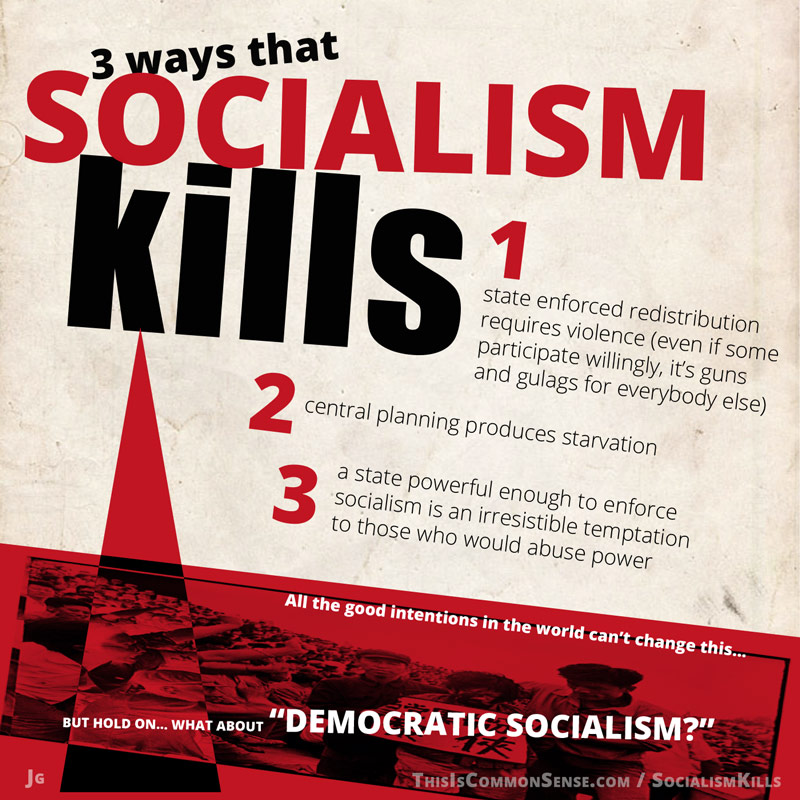
3 Ways That Socialism Kills:

  1. state enforced redistribution requires violence (even if some participate willingly, it’s guns and gulags for everybody else)
  2. central planning produces starvation
  3. a state powerful enough to enforce socialism is an irresistible temptation to those who would abuse power

All the good intentions in the world can’t change this…

but hold on… what about “democratic socialism?”


Categories
Accountability initiative, referendum, and recall local leaders

The Unfairness of Losing

Maine’s citizen initiative process is unfair, claims State Rep. Paula Sutton.

“[R]ural Mainers are left out of the equation,” Sutton tells readers of Knox County’s Village Soup, “and Portland dictates public policy for the rest of the state.”

Hmmm? Every Mainer eligible to vote currently has the equal right to decide ballot measures.

Her grievance appears to be that there are more urban voters than rural.

Last November, voters passed four of five issues, all opposed by Rep. Sutton. Still, losing at the ballot box is hardly prima facie evidence of “unfairness.”

“Unless we do something to fix the citizens’ referendum process here in Maine,” she nonetheless contends, “the state will continue to be an easy target.”

For what, exactly? Voting on issues people favor?

Mainers are “ripe to be taken advantage of by wealthy out-of-state special interests,” she complains, explaining that billionaire Michael Bloomberg “spent millions of dollars in his failed attempt to squash Mainers’ Second Amendment rights with Question 3.”

Yes, you read that right. Question 3 failed. Voters weren’t exploited.

Sutton has introduced legislation “to ensure rural Mainers are no longer being run over by wealthy liberal special interest groups.” Her bill requires petitions to qualify in each of the state’s two congressional districts instead of qualifying statewide. That makes it more difficult, but hardly changes the need to circulate petitions in urban areas.

Not forests and empty fields.

Rep. Sutton seems to understand her proposal won’t effectively thwart citizen initiatives, pledging to support further restrictions. That’s easier for politicians than permitting democracy and persuading people.

This is Common Sense. I’m Paul Jacob.


Printable PDF


Categories
Accountability folly general freedom ideological culture media and media people moral hazard national politics & policies too much government

Bring Back the Eunuchs?

“Everybody knows that ordinary Americans are a bunch of idiots,” a Health and Human Services official told Benjamin Ginsberg. “Why do you need to do a survey to find that out?”

Actually, he was not surveying Americans for their IQs and knowledge levels. He was surveying Washington insiders. Like her.

She hadn’t been listening.

Ginsberg and co-author Jennifer Bachner have a new book out, What Washington Gets Wrong (2016). “We found that public officials,” Ginsberg told C-SPAN’s Brian Lamb last month, “the people who really govern this country . . . don’t think much of ordinary Americans.”

Surprise, surprise. This has been an “open secret” for some time. Washington insiders “are wealthier,” “better educated,” and “think ordinary Americans don’t really know very much.” More alarmingly, they think that the government should “not pay too much attention to what ordinary folks think.”

According to Ginsberg and Bachner, this has been a long time coming. Progressive Era reformers transformed government in an effort to make it less partisan.

They succeeded — only to make it less accountable and less . . . American.

In ancient times, great administrative states were run by eunuchs, men gelded to curb their appetites the better to serve their sovereigns (pharaohs; emperors; kings). Not their own interests.

Is it time to bring back the practice?

Just joking. Instead, Congress can tame the bureaucratic leviathan it has created by trimming its ranks and pulling back on pay and benefits until they’re more in line with the private sector.

Let’s hope the House’s recent passage* of the REINS Act, requiring congressional approval of major regulations, is a sign that Congress’s lackadaisical attitude about the bureaucracy is changing.

This is Common Sense. I’m Paul Jacob.


* Let’s hope the Senate follows suit.


Printable PDF


Categories
Accountability government transparency term limits

Promises & Limits

Last year, Americans — everywhere from Montgomery County, Maryland, bordering the nation’s capital on the east coast, to sunny Santa Clara, California, on the west coast — voted to impose term limits on their elected officials.

There were 40 separate local votes to enact term limits or, conversely, measures put up by politicians to weaken or abolish those limits. In every single case — that’s 100 percent — voters came down on the side of strong term limits. And by a whopping average vote of 74 percent.

Not. Even. Close.

Back in 2014, term limits admittedly did not fare quite as well. In that election year, a mere 97 percent of local term limits ballot measures prevailed. You can’t win them all.

Most folks I know believe we most desperately need term limits on Congress.

Even in these days of division, with our nation racked by partisan rancor and recrimination, a constitutional amendment to term-limit Congress has better than two-to-one support by folks across the spectrum — favored by 77 percent of Republicans, 67 percent of Democrats and 79 percent of independents.

President Donald Trump pledged in the campaign’s homestretch that, as his first order of business in “draining the swamp,” he would push Congress to propose an amendment limiting House members to three terms, six years, and Senators to two terms, 12 years. Those are the limits in the term limits amendment already introduced by Sen. Ted Cruz (R-Tex.) and Rep. Ron DeSantis (R-Fla.).

Speaker Paul Ryan has promised to bring it to the floor for a vote. Senate Majority Leader Mitch McConnell has refused. McConnell’s office number is (202) 224-2541.*

This is Common Sense. I’m Paul Jacob.


* His Facebook page is here.


Printable PDF


Categories
Accountability ideological culture moral hazard nannyism national politics & policies

We Demand Inefficiency

It’s all about the money.

Well, that is what Senator Elizabeth Warren believes.

Grilling Republican Congressman Tom Price, the physician turned congressman Donald Trump picked to be Secretary of Health and Human Services, Warren demanded that Price answer a simple question: would he swear on a stack of medical books that he would never, ever “carry out a single dollar of cuts to Medicare or Medicaid eligibility or benefits.”

Trump had said he would not cut either program. But Price, who is known for his skepticism about the efficiency of government programs and has proposed cuts to the programs before, worries Warren.

So she demanded an answer, using words like “guarantee” and “safeguard.”

Price said neither “yes” nor “no.” Instead, he evaded the question.

Thoughtfully.

“What the question presumes is that money is the metric,” Dr. Price replied. “In my belief . . . from a scientific standpoint, if patients aren’t receiving care, even though we’re providing the resources, then it doesn’t work for patients.”

Elizabeth Warren, the doyen of progressive politicians for several years now, was mighty upset about Price’s attempt to switch the standard (“metric” is the buzzword for this) for judging a program to the practical from the simple, easy-to-demagogue-with disbursement tally.

She could have said, “We demand inefficiency; all we care about is the money. Actually helping people? Too complicated. But we sure can score points in debate when you try to cut something.”

What she said* was, “The metric is money.”

Same thing, actually.

Thus it is that government grows while real human welfare is ignored.

This is Common Sense. I’m Paul Jacob.


* Peter Suderman, over at Reason, sums it up like this: “What Warren seems to want from Price is a commitment to spend more regardless of a program’s results.” Suderman calls Warren’s reaction “a surprisingly blunt expression” of a view “that undermines the programs it is designed to defend.”


Printable PDF


Categories
Accountability general freedom ideological culture media and media people moral hazard national politics & policies

Don’t Trump the Gun

The 2016 presidential election will go down in history as a doozy. The Trump win was a surprise, even shocking many of his supporters. But the most obvious lesson we learned pertains to the modal Obama-Hillary voter.

Well, make that lessons. Plural.

  1. Today’s most vocal Democrats don’t seem to understand democracy. The “deal” of our democratic republic, as I learned in Civics and “on the streets,” is that you do your best for your party, candidate, or policy, and accept the results . . . until the next election. Whiners, rioters and Hollywood actors (to place them in descending order of tolerability) would serve their cause better by remembering this.
  2. It has become commonplace, now, to make sweeping judgments about one’s opponents based on little or no information. Or erroneous info. On no basis whatsoever, nearly every lefty YouTuber and street shouter I have seen yammers on about how anti-gay Trump is. Truth is? No president has ever entered the White House more pro-gay than Donald J. Trump.
  3. Actual policy issues mean too little to too many. What does matter? Style. Obama has “good style.” Bush had “dumb style.” Trump has “evil style.” Substance? Results?

Blankout.

Tomorrow the President-elect becomes President. And Resident of 1600 Pennsylvania Avenue*. As skeptical as some of us may be (myself included), we owe it to ourselves, our neighbors, and the country — perhaps the world — to give the president a chance. At least, take a deep breath and let him make a mistake before pouncing.

Meanwhile, let’s also stop denigrating half the country — that is, those who voted for Trump. Consider their alternative.

This is Common Sense. I’m Paul Jacob.


* Part-time? Will he really spend a lot of time in Trump Tower?


Printable PDF

Trump, president, inauguration, democracy, election, protest