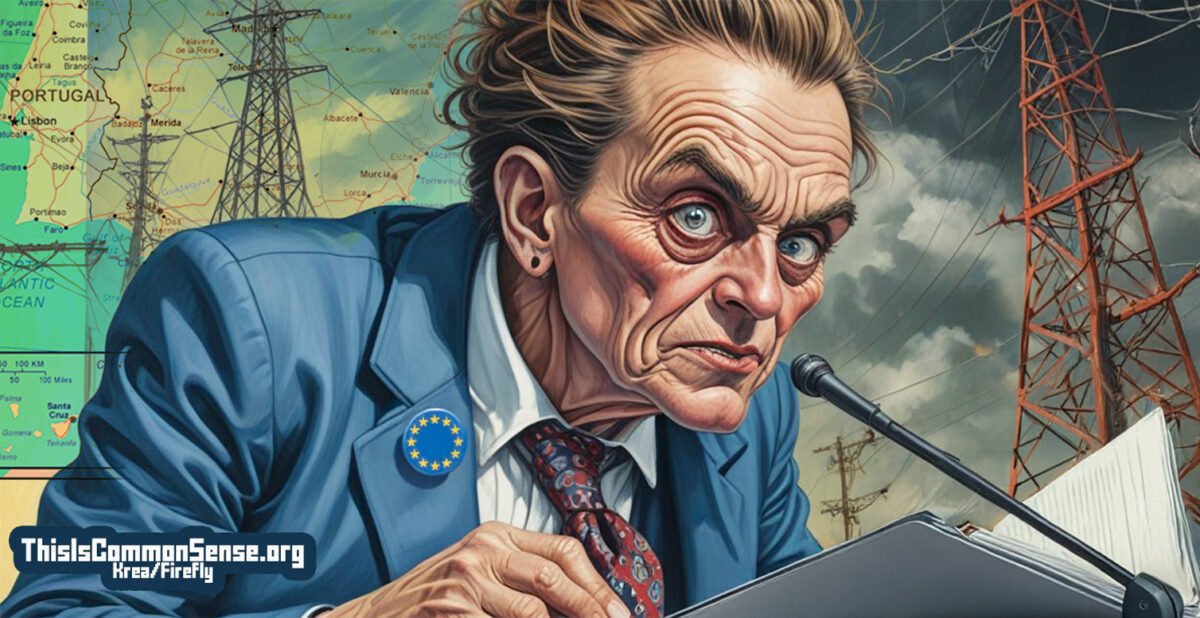
If you prevent countries from using the most reliable fuels for making the electricity that lights the lights, elevates the elevators, and powers all other powered things, what would be the likely consequence?
Not, I think, to make the power grids more reliable.
The power companies say they don’t know why almost all the power went out recently in Spain and Portugal and in other parts of Europe.
No indication so far of cyberattack or other sabotage.
Red Electrica, Spain’s state-run electricity network, points to a “very strong oscillation” in the network causing the Spanish system to disconnect from the European system. Portugal’s grid operator says that the oscillations had to do with extreme temperature variations.
Spain’s electrical network now relies almost entirely on “renewable” sources of energy, “green” energy, anything but fossil fuels. (Actually, no energy is renewable; in usable form it’s gone the instant you use it. And it all comes from nature, including gas and oil.)
On April 16, Red Electra, eager to “curb the climate crisis” (weather), reported meeting all electrical demand using “renewable” sources of energy, mostly solar (60 percent).
Some have pointed out that solar and wind power don’t provide the inertia generated by the massive turbines of “traditional generators, like coal and hydroelectric plants or gas turbines.” And so the power grid becomes much more vulnerable to disruptions and oscillations, no matter the cause.
My theory is that the more ways you hobble yourself, the more likely you are to become hobbled.
This is Common Sense. I’m Paul Jacob.
Illustration created with Krea and Firefly
See all recent commentary
(simplified and organized)
See recent popular posts
4 replies on “Europe Goes Dark”
Every method of power generation has features and bugs that cause intermittency. The sun doesn’t shine, the wind doesn’t blow, the river gets too low to drive the turbines, the tanker doesn’t arrive, the reactor requires a shutdown.
But it’s obvious what the real source of THIS problem was: The reliance on sprawling “grids,” interconnected in non-linear ways where a malfunction in one place can stop power to many places, to distribute centrally generated power over vast areas.
If reliability (rather than, say, production cost per kilowatt-hour) is the criterion, household generation is the ideal, with neighborhood-level solar, wind, or nuclear facilities second best. That way a computer malfunction in Ontario doesn’t throw all of Ohio into darkness.
System resiliency is not factored in to the design when they are working on efficiency and green sources. Means that the ability to handle something unexpected is not there.
Just more of the plan to de-industrialize Europe. And the west in general
When the European canaries die, Americans refuse to go into the coal mine; this collapse was premature.