Categories
media and media people national politics & policies

Big Bucks Buy Votes

Want to know how Washington works? 

Or doesn’t work? 

Drafting legislation to provide COVID (and COVID lockdown) relief, President Joe Biden and Congress contemplate just how big to make the next round of government checks sent to “the inhabitants of America.”

And which folks to send the freshly printed moolah.

“Something very weird is happening,” explains Washington Post columnist Paul Waldman. “On one side you have Republicans and conservative Democrats saying people at higher incomes don’t deserve this government help. On the other side you have liberals advocating that higher-​income people should share in this largesse.” 

Including socialists Sen. Bernie Sanders and Rep. Alexandria Ocasio-Cortez.

“So if I were Biden,” Waldman advises, “this is the argument I’d make to [conservative Democratic Senator] Manchin:

1. People like it when you give them money. A lot.

2. The more people we give money to, the more people will be pleased with us.

3. That will improve our chances of keeping control of Congress in 2022 and the presidency in 2024.

4. If we keep control we’ll be able to do more of the things you want to do. If we lose control, we won’t be able to do anything.…”

Translation? Stay in power by buying votes

Seems the advice you’d get from a sleazy political consultant, not a newspaper columnist. 

Biden and senior Democrats have also unveiled a plan to pay parents up to a certain income over $50,000 per child from birth to 17 years of age.* One obvious benefit? “Its execution could also prove crucial to deciding Democrats’ ability to maintain control of Congress,” informs The Post, “given its likely direct impact on the lives of tens of millions of voters.”

This is our direct-​deposit Republic.

But not Common Sense. I’m Paul Jacob.


* The Democrats’ plan came just “days after Sen. Mitt Romney (R‑Utah) surprised policymakers with a proposal to send even more in direct cash per child to American families.”

PDF for printing

See all recent commentary
(simplified and organized)
See recent popular posts
Categories
Accountability national politics & policies too much government

A Funny Thing Happened on the Way to a Quorum

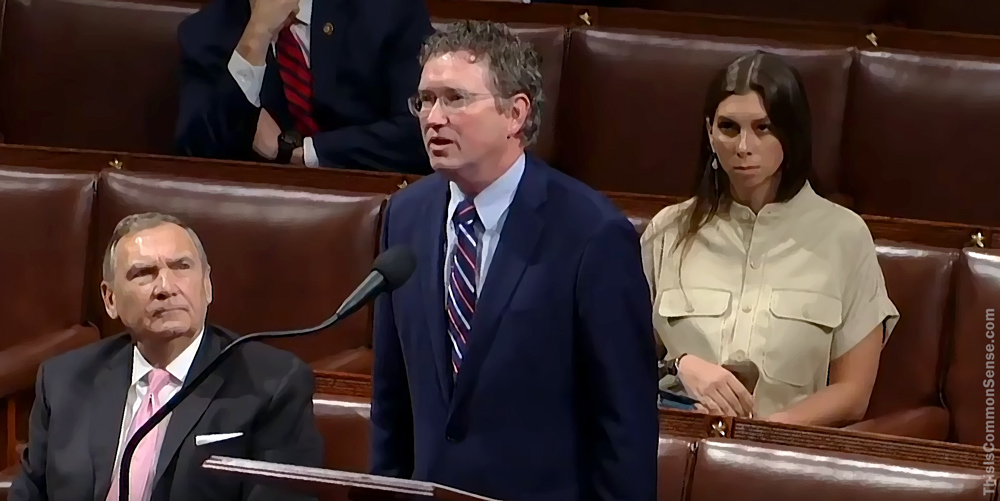
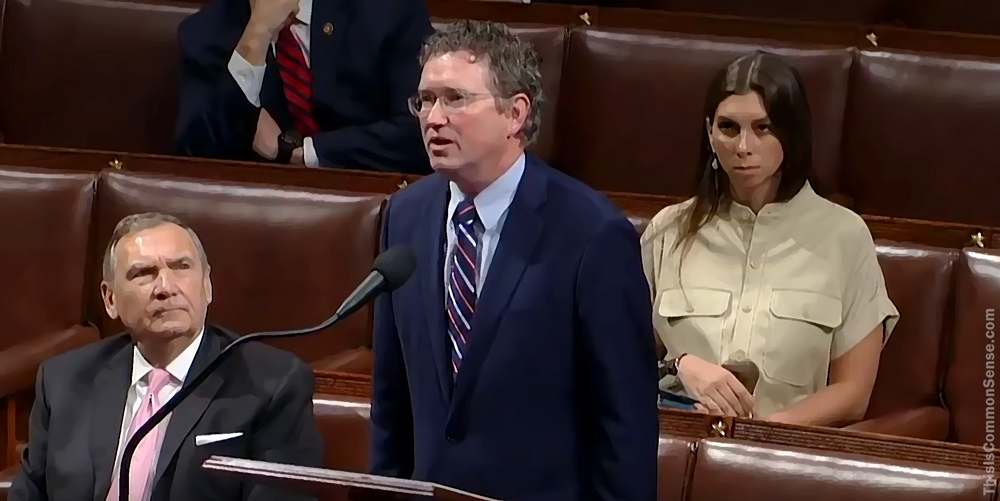
On Friday, the talking heads and Twitterati excoriating Rep. Thomas Massie (R‑Kent.) were so scandalized that they couldn’t quite get to telling us what terrible thing he had done.

“GOP’s Massie outrages House,” screamed The Washington Post headline. The paper informed that “the Republican from northern Kentucky has frequently voted no on issues large and small, even against the wishes of GOP leaders.” 

Wow, is that allowed?

With Congress poised to shovel $2.2 trillion to citizens and businesses by unanimous consent, i.e., without a recorded roll call vote, Mr. Massie balked, thereby requiring a quorum to physically come to the capitol to vote on the relief package. 

“I came here to make sure our Republic doesn’t die by unanimous consent in an empty chamber,” Massie declared on the House floor, “and I request a recorded vote.”

President Trump urged the “third rate Grandstander” be tossed out of the Grand Old Party. And former U.S. Senator and 2004 Democratic presidential candidate John Kerry noted — of all things — his complete agreement with Trump, tweeting that “Massie has tested positive for being an a**hole. He must be quarantined to prevent the spread of his massive stupidity.”

Rep. Max Rose (D‑N.Y.) offered that Massie was “disgusting” and “inhumane,” and that if the vote was pushed “back 24 hours there will be blood on [his] hands.” 

Speaker of the House Nancy Pelosi (D‑Calif.) boasted of having asked the congressman, “Why don’t you just back off?”

Facing the biggest spending bill of all time, Massie’s notion of Congresspeople voting on the record? Hardly radical. But in the face of the COVID-​19 threat, bringing legislators back to the capitol entailed real risk. 

Yet come back they did. And just to show Massie how wrong he was in alleging a cover-​up, they agreed to a roll-​call vote so that there was full accountability. 

Take THAT, Massie! 

Wait … Congress didn’t go on the record?! 

They came back and yet, as Massie pointed out, “they still refused to have a recorded vote.”

This is Common Sense. I’m Paul Jacob.


Note: One spending item, which Massie had specifically complained about, was $25 million for the Kennedy Center. Then, mere hours after President Trump signed the legislation, the Kennedy Center honchos fired the National Symphony Orchestra, informing them “that paychecks would end this week.”

PDF for printing

Thomas Massie, Coronavirus, pandemic, virus, House of Representatives, Congress,

See all recent commentary
(simplified and organized)
See recent popular posts

Categories
general freedom initiative, referendum, and recall

Today’s Trifecta

Three measures on ballots today are particularly worth watching.

Two issues in Washington State represent the only citizen-​initiated measures out of 32 propositions voters will see in eight states: Washington Referendum 88 allows voters to re-decide the issue of racial and gender preferences, so-​called “affirmative action,” while Washington Initiative 976 offers voters a chance to cap their vehicle taxes.

More than two decades ago, in 1998, Washingtonians passed Initiative 200 to end racial and gender preferences in state employment and education. This year, the state legislature enacted a virtual repeal of I‑200, by allowing the state to employ such a preference provided it was not the “only factor” used. 

Washington’s vibrant Asian-​American community, which stands to be discriminated against should affirmative action return, rose up to petition Referendum 88 onto the ballot. A “yes” vote upholds the legislature’s new pro-​preference policy; a “no” vote restores the prior voter-​enacted policy prohibiting such preferences. 

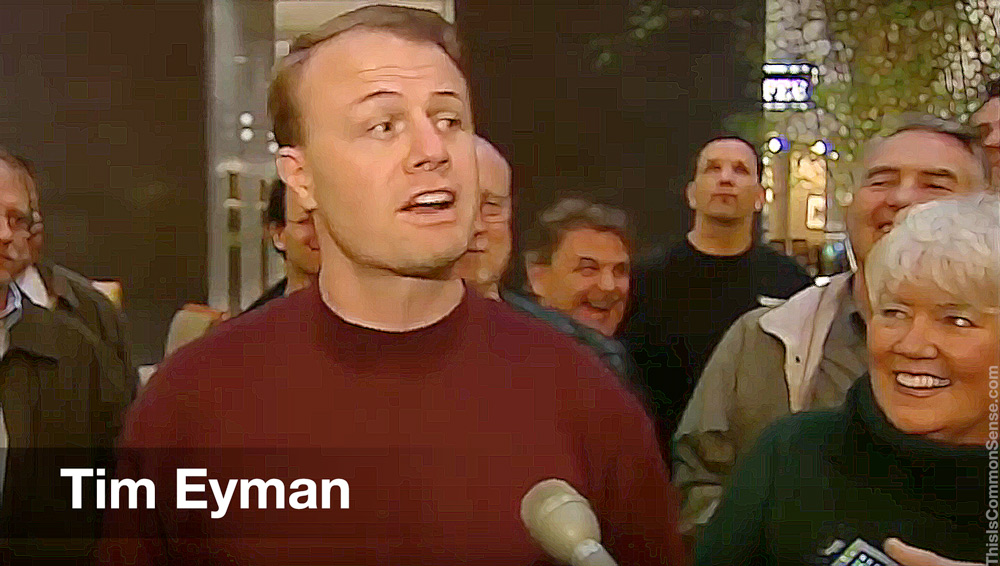
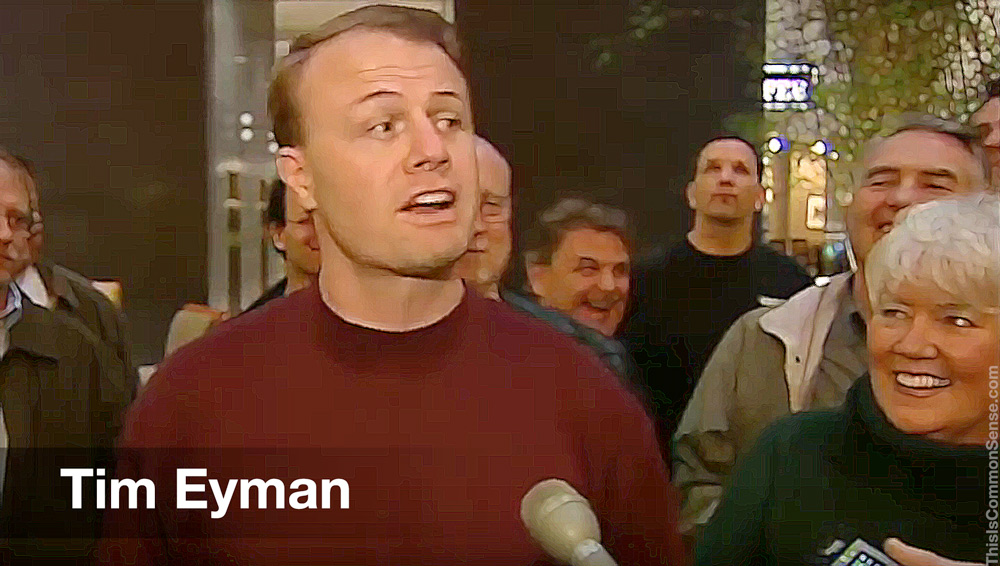
Initiative 976 is yet another effort from Tim Eyman, the state’s most prolific initiative practitioner. “This measure,” as the official summary states, “would repeal or remove authority to impose certain vehicle taxes and fees; limit state and local license fees to $30 for motor vehicles weighing 10,000 pounds or less, except charges approved by voters …”

Like virtually every Eyman initiative, powerful opponents have dramatically outspent supporters — by greater than a 6‑to‑1 margin — funding ads that have been less than truthful. Additionally, government officials have broken campaign laws in pushing a “no” vote.

Nonetheless, a mid-​October poll showed 48 percent of voters support I‑976 against 37 percent who oppose it. Could Eyman again thwart the state’s behemoth Blue Establishment?

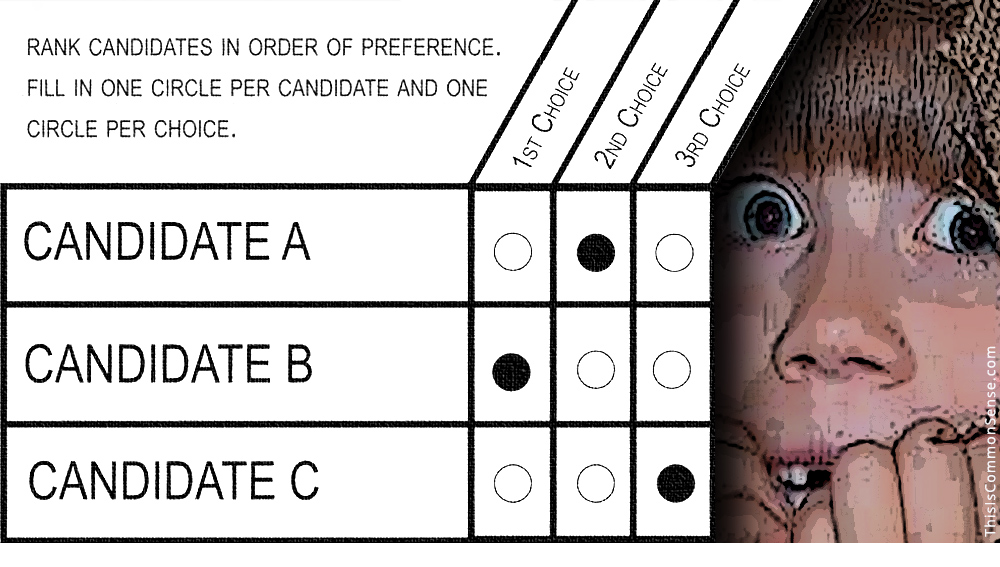
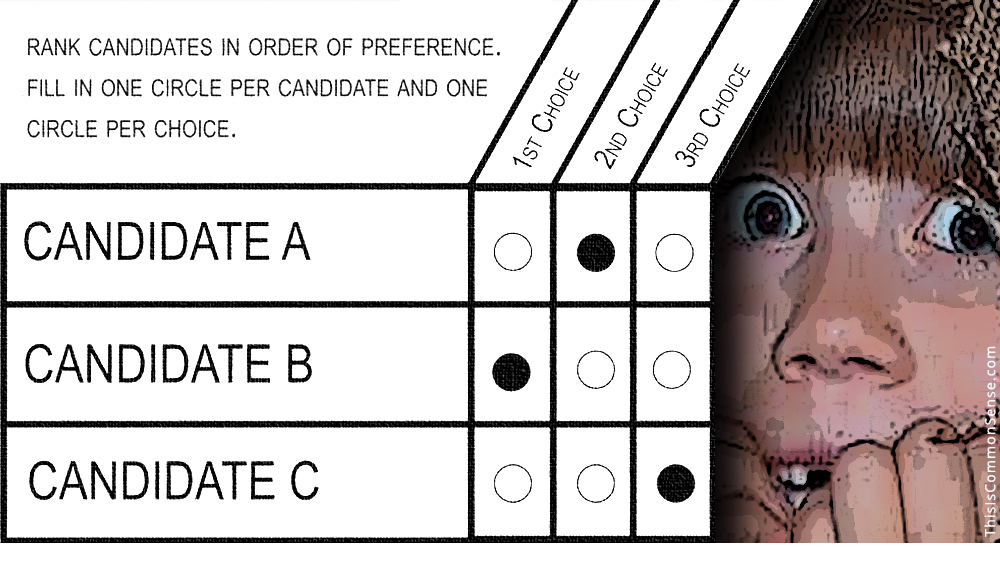
Lastly, New York City voters will decide a ballot question on whether to use ranked choice voting in future primary and special elections for mayor, city council and other offices. It would mark a major victory for a reform growing in popularity.

This is Common Sense. I’m Paul Jacob.


PDF for printing

vote, election, initiative, referendum, Washington, New York,

See all recent commentary
(simplified and organized)
See recent popular posts

Categories
initiative, referendum, and recall tax policy

The Legislature That Couldn’t Tax Straight

“If you lost count of how many new and higher taxes state lawmakers passed this year,” begins Jerry Cornfield’s recent column in the Everett Herald, “it was 12.”

Cornfield doesn’t appear too distressed about the tax hikes, however, worrying instead that Evergreen State voters will be “awash in tax advisory measures this fall.”

That’s because for every tax increase the Washington State Legislature enacts without putting it to a vote of the people of Washington, an advisory vote is mandated by Initiative 960, passed by voters back in 2007.

So 12 tax increases = 12 tax advisory votes. 

“We wouldn’t be talking about advisory votes and providing Eyman a platform for politicial [sic] ministering,” Mr. Cornfield complains, “had Democratic lawmakers gotten rid of them by passing Senate Bill 5224.”

Seems odd somehow that a newspaper columnist would be berating politicians for not passing a law to silence voters regarding tax hikes. Democrats could have done so without a single Republican vote. SB-​5224 did pass the Senate, but it was blocked in the House by the Democratic Speaker — “democratic,” thankfully, in more ways than one.

Eyman is Tim Eyman, the state’s anti-​tax initiative leader. His group, Voters Want More Choices, spearheaded Initiative 960, which from 2008 to 2018 required 19 tax advisory votes. Voters have expressed opposition to 12 of the 19 tax increases passed by the legislature — 63 percent — and support for seven. 

“It’s a tax increase report card,” explains Eyman, “and the Legislature this year gets an F.” 

A grade that was certainly earned.

This is Common Sense. I’m Paul Jacob.


PDF for printing

Tim Eyman, Senate Bill 5224, taxes, vote, democracy,

See all recent commentary
(simplified and organized)
See recent popular posts

Categories
Accountability incumbents initiative, referendum, and recall insider corruption local leaders political challengers term limits

Sneaky Lobbyists Prefer Sneakiness

The Arkansas Chamber of Commerce’s CEO and chief lobbyist, Randy Zook and Kenneth Wall, have formed Arkansans for Common-​Sense Term Limits. 

The Chamber has a burning hatred for term limits — Common-​Sense or otherwise — just like every other lobbyist and special interest. But Zook and Hall are fibbing in their name because they realize that voters love term limits. 

The ballot committee’s stated purpose? To “advocate for the disqualification or defeat” of the Arkansas Term Limits Amendment, which citizens just petitioned onto the ballot, collecting 129,000 signatures.

Defeating such a popular ballot measure isn’t likely. Instead, these politically-​experienced lobbyists are preparing to sue, hoping to disqualify valid voters’ signatures on some ginned-​up technicality, feigning confusion over the clear ballot language — anything that might keep democracy from coming this November.*

At issue? The difference between real term limits and ridiculous ones.

That is, between term limits set by citizens and those set by legislators themselves. 

Currently, legislators can serve for 16 years in a single seat under the state’s “limits.” And because two-​year Senate terms aren’t counted at all, senators can stay as long as 22 years. 

Legislators snuck this past voters in 2014 with a ballot title claiming only to “establish” term limits … amidst other lies. Politicians thereby turned Arkansas’s toughest-​in-​the-​nation term-​limit law into the nation’s very weakest — a significant 50 percent longer than limits in any other state.**

Unfazed by all the corruption in the Arkansas Legislature, Chamber lobbyists are focused on putting politicians in their pocket for as long as possible. 

But those pesky Arkansas voters are once again in the way.

This is Common Sense. I’m Paul Jacob.


* After recently threatening to challenge the signatures of another initiative petition, Zook had to admit that he was not aware of a single problem or deficiency in the petition. But he quickly added, “It’s a very complicated process.”

** Arkansas’s term limits were the same as Michigan’s until 2014, three terms, six years in the House and two-​terms, eight-​years in the Senate.

PDF for printing


Original photo by Jeff Kubina


Categories
Accountability general freedom government transparency initiative, referendum, and recall local leaders national politics & policies political challengers term limits

The Other Maine Thing

Tuesday’s biggest election news was the victory for Ranked Choice Voting (RCV) in Maine. This is the second statewide vote for this reform, which allows voters to rank the candidates by first choice, second choice and so on.*

Voters first passed it in 2016, but the next year the voters’ “representatives” in the legislature repealed the law, overturning their vote. 

Undeterred, RCV supporters filed a referendum and again went out and gathered enough petition signatures to refer the legislature’s repeal to a vote of the people. On Tuesday, Maine’s voters vetoed the legislature, keeping Ranked Choice Voting. 

Initiative and referendum sure are helpful.

RCV is not partisan; it requires the winner to have some level of support from a majority of voters and fixes the wasted vote problem. In Maine, however, the Republican Party opposed. On election day, Republican Gov. Paul LePage even threatened not to do his duty and certify the results.

Paul Jacobs (Vice chair of the [FairVote] Board) whom I once knew and thought was a good American,” a Republican friend posted on my Facebook page, “has helped unleash the hounds of Hell” … adding that “now the voters are so confused by the terrible procedure that voting will be a nightmare this Tuesday!”

Yet voters used the new voting system for the first time Tuesday in candidate primaries before deciding Question 1 on their ballot — about keeping RCV. As one Portland voter put it, “It’s pretty easy to do, despite the negative publicity.”

We need more control over government with our vote. And when voters speak, politicians should listen. 

It wouldn’t hurt political activists to listen, too.

This is Common Sense. I’m Paul Jacob.


* I’ve discussed the idea in this space many times — there’s more information on how it works here.

PDF for printing


Categories
Accountability folly general freedom government transparency ideological culture media and media people moral hazard nannyism national politics & policies too much government

Threat Assessment

Don’t drink transmission fluid. Or perform a swan dive off the Empire State Building. Or munch on a Tide Pod.

Be cautious, in other words, of the advice offered in “Boycott the Republican Party,” the Atlantic opinion piece authored by Jonathan Rauch and Benjamin Wittes, both scholars at the Brookings Institution. Their erudite suggestion? Conservatives should “vote mindlessly and mechanically against Republicans at every opportunity, until the party either rights itself or implodes (very preferably the former).”

My Sunday column at Townhall​.com, “Friendly Suicide Advice for the GOP,” reviewed their proposal and analysis. “[H]orrified” by President Trump, they see congressional Republicans as enablers of his “existential” threat “to American democracy.”

Big government has long frightened me, so I’m certainly not suggesting anyone relax just now. I do wonder, however, why these writers and others in the media have been so blasé to past presidential usurpations (noted in the column) with life-​and-​death implications.

Rauch and Wittes go so far as to reassuringly explain that “the Democratic Party is not a threat to our democratic order.”

Really?

In 2016, every single Democratic Party U.S. Senator voted to partially repeal the First Amendment of the Constitution. The Democrats’ proposal would have largely ended the prohibition that “Congress shall make no law … abridging the freedom of speech,” replacing it with “Congress and the States may regulate and set reasonable limits on the raising and spending of money by candidates and others to influence elections.”

In our present “democratic order,” the Constitution recognizes the primary importance of walling off political speech from regulation by these very politicians. The Democrats seek to repeal that order … that freedom … that criticism.

This is Common Sense. I’m Paul Jacob.


PDF for printing


Categories
folly ideological culture media and media people national politics & policies

A Special Place in Heck?

Former First Lady scolds women for not voting … for a former First Lady.

Yes, “Michelle Obama,” the BBC headlined last week, “scolds female Trump voters.”

Need you ask why? You probably have already guessed.

“Any woman who voted against Hillary Clinton voted against their own voice,” Mrs. Obama remarked at a Boston conference.

Though a majority of women who voted cast their ballots for Mrs. Clinton, a slightly smaller majority of white women voted for Donald Trump.

And to those women who did not vote for Hillary? “Well, to me that just says, you don’t like your voice.”

The idea that one woman candidate can serve as “the voice” for all women is not merely absurd. It is sexist. But it is something that this most recent First Lady shares with the former First Lady who just lost a major election. Yes, Hillary Clinton has said much the same kind of thing. And Madeline Albright, Secretary of State under Clinton’s husband’s command, famously argued “there is a special place in hell” for women who refuse to toe the line and vote Clinton II.

Heck, there is a special place for women who think, appraise and choose against social pressure: America. Here people matter as individuals, as persons, not as members of their race, religion, sex, or … political party.

But the arrogance of these women leaders shows no understanding of effrontery. “You like the thing you’re told to like,” Mrs. Obama belittled female Trump voters.

Truth is: women were repeatedly told to like Hillary for president. But they refused to do as they were told, which is why Mrs. Clinton and Mrs. Obama are attacking them.

This is Common Sense. I’m Paul Jacob.


PDF for printing


Categories
general freedom local leaders national politics & policies political challengers

Virginia Déjà Vu?

Virginia’s odd-​year elections this November 7th offer the nation’s premier race for governor, pitting Republican Ed Gillespie against Democrat Ralph Northam …

… oh, and also Libertarian Cliff Hyra.

Could it be a repeat of four years ago? 

In 2013, notable Friend-​of-​Bill and Democratic Party nominee for governor Terry McAuliffe defeated Ken Cuccinelli, the state attorney general and Republican nominee, by a mere 2.6 percent. McAuliffe garnered 48 percent of the vote to Cuccinelli’s 45 percent … 

… to Libertarian Robert Sarvis’s impressive 7 percent. In fact, the Sarvis vote more than doubled the margin between McAuliffe and Cuccinelli.

Last month, a Virginia Commonwealth University (VCU) poll showed a close gubernatorial race with Northam at 42 percent leading Gillespie at 37 percent … 

… oh, and Hyra at 6 percent among likely voters. Once again, the Libertarian’s support proved greater than the margin between Democrat and Republican.

Back in 2014, Mr. Gillespie challenged incumbent U.S. Senator Mark Warner, nearly pulling a stunning upset, falling just 0.8 percent short. Libertarian Robert Sarvis was also in that race, receiving 2.4 percent.

Lt. Governor Northam, a former U.S. Army doctor, was twice elected to the state Senate.

Former Republican National Committee a Chairman Gillespie, a counselor to President George W. Bush and a lobbyist and political consultant, won the GOP primary by only one percentage point.

Hyra, a patent attorney with no experience in public office, is pushing a tax cut that dwarfs what Republican Gillespie advocates. The Libertarian is also campaigning on criminal justice reform and legalizing recreational use of marijuana.

Surprisingly, or maybe not, Gillespie seems mobile on the pot issue. He has announced his support for legalizing medical marijuana and wants to criminalize recreational use only after two offenses. 

A Libertarian influence?

This is Common Sense. I’m Paul Jacob.


PDF for printing


Categories
Accountability crime and punishment government transparency responsibility

Ferguson Finally Wins

Yesterday, on the 49th anniversary of Martin Luther King’s assassination,* voters in Ferguson, Missouri, passed a charter amendment requiring police to wear body cameras while on duty. The measure also provides the public access to that footage, along with reasonable rules about privacy.

In August 2014, Ferguson came to the nation’s attention — and the world’s — when a black resident was shot and killed by a white policeman. In the aftermath, the nation witnessed a militarized police response to senseless riots that destroyed 17 local businesses. 

People there and across the country jumped to fact-​free conclusions about who was at fault: the deceased Michael Brown or the policeman, Officer Darren Wilson. 

“If there’s one thing that I think everybody in Ferguson would agree on, it’s that we’d like to have a video of what happened on Canfield Drive back in August of 2014,” remarked ballot measure proponent Nick Kasoff.** “If we had that, Ferguson wouldn’t be a hashtag. It would be just another quiet suburb of St. Louis.”

Police began wearing body cameras after the Michael Brown shooting, and the consent decree the city reached with the Department of Justice set some useful parameters. But the rules in the just-​enacted charter amendment go much further to guarantee the public access to the video. 

Not to mention that just this week, Attorney General Jeff Sessions announced a review of all such consent decrees nationwide. Without yesterday’s victory at the ballot box, the police cams policy might simply be abandoned.

Not now. The voters have spoken, 71 to 29 percent.

Spurred by Ferguson, there’s been a ton of talk about reforming criminal justice in recent years. But I like action a whole lot better.

This is Common Sense. I’m Paul Jacob.


* Yesterday also reminds me of 1984, George Orwell’s classic dystopian novel, because the book’s protagonist Winston Smith begins his diary on April 4, 1984.

It’s my favorite book, and has enjoyed quite a surge in sales since last November’s election. Yesterday, the movie was shown in nearly 200 theaters in the U.S., the U.K., Canada, Croatia and Sweden. 

** Nick Kasoff led the six-​resident committee that drafted and petitioned the measure onto the city ballot, with assistance from Liberty Initiative Fund (LIFe). Regular readers may remember that LIFe is where I have my day job — and that without contributions like yours, fewer successful measures like this Ferguson body camera initiative get off the ground.


More on the issue

Townhall: “Finding Ferguson

Townhall: “First Step for Ferguson

USA Today: “Ferguson residents push for body cameras

Townhall: “The Citizens Are In Session


Printable PDF