Categories
Fourth Amendment rights privacy tax policy too much government

A Closer IRS

Congressman Jared Golden, a Democrat in a Trump district, may be feeling heat.

“First, Nancy Pelosi said she’d raise taxes. Now, she’s coming for what’s left,” warns an American Action Network television advertisement airing in Golden’s Maine district. 

“To help pay for trillions in new spending, Pelosi wants the government to spy on nearly every American bank account, looking for new money to spend,” the spot continues. “Your deposits, payments, bank balance . . . under Pelosi’s plan, the government monitors them. 

“Call Jared Golden and tell him to . . . keep the government out of your bank account.”

Fact-checking the spot, News Center Maine determined that, “yes, as part of that plan, banks would be required to give two additional pieces of information to the IRS: how much money went into certain bank accounts over the course of the year and how much came out.”

Those “certain” accounts started out being those with $600 going in or out. After the public uproar, the plan hiked the amount to $10,000. 

Same principle, though.

“The only way to ensure that upper-income taxpayers pay what they owe,” explained a U.S. Treasury press release, “is by giving the IRS the resources and information required to close the tax gap.”

But does our system work that way? Not according to the Fourth Amendment.

We do not keep “a closer eye” on people making a certain amount; it is un-American to require all such “suspects” be put through the wringer the better to find a few guilty of something.

This is Common Sense. I’m Paul Jacob.


PDF for printing

See all recent commentary
(simplified and organized)
See recent popular posts
Categories
education and schooling

School Boards Withdraw

Several state school board associations are withdrawing from the National School Boards Association (NSBA). And doing so pointedly

Why? 

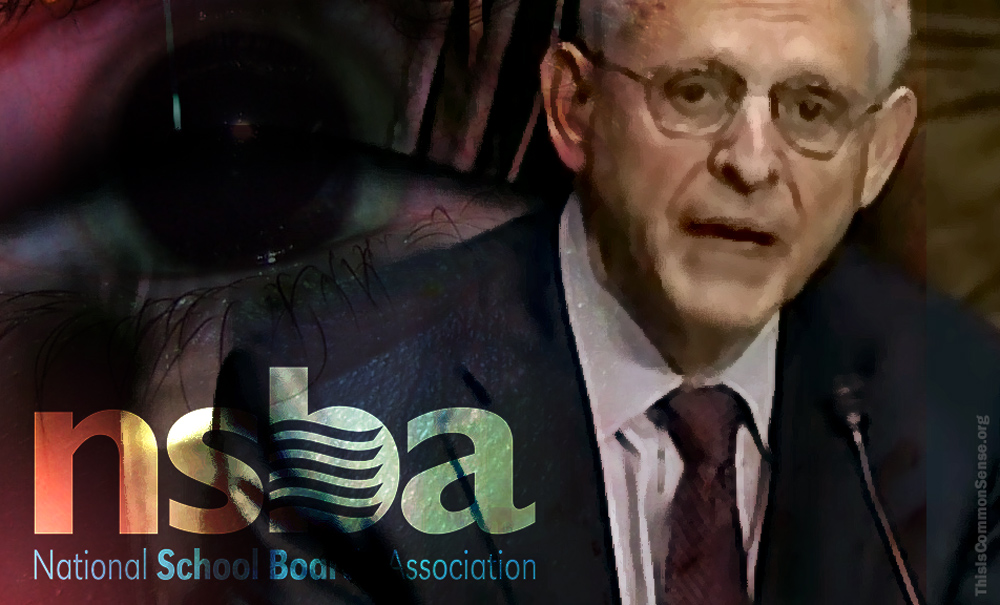
Because of the NSBA’s September letter to President Biden characterizing the many protests by upset parents across the country as “domestic terrorism.”

Those protests are ample evidence of the growing discontent with the injection of racist “critical race theory” (CRT) into K-12 classes. In addition to calling the avalanche of complaints a form of “domestic terrorism,” the NSBA claimed that the CRT agenda “is not taught in public schools.” 

This was met with widespread (and justified) incredulity. The NSBA claimed that CRT was not being taught because college-level texts purveying CRT aren’t used in K-12 classes. Nevertheless, teachers had been instructed, workshops had been conducted, and students had been lectured and censured — all in CRT lore and dogma.

The NSBA later unpersuasively apologized for “some of the language” of their previous letter without repudiating its main contentions or the CRT indoctrination.

Meanwhile, Attorney General Merrick Garland has issued no apology for using the original NSBA letter to rationalize establishing a task force to investigate parents.

The statement of the Ohio School Boards Association public sums up the sentiments of the state organizations leaving the NSBA: “OSBA believes strongly in the value of parental and community discussion at school board meetings and we reject the labeling of parents as domestic terrorists.”

Parents Defending Education reports that as of mid-November, some 26 state school board associations have “distanced themselves” from the letter. Fifteen have formally withdrawn their memberships.

This is Common Sense. I’m Paul Jacob.


PDF for printing

See all recent commentary
(simplified and organized)
See recent popular posts

Categories
Thought

Something to Hate

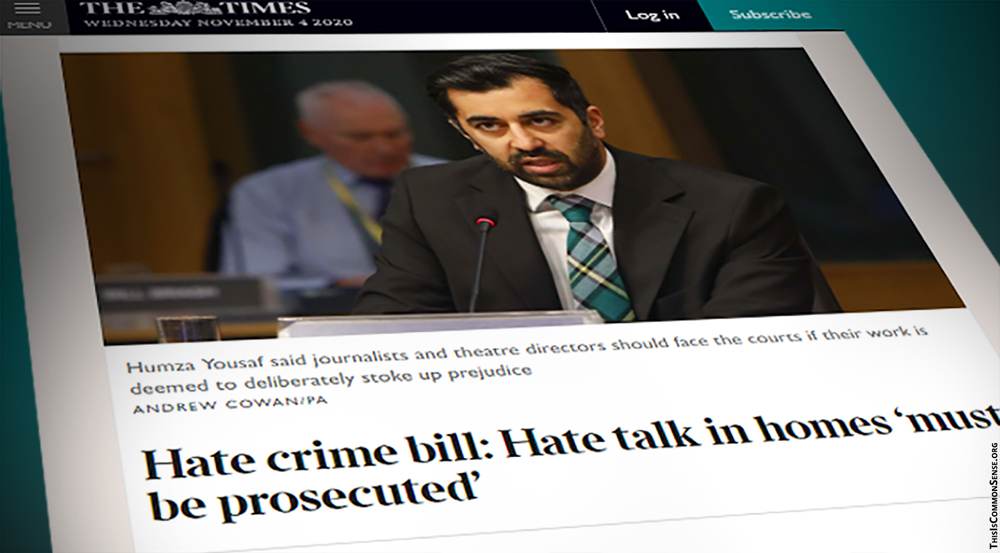
Headline: “Hate talk in homes ‘must be prosecuted.’”

Must”?

The proposed legislation targets speech alleged to promote prejudice. It is backed by Scotland’s secretary for justice, Humza Yousaf.

Might the law be deployed to squelch debate regarding, say, radical Islam?

“Are we comfortable giving a defence to somebody whose behaviour is threatening or abusive, which is intentionally stirring up hatred against, for example, Muslims?” Yousaf asks. “Are we saying that that is justified because that is in the home?”

I suspect that here we have someone who has never attended a sizable family gathering. Many attendees might report “hate talk” but oppose fining or imprisoning the so-called hate-talkers.

Could the law be directed against journalists and others who publicly express loves and hatreds?

“We wouldn’t want to give the likes of Tommy Robinson a defence by saying that he’s ‘a blogger who writes for The Patriot Times,’” says Yousaf.

“Stirring up hatred” is, of course, not identical to threatening or instigating violence. Presumably it is already illegal in Scotland to plan murder and mayhem over the dinner table.

There’s an awful lot of speech out there with which we might vehemently disagree. Plenty of dumb, hateful, prejudice-laden speech that violates the rights of no one does get uttered in homes and Internets. We must preserve the distinction between “things that are wrong to say or do” and “actions that should be illegal.”

Scots should resist these hateful assaults on their right to speak freely.

This is Common Sense. I’m Paul Jacob.


PDF for printing

See all recent commentary
(simplified and organized)
See recent popular posts
Categories
international affairs media and media people

Defying China . . . for Now

According to a New York Times report, “American Internet giants are struggling to respond” to China’s recent crackdown on Hong Kong.

For now, the outcome of the struggle is that Facebook, Twitter, and Google have stopped sharing data with Hong Kong officials. Doing so has become tantamount to sharing data with the Chinese government.

If this wasn’t clear before China’s repressive new “national security” laws in Hong Kong, it’s clear now. The Chinese government is systematically working to muzzle and punish anyone who threatens “national security” by openly criticizing the Chinese government.

Yahoo has changed its policies as well, so that users are now governed in their dealings with Yahoo by American law, not local Hong Kong law (rapidly becoming synonymous with the mainland’s edicts).

So far, so good. 

Worrying, though, is how inconsistent the tech giants have been. Yahoo once helped the Chinese government to identify and imprison two dissidents, claiming it had “no choice” but to turn over the info. Google and others have worked with China to censor information that the Chinese government doesn’t want its citizens to see.

These companies should never — in no way, shape, or form — help China go after dissidents. 

They should never cooperate, rationalize, compromise. 

It would be better to pack up their services and leave Hong Kong altogether than to “struggle” to find a middle way that “sort of” cooperates with China’s repression — and “sort of” leaves Hong Kongers in the lurch.

To bolster these companies’ new backbones, we had best leverage our power as customers.

This is Common Sense. I’m Paul Jacob.


PDF for printing

See all recent commentary
(simplified and organized)
See recent popular posts

Categories
crime and punishment general freedom too much government

Pocket Prohibition?

Should the FDA outlaw backpack pockets?

Trick question. 

Oh, you said “no”? 

Okay, not that tricky . . .

But a little tricky. The FDA doesn’t want to prohibit backpack pockets as such. Only backpack pockets that can hide vaping equipment, like an e-cigarette.

Such pockets could presumably also hold a pen, thermometer, stick of beef jerky, perhaps even a plastic straw or spindled dollar bill. The list of cacheable contraband is endless. But it’s the thoughtcrime that counts.

The FDA wants to deploy its power to regulate food and drugs to also bully makers of pockets and other things that facilitate peaceful actions of which FDA officials disapprove. For now the agency is sending stern letters to sellers of legal products. 

Tomorrow it may send SWAT teams.

“The FDA is especially disturbed by some of these new products being marketed to children and teens by promoting the ease with which they can be used to conceal product use,” frets Mitch Zeller, king of the FDA’s Center for Tobacco Products. (It’s not an emporium.)

Various products that could help a person vape furtively are on the FDA’s hit list. Many of these products never hurt a fly. Backpack pockets in particular are getting a bad rap. I’m a fan of backpack pockets and hope the production of every kind of backpack pocket will continue unabated.

So, regardless of any animus that certain functionaries may feel about the covert carrying of e-cigarettes, pencils, or swizzle sticks, let them leave backpack pockets alone.

This is Common Sense. I’m Paul Jacob.


PDF for printing

vape, backpack, authoritarianism, surveillance,

See all recent commentary
(simplified and organized)
See recent popular posts
Categories
Fourth Amendment rights initiative, referendum, and recall

Big Brother or Barney Fife?

Alaska, Washington, Oregon, Montana, Missouri, Oklahoma, Louisiana, New Hampshire — these are the states that have shouted a big NO to the Federal Bureau of Investigation’s citizen scanning agenda and its database of 640 million faces. 

“As the FBI amasses hundreds of millions of photos for its facial recognition program (with little in the way of safeguards),” asks J. D. Tuccille in Reason, “is it also going to force us to bare our faces for cameras as we move through an increasingly surveilled country?”

Tuccille suggests wearing hats big enough to cover our faces from intrusive cameras. 

Most states do not prohibit surveilling people en masse or at random. And though Kimberly J. Del Greco, deputy assistant director of the FBI’s Criminal Justice Information Services Division, assures us of the operation’s above-board character — “there have been no findings of non-compliance, and no observations of unauthorized requests” — the possibilities of abuse are precedented . . . by past government surveillance.

So, is it any solace that it has so far proved wildly inaccurate? 

Sure, the aforementioned Del Greco claims the FBI’s algorithm is 99 percent accurate. But another study found one system in place with a sorry 98 percent inaccuracy rate. “It’s a creepy police state as administered by Barney Fife,” writes Tuccille. And while that is “pretty damned funny,” it would be not even a little bit funny if “you’re arrested based on a bad match.”

Constraining governments to forswear such practices on the streets, malls and public places of America is surely a good candidate for citizen use of initiative and referendum rights, where available — in states and cities around the U.S.

For these are not supposed to be the United States of Big Brother.

This is Common Sense. I’m Paul Jacob.


PDF for printing

big brother, Barnie Fife, surveillance, face recognition,

See all recent commentary
(simplified and organized)
See recent popular posts

Categories
crime and punishment general freedom media and media people moral hazard

Porn, Video Games and British Crime

British freedom is eroding. The attack comes from two directions.

First, there is the over-bearing police-state style, surveillance-everywhere government.

Second, there is the increasing violence.

Thing is, the justification for Britain’s mass surveillance, as well as for strict gun controls, was to prevent crime.

Oops.

So of course the Labour Party “shadow home secretary” Diane Abbott points an accusatory finger at porn and video games. These two influences may be “desensitising young people to vicious behaviour.”

Well, porn and video games are changing our cultures, on both sides of the pond. But in America, at least, the crime rate for the past two decades plumetted while video games and Internet porn have become ubiquitous, explicit and . . . admittedly, appalling.

Look elsewhere for the crime uptick.

The Brexit fiasco, with the Tory government messing up implementation of the 2016 referendum results, has surely increased, not decreased, tensions all around, as has immigration policy, the collapsing National Health system, and much more. But worst of all? The nanny state, treating citizens as childish subjects. The police arrest people for nothing more than saying mean or just edgy things online. 

If people cannot be free legally, they will take license — illegally. 

Previously, we heard about a rash of acid attacks: acid thrown in the faces of pedestrians. More recently, the headlines are about stabbings — after years of knife control, of government crackdowns on even kitchen knives.

Ms. Abbott places the primary blame for rising crime not on the above, however, but on poverty and malfunctioning education. Not mentioned? The possibility that taking away British citizens’ rights of self-defense may have the perverse (unintended?) consequence of increasing offensive violence.

This is Common Sense. I’m Paul Jacob.


PDF for printing

Great Britain, British, England, knives, violence, freedom, surveillance,

See all recent commentary
(simplified and organized)
See recent popular posts

Categories
Fourth Amendment rights general freedom national politics & policies Popular too much government

Snowden Won?

“The phone records program” that Edward Snowden risked life, limb and freedom to expose “had never thwarted a terrorist attack,” the New York Times informs in a somewhat startling bit of reportage published on Monday.

But that isn’t the startling part. 

The National Security Administration’s unauthorized metadata phone-records collection program was a wish-list snoop system snuck into practice under cover of the Patriot Act. After the Snowden revelation, Congress halted it, replacing it with a similar operation in 2015, via the U.S.A. Freedom Act. But we have long known that U.S. spies could do most of what they “need” without pre- or post-Snowden versions.

What is startling in the Times article, “Disputed N.S.A. Phone Program Is Shut Down, Aide Says,” is there in the title: the federal government’s top spy agency has allegedly not used the program in its Freedom Act version in months, has even closed it.

And the Freedom Act, up for renewal, may just be allowed to die a quiet death.

Nick Gillespie, at Reason, cautions that “the possible end of the USA Freedom Act doesn’t mean the federal government doesn’t have access to all sorts of tools needed to secretly snoop on you, or that your personal data isn’t being collected in any number of ways you have little control over.” And he cites a recent Reason piece on how Patriot Act survellaince powers have been used to bust up a prostitution ring.

Which shows how terrorism is not the only government target. 

And why giving government vast surveillance powers could be used for anything.

Not to mention that niggly problem of abridging the Fourth Amendment rights that had so concerned Ed Snowden.

This is Common Sense. I’m Paul Jacob.


PDF for printing

surveillance, metadata, Snowden, Edward Snowden

See all recent commentary
(simplified and organized)
See recent popular posts

Categories
insider corruption tax policy

There You Go Again, IRS

The old keywords were “Constitution,” “Patriot” and “Tea Party.”

The new ones? “Marijuana,” “oxycodone,” and “legalization.”

Paul Caron, the TaxProf blogger, calls attention to another IRS scandal — again about denying tax-exempt status to organizations because of their political views. He had barely finished blogging about the scandal that came to light in 2013 when a new one burst into view.

You almost certainly remember the older scandal, in which the Internal Revenue Service had been caught intrusively scrutinizing and delaying the applications of conservative non-profits picked on because of their conservatism.

To cover that mess, Professor Caron published a blog series called “The IRS Scandal, Day __.” He added a post daily.

Every day.

For years.

The last installment, Day 1921, published on August 14, 2018, reported a settlement: meager taxpayer-funded payouts to over a hundred victimized organizations. The IRS never admitted wrongdoing. No one was ever punished. According to the Washington Times, the agency said that it had “made changes so that political targeting can’t occur in the future.”

These changes don’t seem to include prohibiting political targeting by the IRS, however.

Now we have another case.

Caron points us to a Wall Street Journal op-ed by David Rivkin and Randal Meyer, lawyers, who have discovered a dirty little secret in Revenue Procedure 2018-5. One provision authorizes IRS to withhold tax-exempt status from applicants seeking to improve “business conditions . . . relating to an activity involving controlled substances,” including marijuana and oxycodone. Advocating legalization of marijuana would count as trying to improve such conditions.

Apparently, the IRS thinks its mandate entails enforcing the status quo by stifling dissent — instead of just doing its congressionally mandated (if all-in-all irksome) job.

This is Common Sense. I’m Paul Jacob.


PDF for printing


» See popular posts from Common Sense with Paul Jacob HERE.


Categories
Accountability crime and punishment government transparency media and media people moral hazard national politics & policies privacy Snowden

Clapper into the Clink?

Lying to Congress is a strange crime. A number of people have been prosecuted for it over the years, but Congress isn’t a court of law and, more to the point, Congress may present the densest source of lies in the United States.

The idea that it would be illegal for a citizen to lie to a den of liars is, well, a bit amusing.

But it is illegal, and definitely should be illegal, for government functionaries to give false testimony before Congress.

That’s why the case of the admittedly “untruthful”* James Clapper is so aggravating. When asked by Senator Ron Wyden, on the Senate floor, about data collection of phone calls by the U.S. federal government, he — the director of national intelligence under President Barack Obama from 2010 to 2017 — lied through his teeth.

And had not Edward Snowden leaked information on the National Security Administration’s metadata collection program, we would not have learned anything about it.

No wonder, then, that several congressmen want to prosecute Clapper before March 12, when the Statute of Limitations runs out on his crime. Steven Nelson at the Washington Examiner quotes Rep. Ted Poe (R-Tex.), Rep. Thomas Massie (R-Ky.), Rep. Louie Gohmert (R-Tex.), and Rep. James Sensenbrenner (R-Wis.) as all being in favor of siccing federal prosecutors on the forked tongue spymaster.

Senator Wyden warns that letting lies such as Clapper’s go unaddressed encourages Americans to be cynical about government, and “makes it possible, even probable, for hucksters and authoritarians to take power.”

Too late?

This is Common Sense. I’m Paul Jacob.


* Clapper’s March 2013 whopper at the Senate Intelligence Committee hearing was that the NSA was “not wittingly” collecting “any type of data at all” on millions of Americans. Later, to MSNBC, he characterized his artful dodge as having been “the least untruthful” way for him to respond.


PDF for printing