Categories
international affairs

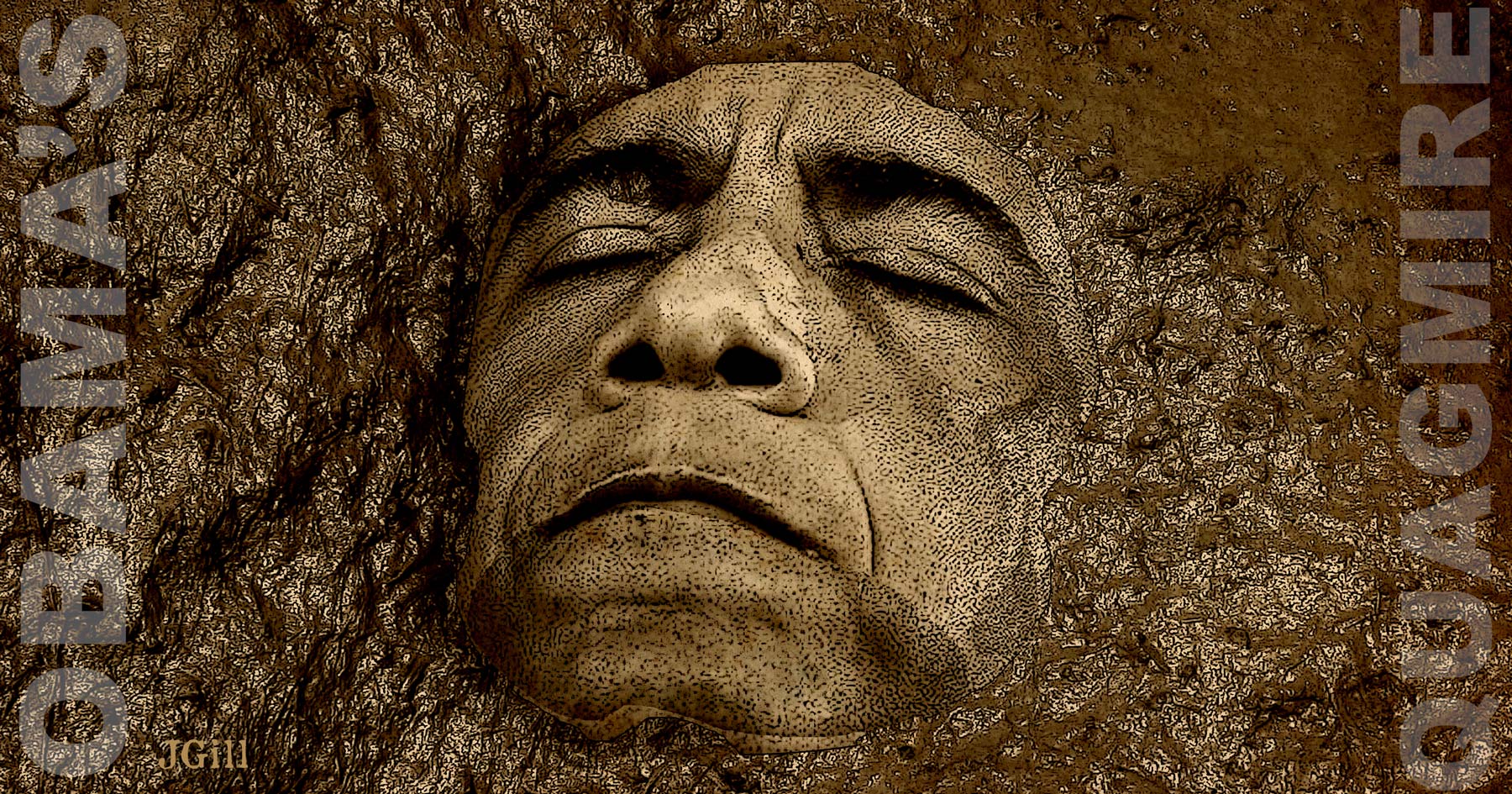
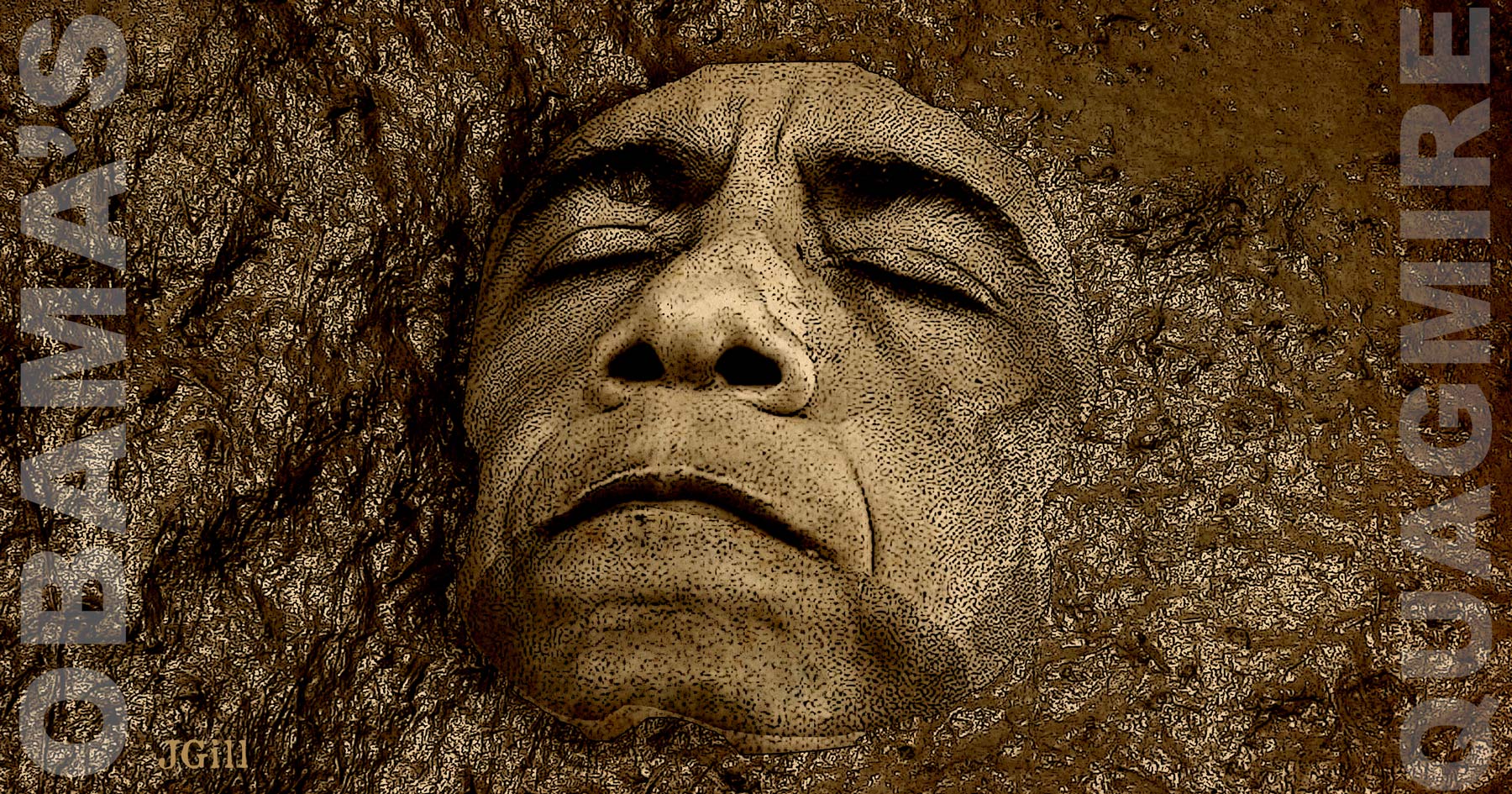
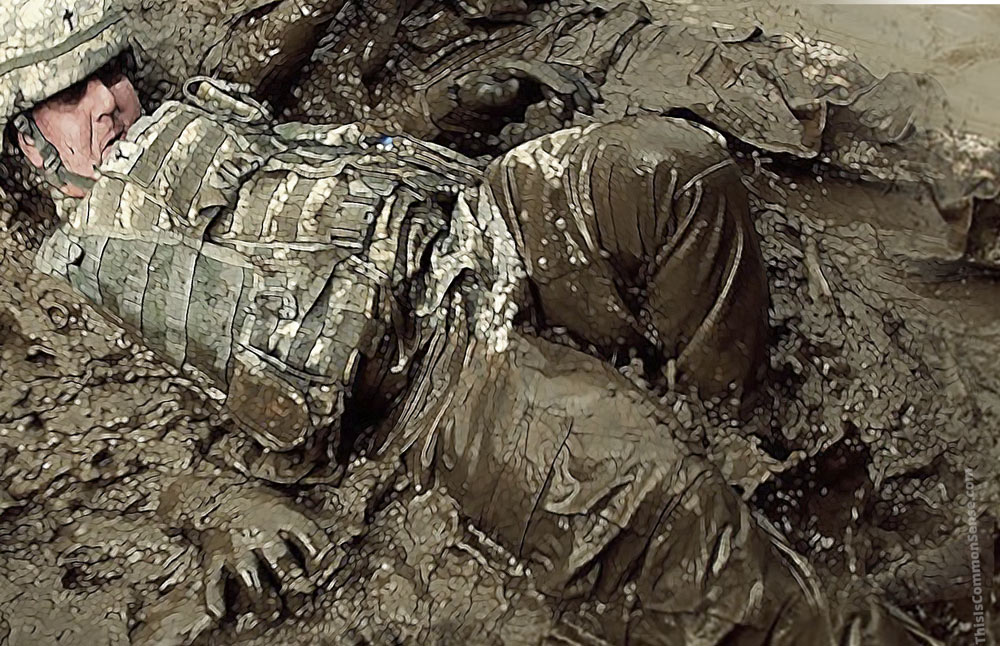
America Safe for Quagmires?

It happened: “The measure asking all foreign troops to leave . . . passed.”

We are talking about Iraq . . . and the U.S. military. 

So, not much else has happened.

After that parliamentary vote, Ron Paul explains, “when the Iraqi prime minister called up Secretary of State Mike Pompeo to request a timetable for a US withdrawal, Pompeo laughed in his face.”

I am with Dr. Paul on this one. The U.S. should take this opportunity to get out . . . “before more US troops die for nothing in Iraq.”

But is it for nothing?

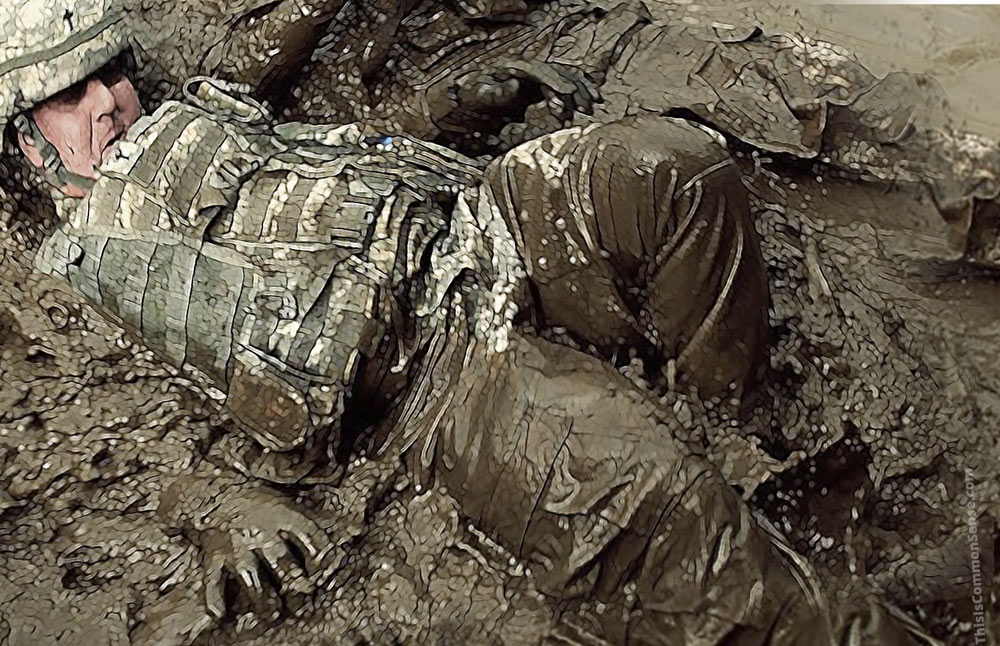
Once upon a time, Americans were afraid of military “quagmires.” Now somehow we’ve come to accept permanent quagmire status in multiple theaters

Could it be that when President George Herbert Walker Bush said, following the First Persian Gulf War, that “By God, we’ve kicked the Vietnam Syndrome once and for all,” he was speaking of its psy-op effect on the American electorate?

Pushing us into World War I,  President Wilson claimed to be “making the world safe for democracy.” Perhaps Papa Bush made America safe for never-ending “regime-change wars.”

Before becoming vice president and then president, and going on to claim victory over  “Vietnam Syndrome,” Bush headed the Central Intelligence Agency, the original regime modification professionals. And certainly endless, pointless foreign warfare has been the health of . . . the Deep State.

“The pressure for the U.S. to leave Iraq has been building within the country,” argues former Rep. Paul, “but the U.S. government and mainstream media is completely — and dangerously — ignoring this sentiment.”

Put American soldiers — not some secret or not-so-secret Deep State agenda — first. Bring them home.

This is Common Sense. I’m Paul Jacob.

PDF for printing

quagmire, war, foreign policy, Iraq, Iran,

See all recent commentary
(simplified and organized)
See recent popular posts
Categories
international affairs

Bye-Bye Iraq?

We may soon be at war with Iran. Wait, in this day and age of endless conflicts without so much as a decent declaration, are we not already at war with Iran?

Clearly, the drone-strike killing of Iranian Maj. Gen. Qassim Suleimani, described by The New York Times as “the architect of nearly every significant operation by Iranian intelligence and military forces over the past two decades,” was an act of war. The Trump Administration predicated the U.S. assault on previous Iranian acts of war — including involvement in the recent storming of parts of the sprawling 104-acre U.S. embassy in Baghdad and, moreover, deadly attacks on U.S. forces in Iraq.

Iran vows revenge. I want to bring U.S. troops home from the Middle East. And so did President Obama and so does President Trump, no? But several thousand more U.S. soldiers are now headed to the region.

The world’s policemen.

But, then, miraculously, a possible way out. News reports announced that Iraq’s legislative body, the Council of Representatives, would take up a resolution on expelling U.S. troops — er, well, asking U.S. troops to leave.

Please, Iraqi legislators, please: don’t throw us in that briar patch! 

The vote was held. The measure asking all foreign troops to leave . . . passed

It is an understandable request, one that we can only presume the U.S. will respect . . . once the legislation is signed.

Oops! The prime minister has resigned; there’s no one to sign it.

Plus, the resolution is “non-binding.”

Training the Iraqi army has been difficult, but how proud our nation-builders must be to see Iraqi politicians show a professional understanding of political sleight-of-hand.

This is Common Sense. I’m Paul Jacob.


PDF for printing

Briar Patch, flag, Iran, war, Iraq,

Photo by incidencematrix

See all recent commentary
(simplified and organized)
See recent popular posts

Categories
folly international affairs national politics & policies Popular

Remember . . . the Maine?

“President Trump warned Thursday that America ‘will not stand’ for Iran shooting down a U.S. drone over the Strait of Hormuz,” a Fox News report summarizes, “while at the same time leaving open the possibility that the attack was unintentional.” 

This incident immediately follows the previous week’s apparent provocation, attacks on Japanese oil tankers in the same vicinity — also said by our government to have been caused by the Iranian military. Nearly everyone now regards these events as portending war,* which some see as a long time coming, since American relations with Iran have been antagonistic since the late 1970s, when Shia clerics raised a popular revolt to oust the American-installed thug, er, Shah.

While Mr. Trump was incredulous that the strike on the drone (opposite of a drone strike) could have been intentional, the rest of us can dare doubt even more: Can we really trust the “intelligence” that blames Iran’s military or paramilitary Revolutionary Guard for these puzzlingly dangerous provocations?

Not based on past performance.

The “intelligence” used to justify America’s several wars with Iran’s neighbor, Iraq, seems more disinformation than mere misinformation. And we now know that the Gulf of Tonkin incident enabling U.S. escalation into Vietnam was a lie.

We should even “remember the Maine!” — the questionable rationale for the Spanish-American War.

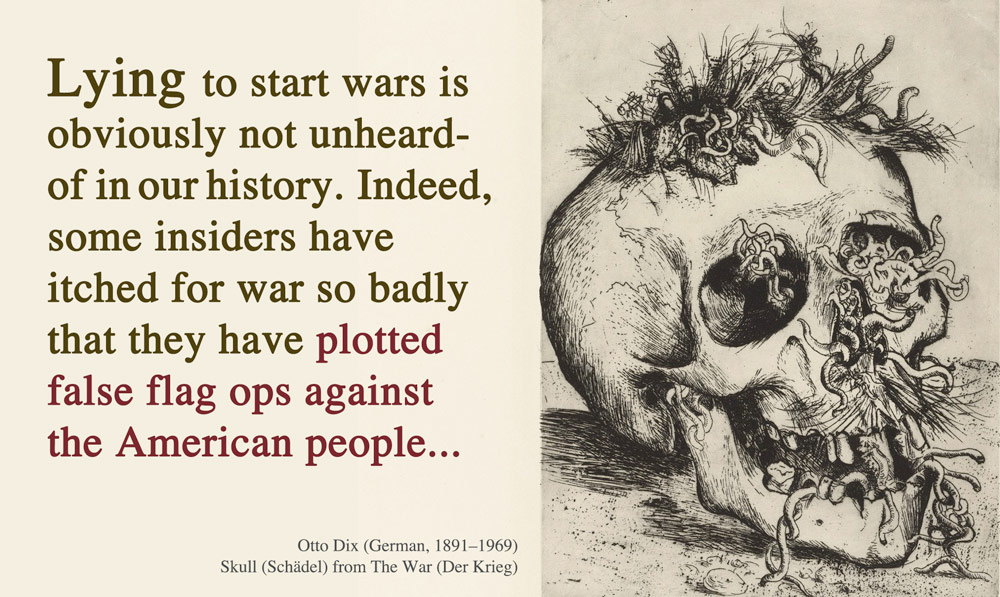
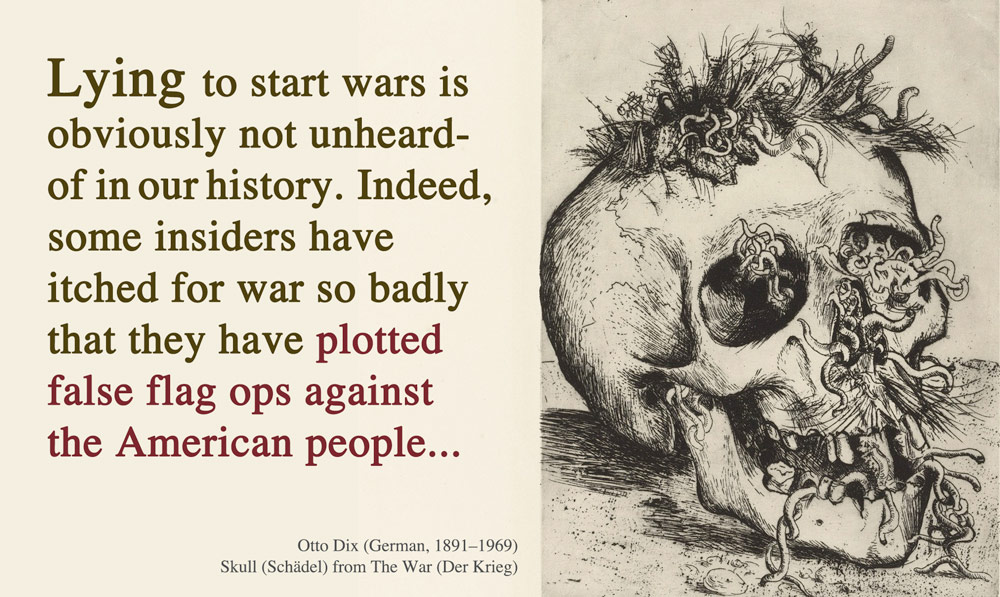
Lying to start wars is obviously not unheard-of in our history. Indeed, some insiders have itched for war so badly that they have plotted false flag ops against the American people.

The truth of what is happening now may not be known for years . . . by us . . . or even by President Trump.

This is Common Sense. I’m Paul Jacob.


* According to the New York Times, late yesterday President Trump authorized and then de-authorized a strike against Iran.

PDF for printing

war, false flag, Iran, Iraq, lies,

See all recent commentary
(simplified and organized)
See recent popular posts
Categories
international affairs meme Popular too much government

What Kind of Ice Cream Cone?

When I wrote about the Donald’s change of troop positions abroad last week, it was less than completely clear that the US President aimed to withdraw troops from Afghanistan as well as Syria. But multiple reports on the day I posted “Strategic Disengagement” make it clearer: about half of America’s 14,000 troops stationed there are scheduled to exit.

Why not all?

Well, you can see how entrenched foreign intervention is for American leaders. While most of the GOP policy establishment howled at Donald Trump’s betrayal of the cause (whatever that cause is, exactly), so, too, did many of the Democrats. And they seem awfully earnest. More earnest than one has reason to expect from the objectors to “George W. Bush’s wars.”

Even Noam Chomsky came out saying that the U.S. should stay in Syria to save the Kurds, and Howard Dean tweeted that American troops must remain in Afghanistan for the sake of women’s rights.

What we are witnessing are eternal programs that do not ever — and cannot ever — fulfill their basic purpose. No amount of occupation of Syria or Afghanistan or Iraq is going to give us what the neoconservatives promised: freedom and democracy and jubilation in the streets.

Freedom and democracy do not work that way.

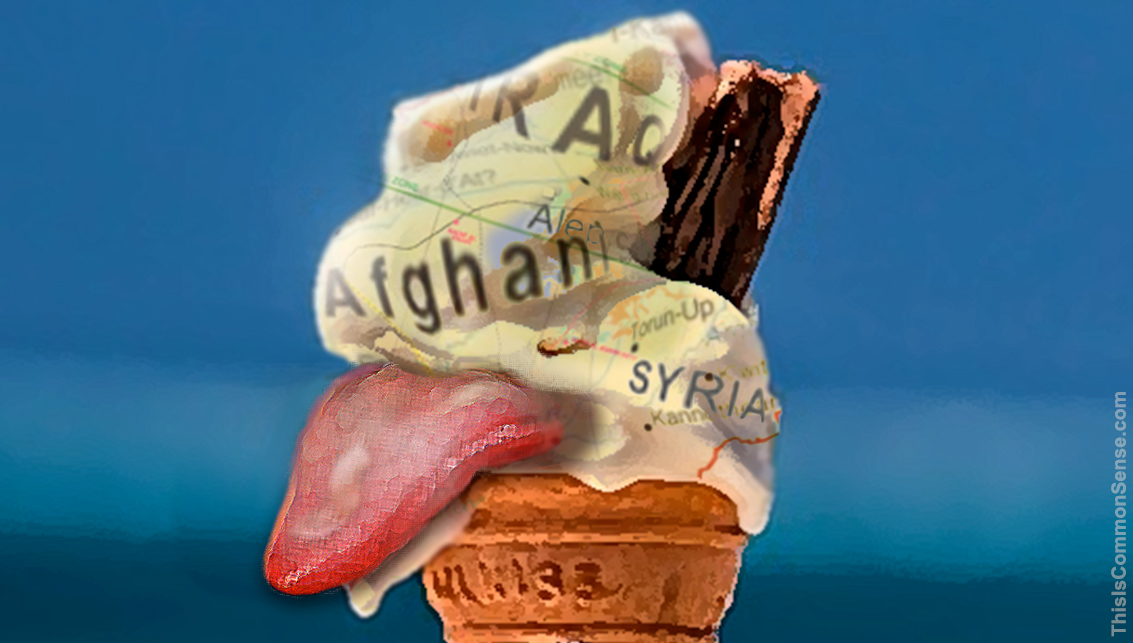
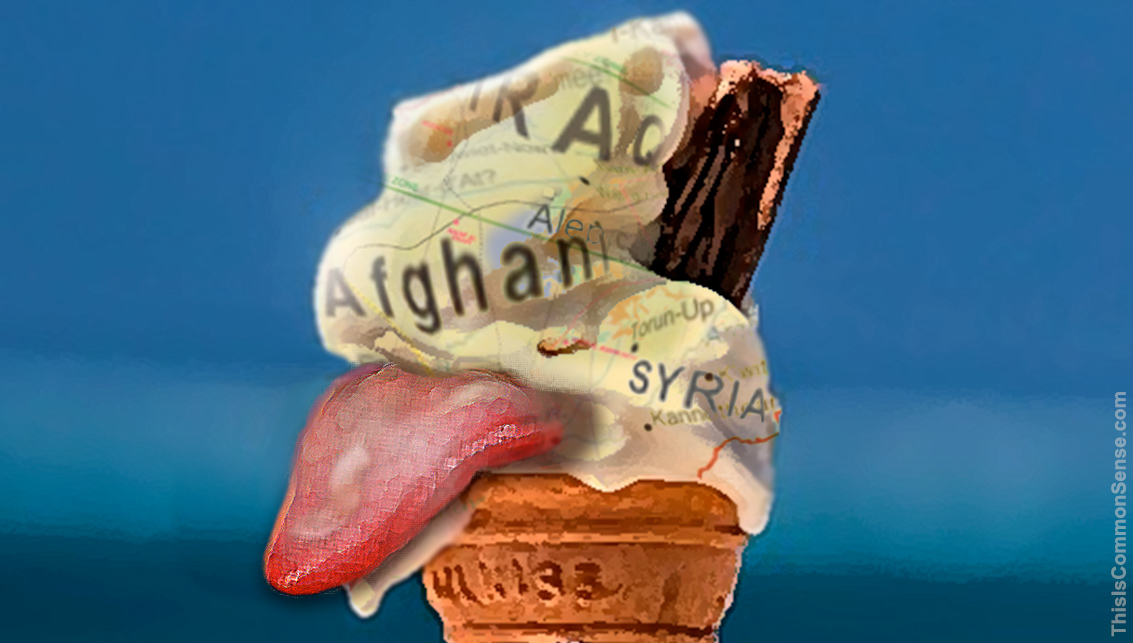
There is a term for such impossible-to-win/impossible-to-stop policy messes: “self-licking ice cream cones.”

The term means a “self-perpetuating system that has no purpose other than to sustain itself,” which is just standard operating procedure for domestic bureaucracies.

But in foreign military action?

Awfully cold imagery, and too comic . . . for tragedy.

This is Common Sense. I’m Paul Jacob.


PDF for printing

self licking ice cream, war, foreign policy, government

See all recent commentary
(simplified and organized)
See recent popular posts
Categories
Accountability media and media people moral hazard national politics & policies responsibility

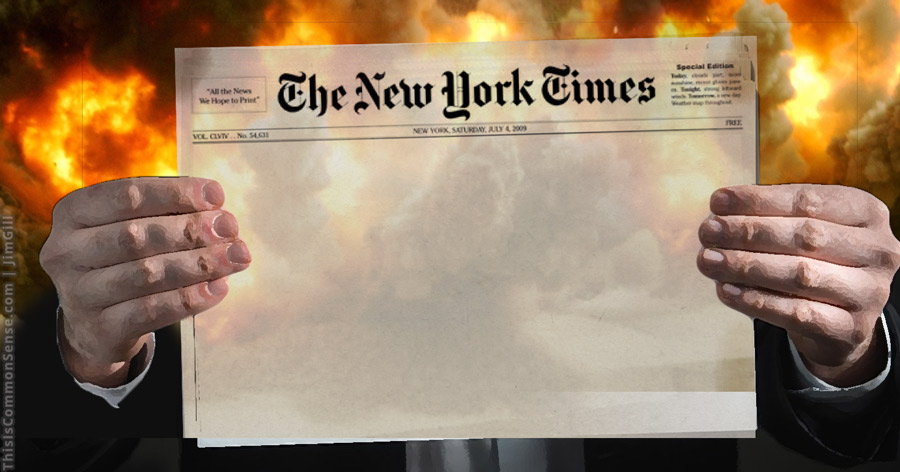
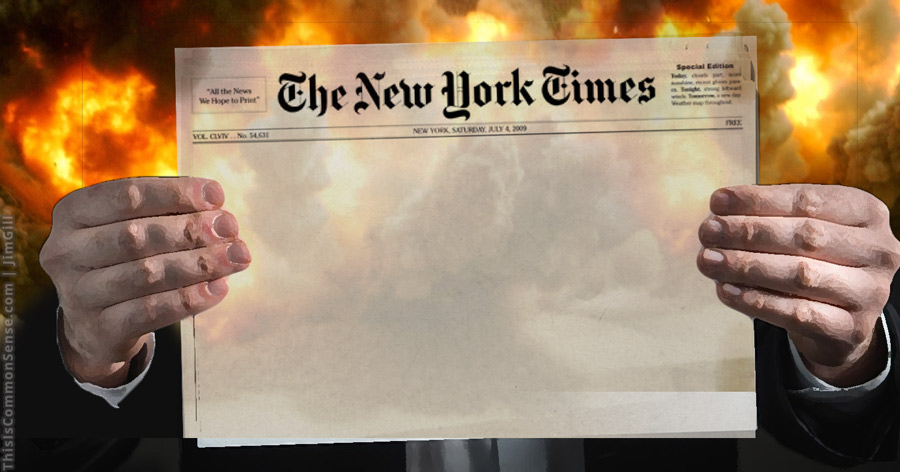
War on Page A-10

War was once big news. Now? Not so much.

Which may be a function of the never-ending War on Terror, no end in sight in Afghanistan and an Iraq War that is officially over . . . except for the fighting.

Last October, Green Party presidential candidate Jill Stein busied fact-checkers by claiming the U.S. was “bombing seven countries.” True, declared PolitiFact: Afghanistan, Iraq, Libya, Pakistan, Somalia, Syria and Yemen.

Yemen is better known after January’s raid that killed Navy SEAL Ryan Owens, wounded three other SEALs, and killed 14 to 25 Yemeni civilians, including children. Last week, during President Trump’s speech to Congress, Owens’s widow, Carryn, received a thunderous ovation.

But, as I argued at Townhall, “Ryan Owens and his widow and her three now fatherless children deserve more than applause.“ How about thoughtful policies and a Congress that holds the executive branch accountable?

Invading Iraq was a mistake. So was President Obama’s swerve over to destabilize Libya.

“We are not about to send American boys 9 or 10 thousand miles away from home to do what Asian boys ought to be doing for themselves,” President Lyndon Johnson once said . . . right before he sent more American soldiers to Vietnam.

Consider that U.S. Special Forces were deployed to 70 percent of the world’s nations in 2016. And, in recent weeks, President Trump asked for a $54 billion increase in military spending, and we have learned of Pentagon plans to seek a “significant increase in U.S. participation” against ISIS.

We owe it to those in uniform to ask tough questions, including: Is what we’re doing really worth a single American life?

This is Common Sense. I’m Paul Jacob.


Further reading:

Reason: Is the Military Really “Depleted” After Years of Record-High Spending?

The Atlantic: Fighting Terrorism With a Credit Card

The National Interest: America Is Never (Ever, Ever) Ending the War on Terror


Printable PDF


Categories
folly national politics & policies

A Tunnel with No Light

President Barack Obama pledged we’d be out of Afghanistan by 2016, but yesterday announced a “modest but meaningful extension of our presence” — keeping the 10,000 troops currently stationed there for all of 2016, and then, in perpetuity, maintaining a force five times larger than previously planned.

Why? Because, after 14 years of conflict and nation-building, Afghanistan is still neck-deep in violence. Last month, the Taliban briefly captured Kunduz, a city of over 250,000 people. Going forward, Obama admitted, “There will continue to be contested areas.”

The Afghan government is not self-sustainable and nobody seems to know how many years or decades or centuries that might take to achieve.

Meanwhile, over in Syria, the U.S. cannot train more than four or five moderate soldiers after much bluster and promise — and splurging a cool $500 million.

The U.S. invaded and “regime-changed” Iraq, helping shape a new government and national army. With all that effort — a cost of thousands of lives — once our soldiers weren’t doing the daily fighting to tamp down the bloody sectarian chasm, ISIS formed, the Iraqi army ran away and the country soon collapsed into civil war.

The Iraq Conquest put southern Iraq into Iranian orbit. How many lives was that worth?

The problem? Not military incompetence. The mission is the problem. Has any politician or military leader plausibly put forth a plan whereby our country’s intervention actually creates an improved and sustainable political order in any of these nations?

If so, let’s see it.

If not, why are our soldiers still in harm’s way?

This is Common Sense. I’m Paul Jacob.


Printable PDF

Obama, quagmire, foreign policy, Afghanistan, Syria, war, collage, photomontage, JGill, Paul Jacob, Common Sense


Categories
national politics & policies

Endless Fog of Endless War

Yesterday, NBC’s Chuck Todd opened a “Meet the Press” segment by calling U.S. involvement in Afghanistan and Iraq “wars now without an end.”

“The U.S. now seems to be in a semi-permanent state of war,” added Chief Foreign Correspondent Richard Engel.

“Right now, we’re just in damage control,” explained Lt. General Dan Bolger, Retired, the author of Why We Lost: A General’s Inside Account of the Iraq and Afghanistan Wars. “Our enemies, the Taliban and ISIS, are talking about winning.”

Mr. Todd asked, “Why do we have this incredible military that can’t win these wars?”

“The military can give you a quick victory over a conventional army. It cannot deliver a rebuilt country in the place you go,” replied the general. “That takes an effort of the entire U.S. population and government. And moreover, it takes the commitment of the American people for the long term.”

And then Baghdad and Kabul will look a lot like Chicago or Boston?

“At what point do we walk away?” Todd wanted to know. Never?

“It becomes difficult to walk away, because these situations are spinning quite badly out of control,” offered Sarah Chayes, now with the Carnegie Endowment for International Peace and formerly an assistant to the chairman of the Joint Chiefs of Staff. “And it’s spreading.”

Our decade-plus in Iraq and Afghanistan has cost us greatly and accomplished little good, if any.

Even a century of Americans fighting and occupying and pacifying these countries will not succeed. The cost, not just in billions of tax dollars, but also in thousands of our countrymen dead and maimed, is unacceptable.

It’s time to really end the “endless” wars.

This is Common Sense. I’m Paul Jacob.

Categories
Accountability national politics & policies

Aeschylation

“In war,” the Greek dramatist Aeschylus told us, “truth is the first casualty.”

This came to mind when Secretary of State John Kerry testified in the Senate last week.

The new Iraq War has been pitched exhaustively to the American people as “only air strikes” and “absolutely no boots on the ground” — even as the Obama Administration continues to send additional U.S. military advisors to place their boots on Iraqi sand (and, at least once thus far, to engage ISIS directly via Apache attack helicopters hovering above Iraqi ground.)

Kerry again assured senators that the president “has been crystal clear that his policy is that U.S. military forces will not be deployed to conduct ground combat operations against ISIL.”

Strangely, however, the Secretary most adamantly urged Senators not to pass an Authorization for Use of Military Force (AUMF) that would restrict President O from doing precisely what he has so often and emphatically pledged not to do: put combat boots on the ground in Iraq.

The fact that the Obama Administration has foreclosed any possibility of putting US troops on the ground to fight, according to Sec. Kerry, “doesn’t mean that we should preemptively bind the hands of the commander in chief or our commanders in the field in responding to scenarios and contingencies that are impossible to foresee.”

Impossible to foresee? Yeah, right. The “no boots” promise provides all the stability of leaves in the wind.

Having any trust in this administration is impossible to foresee.

This is Common Sense. I’m Paul Jacob.

Categories
national politics & policies

Foreign Policy Evacuation?

Last week, the United States closed and shuttered the embassy in Tripoli, Libya, evacuating from the country its personnel — 158 diplomats and 60 Marines. Fighting between two rival militias reportedly got so close that the embassy was actually being hit by stray small arms fire.

I certainly don’t object to the decision to pull people out. Seems prudent, especially in light of the 2012 attack on the U.S. consulate in Benghazi, Libya, which left four Americans, including our ambassador, dead.

But the protective move sends an unmistakable signal about Libya and US foreign policy. Obama’s 2011 military intervention into Libya via NATO — famously promoted as “leading from behind” — has clearly and obviously failed.

Libya is in chaos, unsafe for Americans . . . or Libyans.

President Obama is hardly the sole leader deserving blame. Military campaigns launched by President Bush, who led from in front, haven’t worked, either.

After years of “pacifying” Iraq, at the cost of thousands of American lives, and building up Iraq’s military forces, the Iraqi army disintegrated at the first sign of conflict. The Iraqi government remains thoroughly corrupt.

Sadly, the same fate awaits the end of our nation-building stint in Afghanistan. A recent Washington Post story quoted Sgt. Kenneth Ventrice, a veteran of three tours in Iraq and now serving his second in Afghanistan, saying, “It’s going to fall a lot faster than Iraq did.”

These foreign interventions are failures.

But the biggest failure? Not to learn from our mistakes.

This is Common Sense. I’m Paul Jacob.

Categories
national politics & policies

All the Way

Iraq is a mess. Two presidents have informed us that the Iraq war is over and the mission accomplished. And yet the scions of Al-Qaida are on the march, conquering the country city by city. The U.S. is said to be turning to . . . Iran for help.

In the ’80s, the United States government armed Iraq with weapons* to war on Iran, a country that had just undergone a revolution and humiliated the U.S. with the hostage crisis. Saddam Hussein was “our friend.”

Now, after the U.S. has executed this Hussein, and destroyed Iraq’s ruling leach class, the Sunni Ba’athist Party — after a jury-rigged government and American-trained army failed to withstand assaults from a core group of true-blue-jihadists in the form of ISIS — the old enemy Iran is being dubbed a savior.

My suspicion is that Iraq cannot and should not be “saved.” It was the construct of British imperialism and the mapmakers of the Versailles Treaty. It is easily divisible into of three countries because there are three distinct groups of people: Sunni populations, Shia populations, and Kurds to the north.

One Iraq or three nations?

Here’s the good news: This isn’t our choice to make.

Sure, the military might of the U.S. could “pacify” Iraq for a time, and arguably for the next 100 years — installing and uninstalling and always complaining about one Iraqi regime after another, providing an occupation force to quell disturbances — only to see the old feuds erupt anew once we leave.

Why do it? Why lose one life to such a mission?

Let Iraqi Shia, Sunni and Kurds do the fighting and dying . . . and the deciding.

This is Common Sense. I’m Paul Jacob.

* Recently declassified documents also show U.S. complicity in helping Iraq to target its use of chemical weapons against Iran.