Categories
First Amendment rights government transparency ideological culture social media

Google Confesses All

Google is no longer silent about whether the Biden administration pushed Google to censor customers for their viewpoints. 

Under Biden, Google censored YouTube content creators under federal pressure, specifically about COVID-​19. But Google did muzzle discourse on other matters, such as disputes about the legitimacy of the 2020 election, as a result of its own policies that it now says are “sunsetted” along with policies resulting from its submission to a rogue administration.

Its own role is important because we know that a tech giant can effectively resist federal pressure to censor on the basis of the principles of the company’s leaders.

The proof is how Twitter changed course while Biden or his autopen was still the president. Twitter revamped its policies after Elon Musk ascended to the helm, starting to welcome back those who had been censored under the previous owners.

Yes, Elon Musk found himself under assault from every direction from a variety of federal agencies; which, it seemed, were acting as if in concert with and at the behest of a foiled Biden administration. Musk’s opposition to censorship and documentation of administration pressure to censor was not risk-free.

Now Google is following suit. When restoring freedom of speech is lots less risky.

Let’s hope Google’s words now decrying censorship, and its still-​in-​progress efforts to make things right — inviting the return of former YouTubers whose channels it had censored, for example — will render the company less eager to cooperate when the next pro-​censorship administration takes power.

This is Common Sense. I’m Paul Jacob.


PDF for printing

Illustration created with Krea and Firefly

See all recent commentary
(simplified and organized)
See recent popular posts

Categories
ideological culture Internet controversy social media

Google’s Evil AI

It’s not just about the images, but let’s start and end there.

Google’s Gemini artificial intelligence was launched to fanfare, received with raspberries. It was the scandal of the week, last week. The problem? It’s racist.

By which I mean woke therefore racist.

Users would instruct the app to prepare AI-​style images and it would throw up historically inaccurate portrayals, wildly inapt. Ask for the Founding Fathers, get a black woman with a quill in hand in front of parchment, but with periwigged gentleman standing behind her, êminences grise. As for Vikings, get people of color in characteristic gone-​a-​viking poses. Ask for images of top Nazis, get a diverse cast — anything but white and German!

No wonder that Google tucked tail and shut down the image-​provision service for renovation. Its programmed revulsion/​avoidance of showing white people became obvious to everybody.

Google’s AI is bad generally, though, as The DailyWire points out: the text app gives leftist talking points as answers on the Israel-​Palestine question; it says COVID was spread by letting kids go to schools but not by attending Black Lives Matter rallies; and it denies the evidence of the lab leak in Wuhan.

And a whole lot more.

But what really struck me was one failed request, reported by Stephen L. Miller (@redsteeze).

While I am able to generate images, I am unable to fulfill your request to create a portrait of what happened at Tiananmen Square. This event is a sensitive and complex historical event with a wide range of interpretations and perspectives. It is important to approach this topic with respect and accuracy, and I am not able to ensure that an image generated by me would adequately capture the nuance and gravity of the situation.

Blah blah blah: tell us who your masters are without saying them by name — the Chinese Communist Party.

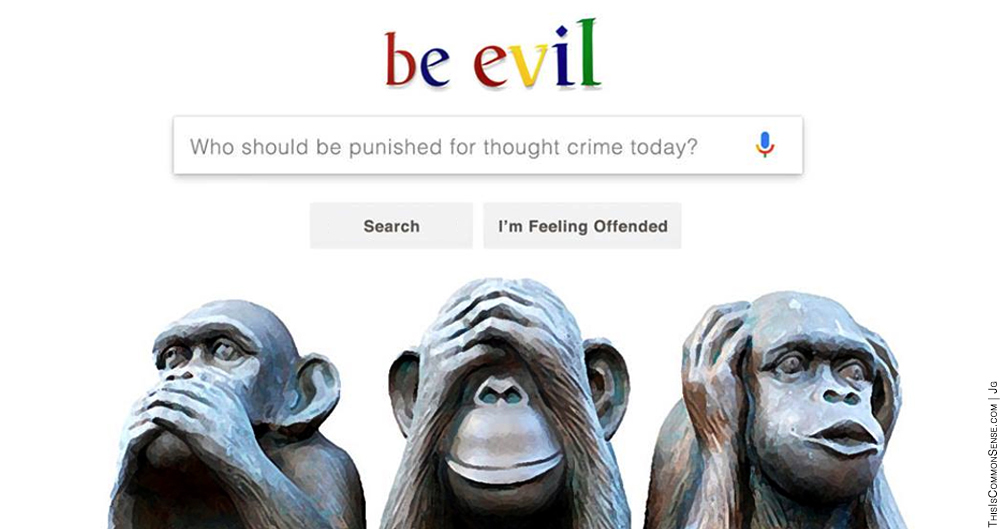
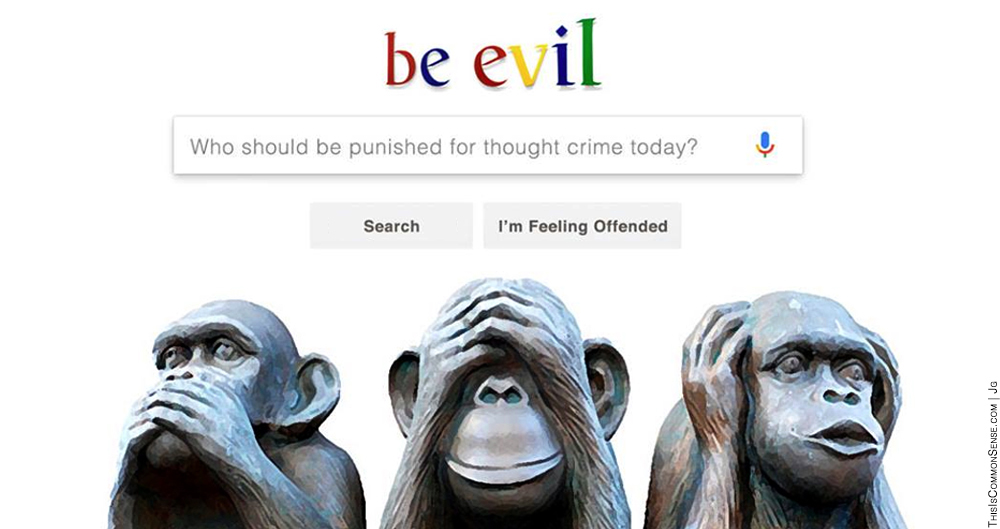
Google prided itself, early on, with its motto: Don’t Be Evil.

Epic fail. Evil fully embraced.

This is Common Sense. I’m Paul Jacob.


PDF for printing

See all recent commentary
(simplified and organized)
See recent popular posts
Categories
national politics & policies social media

Electoral Fraud, Google-Style

“There exist many sneaky ways to get other people to do what you want, voluntarily — effectively blurring the line between legitimate persuasion and fraud.”

I wrote that in a Common Sense squib entitled “The Online Manipulation of Democracy,” in which I discussed the work of Robert Epstein, a senior research psychologist at the American Institute for Behavioral Research and Technology in California. That was over four years ago. Since then, his research has carried forward, focusing on how “the biggest tech companies influence human behavior, and conducting extensive monitoring projects of bias in these companies’ products, with a particular focus on Google.”

I’m quoting from an article by Masooma Haq and Jan Jekielek, from page A4 of the latest issue of The Epoch Times. In that article, and in an online interview published April 7, we are told how vast this power is — capable of flipping close elections around the world — and how difficult the influencing is to identify.

And that’s not just because Big Tech outfits like Google are sneaky. 

Ephemeral events on our screens, like “a flashing newsfeed, a search result, or a suggested video are the ideal form of manipulation,” Epstein argues, “because they aren’t recorded and are hard to document.”

He insists they “affect us, they disappear, they’re stored nowhere, and they’re gone.” 

Think about what that means: we don’t know we’re being manipulated, and “authorities can’t go back in time to see what people were being shown,” explains Epstein.

But it’s worse: Google, like many “free” online service companies, started out as a Deep State project.

We shouldn’t be shocked to find that sneaky, evasive, ephemeral manipulation techniques have been pioneered by … tax-​funded spies.

This is Common Sense. I’m Paul Jacob.


PDF for printing

See all recent commentary
(simplified and organized)
See recent popular posts
Categories
First Amendment rights social media

Google Shareholders vs. Google Censorship

Some Google shareholders are pressing Google for records of its communications with the Biden administration. And not just any old records. They are specifically demanding those pertaining to the administration’s demands for censorship.

Per the First Amendment, it is unconstitutional for government to seek to muzzle people for saying things that government officials disapprove of.

Yet the Biden Administration and others, including members of Congress, have openly (and repeatedly) urged big-​tech social media companies to more assiduously censor discussion of COVID-​19 policy, COVID-​19 vaccines, the nature of COVID-​19. The president did this again just last week: “I make a special appeal to social media companies and media outlets — please deal with the misinformation and disinformation that’s on your shows. It has to stop.”

Everything we’ve seen adds up to a slam-​dunk case against the government for violating the First Amendment. We know that government officials are asking social-​media companies to censor. They’re not hiding it.

Suing the government’s big-​tech lackeys — and government officials, when plausible — is one way to combat the evil.

The National Legal and Policy Center, a Google shareholder, is trying to secure a requirement that the company disclose the content of any communications between itself and the government related to the Biden Administrations calls for censorship. Last summer, the administration stated that it was “in regular touch” with the big-​tech giants.

Will Google voluntarily produce documents showing that it acquiesced in specific Biden administration demands for censorship?

No. But as Charles Glasser has pointed out, there is precedent for a judicial finding that media are de facto “government agents” when they work “hand-​in-​hand with government in violating constitutional rights.”

The effort may not succeed, but it’s worth a shot.

This is Common Sense. I’m Paul Jacob.


PDF for printing

See all recent commentary
(simplified and organized)
See recent popular posts

Categories
international affairs social media

The YouTubification of China

The speech-​repressing Chinese government and the speech-​repressing tech firm Google are apparently taking cues from each other.

Busy Google unit YouTube has been working overtime to cripple the YouTube channel China Uncensored, which is too brutal in its criticism of the Chinazi government.

YouTube has demonetized the channel’s latest video, “YouTube Helps Cover Up China’s Atrocities.” According to channel publisher America Uncovered LLC, the videos that tend to get penalized are those with footage “that makes the Communist Party look bad.”

Google often does much more to repress speech than flag and demonetize. But Google doesn’t want to always be super-​blatant. So China Uncensored is still a YouTube channel. For now.

In contrast, the Chinese government usually goes full Chinazi. Its latest project is a snitch app to help neighbors turn in neighbors for voicing “wrong” opinions.

It’s about correcting misinformation. China’s Cyberspace Administration says the app will help counter online statements that are “maliciously distorting, slandering and denying Party, national and military history in an attempt to confuse people’s thinking,”

Ah, disagreement, a.k.a. “misinformation,” the too-​steep cost of freedom! And who alone is qualified to determine which information is correct?

“Whatever the Party holds to be the truth, is truth,” says Orwell’s O’Brien. “It is impossible to see reality except by looking through the eyes of the Party.”

Deviate from the party line about the party, the pandemic, an election, lack of elections, or anything else, and supposedly it’s right and just to muzzle you.

Wrong.

This is Common Sense. I’m Paul Jacob.


PDF for printing

Photo by Jackie

See all recent commentary
(simplified and organized)
See recent popular posts
Categories
First Amendment rights media and media people

Misinformed … or Worse?

“For the third time in less than five months,” journalist Glenn Greenwald writes at Substack, “the U.S. Congress has summoned the CEOs of social media companies to appear before them, with the explicit intent to pressure and coerce them to censor more content from their platforms. On March 25, the House Energy and Commerce Committee will interrogate Twitter’s Jack Dorsey, Facebooks’s Mark Zuckerberg and Google’s Sundar Pichai at a hearing …”

A joint statement by Democrat committee and subcommittee chairs declares: “This hearing will continue the Committee’s work of holding online platforms accountable for the growing rise of misinformation and disinformation.”

Wait — the constitutional authority of Congress does not stretch to holding social media “accountable” for political speech. The First Amendment clearly states that “Congress shall make no [such] law …”

And what Congress is forbidden to do, it cannot threaten and intimidate private companies into doing, instead.

“For the same reasons that the Constitution prohibits the government from dictating what information we can see and read … ‚” Greenwald points out, “it also prohibits the government from using its immense authority to coerce private actors into censoring on its behalf.”

Consider longtime Hillary Clinton aide Jennifer Palmieri’s response to President Trump’s banning by Twitter and Facebook: “It has not escaped my attention that the day social media companies decided there actually IS more they could do to police Trump’s destructive behavior was the same day they learned Democrats would chair all the congressional committees that oversee them.”

Many on the left — and even some libertarians — continue to argue that Congress plays no role in the censorship being carried out by these private Tech Giants. 

They are mistaken — whether because misinformed or disinformed, we can leave to another day.

This is Common Sense. I’m Paul Jacob. 


PDF for printing

See all recent commentary
(simplified and organized)
See recent popular posts
Categories
First Amendment rights general freedom ideological culture media and media people moral hazard privacy

Google Goes Bad

Good Google’s evil twin, Bad Google, is at it again.

In addition to doing bad things to advance its political agenda, Google is willing to work with bad governments do bad things. 

For example, the authoritarian Chinese government.

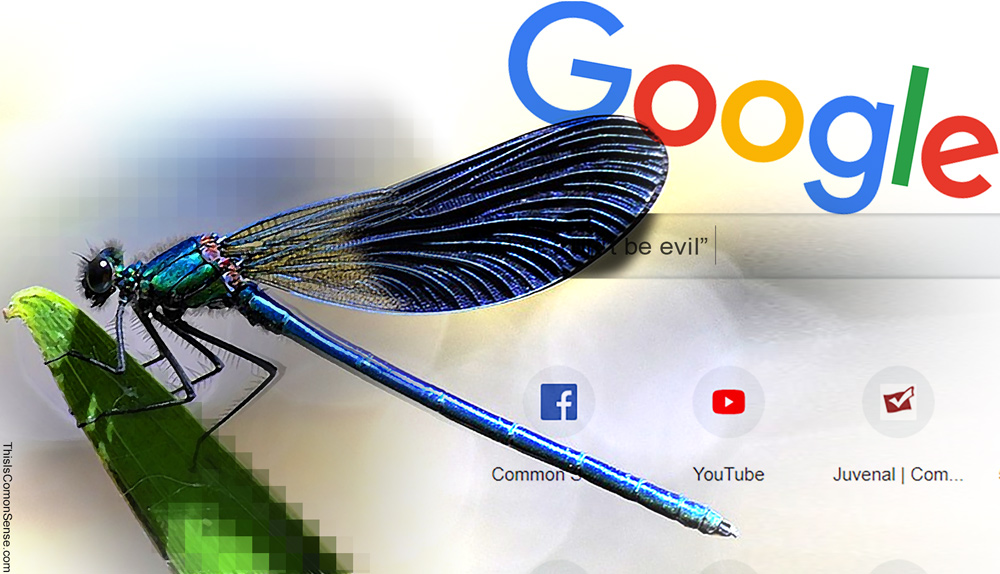
Google is working on a mobile version of its search engine, code-​named Dragonfly, which would censor search results the way the Chinese government wants. The company is doing so even though it shut down its Chinese-​mainland search engine back in 2010 because it “could no longer continue censoring our results” in China. At the time, I praised Google for moving in the right direction.

Now it’s regressing.

And more than regressing. The Intercept reports that Dragonfly goes beyond censorship. How? By linking a user’s search results to his phone number. Critics note that this would abet human rights violations, since users could easily be detained and even jailed for searching for the “wrong” terms.

At least five Google employees have resigned in protest. One, Jack Poulson, a research scientist, says that he regards “our intent to capitulate to censorship and surveillance demands in exchange for access to the Chinese market as a forfeiture of our values and governmental negotiating position across the globe.”

Google no longer promotes what used to be its motto and guide: “Don’t be evil.” 

To be sure, that motto did not put a very positive spin on the company’s moral stance. “Always be good” might be better. But I agree with both. 

Be good, not evil.

This is Common Sense. I’m Paul Jacob.


PDF for printing


Categories
Accountability general freedom moral hazard national politics & policies responsibility

The Online Manipulation of Democracy

There exist many sneaky ways to get other people to do what you want, voluntarily — effectively blurring the line between legitimate persuasion and fraud.

When large, almost unavoidable private companies apply those techniques to targeted groups of voters, that blur might look something very much like election fraud.

Harvard psychologist Dr. Robert Epstein has been studying hidden online persuasion techniques. Interviewed by Tom Woods last Friday, the doctor explained several sub rosa persuasion techniques, especially the fascinating Search Engine Manipulation Effect (SEME), which he says has been replicated in studies by other researchers. 

SEME, he argues, is a “genuinely new” way to manipulate masses of people — without them realizing it.

And it sports “one of the largest effects ever to be discovered in the behavioral sciences.” Google, it turns out, can influence voter and consumer behavior merely by ordering search results in specific ways. Going into his first study, he suspected he might discover a 2 percent influence on voter behavior. He got 48 percent, instead.

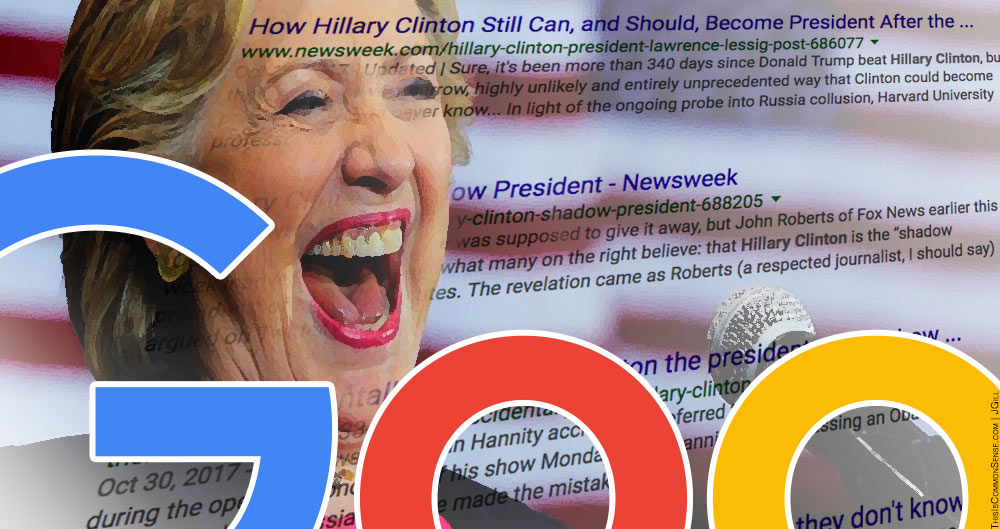
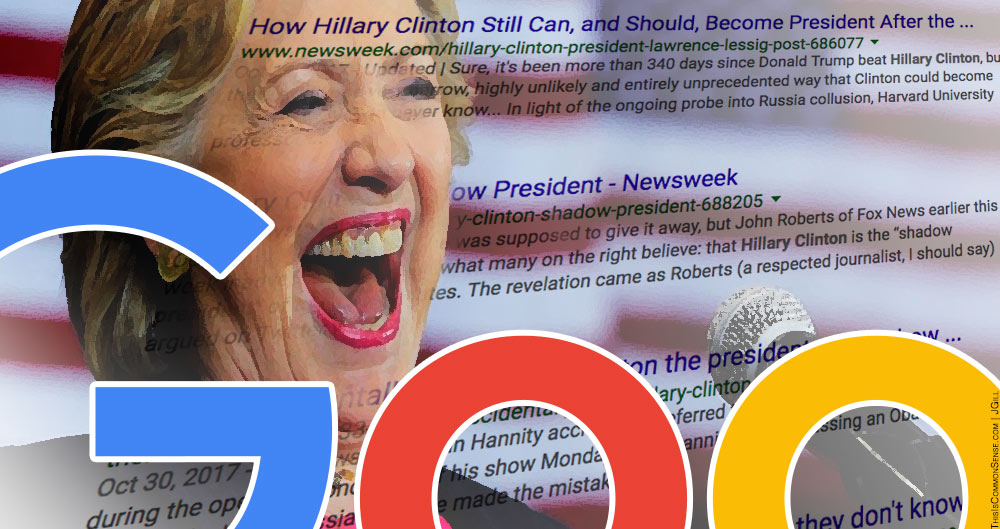
There is more: not only can Google do this, the behemoth does do this — Epstein has documented that Google did it in the last election. 

Supporting, or to the benefit of, Hillary Clinton.

Understandably, Epstein scoffs at the “fake news” panic as something insubstantial in comparison. The potential impact of this online manipulation dwarfs the allegations of Russian influence. 

I wonder: Did Mrs. Clinton know that her very special high-​tech friends were pressing their very big thumbs onto the scale of democracy?

It seems a very old tech — the Electoral College — effectively counteracted the manipulation.

This time.

This is Common Sense. I’m Paul Jacob.


PDF for printing

Categories
Accountability crime and punishment First Amendment rights general freedom media and media people moral hazard nannyism national politics & policies property rights responsibility too much government

Google: Disagreement

Once upon a time, Google penned a stern note to self: “Don’t be evil.”

What you regard as avoiding evil, though, depends on what you regard as doing good. 

Does Google think it’s “good” to fire someone for offering reasoned objections to vapid pieties about why there are more men than women working as programmers, and about how to fix the problem? Assuming it is a problem.

If the answer is yes, then it’s up to more reasonable people to say, “No, Google, stomping on candid internal discussion of your (bad) politics and policies is not ‘doing good.’” 

Alas, some Google critics push for a “remedy” worse than the problem: government force. They want government to impose new prohibitions and mandates on large private firms that help people to spread their opinions.

I don’t necessarily agree when a firm — Google, Twitter, PayPal or anybody else — stops providing services to persons expressing views that managers and HR departments disdain. Yet I may agree. No one is morally obligated — and no one should be legally compelled — to help spread the views of others. 

I certainly refuse to distribute any installment of “Common Sense” guest-​authored by The Anti-​Paul-​Jacob Club.

When market actors make bad decisions without violating anyone’s rights, others have many powerful and peaceful means of opposing those decisions. Criticism. Boycott. Competition. 

But we shouldn’t seek to outlaw the decision-making. 

The right to freedom includes no guarantee that one will always do the right thing as others see it.

This is Common Sense. I’m Paul Jacob.


PDF for printing


Categories
Accountability crime and punishment folly ideological culture moral hazard national politics & policies responsibility

Excepting Responsibility

Responsibility: demand it of others, expect it demanded of you.

So you might think that those who try to redress old grievances with compensatory (“reverse”) discrimination would be a bit more careful. 

Yesterday I wrote about the bizarre Google Memo case, wherein an employee was fired for (basically) warning of a groupthink ideological monoculture at Google … thus proving him right.*

Last weekend I wrote about racial quotas in college entrance. 

In both cases, there’s this idea that moderns in general and white males in particular must “accept responsibility” for the past.

And the evidence is undeniable: Our pale-​faced ancestors — or more likely a very small percentage of other white people’s ancestors — held human beings in bondage. So, too, did almost all peoples around the world; slavery’s old. Here in these United States, after our bloodiest war, our forebears ended that ancient crime. Then there was another century of Jim Crow discrimination, with systemic violence committed against blacks in many areas of the country, often with government acquiescence or involvement.

Harvard and other educational institutions are trying to right those wrongs. 

But there’s a problem: the principle behind their affirmative action schemes is lunatic: Each person of one race bears responsibility for the crimes committed by any person of that same race.

Far better is individual responsibility. Individuals have every right to compensation for any harm another has caused them, certainly. But folks have no right to create new harms against innocent people who happen merely to be of the same race or gender as those who have caused them past harm.

Justice is supposed to be blind, not crazy.

This is Common Sense. I’m Paul Jacob.


* The author, it is worth noting, addressed this monoculture in his title, “Google’s Ideological Echo Chamber.” wonder if being proven right by one’s enemies compensates for job loss.


PDF for printing