Categories
First Amendment rights general freedom ideological culture

The King’s Airball

“The thing is, LeBron, we’ve come to expect more of you,” writes Dan Wolken in USA Today, taking the National Basketball Association star to task for his comments taking Houston Rockets executive Daryl Morey to task for having tweeted “Fight for freedom, stand with Hong Kong.”

Morey’s pro-protester statement had caused a backlash against the NBA from the totalitarian Chinese government, threatening the league’s — and LeBron’s — continued access to China’s large and lucrative market of basketball fans.

LeBron James told reporters that Morey was “misinformed, not really educated” about the Hong Kong situation, before adding, witlessly, “I have no idea but that’s just my belief.”

“Yes, we all do have freedom of speech,” acknowledged James, “but at times there are ramifications for the negative that can happen, when you’re not thinking of others and you’re only thinking about yourself.”

Ramifications for whom? The people of Hong Kong yearning for freedom and democracy? Or was Mr. James . . . only thinking about himself?

Criticism came fast and furious. “@KingJames — you’re parroting communist propaganda. China is running torture camps and you know it,” tweeted Nebraska Senator Ben Sasse. 

“Let me clear up the confusion,” responded the King of Basketball, if not public relations. “I do not believe there was any consideration for the consequences and ramifications of the tweet.  I’m not discussing the substance.”

And then LeBron further clarified, “My team and this league just went through a difficult week. I think people need to understand what a tweet or statement can do to others. . . . Could have waited a week to send it.”

Hong Kong protesters are now burning LeBron’s No. 23 jersey. 

Apparently, their freedom can’t wait a week.

This is Common Sense. I’m Paul Jacob.


PDF for printing

LeBron James, Hong Kong, China, freedom, free speech,

See all recent commentary
(simplified and organized)
See recent popular posts

Categories
government transparency

Transparent on Twitter?

I find Twitter distasteful, annoying, even stupid. I sometimes wonder why I should care about that particular “micro-blogging” platform.

But since it is a big deal to others, I struggle to understand.*

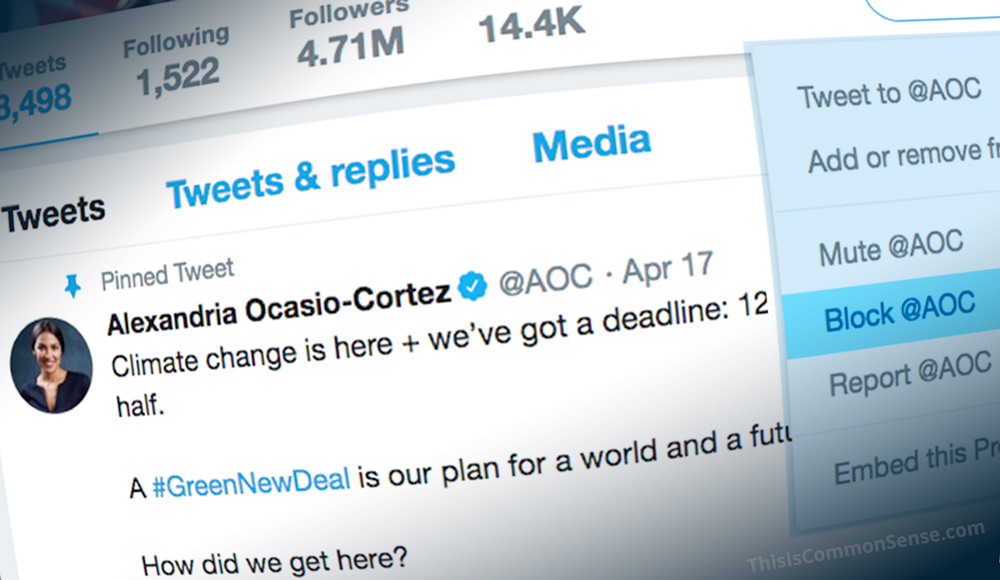
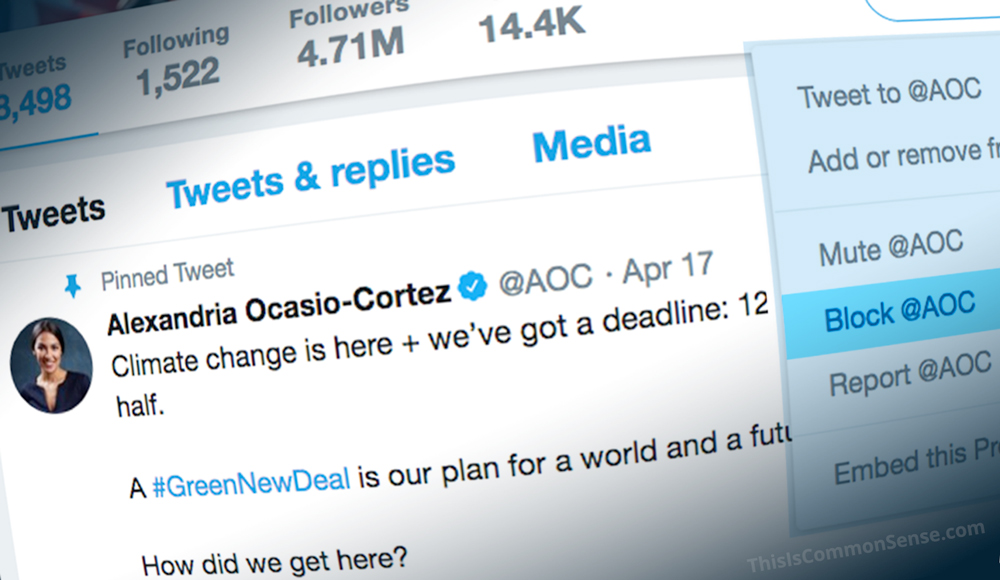
Joining me in the struggle are our two most famous political Twitterers, President Donald Trump and Representative Alexandria Ocasio-Cortez (D-N.Y.).

The president lost in court the other day, with the 2nd Circuit Court of Appeals telling him he must no longer block users on the social media platform.

Now AOC finds herself in a similar pickle. On Tuesday, a former Democratic New York Assemblyman filed a lawsuit in federal court against the popular freshman U.S. Representative for doing the same thing Trump had been doing: blocking users on Twitter based on their personal viewpoints.

The litigant surmises that AOC had blocked him “apparently because my critique of her tweets and policies have been too stinging.”

Ouch?

“Twitter is a public space,” insists this Democrat, Dov Hikind, “and all should have access to the government officials on it.”

This puts me in a pickle, too. I am all for government transparency — and I do think officials and representatives should not be completely insulated from the citizens they serve. But we don’t have a right to follow them into their bedrooms or bathrooms.

So, high-profile federal employees who in any way discuss public matters on social media should not be allowed to block Americans from seeing their posts. But take pity on the poor pols: they should be able to mute users, that is, keep others from cluttering up their social media experience.

Oddly, the lawsuit does not address this muting option.

This is Common Sense. I’m Paul Jacob.


* I even use it, occasionally.

PDF for printing

AOC, Trump, twitter, block, blocking, free speech,

See all recent commentary
(simplified and organized)
See recent popular posts

Categories
First Amendment rights general freedom local leaders

Deep Show-Me State

Worried about the Deep State undermining democracy in Washington? What about the Deep State in Missouri?

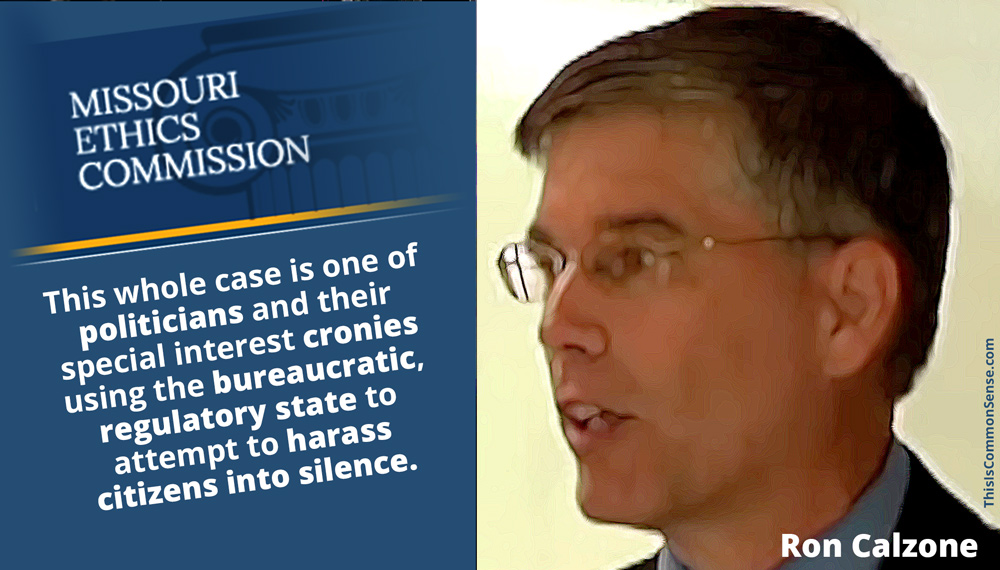
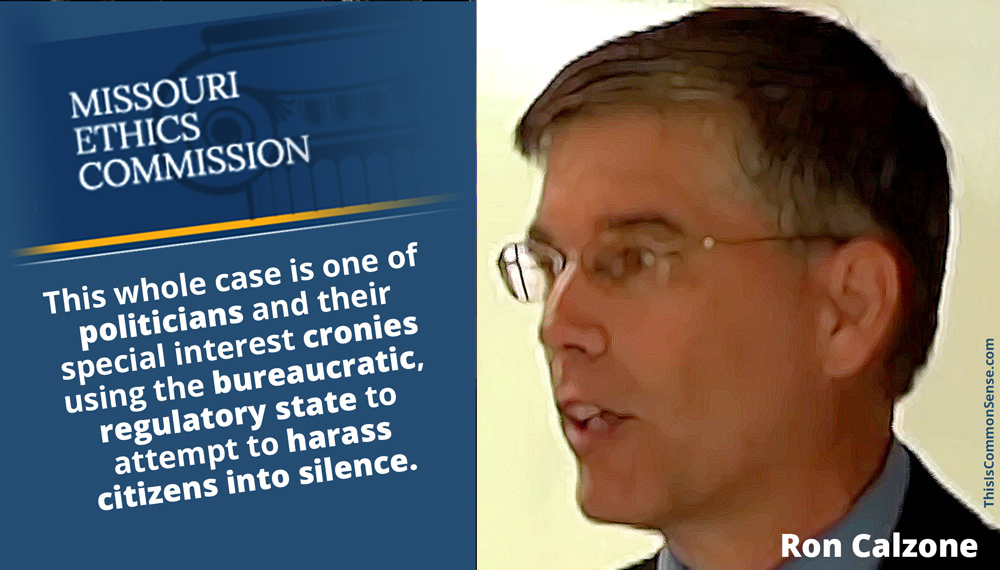
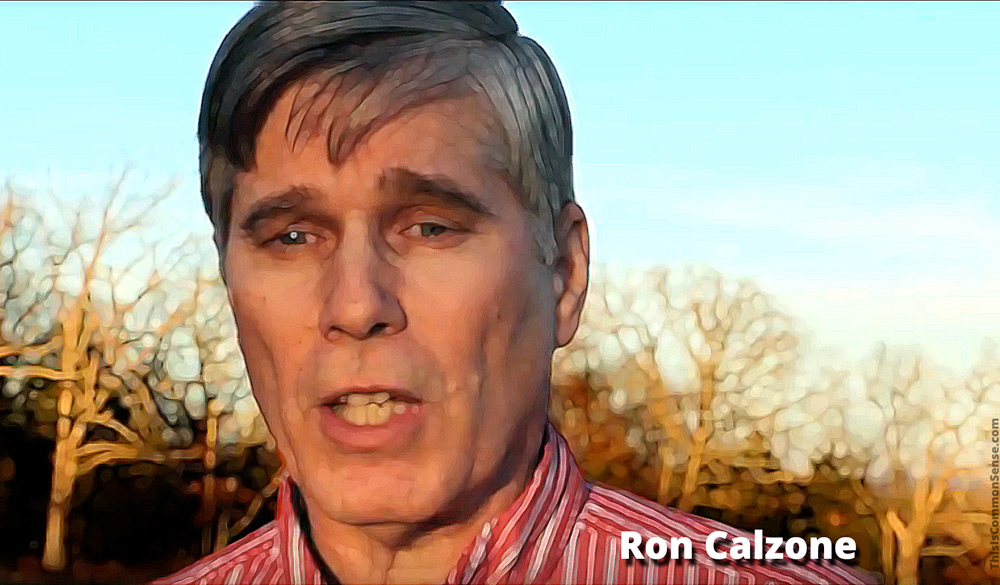
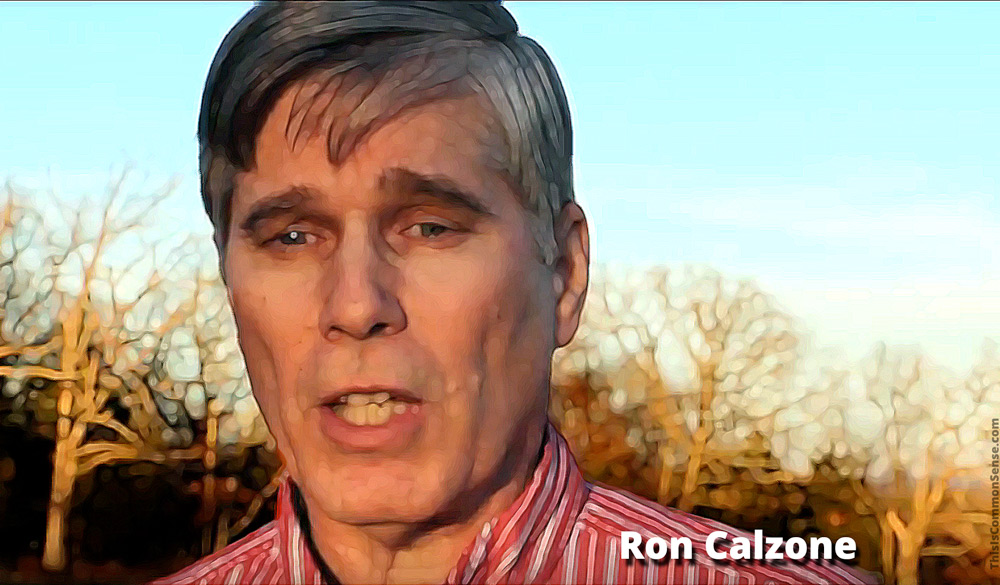
Today, Ron Calzone will sit in a St. Louis courtroom with his wife, Anne, intently listening to arguments in his case, Calzone v. Missouri Ethics Commission, before the entire Eighth Circuit Court of Appeals. 

In what sort of evil corruption has Mr. Calzone been engaged? 

Good citizenship. 

Talk about an open-and-shut case! For zero pay, Calzone and others — organized through Missouri First — track legislation and communicate their viewpoints to their state representatives, urging legislators to follow a constitutional, limited government philosophy. The group gives no gifts to legislators, only their opinions, and spends no money. Doesn’t even have a bank account.

This is the sort of wholesome citizen participation envisioned in civics textbooks. But politicians see engaged citizens, like Ron, as pests, infesting their capitols. 

In 2014, angered by the grassroots input Calzone had generated, two state legislators convinced the Missouri Society of Governmental Consultants (the state’s “lobbyist guild”) to file an ethics complaint against Ron, demanding he register as a lobbyist. At the measly cost of $10 a year.

Calzone can afford the Hamilton, but refused, on principle, to pay it or to register as a lobbyist. Thankfully, great lawyers at the Freedom Center of Missouri and the Institute for Free Speech have come to his defense.

Laws regulating lobbyists have been enacted to check the influence of rich, powerful special interests. Or so the powerful interests tell us.

Instead, politicians and bureaucrats are twisting the law, trying to block grassroots citizens.

It is time to deep six Deep States.

This is Common Sense. I’m Paul Jacob.


PDF for printing

Ron Calzone, Missouri, free speech, lobbying, 1st Amendment,

See all recent commentary
(simplified and organized)
See recent popular posts


Categories
insider corruption tax policy

There You Go Again, IRS

The old keywords were “Constitution,” “Patriot” and “Tea Party.”

The new ones? “Marijuana,” “oxycodone,” and “legalization.”

Paul Caron, the TaxProf blogger, calls attention to another IRS scandal — again about denying tax-exempt status to organizations because of their political views. He had barely finished blogging about the scandal that came to light in 2013 when a new one burst into view.

You almost certainly remember the older scandal, in which the Internal Revenue Service had been caught intrusively scrutinizing and delaying the applications of conservative non-profits picked on because of their conservatism.

To cover that mess, Professor Caron published a blog series called “The IRS Scandal, Day __.” He added a post daily.

Every day.

For years.

The last installment, Day 1921, published on August 14, 2018, reported a settlement: meager taxpayer-funded payouts to over a hundred victimized organizations. The IRS never admitted wrongdoing. No one was ever punished. According to the Washington Times, the agency said that it had “made changes so that political targeting can’t occur in the future.”

These changes don’t seem to include prohibiting political targeting by the IRS, however.

Now we have another case.

Caron points us to a Wall Street Journal op-ed by David Rivkin and Randal Meyer, lawyers, who have discovered a dirty little secret in Revenue Procedure 2018-5. One provision authorizes IRS to withhold tax-exempt status from applicants seeking to improve “business conditions . . . relating to an activity involving controlled substances,” including marijuana and oxycodone. Advocating legalization of marijuana would count as trying to improve such conditions.

Apparently, the IRS thinks its mandate entails enforcing the status quo by stifling dissent — instead of just doing its congressionally mandated (if all-in-all irksome) job.

This is Common Sense. I’m Paul Jacob.


PDF for printing


» See popular posts from Common Sense with Paul Jacob HERE.


Categories
general freedom term limits

The Bonesaw Massacre

Last week, the Washington Post published journalist Jamal Khashoggi’s final column. Khashoggi was apparently murdered by dismemberment at the Saudi consulate in Istanbul, Turkey, earlier this month.

“The Arab world is facing its own version of an Iron Curtain,” Khashoggi wrote, “imposed not by external actors but through domestic forces vying for power.”

Decrying that “Arab governments . . . continue silencing the media at an increasing rate,” he called for the U.S. to “[play] an important role in fostering and sustaining the hope of freedom,” advocating the equivalent of a Radio Free Europe to reach nearly 400 million Arabs.

The Saudi dissident highlighted Freedom House’s 2018 report “Freedom in the World,” noting that “only one country in the Arab world . . . has been classified as ‘free.’ That nation is Tunisia. Jordan, Morocco and Kuwait come second, with a classification of ‘partly free.’ The rest of the countries in the Arab world are classified as ‘not free.’”

Perusing that report’s coverage of the Americas, I noticed a section on “Gains and declines show value of electoral turnover.”

“Under new president Lenín Moreno, Ecuador turned away from the personalized and often repressive rule of his predecessor, Rafael Correa,” the report states. “Moreno has eased pressure on the media, promoted greater engagement with civil society, proposed the restoration of term limits, and supported anticorruption efforts . . .”

In Bolivia, sadly, “the constitutional court . . . struck down term limits that would have prevented incumbent leader Evo Morales from seeking reelection. Voters had rejected the lifting of term limits in a 2016 referendum, and international observers called the court’s reasoning a distortion of human rights law.”

Rotation in office — you know, like provided by term limits — appears strongly linked to freedom.

The lack of which having proved tragic for Jamal Khashoggi.

This is Common Sense. I’m Paul Jacob.


PDF for printing


Categories
First Amendment rights ideological culture media and media people Regulating Protest

James Woods, Parody, and a Pillow

The beginning of the end of actor James Woods’s time on Twitter likely occurred on July 20, 2018.

Only recently discovering a tweet that he posted then, Twitter has locked Woods out of a forum where his right-leaning messages have been followed by 1,730,000 people.

His delinquent tweet forwarded an image of giddily grinning guys promising to abstain from voting so that a woman’s vote would be “worth more.” Woods tweeted: “Pretty scary that there is a distinct possibility this could be real. Not likely, but in this day and age of absolute liberal insanity, it is at least possible.”

Twitter told the actor that if he agreed to the deletion of this fake-news tweet — simple enough — it would let him tweet once again.

Woods refuses.

“Free speech is free speech — it’s not [Twitter CEO] Jack Dorsey’s version of free speech,” Woods says. “The irony is, Twitter accused me of affecting the political process, when in fact their banning of me is the truly egregious interference. . . . If you want to kill my free speech, man up and slit my throat with a knife, don’t smother me with a pillow.”

There’s lots more where that came from, but you get the idea. I don’t, um, strictly agree with everything Woods says here. But I can only applaud the spirit of his refusal to submit to Twitter’s arbitrary standards of acceptable speech.

Oh, and one other thing: somebody tell Twitter that parodies are inherently fake.

This is Common Sense. I’m Paul Jacob.


PDF for printing


Categories
First Amendment rights general freedom ideological culture media and media people moral hazard privacy

Google Goes Bad

Good Google’s evil twin, Bad Google, is at it again.

In addition to doing bad things to advance its political agenda, Google is willing to work with bad governments do bad things. 

For example, the authoritarian Chinese government.

Google is working on a mobile version of its search engine, code-named Dragonfly, which would censor search results the way the Chinese government wants. The company is doing so even though it shut down its Chinese-mainland search engine back in 2010 because it “could no longer continue censoring our results” in China. At the time, I praised Google for moving in the right direction.

Now it’s regressing.

And more than regressing. The Intercept reports that Dragonfly goes beyond censorship. How? By linking a user’s search results to his phone number. Critics note that this would abet human rights violations, since users could easily be detained and even jailed for searching for the “wrong” terms.

At least five Google employees have resigned in protest. One, Jack Poulson, a research scientist, says that he regards “our intent to capitulate to censorship and surveillance demands in exchange for access to the Chinese market as a forfeiture of our values and governmental negotiating position across the globe.”

Google no longer promotes what used to be its motto and guide: “Don’t be evil.” 

To be sure, that motto did not put a very positive spin on the company’s moral stance. “Always be good” might be better. But I agree with both. 

Be good, not evil.

This is Common Sense. I’m Paul Jacob.


PDF for printing


Categories
First Amendment rights

Fake News; Real Assault

I don’t defend the way Twitter, Facebook, and others target users for expressing views that these firms dislike. I do defend the individual rights of all persons, including owners of companies. Our freedom to act includes the freedom to act in ways others consider to be wrong — if we do so while respecting the (actual) rights of others.

But something is extra-disturbing about the way Facebook, Google, Apple, Spotify, etc. (though not Twitter) ejected Alex Jones from their platforms. The firms apparently obeyed journalists and politicians demanding InfoWar’s ouster for purveying “hate speech.”

And now: “These companies must do more than take down one website,” intones incumbent U.S. Senator Chris Murphy.*

Such statements aren’t laws. But every company must worry about the arbitrary government power that incumbents like Murphy can deploy. And fellow U.S. Senator Mark Warner’s leaked paper on the dangers of technology-abetted fake news tells us we’re in for a more direct assault on free speech.

“The size and reach of these platforms demand that we ensure proper oversight, transparency and effective management of technologies that in large measure undergird our social lives . . . and our politics,” says the plan. The goal is to “ensure that this ecosystem no longer exists as the ‘Wild West’,” i.e., unfettered by government.

So . . . the idea is to rescind that wild First Amendment? 

I would sooner press for a new law penalizing politicians who threaten the liberty of firms on the basis of catering to the “wrong” customers.

But there is no crying need for this. Let’s stick with “Congress shall make no law . . .”

This is Common Sense. I’m Paul Jacob.


* These companies did not take down a website, by the way. Alex Jones’s InfoWars.com appears to be going gangbusters. Those companies ousted InfoWars from their Web services. This is a distinction with a difference.

PDF for printing


Categories
First Amendment rights general freedom ideological culture media and media people moral hazard

May Trigger Eye Rolling

The fashionable campus notion of “microaggressions” blurs the distinction between peaceful speech (offensive or not) and bashing somebody over the head with a club. 

If courts, police and/or university officials can rationalize regarding the perpetrator of a so-called “microaggression” as initiating force against an offended listener, they can also rationalize using actual physical force in retaliation. Which, to the extent implemented, would mean the end of freedom of speech. 

After all, nobody needs a First Amendment in order to utter banal pronouncements about the weather.

The allied campaign urging or requiring professors to issue “trigger warnings” before discussing anything that might provoke discomfort also dampens discourse. 

Who can object to letting viewers of TV news know that they are about to see a corpse? Or sending little kids out of the room when certain subjects are discussed? But is such common sense the point of “trigger warnings”?

At best, “trigger warnings” are a silly name for referring to what nobody seeks to keep secret. At worst, they help trigger distress themselves — or impede frank discussion of controversial subjects. The latter treats adults as if they were not adults; the former makes adults less adult. 

If and when “trigger warnings” are imposed by force, with penalties for omitting them, they also endanger freedom of speech.

Advocates of open discourse seem to be in an endless war with champions of a repressive political correctitude. The jabberwocky used to justify that repression keep evolving. The response must be constant: intellectual clarity and eternal vigilance.

This is Common Sense. I’m Paul Jacob.


PDF for printing


Categories
crime and punishment First Amendment rights general freedom Second Amendment rights too much government U.S. Constitution

Progressive Designs

In February 1979, Professor George Rathjens called the editors of The Progressive, urging them not to publish a story in the works, which included a journalistic best guess as to the design of a hydrogen bomb. The Progressive refused to squelch the story, and the professor of poli-sci (not nuclear physics) contacted the Department of Energy, which sued to suppress the article.

The Progressive defended itself on free speech grounds.

Fast forward to today, with progressives screaming to squelch the freedom of speech and press of Defense Distributed, an Austin, Texas, organization, which expressed its intention to publish easily downloadable plans* to print plastic guns using 3D printing technology.

This hit the news first as the result of a court decision early in the month,** but now Senator Edward Markey (D-Mass.) blames the Trump administration, not the court. “Donald Trump will be totally responsible for every downloadable, plastic AR-15 (gun) that will be roaming the streets of our country.”

Why blame the administration? Because the administration settled its lawsuit holding up the publication.

Amusingly, back in 1979, the government dropped its suit against The Progressive.

Progressives were definitely not for nuclear bombs 40 years ago, and The Progressive had its own agenda in publishing a version of the article that saw print in the magazine’s November 1979 issue. Now progressives express more alarm about private individuals having weapons, not about the government’s weaponry. 

But the biggest change? It has something to do with free speech.

This is Common Sense. I’m Paul Jacob.


* I say “easily downloadable” because plans like this have been available on the not-exactly-easy-to-access Dark Web for some time.

** The decision is clear: “Arguments for tighter restrictions on firearms are, in this case, directly opposed to arguments for the unfettered exchange of information on the internet.”

PDF for printing