Categories
Accountability First Amendment rights folly general freedom ideological culture media and media people moral hazard nannyism national politics & policies Regulating Protest too much government U.S. Constitution

Freedom “Weaponized”

Justice Elena Kagan has a way with words. The conservative majority on the court, she said after two recent rulings, is “weaponizing the First Amendment.”

What a phrase! But what does it mean?

“Conservative groups, borrowing and building on arguments developed by liberals,” explains The New York Times, “have used the First Amendment to justify unlimited campaign spending, discrimination against gay couples and attacks on the regulation of tobacco, pharmaceuticals and guns.”

First: if “liberals” now find themselves not supporting the idea of particular freedoms, or freedom in general, are they really “liberal”?

Second: “borrowing arguments” is what we expect to happen. Logic isn’t partisan.

Third: the point of the Bill of Rights is to “weaponize” the defense of freedom.

Remember, it is freedom of speech; freedom of the press; freedom of association; freedom of exercising one’s religion. The First Amendment weaponizes their defense by disallowing Congress from legislating against them.

Now, it has long been a “problem” that these listed freedoms blend together. They all work together or don’t work at all. And each points to freedom more broadly.

Kagan wants to read freedoms narrowly — though liberals historically have, indeed, read them broadly.

She’s objecting to two recent rulings. The first prohibits states from requiring pregnancy centers to talk up abortion options to their clients. An obvious free speech issue. The second prohibits governments from backing unions in their extraction of “agency fees” from non-members. An incontrovertible issue of freedom of association.

Kagan and The New York Times apparently think that “liberalism” means defending some freedoms in some contexts, but denying freedom in others.

This is Common Sense. I’m Paul Jacob.



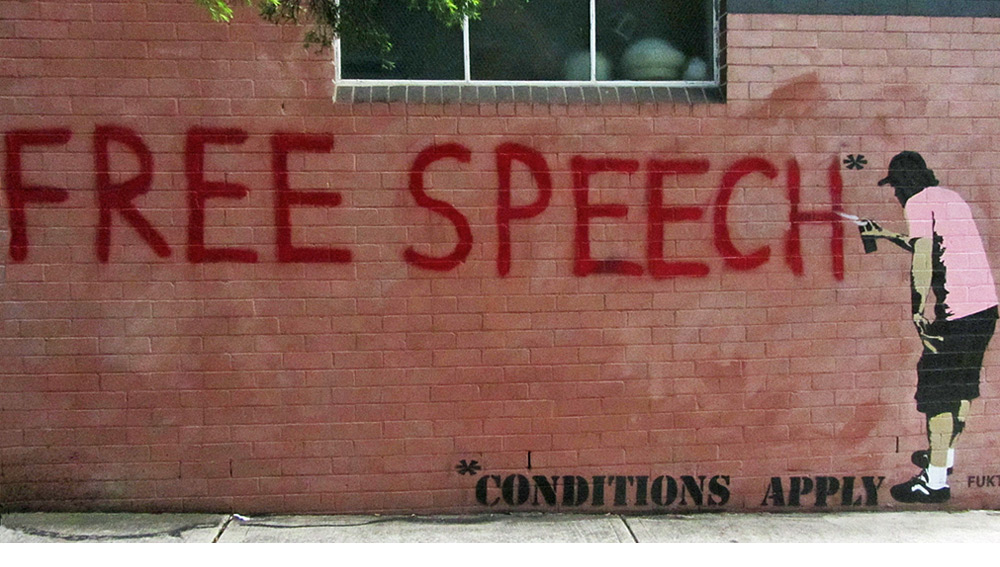
Illustration by Newtown grafitti


Categories
Accountability crime and punishment First Amendment rights general freedom ideological culture national politics & policies political challengers Regulating Protest

Assaults Not Allowed

Have Americans forgotten that freedom makes getting along easier?

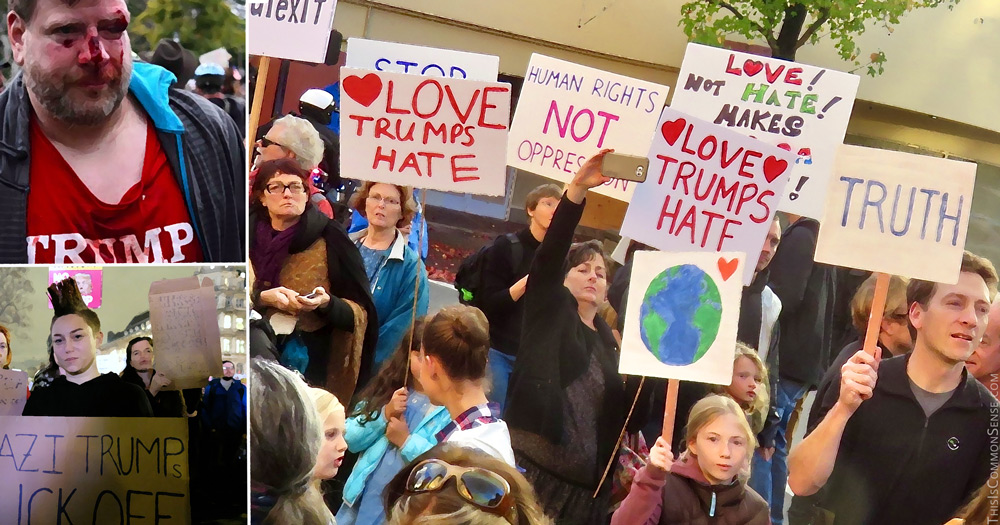
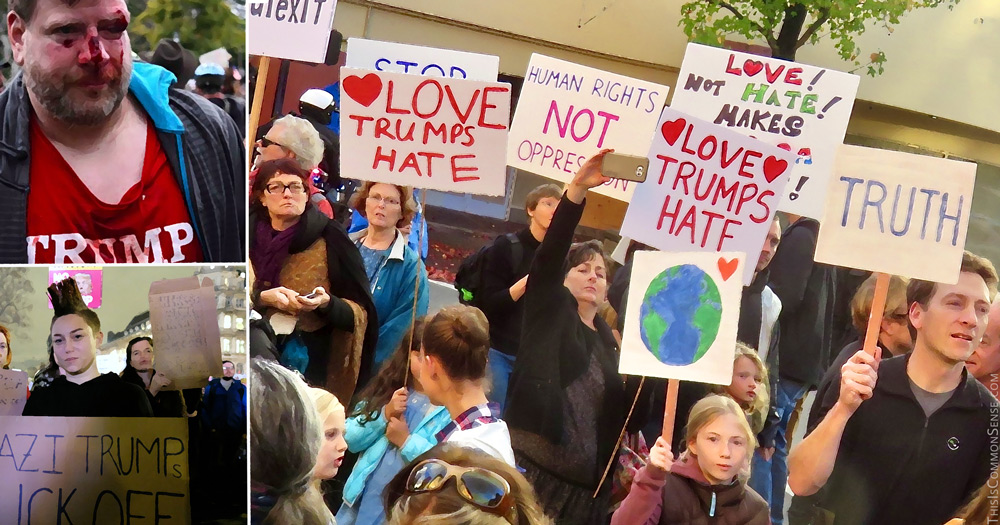
We do not all have to like each other. We do not even all have to be nice to each other. We just don’t have license to hit or hornswoggle our fellows. Hate speech may be bad, but it is hate assaults — not talk — that should be punished by law.

Yes, free people are at liberty to insult each other, call each other nasty names, even demean each other. And those insulted, besmirched, and dissed may return in kind or shrug the negatives off.

But we needn’t let it go at that.

Bill Ottman, founder and CEO of Minds.com, reminds us that there is more than one way to skin a hate. When coming across vile nonsense and worse, “the most important question is how we deal with these situations,” he writes.

We may be able to find the answer in the work of Daryl Davis, a famous blues musician with a hobby of  befriending members of the Ku Klux Klan. According to him: “Once the friendship blossoms, the klansmen realize that their hate may be misguided.” By having dinner with Klansmen, he has inspired over 200 members to give up their robes.

Ottman goes on to call for a concerted effort to reclaim a future for “internet freedom and human rights.” That’s a good idea.

Don’t accept the premise that, to get along, we must squelch speech. Instead, ignore disagreeable people trying to make us feel bad.

And look for ways to persuade those who hate us.

We can be adults about this. And keep freedom of speech.

This is Common Sense. I’m Paul Jacob.


PDF for printing


Categories
Accountability First Amendment rights ideological culture media and media people moral hazard U.S. Constitution

Exit Strategy Advised

The First Amendment applies only against governments, but our free speech rights can be violated by nearly anyone.

These days, these rights are most notoriously and routinely violated by mobs of students . . . attending colleges and universities nearly all of which depend upon taxpayer subsidies.

David E. Bernstein, writing at the Volokh Conspiracy, in “USC Law Professor: Supporters of Campus Free Speech are ‘Preying on Vulnerable Teenagers,’” makes a number of points regarding a law professor’s published defense of nasty student reactions to a Federalist Society speaker . . . on a campus not his own.

Bernstein notes that “the article has to have the requisite references to the Emmanuel Goldsteins of the modern left, the Koch Brothers, who are mentioned four times for no discernable reason.” The reason, of course, is demonization. For a movement needs enemies.

The USC law professor argues that journalists should ignore campus speaking events that “goad” students into “tactical mistakes” by the “mean-spirited provocations” of “seasoned political operatives preying on vulnerable teenagers and inexperienced young adults.”* Bernstein shows that the “tactical mistakes” amount to peaceful and intellectual speakers being “harrassed, shouted down, and subject to or threatened with violence”; every reasonable person knows that disagreeing with the ideas someone communicates does not excuse violating that someone’s rights.

No matter how “provocative.”

Most chillingly, the speaker who incited student ire and accusations, etc., had been advised by “a security guard” before his “talk” to devise “an ‘exit strategy.’” This indicates that the American taxpayer needs an exit strategy from subsidizing anti-democratic mob activism.

And its professorial enablers.

This is Common Sense. I’m Paul Jacob.


* Don’t you find this language awfully coddling of people who should be treated as responsible for their actions, and who, by their attendance at an institution of higher learning, should be capable of listening to any point of view? I find it maddening.


PDF for printing


Categories
Accountability crime and punishment education and schooling First Amendment rights general freedom ideological culture moral hazard Regulating Protest

The Shallow State

Amidst all the talk of The Deep State, we are in danger of losing track of a parallel problem: the Shallow State — which, despite lack of depth, is very wide.

I am referring to government employees who increasingly abandon any pretense of impartiality. And the public institutions that protect them.  

Consider the case of the University of Illinois at Urbana-Champaign and its 39-year-old lecturer Tariq Khan, who is a member of an Antifa-affiliated group called the Black Rose Anarchist Federation. Mr. Khan had been angrily shouting and chanting at a campus anti-Trump rally when he was mildly challenged by a non-nut student journalist. Khan went on a rampage, screamed at and pushed the young journalist, and deliberately broke the smartphone of a fellow journalist who had been recording the fracas.

Khan was charged with destruction of property. But the story doesn’t stop there.

“I was told that if I wanted the ‘situation to improve,’” wrote a third journalist, “that I should stop writing about Khan.”

The university placed a restraining order on the three, to squelch news and dissent.

So the trio sued on First Amendment grounds.

Here we have a teacher willing to abridge free speech the old-fashioned way, by playing the bully. And a public institution ready and willing to defend him, to take his petty criminality and raise it to a conspiratorial, Big Brother level.

Not only does this rob Americans of rights, taxpayers are being forced to fund what they might justifiably regard as the destruction of the republican form of governance.

Root out the infamous Deep State?

Sure.

But limit and make transparent the Shallow State, too.

This is Common Sense. I’m Paul Jacob.

PDF for printing


Categories
education and schooling First Amendment rights folly ideological culture media and media people moral hazard national politics & policies

The Critique of Pure Intolerance

If you are older than 50, you probably remember when “liberal” meant free speech advocacy to the point of absolutism. “I may disagree with what you say,” stalwart liberals pledged back in the Sixties, “but I’ll defend to the death your right to say it.”

Nowadays, if you are under 30 and have gone to college, you may not even have encountered this saw.

Which has consequences.

Nine student groups protested, last week, the Federalist Society’s invitation of writer Christina Hoff Sommers to speak at Lewis & Clark Law School. The groups called it an “act of aggression and violence” and smeared the philosopher and Democrat as “a known fascist.”

Bari Weiss, writing in The New York Times, calls this “the moral flattening of the earth,” the “main effect is that these endless accusations of ‘fascism’ or ‘misogyny’ or ‘alt-right’ dull the effects of the words themselves. As they are stripped of meaning, they strip us of our sharpness — of our ability to react forcefully to real fascists and misogynists or members of the alt-right.”

While this “flattening” does prevent the flatteners (bullies) from even seeing any gradations of threat or error, let’s not pretend to be surprised. Their techniques do not merely echo, but replicate exactly, neo-Marxist postmodernist philosopher Herbert Marcuse’s proposal, in “Repressive Tolerance,”* to censor writing and speech “from the right.”

Ideas have consequences. Just as Marxian socialism led to Lenin, Stalin and Mao, these tyrants led to Marcuse, whose thinking set much of today’s Academia into full tyranny mode.

It’s time for liberals “on the left” to repudiate explicitly the methods of tyrants . . . to their left.

This is Common Sense. I’m Paul Jacob.
 

* See Herbert Marcuse and Robert Paul Woolf, A Critique of Pure Tolerance (1965). My college political theory professor, a proud communist, was a big fan of Marcuse.


PDF for printing


Categories
First Amendment rights general freedom media and media people moral hazard nannyism national politics & policies too much government

Why They Hate the First Amendment

Does banning Facebook in the weeks leading up to an election sound like freedom?

“The corrosive effect of social media on democratic life,” writes The New Republic’s Jeet Heer, “has led both French President Emmanuel Macron and Canadian Prime Minister Justin Trudeau to make the same threat to Facebook: self-regulate or be regulated.”

But Macron doesn’t go far enough. “If fake news truly poses a crisis for democracy, then it calls for a radical response,” Heer insists.

“Many countries have election silence laws, which limit or prohibit political campaigning for varying periods of time ranging from election day alone to as early as three days before the election.” And Heer sees little reason not to apply such regulations to social media.

“What if you weren’t allowed to post anything political on Facebook in the two weeks before an election?”

This exactly parallels the prohibition of political spending “by corporations” before an election, as in the McCain-Feingold campaign finance regulation. Except here we have it directly affecting normal citizens.

The current excuse, “fake news,” appears to be defined by partisans almost entirely as the errors and lies and spin of their opponents’ side(s).

But since lying about one’s political enemies is at least as old as the Election of 1800, why is this different now?

Because, I submit, Facebook is just another area the folks pushing such obvious breaches of the First Amendment — politicians and most of the media — do not yet control.

Competition mustn’t be tolerated.  

This is Common Sense. I’m Paul Jacob.

PDF for printing


Photo credit: by John Nakamura Remy


Categories
Accountability crime and punishment First Amendment rights general freedom government transparency local leaders moral hazard Regulating Protest too much government U.S. Constitution

Lock Her Up

“Who Are We?” I asked Sunday at Townhall.com.

Today’s question: What have we come to?

Under a seemingly click-bait headline in The Atlantic, “Can Government Officials Have You Arrested for Speaking to Them?” Garrett Epps examines last week’s outrageous handcuffing and arrest of a Louisiana teacher, Deyshia Hargrave, for speech displeasing to the Vermilion Parish school board at a public meeting.

The elementary school teacher complained about a $30,000 raise the board was giving the superintendent, noting that teachers had not seen an increase in nearly a decade. After asserting that the raise would be “basically taken out of the pockets of teachers,” she was ruled out of order by the school board president and then asked to leave the premises. She calmly left the meeting room . . . only to be forced to the floor, handcuffed and arrested once in the hallway.

Police claimed the arrest was for “remaining after having been forbidden” and “resisting an officer.”

The school district announced it won’t press charges. Very funny. Anyone can see from the video that her treatment was excessive.

Next month, the U.S. Supreme Court will hear oral arguments in Lozman v. Riviera Beach, Florida, where an arrest was clearly retaliatory, but the city is newly claiming another violation it could have used to arrest Mr. Lozman.

Does this after-the-fact adding on of charges provide governments with an escape clause? As Epps argues, a Lozman decision “could either rein in, or embolden, the tiny-handed tyrants who rule county buildings and city halls around the country.”

If respectfully challenging our so-called public servants in meetings designed for that can lead to being arrested, handcuffed and dragged off, we no longer live in ‘the land of the free.’

This is Common Sense. I’m Paul Jacob.

PDF for printing


Categories
Accountability First Amendment rights folly media and media people moral hazard national politics & policies too much government U.S. Constitution

Our Royals Are Not Amused

“You created these platforms,” Sen. Dianne Feinstein (D-CA) informed the top legal minds at Facebook, Twitter, and Google, “and now they’re being misused.”

“And you have to be the ones who do something about it — or we will.”

Take that as a threat.

But also take it as the grand moment when the Establishment showed its hand.

Consider: Facebook, Twitter, and YouTube (a Google product) are “media platforms.” So are books, libraries, newspapers and newsstands. Imagine being a king right after Johannes Gutenberg invented the printing press. Very quickly, the world changed.

People thought differently. And they began demanding change from government. The sovereigns had to make room for subjects-turned-citizens.

Royalty and aristocracy did try to regulate the new platforms of information and opinion. Censorship was all-too-common. The rulers killed upstarts for writing the wrong things, saying the wrong things.

So, which side would you be on, Mrs. Feinstein?

That is Scott Shackford’s basic take on this. I’m with him.

I just wish to expand: in my lifetime the media platforms of newspapers and television were regulated. Heavily. Mergers and business purchases were subject to government permission; the electromagnetic spectrum was licensed rather than treated as private property, and the actual content of radio and TV shows were regulated by the FCC.

And the Feinsteins of Washington got awfully secure in their positions. Had the regulation of American media done its trick?

Enter new media, uncorking the bottle of opinion.

No wonder the Establishment is scared.

We shouldn’t let them regulate political content on the Internet. Demand, instead, the opposite: a complete repeal of the regulation of business management — and non-criminal content regulation — of all media platforms

This is Common Sense. I’m Paul Jacob.

PDF for printing


Categories
crime and punishment folly general freedom ideological culture media and media people national politics & policies

Shadow Boxing with “Nazis”

Voltaire’s prayer, “make my enemies ridiculous,” has been granted to Ben Shapiro.

The New York Times has graced its pages with the writings of one Jane Coaston, who, in “The Hollow Bravery of Ben Shapiro,” accuses the brilliant intellectual pugilist Mr. Shapiro for “shadow boxing meant to pander to his conservative fans.”

And while she admits the truth that “campuses tend to be hostile places to conservatives like Mr. Shapiro, Charles Murray and Heather Mac Donald,” she insists that “the notion that they are the cultural underdogs is bogus.”

Failing to back up her “cultural underdog” thesis in any way, Coaston’s essay wanders off, evading the street and campus violence by leftist activists who, until recently, were given de facto license by mayors and college administrators to shout down, beat up and “de-platform” people they called “fascists.”

By just glossing over all this, Ms. Coaston is pandering to her audience — certainly not challenging it, which is precisely what she accuses Mr. Shapiro of doing.

Amusingly, I noticed this journalist arguing earlier this year that “you should punch Nazis in the goddang face.”

But Antifa and other “Nazi-punchers” aren’t in the habit of sending out questionnaires before planting fist to face or bike lock to noggin.

Which brings us to the ridiculous. She minimizes the extent to which Ben Shapiro and others have been threatened (and their fans violently attacked) by mobs shouting against “fascism” and “Nazis.” And yet she provided not merely the intellectual ammunition for this practice, she provided the declaration of war.

Maybe she has a career in politics.

This is Common Sense. I’m Paul Jacob.

PDF for printing


Categories
folly general freedom ideological culture media and media people moral hazard nannyism national politics & policies Popular Regulating Protest U.S. Constitution

Force Over Persuasion

Today’s campus radicals assert that free speech is bad because it “gives voice” to people with hateful, dangerous views.

Does that argument seem at all familiar? It is the old RightThink rationale for censorship.

A recent Spiked “Unsafe Spaces” event at Rutgers (“Identity Politics: the New Racialism”) was interrupted by now-too-famiar shouts and out-of-turn questions and invective. Kmele Foster, one of the panelists, had been explaining how important free speech rights were to the civil rights protesters in the 1960s, and to Martin Luther King in particular.

At “that precise moment,” as Reason’s Matt Welch puts it, the shouts of “Black lives matter!” began. And continued.

But more interesting than this bullying? Some of the more coherent theses articulated by the interrupters. One woman, CampusReform relates,

yelled in response to the panelists that she doesn’t “need statistics,” later complaining that “the system” controls facts.

“It’s the system. It’s the institution,” she said. “Don’t tell me about facts. I don’t need no facts.”

Well, the moment you prove immune to any fact is the exact point in time that you’ve given up on rationality, free inquiry, and maybe even civilization itself.

It’s so 1984-ish.

And it demonstrates the old idea that, when you can no longer reason or allow others to express different opinions . . . or even discuss the factuality of this or that contention, you have only one other option: force.

Become bully.

Or tyrant.

Civilization is the triumph of persuasion over force. Being against free speech is to reverse that.

The acme of barbarism.

This is Common Sense. I’m Paul Jacob.

PDF for printing