
Categories
education and schooling judiciary subsidy

One Way or Another or Another

The courts have not been kind to President Joe Biden’s unilateral attempt to erase some $200 billion to $500 billion in student-loan debt. (By “erase” I mean force all taxpayers to pay debt incurred by the millions of borrowers eligible for the forgiveness program.)

Last month, a federal judge issued a temporary stay on the program while the litigation plays out.

On November 10, another federal judge, Mark Pittman, ruled that the program is a “complete usurpation” of congressional authority. Per Pittman, the U.S. is “not ruled by an all-powerful executive [but] by a Constitution that provides for three distinct and independent branches of government.”

In consequence, the Biden administration stopped accepting applications for student-loan debt relief. By then more some 26 million borrowers had applied.

On November 14, another federal court also blocked the program. So Biden’s debt-transfer plan is apparently at least thrice bogged down.

Except that another student-loan-debt-erasing thing has been going on since early in the pandemic, a pause on debt payments rationalized by the economic hardship imposed by lockdowns.

This pause was set to lapse at the end of this year, with payments to resume in January. But according to a White House insider “familiar with the matter,” the administration has been making “increasingly firm plans to extend the repayment pause.”

The pause also costs taxpayers money. The original rationale for it no longer exists. Like the mega-debt-relief program, extending the pause would also be unconstitutional.

This subsidy is also unlikely to inspire kindness from the courts.

This is Common Sense. I’m Paul Jacob.


PDF for printing

Illustration created with DALL-E 2

See all recent commentary
(simplified and organized)
See recent popular posts

Categories
education and schooling ideological culture

The Liars

Talk about proof positive that school officials have a policy of lying to parents about their children!

According to Fox News, Kansas teacher Pamela Ricard contends that “deceiving parents about their children’s pronouns was against her Christian beliefs.”

Yet her bosses demanded this precise deceit.

Officials at Fort Riley Middle School suspended Ricard for referring to a transgender child by his or her legal name and by standard pronouns rather than by his or her preferred name and pronouns. (The Fox News report is coy about the actual sex of the child.) Ricard had also been ordered to use only the legal name and standard pronouns when speaking to the child’s parents — i.e., to conceal the child’s stated preferences.

Parents of any religion, or none, may well dispute the notion that when their kid suggests that he or she is “really” a member of the opposite sex, this profession of sexual faith points in a direction that any supportive adult ought only to encourage and sanction.

Of course, it is precisely the fact that parents may well disagree with school officials about the appropriate response to such intimations that inspires dishonest officials with an ideological-cultural agenda to demand that parents be lied to.

With the help of Alliance Defending Freedom, Pamela Ricard won a settlement of $95,000 from the Geary County school district for its treatment of her. After she filed the lawsuit, the district dropped its policy of lying to parents.

At least, so they say.

This is Common Sense. I’m Paul Jacob.


PDF for printing

Illustration created with DALL-E

See all recent commentary
(simplified and organized)
See recent popular posts
Categories
education and schooling government transparency

Parents Kept in the Dark

When does it become irresponsible to send children to a public school? 

Has the line been crossed in Fairfax County, Virginia?

Their school board now prohibits teachers from telling parents when children “change gender” or pretend to change gender. Such decisions may be evidenced by a student’s changing his name or by identifying as a member of the opposite sex or as “nonbinary” on a school’s learning portal.

The district is not inviting teachers to exercise discretion about whether to inform parents. One can imagine cases in which a teacher knows parents to be physically abusive and likely to come down on a kid like a ton of bricks if alerted to such an event.

Rather, the policy stipulates that parents needn’t ever be told about such matters. To the extent teachers obey, parents won’t know unless informed by the children themselves.

If you live in Fairfax County, you could protest.

And you could do other things, such as

  • attend school board meetings to object, as parents attended a Fairfax board meeting to object to the policy of suspending fourth-graders for using the “wrong” pronouns for classmates;
  • join the shadow board that parents have formed to criticize the doings of the Fairfax County board;
  • vote against a school board member or try to recall members — unless a judge decides that your recall petition fails to show “probable cause for removal.”

Or you could just get your kids the heck out of the public schools.

This is Common Sense. I’m Paul Jacob.


PDF for printing

See all recent commentary
(simplified and organized)
See recent popular posts
Categories
Accountability education and schooling initiative, referendum, and recall

After Recall, Revival

Is San Francisco waking up from its dystopian nightmare?

The egalitarians who have pushed the great city into absurdity have suffered another setback.

The earlier victory for sanity was won in a landslide election this February when parents recalled three members of the local school board for doing things like renaming 44 schools to conform to a left-wing agenda, keeping San Francisco schools closed because of outsized fears of the pandemic, and using a lottery system to undermine the magnet school Lowell High.

The lottery ended Lowell’s merit-based admissions, preventing the most qualified students from getting in unless they happened to get a lucky number. A step was thus taken toward reducing all students in the district to the same low academic level. Obviously, kids too behind or lazy to be even good students let alone top students would not suddenly become stellar academicians merely by winning a lottery.

The three board members ousted in February were the only ones then eligible to be recalled. Now the reconstituted board has voted 4-3 against extending the lottery system. The vote restores merit-based admissions.

A victory, but way too narrow. One flipped vote and the district would be back to hobbling the best and brightest.

The three anti-education board members who voted against the best possible future for the best students are Kevine Boggess, Mark Sanchez, and Matt Alexander.

They should be recalled or at least defeated in their next election. Since district parents are on the alert and active, there’s a good chance that this will happen.

This is Common Sense. I’m Paul Jacob.


PDF for printing

See all recent commentary
(simplified and organized)
See recent popular posts

Categories
education and schooling First Amendment rights general freedom ideological culture

Target: Government Schools

Former Attorney General William Barr gave a rather stark appraisal of the current politico-cultural moment, last Saturday.

Speaking at a Christian conference in Chicago, Bill Barr said that our “whole civilization” is “under sustained attack by increasingly secular forces.”

Certainly, the western tradition in which we live is “Judeo-Christian,” yet the explicitly religious aspect of our civilization is openly mocked and undermined by major progressive institutions. But is the civilization itself under attack?

Well, if you lean left you might say No. 

To others, the “woke” mob that dominatesso many major organizations in America is foursquare against freedom of speech and religion, and by demanding ideological conformity on a number of issues like sexual identity and racial “equity,” seems determined to re-make society from the ground up, and have that work done under mob violence threat as well as corporate compliance and state command.

But especially interesting is what Barr said was the foundation for today’s secular revolutionaries: the public schools. 

“The variety of American beliefs now makes a monopoly on education untenable,” Barr argued, as quoted by The Federalist. “You can’t finesse it anymore. You can’t pretend what’s being taught in schools is compatible with traditional religion, nor can you pretend schools are neutral any more.”

This radical a critique of government schooling is something I used to hear only from libertarians. Barr’s advocacy of school choice is not as cautious as Republicans would advance decades ago. His is an attack on government-run schools as such: the constitutional and existential crisis in American education requires,Barr said, a direct attack upon the government monopoly over the provision of education.

The culture war just ramped up a notch.

This is Common Sense. I’m Paul Jacob. 


PDF for printing

See all recent commentary
(simplified and organized)
See recent popular posts
Categories
education and schooling judiciary

The Choice in School Choice

The U.S. Supreme Court has ruled that state programs which help parents pay for private schooling may not discriminate against parents who want to send their kids to a religious school.

The court relied on its 2020 ruling that state programs subsidizing private schooling “cannot disqualify some private schools solely because they are religious.”

The present case pertains to a Maine program. The court determined that “Maine’s ‘nonsectarian’ requirement for otherwise generally available tuition assistance payments violates the Free Exercise Clause.”

It adds that a state government’s interest in not establishing a religion “does not justify enactments that exclude some members of the community from an otherwise generally available public benefit because of their religious exercise.”

Maine’s tuition program is for families who live in regions without any secondary public school. Qualifying families can use the subsidy to pay for either public or private schooling in another part of the state. Before 1981, Maine had no problem with students going to religious schools under the program. In that year, the rule changed.

So-called sectarian schools are, of course, often the major and sometimes the only private secondary-school alternative to public schools in an area. According to the Council for American Private Education, 78 percent of all students who attend private schools in the U.S. attend schools that are religiously affiliated.

Proponents of keeping kids trapped in public schools are in an uproar over the court’s decision.

But it only stands to reason that school choice programs must permit choice.

This is Common Sense. I’m Paul Jacob.


PDF for printing

See all recent commentary
(simplified and organized)
See recent popular posts

Categories
education and schooling ideological culture

Some Scandal

Why do public schools and libraries expose their charges to drag queens and cross-dressers but not to strip-club “artistes”?

Both are overtly sexual and “kinky” and contra traditional family values. But “drag” is where men (and now boys) dress up in parodic feminine clothing. Milton Berle did it as comedy while the “Drag Queen Story Hours” held these days in schools and libraries around the country play for something else.

In late May, in Iowa, “Ankeny’s Gay Straight Alliance (GSA) club hosted a drag event as part of the club’s end-of-the-year meeting,” explains KCCI Des Moines. “The event was not for the whole school.”

Thankfully

“Drag event at Ankeny High School,” ran the headline, “draws criticism from some parents” — why the “some”? Normally, wouldn’t it read “draws criticism from parents”? Could the editor have used it, here, to weaponize this as a divisive issue rather than a public scandal?

Before you can say “Sodom and Gomorrah,” the real problem with allowing drag shows in schools reveals itself: this is not unlike a religious issue, except the religion is irr-. 

A tent revival meeting in a public school should be scandalous, too, if with a different “some.” While prayer groups and LGBTQ+ clubs are both fine on public school campuses, as part of normal student activities allowed outside the curriculum, a mass baptism would not be fine, and neither are . . . drag shows.

Behind all this I catch a whiff of something worse than the push to normalize (rather than merely legalize) “sex work”: anti-natalism. Not having babies. All of this fits the population reduction ideology that has been pushed since the Sixties.

A tax-funded movement against the basic task of humanity. 

That’s the most scandalous.

The opposite of Common Sense. I’m Paul Jacob.


PDF for printing

See all recent commentary
(simplified and organized)
See recent popular posts
Categories
education and schooling judiciary

School Choice Rescued

Though not yet a complete victory for school choice, a recent decision by the Tennessee Supreme Court constitutes a big win for the Tennessee Education Savings Account Pilot Program.

The court rejected a major claim in a lawsuit filed by Nashville County and Shelby County to challenge the constitutionality of the program, which awards scholarships up to $7,300 to qualifying students so they can escape failing public schools.

The lawsuit contends that the program flouts a rule prohibiting the state legislature from passing local laws that are “applicable to a particular county . . . either in its governmental or its proprietary capacity.”

Judging that school districts aren’t counties and that the ESA program does not impair the ability of counties to govern themselves, Tennessee’s highest court threw out a determination to the contrary by lower courts and sent the case back down for review of other claims in the lawsuit.

The Institute for Justice and the Beacon Center of Tennessee, which have been working together on the case, are optimistic about the final outcome.

According to IJ attorney Arif Panju, the ruling means that “thousands of Tennessee parents and children trapped in failing school districts can look forward to seeking a better education this fall at a school of their choice.”

In its description of the program, the Tennessee government mentions the lawsuit and expresses the hope that the state will “succeed on appeal” and begin enrolling students in 2022.

This is Common Sense. I’m Paul Jacob.


PDF for printing

See all recent commentary
(simplified and organized)
See recent popular posts
Categories
Accountability education and schooling

Grading on a Skewed Curve

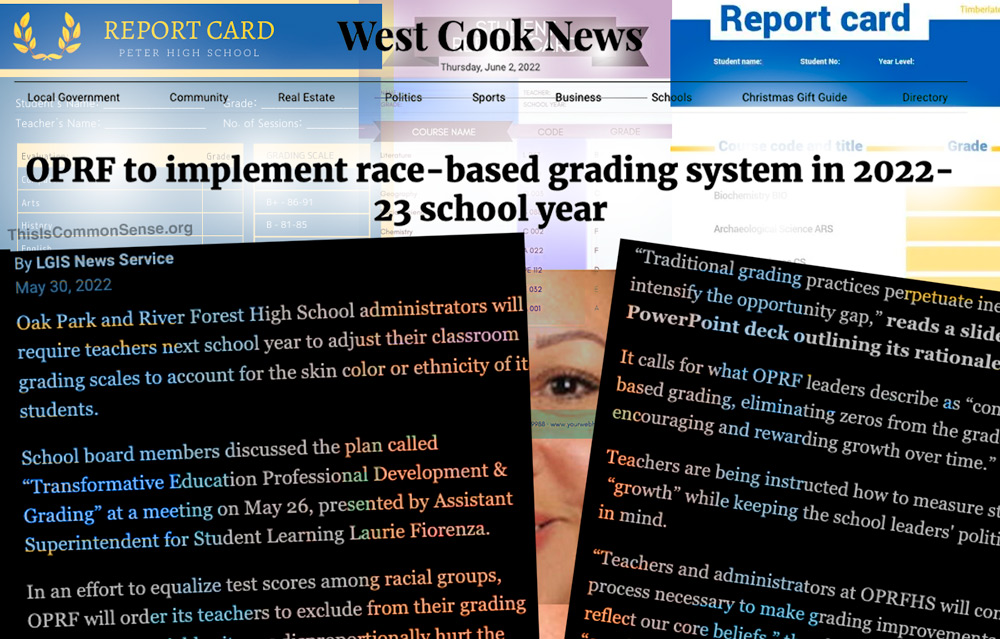
Oak Park and River Forest High School, a Chicago-area school, is imposing standards of grading designed to equalize academic performance among races.

According to a plan discussed at a recent school meeting, “Traditional grading practices perpetuate inequities and intensify the opportunity gap.”

Teachers must now ignore whether, for example, students miss class, misbehave, or fail to promptly submit homework. It seems that students of certain races commit such lapses, on average, more often than students of other races.

It’s not the first major step taken at the school to promote “diversity, equity, inclusion and justice [sic].” Last year, a teacher there adopted a grading scale under which students had to score as low as 19 percent to get an F and could get an A with 80 percent, a B with 65.

Students who conscientiously try to learn despite the fact that excellence and conscientiousness are no longer being appropriately recognized may do okay despite the perverse incentives being pushed.

But what about students on the margin who need to be rewarded for their efforts? Might they not slide into apathy if, no matter what they do, they’re treated like anybody else? Grades, after all, are there to serve as feedback — signalling successes and failures in learning, rewarding for excellence and warning for error. Take that away and one incentive to adjust studying habits flies out the window.

Even under the new plan, there will perhaps be some remnant of recognition of actual individual performance at Oak Park and River High. But precedents have been established that pave the way to further erosion of standards.

Unless the whole noxious egalitarian approach is repudiated, things there can only get worse.

This is Common Sense. I’m Paul Jacob.


PDF for printing

See all recent commentary
(simplified and organized)
See recent popular posts
Categories
education and schooling ideological culture

The Enforcers of Conformity

In the American academe of 2022, you never know who will be next on the chopping block for disputing the latest insanities. At the moment, that someone is former Princeton University classics professor Joshua Katz.

Katz is supposedly being fired for a relationship he had with a student 15 years ago and for which he was penalized in 2017. Actually, it’s for exposing the racist assumptions of so-called antiracism in a 2020 article.

It seems Princeton has been itching for an excuse to can him. Last year, the university found its excuse when the student involved in the older controversy, provoked by the new one, revived the old complaint.

Katz’s lawyer, Samantha Harris, says “the message to would-be dissenters is clear: the price of speaking out is having your personal life turned inside out looking for information to destroy you.”

Only a few colleagues have publicly supported Professor Katz.

Or even still talk to him. 

More have joined the bandwagon against him. When it’s been most urgent to profess the truth, these professors have preferred a “safer” path.

In 2020, Katz wrote: “The pressure to apologize . . . to appease one’s tormentors can be tremendous, but do not give in to the pressure. If you feel you did no wrong, do not apologize.”

If Professor Katz wants to put this nightmare behind him, I’d understand. If he wants to sue Princeton for a billion dollars or so, well, I’d understand that too.

This is Common Sense. I’m Paul Jacob.


PDF for printing

See all recent commentary
(simplified and organized)
See recent popular posts