Categories
Accountability moral hazard nannyism national politics & policies political challengers too much government U.S. Constitution

Term Limits Trump

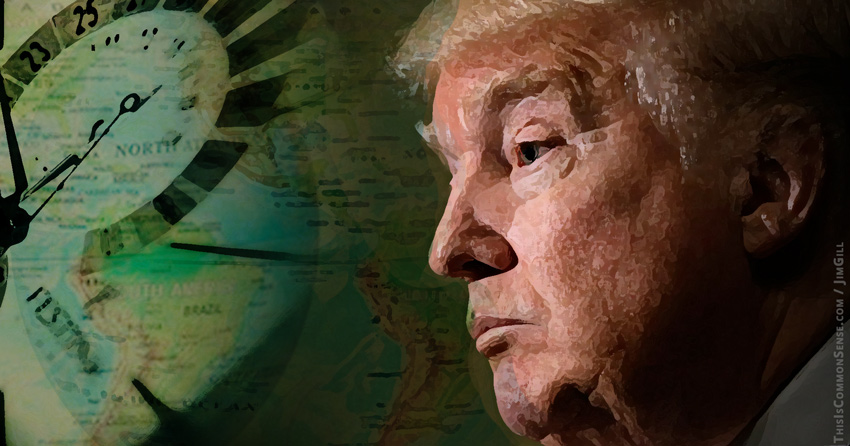
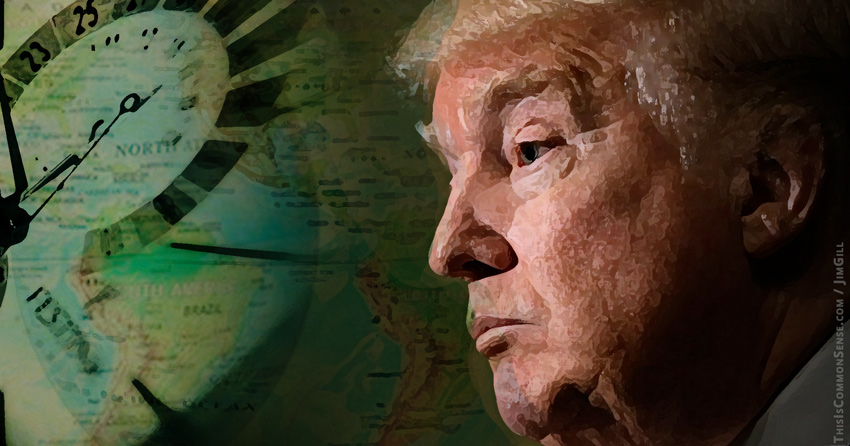
Entering his campaign’s homestretch, underdog Donald J. Trump gave an important speech at Gettysburg, Pennsylvania. He emphasized his support for term limits in what he called his “100-​day action plan to Make America Great Again.”

“[R]estoring honesty, accountability and change to Washington” is the top item on Trump’s agenda, along with a pledge to begin the drive for “a Constitutional Amendment to impose term limits on all members of Congress” on his very first day in the Oval Office.

Public disgust with the corrupt status quo in Washington — and the hope that he will shake things up — drove Trump’s victory.

Yet, today, the Elections Committee of Michigan’s House of Representatives hears testimony on several bills to weaken or repeal term limits. Have the limits lost public support? Not on your life.

Politicians simply want to stay ensconced in power, reaping the many benefits they’ve bestowed upon themselves. They want to stay in power longer.

Just look to California. Back in 2012, a dishonest ballot explanation tricked voters into thinking they were tightening their term limits law. But what they were actually doing was voting to weaken it.

Now, Golden State legislators can stay in the same seat for a dozen years. And special interests have noticed. They’re “investing” more heavily than ever before.

The Los Angeles Times summarized the result in its headline: “Longer terms for California’s Legislature mean a flood of cash from interest groups …”

Here’s for enacting real term limits at every level of government. And if the politicians and special interests don’t like it — good!

This is Common Sense. I’m Paul Jacob.

Printable PDF

Donald Trump, term limits, president, first, illustration


Categories
Accountability media and media people moral hazard national politics & policies

Indecency Abounds

The most indecent aspect of this bizarre election year? The “grab them” comment … from a decade ago? The lies about lies about lies? The “debates”?

Maybe not. Maybe it’s the infamous “mainstream media.”

Last week I wrote about the most obvious case, that of Donna Brazile and her helping hand emails to the Clinton campaign, accomplishing what years of mere induction and analysis could not: justifying, totally, the epithet for CNN as the “Clinton News Network.”

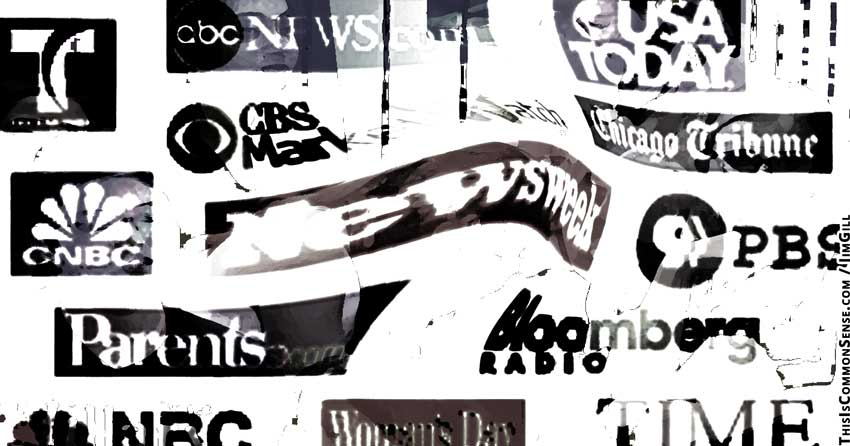
But it was nearly the whole media that was in the tank, as we say nowadays, for Mrs. Clinton. This has been obvious for some time. Even mainstream media mavens have noticed it, as I wrote not too long ago.

Will more journalists and TV faux-​journalists notice?

They certainly have now noticed that they did not see a Trump victory coming.

Delusional about Hillary Clinton’s likability, and about how normal folks react to her history of corruption and scandal, TV talking heads and powerful newspapers doubled down in her favor … which may have actually helped precipitate a result against their intention.

The mainstream media triggers much of America, you see, especially the parts of the country that revolted against the prospect of a Clinton Dynasty.

Not that I place myself above journalists as objective, either. I’m not a journalist. I’m an activist. I am for liberty. Responsibility. Accountability. Limited government. I’m no more a fan of major party messiahs than I am of their rah-​rah boys in the journalist biz.

I’m not exactly shouting about Trump’s win. I’m just happy that Hillary — and her vast Democratic-​partisan media conspiracy — lost.

If this be indecency, make the most of it.

This is Common Sense. I’m Paul Jacob.

Printable PDF

Donald, Trump wins, media, failure, illustration


Categories
ballot access general freedom government transparency media and media people national politics & policies political challengers

A Brexit Effect?

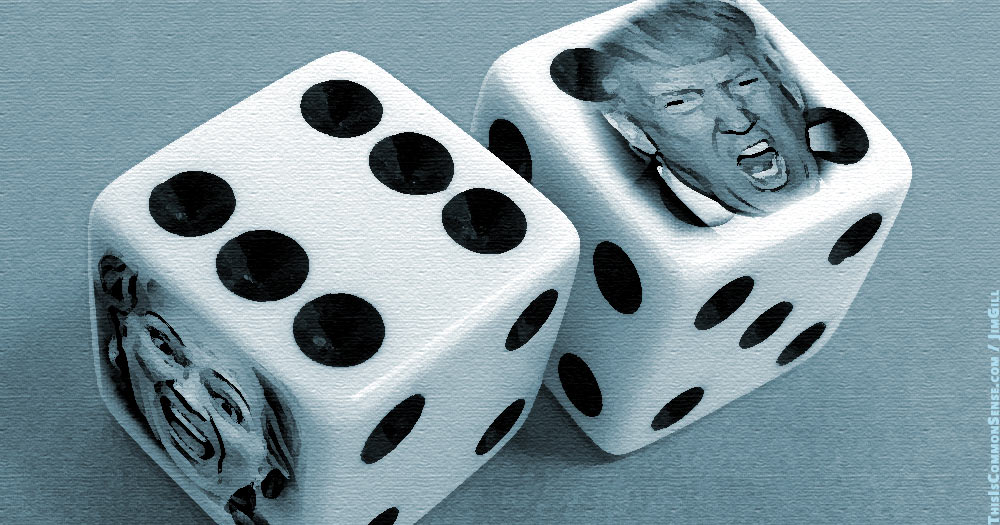
Before the Brexit vote, the likelihood of British secession from the European Union garnered a mere 25 percent chance. That was according to European betting markets, which are usually more accurate. In June, the Brits voted Brexit.

Donald Trump has made much hay of this, understandably.

On Tuesday, the odds of a Trump victory hit the same mark: 25 percent.

Gwynn Guilford’s report on this was drolly titled “Donald Trump has the same odds of winning as Jon Snow ruling Westeros, according to betting markets.”

On June 11, Business Insider had reported that Hillary was increasing her lead; on October 18, it exulted that the Irish betting markets had “already declared a winner” — not Trump. On November 1, the news aggregator merely noted that Moody’s is calling the election a landslide for Clinton.

But BI is also covering the scandal that has disturbed the Clinton camp. There’s no love lost between the Federal Bureau of Investigation and the Department of Justice, explains Natasha Bertrand in “‘The Antichrist personified’: ‘Open warfare’ and antipathy toward Clinton is reportedly fueling the FBI leaks.” The meat of her representation is that “much of the agents’ frustration … may boil down to partisanship”; the FBI is “Trumpland.”

Yet the article ends quoting another FBI official insisting that both Trump and Clinton are awful candidates.

A plausible judgment.

Whether late-​in-​the-​game revelations of Clinton corruption and FBI probing can defy current odds and produce a Clinton defeat remains to be seen. As of Thursday evening, polls-​only forecasts placed the odds of winning at 67/​33 in favor of Mrs. Clinton, while electionbettingodds​.com placed them at 70.2/29.2.

This is Common Sense. I’m Paul Jacob.
 

N.B. Late-​breaking Brexit news: The United Kingdom’s high court ruled yesterday that Parliament must vote to approve Brexit before the secession can proceed.


Printable PDF

gamble, betting, HIllary Clinton, Donald Trump, president, presidency, election, voting, illustration, creative commons


Categories
ideological culture media and media people moral hazard national politics & policies responsibility too much government U.S. Constitution

Pigs in Pokes

On Tuesday, Former Massachusetts Governor William Weld exhorted Americans to stop Donald Trump at all cost.

The Donald, he asserted, is dangerous because too touchy, too childish in his egoism, to withstand the pressures of the presidency of these United States. “In the statement, Weld made no mention of Clinton,” writes the AP. He focused on Trump and the GOP, instead.

Both progressive and conservative outlets interpreted this as a de facto endorsement of voting for Democrat Hillary Clinton — an uncomfortable conclusion, considering that Weld is Libertarian Party presidential nominee Gov. Gary Johnson’s VP running mate.

Looking at the statement itself, it is apparent that Gov. Weld prefers The Devil We Know to The Devil He Fears.

Which is where he loses me.

One need not like Trump to understand his appeal. Trump is a smoking sack of Who Knows What placed upon the doorstep of the Establishment, the insider classes running the federal government and the Fourth Estate. By taking offense at Trump but not Clinton, Weld sides with the insiders. My longtime respect for Weld aside, how can one plausibly do that?

We know what the Establishment wants most: perpetual war, permanent debt, and secure power.

Meanwhile, the ostensible Republican has been awfully vague on policy. Voting for Trump is buying a pig in a poke.*

The Democratic poke is fairly well known. But Hillary, the war-​monger who accuses Trump of being Putin’s “puppet” and repeatedly plays chicken with the world’s other great nuclear power, puts her own policies in a poke by proclaiming her personal prerogative of telling the voters one thing and her insider crowd another.

Neither sack of …  uh, please.

This is Common Sense. I’m Paul Jacob.
 

* Old idiom: synonym for swine in a sack.


Printable PDF

Hillary Clinton, Donald Trump, war, danger, president, illustration


Questions Answered:
Who is Gov. William Weld most fearful of this election year?
How plausible is a preference of Hillary over The Donald?
What can we make of Hillary’s and Donald’s foreign policies?

Ask the next question. --Theodore SturgeonThe Next Question:
If pigs could fly, which one would you vote for?

Categories
Accountability crime and punishment general freedom ideological culture judiciary national politics & policies U.S. Constitution

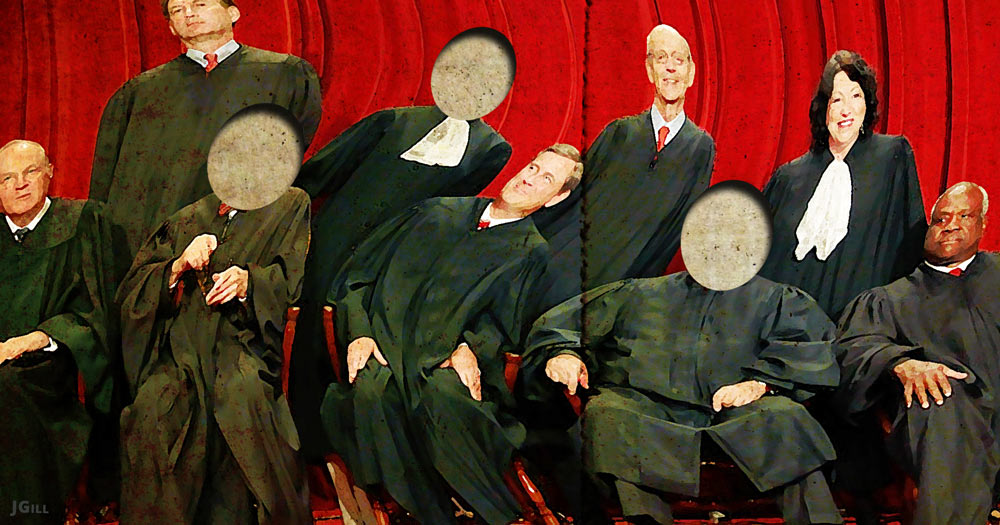
The Best Case for Trump Isn’t

I support neither Hillary Clinton nor Donald Trump for the presidency. Still, I do understand several reasons to vote for Trump, including, most obviously, “he’s not a Clinton.”

The most persuasive strategic reason given for voting for the man, however, and the one that has most purchase with me, is that he would appoint better Supreme Court justices than would Mrs. Clinton.

Note: if the Democrats gain hold of the U.S. Senate, an elected Donald Trump would “negotiate.” And the next set of Supremes might be quite bad.

But is all this irrelevant? It does not look like Trump will be elected, so any vote thrown at him will be just as “wasted” as a vote for Johnson, Stein, or Mickey Mouse.

More importantly, if Hillary wins, no biggie on the Supreme Court front IF (a big “if”?) the Republicans maintain congressional dominance.

Why?

Our Senators are not required to vote for any of a president’s appointees. But, alas, that is not what Democrats are saying now! Forget such self-​serving nonsense. The Constitution does not specify the number of justices on the Supreme Court. It is nine now, sure, but the Highest court in the land was first manned by five justices, then seven.

So, after the election, unpack the court.* Back down to seven, at least.

And then let’s talk terms for the currently “serving for life” justices, and term limits.

In any case, the best case for Trump isn’t so much a case for him, as a plan of action no matter who is elected.

This is Common Sense. I’m Paul Jacob.
 

*This notion is more doable, I think, than Franklin Delano Roosevelt’s infamous court packing scheme, in which he threatened to put more justices in to over-​rule those justices who thought his “New Deal” program unconstitutional. Congress, not required to vote in any proposed Supreme Court candidate, could balk at all and then, by law, reduce the number, even removing one justice from office if need be.


Printable PDF

Supreme Court, Congress, Hillary Clinton, Donald Trump, election, illustration


Questions Answered:
Does the best reason to vote for Donald Trump really hold water?
Does the Constitution specify the number of justices that should be on the Court?
Is Congress really at the mercy of any bully who occupies the Oval Office?

Ask the next question. --Theodore SturgeonThe Next Question:
Will voting for someone other than Trump be more of a “wasted vote” than voting for Trump himself, if, as polls indicate, he loses?


Categories
meme

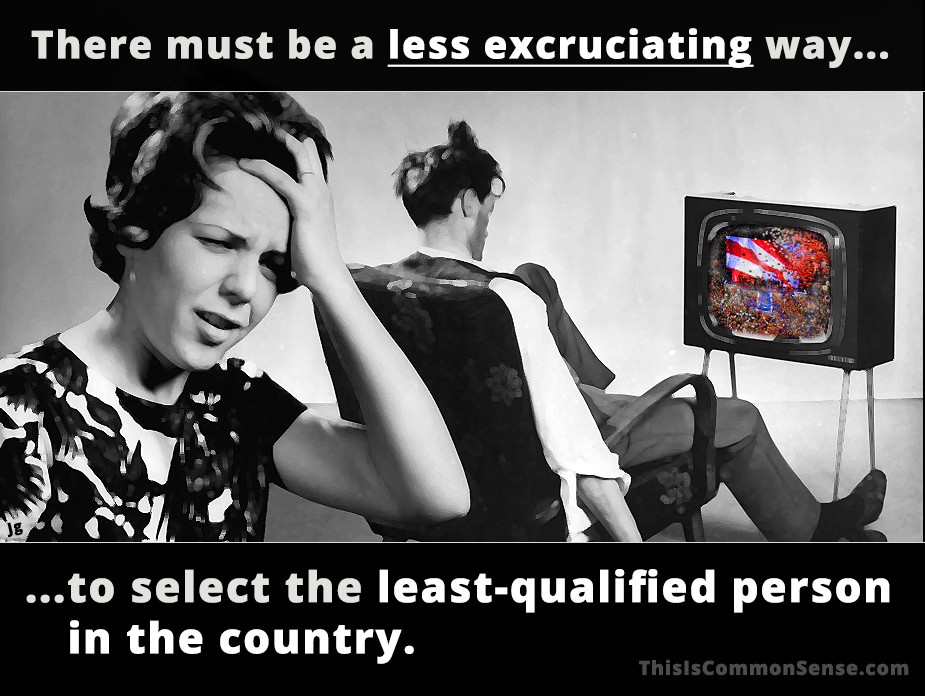
There must be…

There must be a less excruciating way to find the least qualified person in the country.

Categories
general freedom insider corruption media and media people national politics & policies political challengers responsibility too much government

We Take the Bullet

“[I]f someone puts a gun to your head,” argues David Boaz of the Cato Institute, “and says you have to choose between Clinton and Trump, the correct answer is, take the bullet.”

Then, proving the axiom “it can always get worse,” came Friday’s twin revelations: the Washington Post broke the story of Donald Trump caught on a hot microphone bragging about groping women, and WikiLeaks released hacked emails with unflattering revelations about Hillary Clinton “principled” duplicity.

The Clinton camp huffs about the hack of campaign chairman John Podesta’s emails, but denies nothing.

In those speeches for which Wall Street firms paid her millions, Clinton’s progressivism evaporates. She suggests Goldman Sachs and other large financial firms should regulate themselves, because they “know the industry better than anybody.”

While publicly bashing the rich, she privately complains before her wealthy audience about the “bias against people who have led successful … lives.” Moreover, Hillary explains that it’s bad “if everybody is watching” public policy being made, adding: “[Y]ou need both a public and a private position.”

And to think some folks don’t trust her.

Mr. Trump likewise confirmed our worst fears. During a 2005 taping of a television soap, he boasted that “when you’re a star, they let you do it. You can do anything.”

And then gave a “rapey” example of what “anything” means.

This man deserves political power?

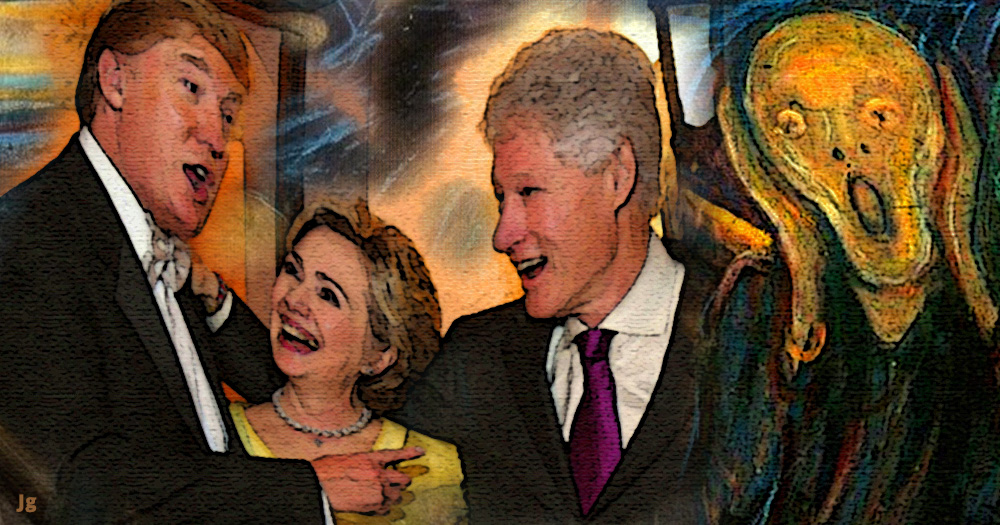
Forget which is worse. Note how much alike they are. Both seem to think they can say — even do — anything. Without consequences.

Without caring one whit about the rest of us.

This is Common Sense. I’m Paul Jacob.


Printable PDF

debate, Hillary, Donald Trump, the scream, bullet, illustration


Categories
folly free trade & free markets moral hazard national politics & policies too much government

Trump’s Road Rage

There is no reason why the states shouldn’t handle their own infrastructure. Not only in funding, but in direction and method of production and “distribution.”

But politicians aiming for the presidency tend not to even consider that heresy. And journalists, of course, tend to rah-​rah for the nationalist planning notion, too. It’s easier to cover everything from Washington. I remember much talk of “our crumbling infrastructure” back in the 1980s.

Thankfully, Shikha Dalmia has not jumped onto that bandwagon. The Reason writer notes that Trump is trumping Obama’s fling with “shovel-​ready jobs,” demanding that the federal government spend up to a trillion in infrastructure “stimulus.”

Forget for the moment the obvious contradiction: pretending to be an outsider, Trump is pushing as “insiderish” a program as imaginable.

I wonder: is Trump playing the cuckoo here, placing an alien idea into his constituents’ nests? Are his supporters about to be “cucked”? (As alt-​rightists like to put it.)

Trump looks abroad for models of beautiful roads and bridges and trains and all the rest. If you travel “from Dubai, Qatar, and China,” he bemoans, our biggest cities give off a certain “Third World” vibe.

Dalmia blanches: “the countries Trump is praising as models for a better America are all autocracies that have made a complete hash of things.”

Boy, we do not need to find another way to make a complete hash of things here in the States. And our federal budgets are strained (and pushing us further into debt) as it is.

Besides, it is not written in stone, concrete, or even asphalt, that these United States’ roads and bridges must be made the federal government’s business.

This is Common Sense. I’m Paul Jacob.


Printable PDF

infrastructure, shovel ready, government, roads, illustration


Categories
Accountability national politics & policies political challengers responsibility too much government U.S. Constitution

How to Corrupt Politicians Without Really Trying

In a Townhall​.com column last January, I argued that politicians weren’t “stupid,” as Mr. Trump had loudly proclaimed — to few objections.

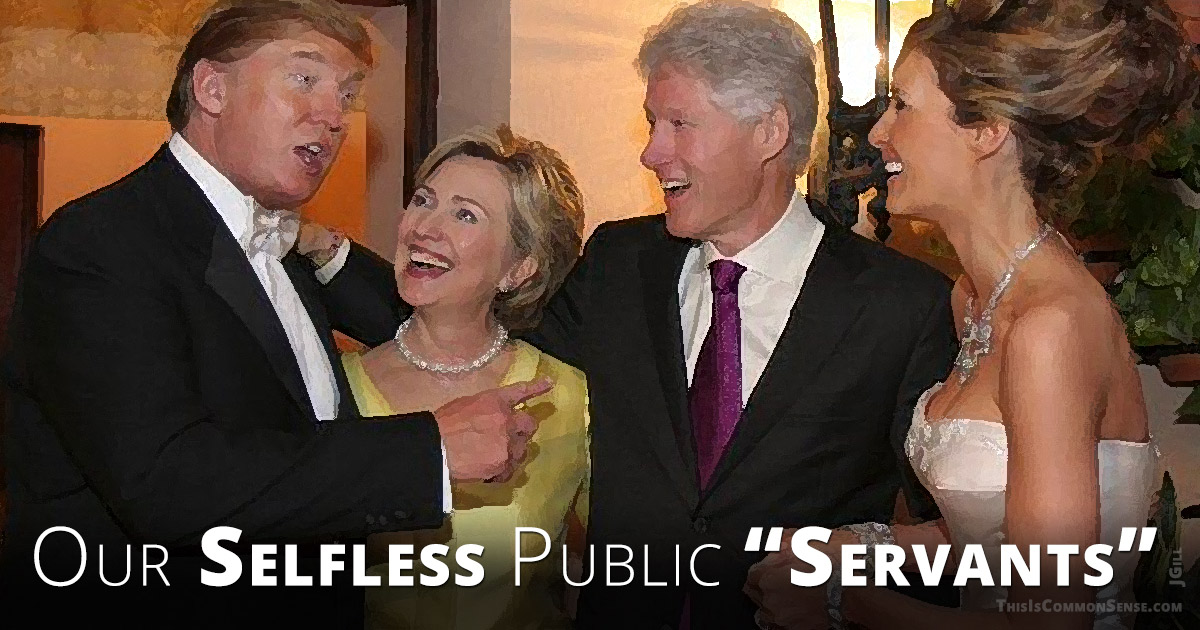
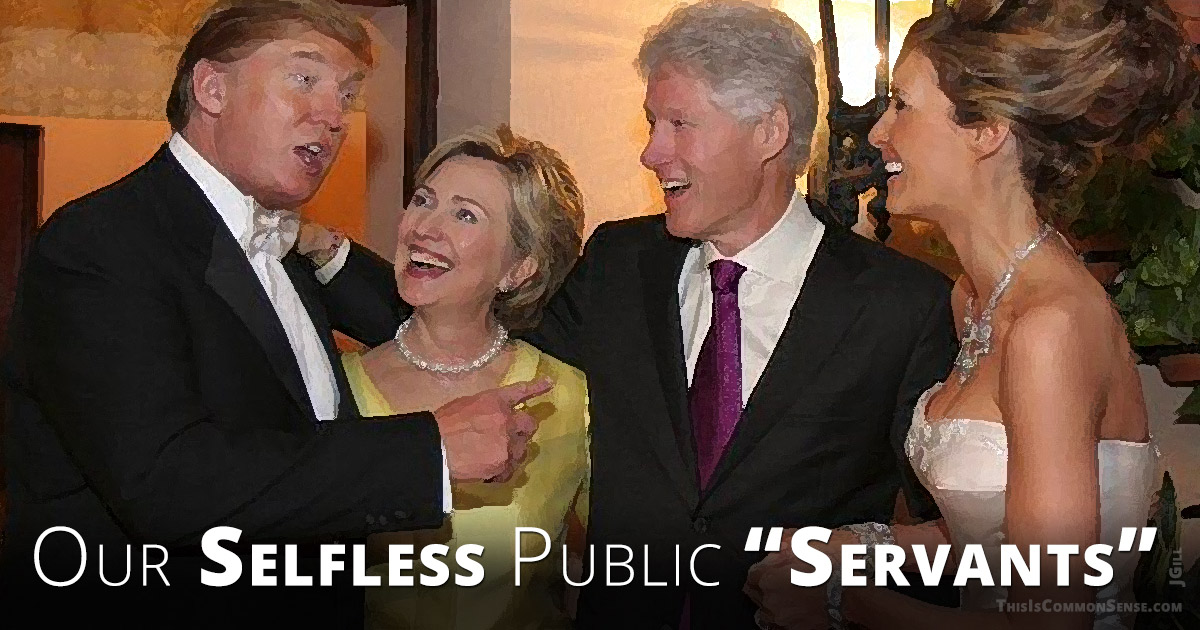
The problem is worse: too many politicians lack honesty and integrity. They’re in the politics biz for their own lucrative ends.

Six weeks ago, I declared — again, to few objections — that “Politicians Must Suffer.” Despite the provocative, sizzling-​with-​Schadenfreude title, my point was simple: “lavish pay, pensions and other benefits for city councilmen, state legislators and congressmen constitute a serious problem.”

“It breeds,” I added, “bad behavior when politicians line their own pockets.…”

Well, I’m right.

At least, I’ve got some academic back-​up from a new study by Mitchell Hoffman of the University of Toronto and Elizabeth Lyons of the University of California-​San Diego, entitled, “A Time to Make Laws and a Time to Fundraise? On the Relation Between Salaries and Time Use for State Politicians.”

Sounds like a fascinating read, eh?

“Using data on time use and legislator salaries, we show that higher salary is associated with legislators spending more time on fundraising,” the study’s abstract reads. “In contrast, higher salary is also associated with less time spent on legislative activities and has no clear relation to time spent on constituent services.” [Emphasis added] 

While their study jives with my experience, the Wall Street Journal reports that others were surprised. Authors Hoffman and Lyons explain: “When salaries are higher, politicians face a greater incentive to get re-​elected (as the value of serving in office is greater). Thus, they will optimally respond by increasing the time spent on fundraising.”

Sounds like in addition to lower pay for politicians, we need term limits, too.

This is Common Sense. I’m Paul Jacob.

Printable PDF

politicians, public servants, service,


Categories
Accountability nannyism national politics & policies tax policy

The Year of Translucency

Barack Obama promised transparency in government. He didn’t deliver.

But others stepped up to the plate.

It’s now possible to see through a lot of political, elitist, and bureaucratic bunk courtesy of fugitives like Snowden, convicts like Manning, and citizens using FOIA (Freedom of Information Act) procedures.

And we are learning more about Hillary Clinton with each info dump from Julian Assange’s Wikileaks and every court-​ordered disclosure thanks to lawsuits to enforce FOIA by organizations like Judicial Watch.

Some folks demand that Donald Trump release his tax returns. On the one hand, hooray for public demands for more information about candidates. But on the other hand, the richer you are, the longer and stranger your tax returns become. One shifts income around to avoid taxes — indeed, you take every “loophole” the law allows. As Justice Brandeis advised. Some folks may be shocked by Trump’s creative-​but-​legal accounting.

To avoid future confusion, we should demand simple tax returns from the rich. That would require jettisoning most of the tax code, simplifying the system. But ask your congressional representative why he or she will not support such a reform.

The reason we have an opaque and complicated tax code is … well, transparent. Under a simple tax system, there would be fewer favors to “trade” … and thus less power to accumulate, less oomph to parlay into pomp and splendor.

Which is why politicians rarely provide much transparency, and why it must often be wrested from them.

Merely by being merchants of opacity, our pols reveal, if inadvertently, the nature of our Too Big Government.

This is Common Sense. I’m Paul Jacob.


Printable PDF

tax code, power, politicians, transparency, illustration