Categories
incumbents political challengers

Winning Reform

Bruce Poliquin, Maine’s incumbent second-district U.S. Representative, knows what to blame for his loss this last election: the preferences of Maine voters.

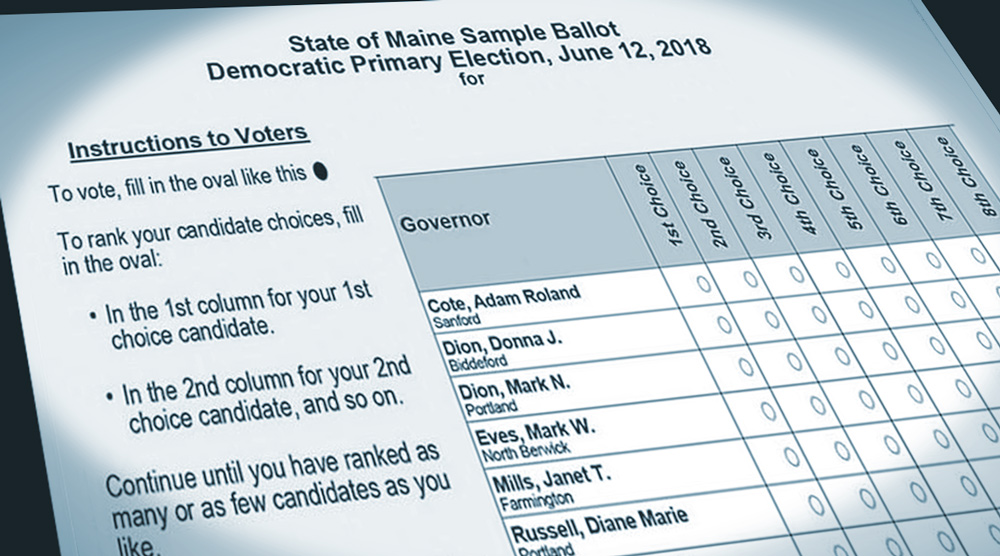
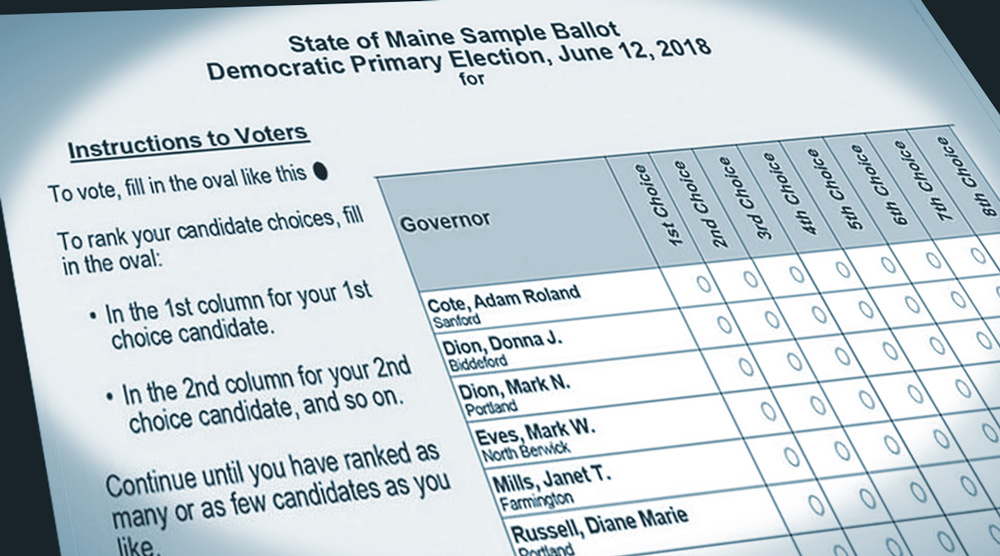
Well, he blames Ranked Choice Voting (RCV) . . . in which voters rank the candidates by preference, and whose votes are counted so to better tally second- and even third-favored options.*

The Republican Representative enjoyed a slight lead on election night, but fell short of a majority. When two independent candidates were eliminated, their second-choice votes put Democrat challenger Jared Golden over the 50-percent mark.

Maine Republicans are upset. It turns out that losing isn’t as much fun as winning.

Shocking, I know.

So Poliquin sued, arguing that RCV is unconstitutional. He asked a federal judge to stop the ballot tabulation.

Judge Lance Walker, a Trump appointee, was “not persuaded.” He additionally noted that “the citizens of Maine have rejected the policy arguments plaintiffs advance against RCV.”

Twice.

In 2016, Mainers passed RCV by ballot initiative and then, in a 2017 referendum, vetoed the legislature’s arrogant repeal of the voter-enacted reform.

“While Mr. Poliquin publicly works through the five stages of grief over his election loss,” remarked RCV advocate Kyle Bailey, “the real story is that the implementation of Maine’s Ranked Choice Voting law was smooth, transparent, and in accordance with the will of the Maine voters,”

Meanwhile, Chuck Slocum, past chair of the Republican Party of Minnesota, urges fellow Republicans to “consider” this non-partisan reform.

Yes, a process that better counts voter preferences ought to help your political party.

This is Common Sense. I’m Paul Jacob.



* In cases where no candidate gains a majority of first-choice votes, the last place candidate is eliminated and his or her votes re-allocated to those voters’ second choice, and this process continues until a candidate reaches a majority.

PDF for printing


» See popular posts from Common Sense with Paul Jacob HERE.


Categories
general freedom initiative, referendum, and recall political challengers Popular

Spoiler Season

“Libertarians poll high enough to tip key races,” informs The Washington Timesciting contests for governorships and both houses of Congress.*

Libertarian Lucy Brenton is one example, running for U.S. Senate in Indiana. She grabbed 7 percent in a recent poll, greater than the margin between incumbent Democratic Sen. Joe Donnelly, who had 44 percent, and Republican challenger Mike Braun with 40 percent. The Times says Brenton is just one of “a number of Libertarians whose poll numbers are high enough to more than account for the difference between Republicans and Democrats in key midterm races.” 

She had garnered 5.5 percent in 2016, when she sought the state’s other U.S. Senate seat. 

There is disagreement over whether Libertarians help or hurt Republicans. Most folks suspect that Libertarians take votes away from Republicans, but polling appears to show Libertarians snagging more otherwise Democrat-inclined voters.

No matter. As often discussed here, enacting Ranked Choice Voting is the rational institutional solution to the so-called spoiler effect Libertarians present. It’s a win-win for both so-called major and minor political parties. 

“Libertarians bristle at the term ‘spoiler,’” the newspaper notes, “saying it’s a belittling term for a party that presents a viable option to voters.”

Which brings me to a second solution to Libertarians luring away your voters. Steal their issues. Take them and make them your own.

There’s no law against it.

No reform required.

“Libertarians are running against President Trump’s tariffs, immigration policy and record on spending . . .” explains The Times, and “are embracing . . . less taxation as well as marijuana legalization, criminal justice reform and ending the war on drugs.”

Fresh elections. Happy voting.

This is Common Sense. I’m Paul Jacob.


* It won’t change the outcome, but on Monday the Boston Globe endorsed Libertarian Dan Fishman for state auditor, writing: “An auditor without any partisan axes to grind could shake up the state.” That’s a different kind of spoiler.

PDF for printing


Categories
general freedom ideological culture Popular too much government

Socialism Is Anti-Democracy

Common sense politics must peer beneath the superficial attractions of “democratic socialism.”

In “Civil Liberties and Socialism Don’t Mix,” Matthew Harwood explains why those who call themselves democratic socialists may “say they believe in civil liberties” nevertheless “will always be hostile to individual freedom.”

In this short Reason piece, Mr. Harwood starts out by showing that socialism cannot merely be “a more generous welfare state along Nordic lines.” For “socialism” to remain distinct socialists must offer a Unique Selling Proposition. You cannot plausibly push a “new” philosophy and stick to pushing the old liberal stand-bys of private property and markets.

Their own pretensions force them back to central planning, to economic planning for all by a few.

Which is not democratic, of course. It goes far further, to anti-majoritarian.

Actual economic planning requires micromanagement. Harwood quotes socialist economist and luminary Robert Heilbroner, who expresses this requirement as “the necessity to intervene deeply, and probably ruthlessly, into the economy in order to establish the socialist order in the first place.”  

But it cannot stop there. Once established, a socialist state must feel a “need to continue a policy of painful intervention” to adjust to “the constricting limits of the environment.”

“Democratic socialism is not freedom,” Harwood concludes. “It is authority paternalistically dressed up in the language of liberation and wielded on behalf of that fuzzy abstraction, ‘the people,’ regardless of what flesh and blood individuals want.”

Sure, democratic socialists may hope that majorities will allow their elites to plan for everybody. 

But once that handoff is made, the power obtained, then the tyranny.

Inescapably.

This is Common Sense. I’m Paul Jacob


PDF for printing


Categories
initiative, referendum, and recall insider corruption term limits

Corruption, Arkansas-Style

On Friday, the Arkansas Supreme Court struck Issue 3, a citizen-initiated measure to restore legislative term limits, from Arkansas’ November ballot. The Court declared, 4-3, that there weren’t enough “valid” signatures.

This, despite opponents never disputing that more than enough Arkansas voters had signed the petition.

In recent years, legislators have enacted a slew of convoluted laws, purposely designed to wreck the initiative and referendum process.* The regulations give insiders and partisans a myriad of hyper-technical “gotchas” that can be used to disqualify whole sheets of bonafide voter signatures.

“The legislature,” explained former Governor Mike Huckabee recently, “sucker-punched the people of Arkansas and expanded their terms. They did it, I think, very dishonestly — by calling it an ethics bill . . . that had nothing to do with ethics. It was all about giving themselves longer terms.”

Since getting away with that 2014 ballot con job, giving themselves a whopping 16 years in office, seven Arkansas state legislators have been indicted or convicted of corruption. The author of that tricky ballot measure, former Sen. Jon Woods, just began serving an 18-year federal prison sentence for corruption.

Other corruption, that is.

“It’s one reason I think term limits are a very important part of our political system today,” said Huckabee. It is, he argued, “easier to get involved in things that are corrupt the longer you stay.”

Now, sadly, after 2014’s fraudulent ballot measure and two 4-3 state supreme court decisions neutering the entire ballot initiative process, political corruption can continue unabated in the Natural State. 

This is Common Sense. I’m Paul Jacob.


* The state supreme court has ignored the clear language in the state constitution regarding such petitions: “No legislation shall be enacted to restrict, hamper or impair the exercise of the rights herein reserved to the people.”

N.B. For relevant links, check yesterday’s splash page for this weekend’s Townhall column.

PDF for printing


Categories
incumbents insider corruption

The Politics of Exclusion

“The mainstream media screams about Russia stealing elections,” says U.S. senatorial candidate Dale Kerns, “but behind the scenes they pull the strings to keep the duopoly in control.”

Mr. Kerns, who is running in Pennsylvania as a Libertarian in a four-candidate race, has had the rug pulled out from under him. Early on, the League of Women Voters had assured him that he would be able to participate in televised candidate debates in Philadelphia. That opportunity was dashed as the date of the event neared.

“Make no mistake, this is cronyism,” insists Kerns, who notes that “big media corporations collud[e] with big government political parties to keep out competition.”

Eric Boehm covers the scandal/not-a-scandal over at Reason. The early promise of inclusion came from the League, and it was “other organizers” of the event who decided that the Libertarian and Green candidates’ polling numbers were low enough to excuse exclusion.

You might wonder why debate organizers would want to have less interesting debates. But remember: the two entrenched parties’ candidates want to win. Period. The last thing they want are challengers from other parties included, because those challengers can only peel off voters from them.* And though the major-media hosts may wish to seem non-partisan, they almost never refrain from taking a side. 

I do not (and cannot) know which reason contributed more to the Philadelphia renege, so will let you hazard your own guesses. 

This is Common Sense. I’m Paul Jacob.


* Which helps explain why the parties tend to “cheat with both hands,” as Nicholas Sarwark, the Libertarian candidate for the mayorship of Phoenix, Arizona, put it.

PDF for printing


Photo from Max Pixel


Categories
Accountability government transparency incumbents initiative, referendum, and recall local leaders nannyism political challengers Regulating Protest term limits too much government

Strange It Is

Strange for the Arlington, Texas, City Council to hold a meeting on a Sunday evening, much less one to “consider suspending the city charter.”

That is how the Fort Worth Star-Telegram reportedthe latest twist in the term limit controversy that has engulfed the city with a lawsuit and competing ballot proposals.”

Led by Zack Maxwell, citizens in this Fort Worth adjacent community of 400,000 gathered 11,000 voter signatures to place a term limits charter amendment on the November ballot. It would limit councilmembers to three two-year terms. It also figures in past service, so five of the eight current councilmembers would be blocked from seeking re-election in the coming two years.

With swift legislative prowess, the council responded, passing its own competing “term limits” measure, which incidentally allows them to stay 50 percent longer in office.

But there’s one problem: the council did not follow the law, which requires multiple readings, with one at a regular meeting. 

Actually, there’s a second problem: Mr. Maxwell challenged the council’s unlawful action in court. 

The court blocked the council’s measure. 

That left the council holding an unusual weekend meeting to suspend the rules and re-pass their fumbled alternative to the term limits voters really want. But news travels fast and city hall was “packed.” 

“You’re suspending the rules because your jobs are in jeopardy,” charged one man.

A woman told the council, “You guys should be absolutely embarrassed about this.”

“After hearing from dozens of angry residents,” the paper explained, “[t]he council voted unanimously to not suspend the rules, finally killing its own term limit proposal.”

Politicians doing the right thing . . . having exhausted every other possibility.

This is Common Sense. I’m Paul Jacob. 


PDF for printing


Photo from the Fort Worth Star-Telegram


Categories
Accountability general freedom ideological culture porkbarrel politics responsibility too much government

Ask the Next Question

Republicans are very reliable. When given our system’s “Mandate of Heaven” — majorities in both houses of Congress and the Presidency — they can be relied upon to do one thing: add debt by piling up huge deficits.

It happened under George W. Bush, and it is happening under Donald J. Trump: “The Trump administration expects annual budget deficits to rise nearly $100 billion more than previously forecast in each of the next three years,” the Wall Street Journal tells us, “pushing the federal deficit above $1 trillion starting next year.”

Republicans should ask themselves why. And while they ask themselves that, everyone else should ask the next question: why do politicians who say they want one thing so often deliver its opposite?

This is not a mere “right-wing” phenomenon. Leftists say they want “democratic socialism,” but, as Irving Kristol noted, at some point not far down their road to Utopia, “democratic socialists” must choose between democracy and socialism.* By promising everybody everything, too quickly everybody gets shanghaied into service to produce that “everything,” finding themselves conscripts in socialism’s army.

The equation of socialism with regimentation and general un-freedom has been clear for over a century, explained carefully by sociologists, economists and even politicians.* And yet, increasingly, today’s Democrats are embracing a philosophy with proven anti-democratic features.

Could some deep principle be at play?

Probably. It is built into the very nature of state governance, of politics itself. It may be why republics metamorphose into empires, conservatives go radical and liberals become serviles.

Which is why effective democracy requires limited government. To minimize that boomerang effect.

We might start by limiting spending.

This is Common Sense. I’m Paul Jacob.


* Herbert Spencer’s writings on socialism include The Man versus the State (1884) and Industrial Institutions (1896, Principles of Sociology, Vol. III, Part VIII); German politician Eugene Richter’s satire Pictures of the Socialist Future (1896) is well worth reading; and economist Yves Guyot preceded Ludwig von Mises’ classic Die Gemeinwirtschaft (1922, translated as Socialism: An Economic and Sociological Analysis, 1950) with several books, including The Tyranny of Socialism (1893) and Socialistic Fallacies (1910).

PDF for printing


Categories
Accountability folly general freedom government transparency initiative, referendum, and recall local leaders nannyism responsibility too much government

Minimum Sense

Suddenly, the Democrats who dominate the Washington, D.C., City Council seem unwilling to increase the minimum wage for tipped workers — despite their official support for legislative minimum wage rate increases.

And a vote of the citizens.

Initiative 77, which passed easily last month, requires restaurant employers to incrementally increase the “tipped wage” until rates “reach what will be the uniform minimum of $15 an hour by 2025.”

“Initiative 77 is something I believe will be very harmful to our restaurants and, more importantly, our restaurant workers,” argues Councilman Jack Evans, one of three council members pledging repeal.

A spokesperson for One Fair Wage DC, calling a repeal “deeply undemocratic,” notes that “D.C. voters don’t like it when Republicans in Congress do it, and we trust council will not stoop to that level.”

Yet it would not be “the first time the city’s lawmakers overturned a decision by the electorate,” the Washington Post reminds readers, citing “a decision in 2001 when the D.C. Council overturned term limits approved by voters.”*

I’m all for ballot measures to decide any issue the people have a right to decide . . . limited by all of our inalienable rights as individuals. Minimum wage laws constitute an abuse of our First Amendment right to association, which neither legislatures nor voters may legitimately abridge.

That the council doesn’t recognize this right of association, yet nonetheless thinks it should nullify a vote of the people tells you everything you need to know about the sorry state of representation.

This is Common Sense. I’m Paul Jacob.


* And even quoting moi on the incredible hypocrisy dating back 17 years: “If you’re in a city struggling to get representation in the first place, that’s a terrible signal to say that your own local officials don’t respect their own citizens.”


PDF for printing


Categories
Accountability ballot access folly general freedom ideological culture initiative, referendum, and recall media and media people national politics & policies political challengers responsibility U.S. Constitution

Should Non-Citizens Vote?

“A lot of people would like to say this is an immigration issue. It’s really not,” offered Gary Emineth, the head of North Dakotans for Citizen Voting and a candidate for state senator.  

“It’s really about preserving the right for U.S. citizens, and in our case, North Dakota residents, to only be the voters in all elections across the state of North Dakota,” added Emineth. “And that’s why we want it in the constitution.”

Turning in more than 35,000 voter signatures on petitions last Friday, Emineth and others placed a constitutional amendment on this November’s ballot that, if passed, would make voting the exclusive right of U.S. citizens in North Dakota.

Elsewhere in the country, Emineth points out, non-citizens are already voting — in Chicago and San Francisco, and in 11 cities across Maryland. Moreover, campaigns are underway across the country to give non-citizens the vote — in California, Connecticut, New York City, Boston and Montpelier, Vermont.

Opponents claim the North Dakota measure is completely unnecessary, as the state doesn’t currently allow non-citizens to cast a ballot, nor has any city yet attempted to allow non-citizens to vote. But Emineth’s goal is to keep it that way.

Moreover, University of North Dakota Law Professor Steven Morrison acknowledged to The Forum in Fargo that “the proposed amendment does clean up what could be a grammatical loophole since the word ‘every’ doesn’t conclusively exclude non-citizens from voting. . . .”

It is a very simple proposition: Do you want voting to be the exclusive right of U.S. citizens? Or should non-citizens be allowed to vote?

Coming to a ballot near and Fargo.*

This is Common Sense. I’m Paul Jacob.


* With some help from Liberty Initiative Fund.


PDF for printing


Categories
Accountability general freedom government transparency initiative, referendum, and recall local leaders national politics & policies political challengers term limits

The Other Maine Thing

Tuesday’s biggest election news was the victory for Ranked Choice Voting (RCV) in Maine. This is the second statewide vote for this reform, which allows voters to rank the candidates by first choice, second choice and so on.*

Voters first passed it in 2016, but the next year the voters’ “representatives” in the legislature repealed the law, overturning their vote.

Undeterred, RCV supporters filed a referendum and again went out and gathered enough petition signatures to refer the legislature’s repeal to a vote of the people. On Tuesday, Maine’s voters vetoed the legislature, keeping Ranked Choice Voting.

Initiative and referendum sure are helpful.

RCV is not partisan; it requires the winner to have some level of support from a majority of voters and fixes the wasted vote problem. In Maine, however, the Republican Party opposed. On election day, Republican Gov. Paul LePage even threatened not to do his duty and certify the results.

Paul Jacobs (Vice chair of the [FairVote] Board) whom I once knew and thought was a good American,” a Republican friend posted on my Facebook page, “has helped unleash the hounds of Hell” . . . adding that “now the voters are so confused by the terrible procedure that voting will be a nightmare this Tuesday!”

Yet voters used the new voting system for the first time Tuesday in candidate primaries before deciding Question 1 on their ballot — about keeping RCV. As one Portland voter put it, “It’s pretty easy to do, despite the negative publicity.”

We need more control over government with our vote. And when voters speak, politicians should listen.

It wouldn’t hurt political activists to listen, too.

This is Common Sense. I’m Paul Jacob.


* I’ve discussed the idea in this space many times — there’s more information on how it works here.

PDF for printing