Categories
media and media people national politics & policies Popular

Birth of a Twitterstorm

“Kamala Harris is *not* an American Black. She is half Indian and half Jamaican,” tweeted Ali Alexander, a self-described black American activist, after the California Senator’s presidential debate performance. “I’m so sick of people robbing American Blacks (like myself) of our history.”*

On Friday, Donald Trump, Jr., retweeted Alexander’s tweet (before later deleting it). His traipsing into the details of Harris’s birth immediately sparked comparison to his father’s “birther attacks” suggesting that President Obama wasn’t born here.**

Seemingly, the entire Democratic presidential field was quick to condemn the tweet and Don Jr.’s retweet as “racist.” So did much of the media. Although months ago, CNN’s Don Lemon argued, “Jamaica is not America.”

The New York Times article identified Ali Alexander only as an “alt-right fringe figure” and “a member of a right-wing constellation of media personalities,” but nowhere informed readers he is African-American.

“This stuff about Harris, about her status, about her blackness,” Jason Johnson, politics editor of TheRoot.com, told Joy Reid on MSNBC, “that’s about black people.”

In fact, on Reid’s program back in February, Johnson was part of a discussion about the senator’s — gasp! — white husband. “She needs to find a strong black man advocate,” advised Tiffany Cross, co-founder and managing editor of The Beat DC. “Let’s just be candid,” Johnson remarked, “it’s not going to be her [white] husband.”

How important is the color of a person’s skin or their ancestry or the skin color of their spouse to that person’s fitness to be president?

It only matters to racists.

This is Common Sense. I’m Paul Jacob.

* “Kamala Harris,” Alexander also pointed out, “comes from Jamaican Slave Owners.” True enough, but how is she responsible for what her ancestors did? Would it matter if she supported . . . reparations?

** For the record, Sen. Harris was born in Oakland, California, which was then and is still part of the United States of America.

PDF for printing

Kamala Harris, race, debate, democratic, president, democracy,

See all recent commentary
(simplified and organized)
See recent popular posts

Categories
general freedom Popular Regulating Protest too much government

I Am Hong Kong

“I love my students so much,” a protesting teacher in Hong Kong told a BBC reporter, wiping tears from her eyes. “I worry about they cannot have the freedom we have before. They cannot speak what they want to speak like us. So, I don’t want . . . this.”

Her English grammar notwithstanding, she speaks a language we should all understand: Liberty.

“If there must be trouble,” Tom Paine wrote in The American Crisis, “let it be in my day, that my child may have peace.” As usual, it is the young, whose idealism and courage has not been worn down and compromised — and who have their own future children to fight for — who lead the effort, facing tear gas and truncheons. That is precisely what they’ve encountered in Hong Kong . . . along with pepper spray and rubber bullets . . . for now. 

It can get worse.

Nonetheless, millions of Hong Kong residents have taken to the streets against Hong Kong’s legislature considering a bill to allow Mainland China the power to extradite criminal suspects. People well understand that, if the bill passes, their civil rights will be extinguished in China’s crooked, totalitarian justice system.

What to do? Hope and pray for Hong Kong. 

But let’s draw some lessons. Freedom requires not merely bravery, but also unity. An attack on the rights of anyone is an attack on us all. And attacks on precious democratic checks on political power are attacks on everyone’s freedom. 

Instead of the United Nations, we need an organization of united citizens across the globe. People everywhere want to be free and democratic. We should work together . . . bypassing our governments.

This is Common Sense. I’m Paul Jacob.


PDF for printing

Hong Kong, protests, extradition, freedom, democracy,

See all recent commentary
(simplified and organized)
See recent popular posts

Categories
incumbents partisanship

AOC Right, DCCC Wrong

“AOC is right as rain here,” I re-tweeted Sunday.

And what was the usually all-wet U.S. Rep. Alexandria Ocasio-Cortez (D-N.Y.) right about?

“By stymieing primaries,” the freshman representative had tweeted at her own party’s congressional leaders and the Democratic Congressional Campaign Committee (DCCC), “you deny most voters their best chance at choosing their representative.”

On purpose. 

Ocasio-Cortez refers to the recent DCCC announcement, first reported by The Intercept, that “warned political strategists and vendors . . . that if they support candidates mounting primary challenges against incumbent House Democrats, the party will cut them off from business.”

Isn’t the goal of the DCCC to elect as many Democrats to Congress as possible? 

No. 

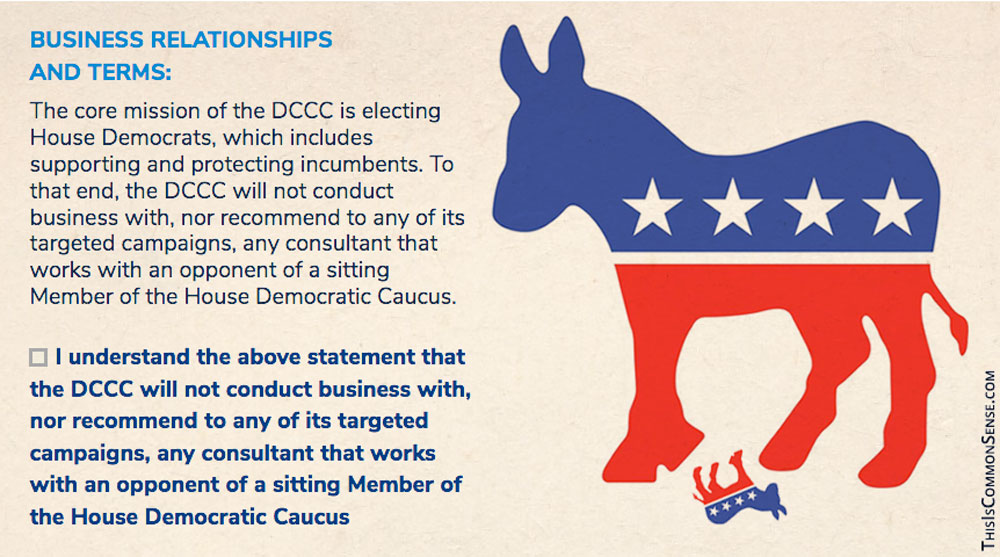
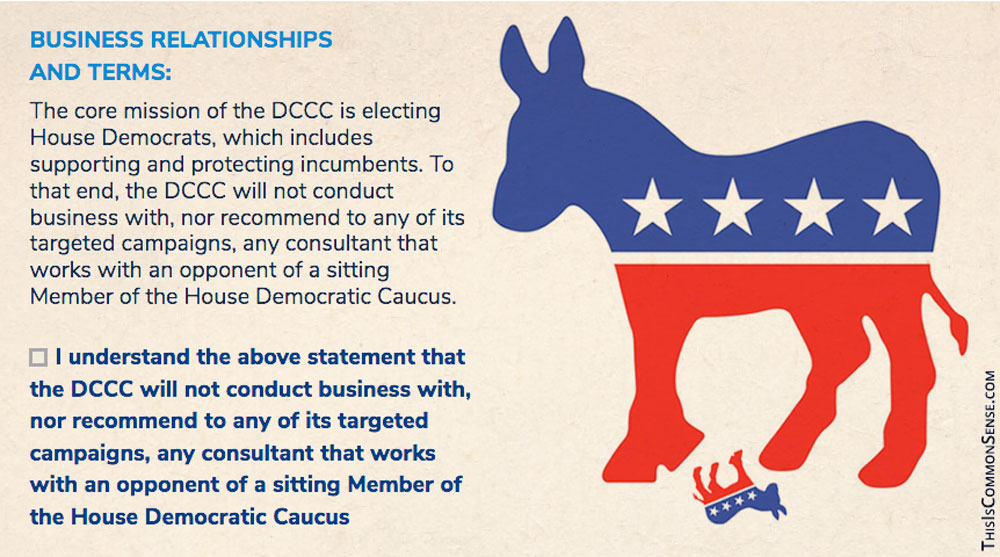
“The core mission of the DCCC is electing House Democrats, which includes supporting and protecting incumbents,” reads a new form for party political consultants. “To that end, the DCCC will not conduct business with, nor recommend to any of its targeted campaigns, any consultant that works with an opponent of a sitting Member of the House Democratic Caucus.”

In short, if you want to make money, and most political professionals do, don’t dare work for a Democratic challenger against a Democratic incumbent. 

“If the DCCC enacts this policy to blacklist vendors who work with challengers, we risk undermining an entire universe of potential candidates and vendors — especially women and people of color,” Rep. Ayanna Pressley of Massachusetts, another Democratic freshman who defeated an incumbent Democrat, tweeted on Saturday. 

The policy has been enacted and is in full effect.

Among Washington Democrats, incumbency trumps everything . . . even diversity. 

This is Common Sense. I’m Paul Jacob.


N.B. The National Republican Congressional Committee has long had this same total fixation — mutatis mutandis — on re-electing incumbents. In fact, the newsworthiness of this latest DCCC strong-arming of consultants seems to be only that the insider power-play is more “open” than ever before.

PDF for printing

Democrat, incumbent, fairness, AOC

See all recent commentary
(simplified and organized)
See recent popular posts


Categories
ballot access initiative, referendum, and recall

Holding All the Trumps

Last week, Idaho’s Senate Bill 1159 — “the bill to make it much harder to qualify a voter initiative or referendum for the Idaho ballot,” as the Idaho Press summarized it — passed the Senate on the narrowest 18–17 vote.

Now headed to the House, the legislation would 

  • nearly double the number of voter-signed petitions to place an initiative onto the ballot
  • reduce the time to gather those signatures by a whopping two-thirds 
  • throw up numerous additional hurdles

What’s the point?

The state already has one of the most arduous petition processes in the nation for qualifying a citizen initiative for the ballot. Moreover, without passing any new law, Idaho legislators currently have and have always had a 100 percent veto on any citizen-initiated measure enacted by voters. 

Idahoans cannot place constitutional amendments on the ballot through their citizen initiative, only statutes. And any statute voters pass can then immediately be repealed by a simple majority of legislators. Or amended any which way those solons so desire.

So, again, why the need for politicians to pull up the ladders? 

Senate Republicans claim — in a news release headlined, “Setting the record straight on initiative bill” — to be “concerned about the integrity, transparency and fairness of the initiative process.”

What does heightening all the hurdles to trip up citizens have to do with integrity, transparency or fairness?*

Voting on an issue is “unfair” to whom . . . legislators?

Holding all the trump cards, Idaho senators still didn’t want the people to have a say. The politicians are scared to death of democracy. 

Which is why we need more, not less. 

Certainly not none.

This is Common Sense. I’m Paul Jacob.


* I do acknowledge that the bill is transparently awful.

PDF for printing

Idaho, initiative, ballot, Senate Bill 1159, democracy, voting,

See all recent commentary
(simplified and organized)
See recent popular posts


Categories
Accountability ideological culture initiative, referendum, and recall

March Sanity

“A public debate on the merits of a measure can reveal its flaws,” the Bismarck Tribune calmly and reasonably editorialized yesterday, “and then we have to trust voters to do the right thing.”

“Why are some legislators so afraid to allow North Dakota voters to decide what is in their constitution?” an earlier Fargo Forum editorial asked. The Forum dubbed one bill — giving the legislature a partial veto on voter-enacted constitutional amendments — “The Voter Nullification Act.” 

On the voter initiative, North Dakota’s elected representatives are of a much different mind than these newspapers or the people of North Dakota.

The Flickertail State is hardly alone on this. 

Michigan’s legislature made their ballot initiative process more difficult in last December’s lame-duck session. Arkansas politicians have been stabbing at the initiative with rules and regulations for years, and they’re back at it this session. On a recent trip to the Missouri capitol, I heard elected officials privately argue that voters deciding issues directly — without going through the legislature — was a “bastardization” of our republic. 

Take Idaho’s Senate Bill 1159, which would hike up the signature requirement from 6 to 10 percent of voters, a 67 percent increase, while also reducing by two-thirds the time allowed for petitioning. The legislation’s stated purpose? “[T]o increase voter involvement.”

“It is odd,” wrote former state Supreme Court Justice Jim Jones in the Idaho State Journal, “that some in the Legislature now wish to drive a stake into the heart of that people-driven legislative process.”

It’s not really very odd. Legislators routinely put their political self-interest before the people — especially when it comes to voters having a democratic check on their power. 

This is Common Sense. I’m Paul Jacob.


PDF for printing

North Dakota, initiative, citizen initiative, ballot initiative, democracy, suppression

See all recent commentary
(simplified and organized)
See recent popular posts


Categories
initiative, referendum, and recall

Meet the Mob

North Dakota faces a serious problem: The Mob. 

“The point of being a republic is so that Mob doesn’t rule,” warned Chris Berg, host of Point of View on Fargo, North Dakota’s Valley News Live. “If you live in a true democracy that’s where Mob can rule.”

Berg called citizens petitioning issues onto the ballot for a vote “a mob-rule system . . . that allows us to change the actual constitution of our state.”

Not sure which constitution one might work to amend except for the “actual” constitution. But I do see a clearly articulated concern with mob rule. 

“A republic, my folks, is what we live in,” continued Berg, juxtaposing the ballot initiative process as “a pure democratic system.”

But ballot measures are no more pure democracy than are acts enacted by the legislature. Both can be challenged and overturned if they violate constitutional rights.

The focus of Berg’s anti-initiative worry is Measure 1, an ethics amendment passed last November and derided by Berg as “a bunch of Hollywood money to change North Dakota.” 

True, Measure 1 did receive support from folks outside North Dakota, including groups supported by Hollywood stars. 

Those financial backers were well known to North Dakotans, 54 percent of whom voted for the measure. 

And freedom means the right to associate with fellow Americans across state lines. 

Responding to Berg, Dustin Gawrylow, managing director of the North Dakota Watchdog Network, said the citizen initiative process was “the best way to keep legislators honest and in tune with the people.”

After all, without “a way for the people to actually set the rules for lawmakers,” the people would be ruled by . . . the capitol mob.

This is Common Sense. I’m Paul Jacob.


PDF for printing

citizen's initiative, democracy, mob, North Dakota, initiative

See all recent commentary
(simplified and organized)
See recent popular posts


Categories
term limits

Democratic-Republican Day

“We live in a republic,” I often hear, “not a democracy!”

Sometimes it seems like we live in neither.

Today is the first National Term Limits Day. Its proponents aim to style February 27th as an annual event. 

It’s a new thing. 

But term limits themselves are not new.

For instance, 68 years ago today, the 22nd Amendment was ratified, limiting the president to two lifetime terms.

Long, long before that, ancient Athens — often called a democracy — term-limited elected offices, as was done in Rome — which was called a republic.*

The idea being that, if the people are to rule, in even a loose sense, those who hold office must not be permanently perched, able to acquire increasing amounts of power and privilege.

To accomplish this, elections serve as ways to rotate people into and out of power. Unlike in hereditary monarchy or military rule, elections of “rulers” to positions of power require the establishment of terms in office, a set period of time that limits those in power by requiring elections to renew their service for another term, or peaceably to oust them.

A term limit takes the next step, disallowing an individual from staying in office for life by limiting the number of terms legally available.

Thomas Jefferson was upset that the new Constitution, devised in convention in 1787, did not have provisions ensuring “rotation in office,” via term limits. He was what was then called a “democratic republican.”**

Whether you call it “democracy” or “republic,” or something else, citizens being in charge of government is something we could use more of. The United States has term limits for the presidency, for 15 state legislatures, for elected officials in eight of the ten largest cities. We need them for Congress most of all.

This is Common Sense. I’m Paul Jacob.


* O’Keefe, Eric (2008), “Term Limits,” in Ronald Hamowy, The Encyclopedia of Libertarianism, Thousand Oaks: SAGE; Cato Institute. pp. 504–06. “Political scientist Mark Petracca has outlined the importance of rotation in the ancient Republics of Athens, Rome, Venice, and Florence.”

** Alexander Hamilton, infamously, leaned the other direction: in his first speech at that first constitutional convention he argued to elect a national king to serve for life. He was a nationalist, in those days called a “Federalist.”

PDF for printing

Thomas Jefferson, term limits, democracy, Democratic-Republican,

See all recent commentary
(simplified and organized)
See recent popular posts

Categories
ideological culture Popular

Pigment Politics

“VOTE LIKE YOU,” read the Election Day sign from last November, pictured above Dan Balz’s Sunday Washington Post column about identity politics.

The implication is clear: one should vote for the candidate with the same skin color, of the same race as your own.

Uh, really?

We do want our elected officials to be “like us.” But in terms of values. Not pigment.

Race is completely meaningless in judging a prospective candidate. I want my candidate to think like me, not win the Paul Jacob Lookalike Contest.

On the other hand, those seeking a new cultural revolution — like the Chinese Cultural Revolution, but based on racial and gender and sexual orientation grievances — think it’s fine to push race-based voting, so long as you aren’t pushing whites and . . . it helps Democrats.

The latest real “culprit” in Hillary Clinton’s 2016 defeat appears to be a lack of enthusiasm and turnout among black voters. Black turnout dropped eight percent from 2012, when President Obama was running for re-election as the first black president, to 2016, when Hillary Clinton, a white woman, was the Democratic standard-bearer.

Balz looked at the 2018 gubernatorial races in Florida and Georgia, where Democrats Andrew Gillum and Stacey Abrams, respectively, both African American, lost but performed far better than Democrats have in recent years in those states in such races.

“Would a white candidate have done better?” he asked.

Perhaps not. But the whole approach stinks. Identity politics is openly the politics of division. Surely “e pluribus unum” must not be replaced with “ex uno plures.”

This is Common Sense. I’m Paul Jacob.


N.B. For the Latin, which is not straightforward, see Google Translate.

PDF for printing

e pluribus unum, democracy, racism, collectivism, individualism

Photo Credit: detail from US Capital Building Dome

See all recent commentary
(simplified and organized)
See recent popular posts
Categories
Accountability initiative, referendum, and recall term limits

What’s Love Got to Do With It?

“One of the great myths in official Washington,” writes pollster and pundit Scott Rasmussen at Ballotpedia.org, “is that voters hate Congress but love their own representative.”

Working for term limits, boy have I heard this assertion a lot.

Oh, voters do hate Congress; this we know. Less than one in eight Americans approve of the job being done (or not) by Congress, according to a brand new The Economist/YouGov poll. 

The remaining question, however, is whether we really like our own congressperson. The correct answer appears to be: Not so much.

A recent ScottRasmussen.com national survey, conducted Feb. 1-2, 2019, found that less than one in four voters, only 23 percent, “actually think their own representative is the best person for the job.” A far larger percentage, 38 percent, believe “others in the District are more qualified.” 

It is certainly possible, of course, that folks could think there is someone better than their sitting congressperson and, nonetheless, still love their Rep.

Though, doesn’t “love” seem like way too strong a word?

The notion that we are consumed with amorous urges toward our own federal representative is evidenced only by the high re-election rate for incumbent congressmen. But those rates are more likely the result of the powerful advantages of incumbency.

Not gleeful adoration of “our” career politicians.

There is one way to test our level of devotion: Let us vote on term limits and see what happens.

It would lead to a new question: Where did our love go?

This is Common Sense. I’m Paul Jacob.


PDF for printing

term limits, democracy, representative, congressman, Senate, House of Representatives

See all recent commentary
(simplified and organized)
See recent popular posts


Categories
initiative, referendum, and recall

Advice & Conceit

The core idea behind the institutions of representative government — state legislatures, city councils, Congress — is that lawmakers, sometimes called “representatives,” endeavor to implement “the will of the people.”

To do so . . . necessarily entails knowing the public’s preferences.

Hmmm. How to find out what people want? Or don’t?

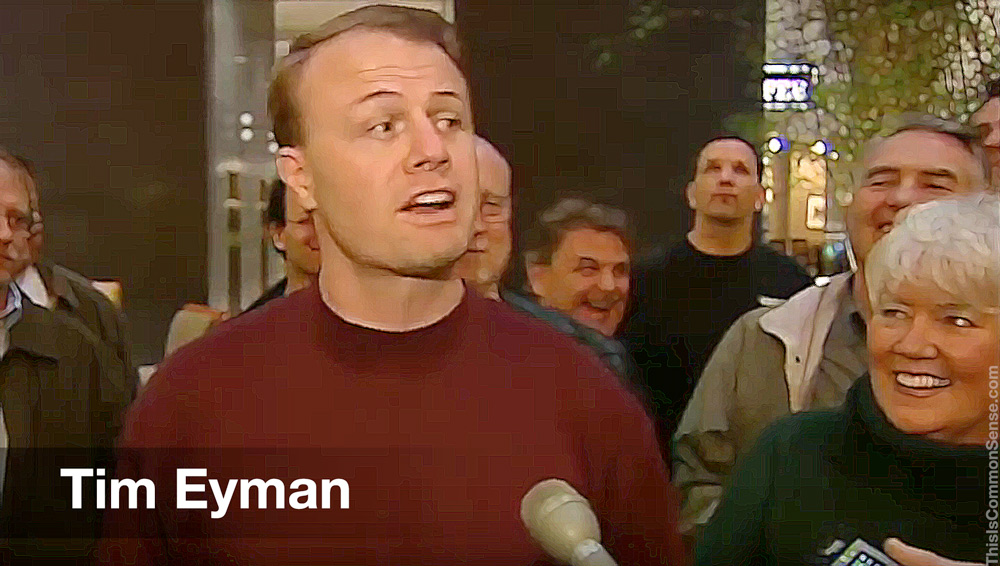
A ballot initiative sponsored by Tim Eyman and Voters Want More Choices offered one method, mandating advisory votes for Washington State’s electorate to approve or disapprove the last 19 tax increases passed by legislators.

These advisory tax questions sometimes garnered more votes than races for superintendent of public instruction and the state supreme court. Results? Mixed. Seven times voters favored the legislators’ tax hikes, while opposing the other 12. 

Either way, good info for legislators to know, no? 

No . . . apparently. Conceited Washington state politicians don’t want to know what voters think. The core idea behind Senate Bill 5224 is stopping voters from officially expressing their will on taxes by getting rid of these pesky advisory votes.

In testimony last week, Tim Eyman reminded legislators that voters have four times mandated advisory votes on tax increases (2007, 2010, 2012, 2015); have six times voted to require a two-thirds legislative majority to raise taxes, only to have those measures overturned in court; and that legislators have prevented citizens from using the state’s referendum process by attaching phony emergency clauses to tax hikes.

“Give the peasants a couple of crumbs,” Eyman beseeched, “and let them at least express an opinion at the ballot box.”

This is Common Sense. I’m Paul Jacob. 


PDF for printing

Tim Eyman, democracy, initiative

See all recent commentary
(simplified and organized)
See recent popular posts