Categories
ballot access initiative, referendum, and recall local leaders political challengers Regulating Protest too much government

New-Fangled Vote Counting

Call me old-fashioned, but when you go to the pols to cast your vote on a ballot measure, your Yes vote should count for yes and your No vote for no.

And if you choose not to vote, your non-vote should count for neither yes nor no.

That’s just common sense. Right?

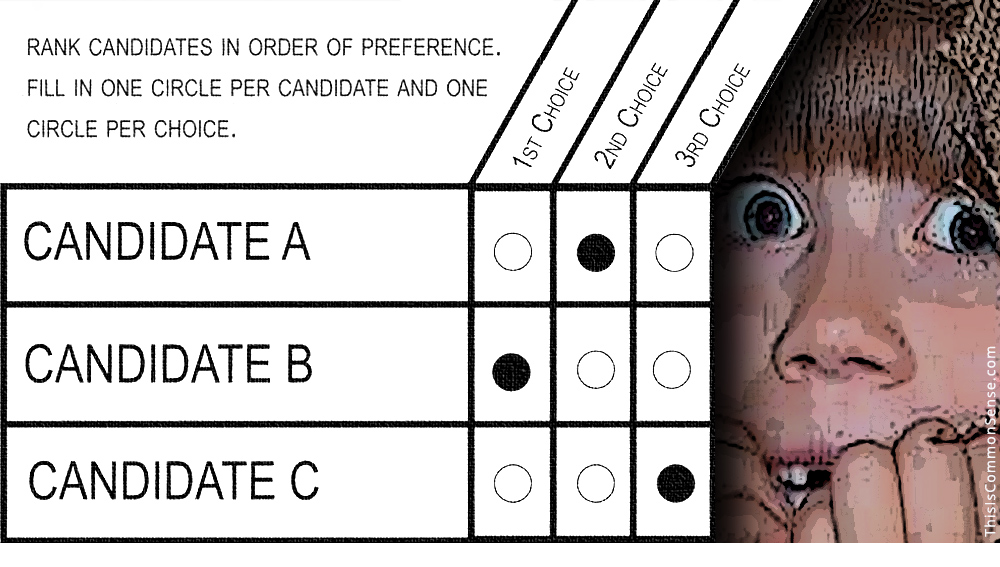
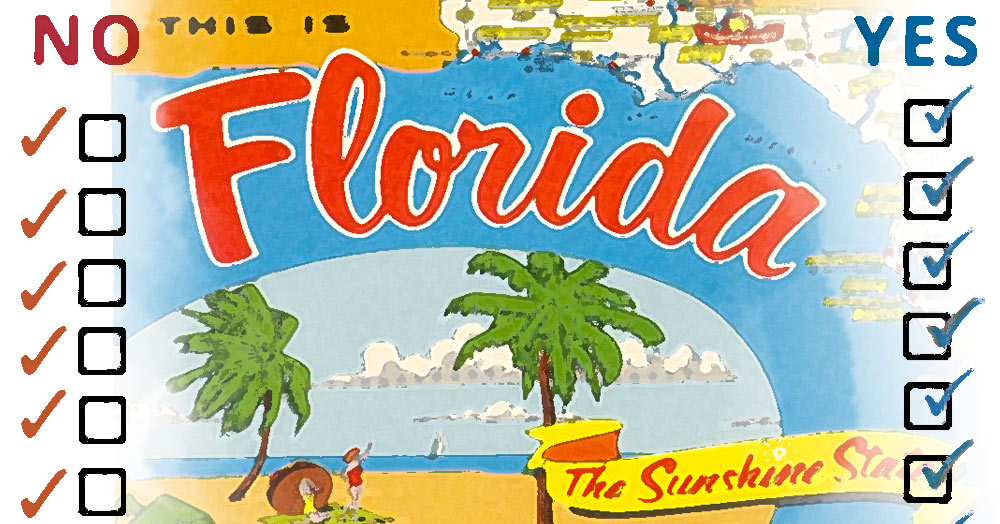
Well, meet its antithesis: Proposal 97, now being considered by Florida’s powerful Constitution Revision Commission (CRC).* Proposal 97 would count all those who do not cast a vote for or against a ballot measure as a No vote against it.

To pass a constitutional amendment in the Sunshine State already requires a supermajority vote of at least 60 percent of those who do cast a vote on the measure. Under Proposal 97, counting all those not voting on it as No votes, that percentage would necessarily go even higher. If 10 percent don’t vote, Yes would have to come in at 67 percent to win.

This is minority rule . . . with an extra perverse twist.

The supermajority requirement encourages big money interests to spend heavily against ballot initiatives — even when the issues have clear majority support — because if they can manage to lose by less than 20 points (60–40 percent), they win. Now all opponents need do is poison the water with the nastiest campaigning imaginable, causing more voters to throw up their hands or pinch their noses and avoid the issue . . .

. . . thus, being counted as voting No.

Don’t abstain. Stop Proposal 97. Tell them NO here.

This is Common Sense. I’m Paul Jacob.


* How powerful is the CRC? Every 20 years it meets with the awesome authority to refer constitutional amendments directly to the ballot — as many as it wishes and the amendments can be packaged to include several different subjects. No other state has a similar body. Of the 37 commission members, the governor appoints 15, the Senate president and the House speaker each appoint nine, the chief justice of the state supreme court appoints three and the attorney general is an automatic member.


PDF for printing


Categories
Accountability ballot access general freedom government transparency initiative, referendum, and recall local leaders moral hazard

Fear of Voters

You are a state legislator, say. And an issue could be placed on the ballot on which a majority of your state’s citizens might not vote according to your preference. What would you do?

  1. Educate your fellow citizens on the merits of your position; or
  2. Dawdle while calling a lobbyist for advice; or
  3. Change the constitution to make it impossible for such a vote to ever be held?

State Rep. John Enns chose option C — perhaps after exhausting B. Stamping out Oklahoma’s ballot initiative process, freeing Enns and other legislators from this citizen check at the ballot box, is the essence of his House Bill 1603.

The Sooner State already possessed the toughest petition requirements in the country.  Supporters must gain the country’s highest percentage of voter support (15 percent) while limited to the second shortest time period (90 days) to circulate petitions.

On top of this current statewide slog, Enns’ constitutional amendment would require also qualifying in every single county. Oklahoma has 77 counties.

As the Tulsa World editorialized, “he wants to make it impossible.”

What lousy rationale lies behind Enns’ desire to destroy democratic governance?

In response to another legislator’s query about his “fear that some marijuana bill will . . . become a state [ballot] question,” Enns claimed his effort was “not pre-emptive.” But he acknowledged his strong opposition to legalizing recreational marijuana, which he pointed out “had been done through initiative petition” in other states.

Enns is afraid of Oklahoma voters having their say. He should be.*

This is Common Sense. I’m Paul Jacob.


* I mean, of course, that Rep. Enns should fear being booted out of office on his keister. He should not have to fear physical reprisal. The Tulsa World reports that the Oklahoma Highway Patrol is now providing security to Enns, after a death threat was received related to his HB 1603.


PDF for printing


Categories
Accountability general freedom ideological culture media and media people Popular term limits

Let There Be Light

The Washington Post sports a new masthead slogan: “Democracy Dies in Darkness,.”

A story in last Sunday’s Metro section suggests that the editors are yet to fully implement the slogan’s implicit mission — providing impartial, unbiased illumination. “Term limits for Maryland legislators?” reads the headline. “Here’s why that’s unlikely,” it immediately answers.

“Term limits seem highly popular in Maryland,” begin the article.

Seem?

What produces that elusive sensory perception? I mean, other than every poll ever taken and, as the Post elaborates, “Voters in the state’s two largest jurisdictions, Montgomery and Prince George’s counties, strongly endorsed them at the polls in recent years.”

Add to that three other counties, which had previously enacted term limits, the paper informs.

Still, the idea is “widely considered dead on arrival.”

Why? you ask.

It’s very difficult,” explains Gov. Larry Hogan, “to convince people to willingly give up their power.”

“People” not as in “the People” but, instead, such as Senate President Mike Miller, a 46-year incumbent and the Senate boss for three decades running, and Speaker Mike Busch, a 31-year incumbent and the longest serving speaker in state history.

But wait . . . why didn’t politicians in those five Maryland counties block term limits like state legislators “likely” will? Did their lack of experience cause them to forget to be self-serving jerks?

No. Counties in Maryland have a ballot initiative process whereby citizens can petition term limits directly to a democratic vote. Their elected servants simply cannot ignore them.

The Post piece could have pointed out that very difference — between the democratic outcomes in those counties and an unrepresentative one at the state capitol.

It did not.

Democracy dies in darkness.

This is Common Sense. I’m Paul Jacob.


PDF for printing


Categories
Accountability ballot access general freedom government transparency initiative, referendum, and recall local leaders national politics & policies political challengers responsibility tax policy term limits too much government

What Unlimited Government Costs Us

“Olympia can’t restrain itself,” Tim Eyman wrote the other day, a judgment on legislative irresponsibility hardly unique to the Evergreen State. Citizens around the country have cause to lament the difficulty of obtaining anything close to a good legislature.

Too often the merely “bad” would constitute a significant improvement.

Which is why legislators need to be put on a short leash. Limits on government must be written into law, where possible into either the U.S. Constitution or state constitutions, so the limits cannot be tampered with by legislators, good or bad.

Washington State initiative guru Tim Eyman, cited above, has made a career of working for just those kinds of limits. In 2007, Eyman and the citizen group Voters Want More Choices petitioned onto the statewide ballot a requirement that any tax increase must receive a two-thirds vote from both legislative chambers.

Voters passed the measure* in 2007, 2011 and 2012.

In an email to supporters this month, Eyman presents data — an “amazing real-world comparison” — to help us understand how effective the limits were . . . while they lasted.

He notes that “with the 2/3 rule in effect from 2008-2012, those 5 legislative sessions cost the taxpayers $6.894 billion” in increased taxes.

And he compares that to the five years (2013-2017) since the state’s highest court struck down the voters’ two-thirds mandate: “WITHOUT the 2/3 rule, those 5 legislative sessions cost the taxpayers $23.679 billion.”

“Without the fiscal discipline imposed by citizen initiatives,” Eyman concludes, “politicians cannot hold back.”

Now we have hard evidence for what unlimited government costs us: more than three times more!

This is Common Sense. I’m Paul Jacob.


* Washington State’s ballot initiative process allows voters to pass simple statutes but not constitutional amendments. For two years after passage, legislators must garner a two-thirds vote to override a ballot initiative. After those two years, only a simple majority is required.


PDF for printing


Categories
Accountability general freedom moral hazard national politics & policies responsibility

The Online Manipulation of Democracy

There exist many sneaky ways to get other people to do what you want, voluntarily — effectively blurring the line between legitimate persuasion and fraud.

When large, almost unavoidable private companies apply those techniques to targeted groups of voters, that blur might look something very much like election fraud.

Harvard psychologist Dr. Robert Epstein has been studying hidden online persuasion techniques. Interviewed by Tom Woods last Friday, the doctor explained several sub rosa persuasion techniques, especially the fascinating Search Engine Manipulation Effect (SEME), which he says has been replicated in studies by other researchers. 

SEME, he argues, is a “genuinely new” way to manipulate masses of people — without them realizing it.

And it sports “one of the largest effects ever to be discovered in the behavioral sciences.” Google, it turns out, can influence voter and consumer behavior merely by ordering search results in specific ways. Going into his first study, he suspected he might discover a 2 percent influence on voter behavior. He got 48 percent, instead.

There is more: not only can Google do this, the behemoth does do this — Epstein has documented that Google did it in the last election. 

Supporting, or to the benefit of, Hillary Clinton.

Understandably, Epstein scoffs at the “fake news” panic as something insubstantial in comparison. The potential impact of this online manipulation dwarfs the allegations of Russian influence.

I wonder: Did Mrs. Clinton know that her very special high-tech friends were pressing their very big thumbs onto the scale of democracy?

It seems a very old tech — the Electoral College — effectively counteracted the manipulation.

This time.

This is Common Sense. I’m Paul Jacob.


PDF for printing

Categories
Accountability folly general freedom local leaders media and media people moral hazard national politics & policies responsibility

Another Election “Against”

As I write, Democratic candidate Doug Jones has just taken the stage to declare himself the winner of the Alabama Senate race, the one in which Roy Moore became more infamous than famous, and better known for the worst kind of reasons.

The final counts are not in, and I suppose there could be a turnaround at the last moment, but it doesn’t look like it. It looks like Republicans lost the seat. Hillary Clinton is already crowing that this is a sign of more Democratic victories to come.

Maybe.

Too soon to tell.

Meanwhile, what to make of it all? Jones has declared that “This entire race has been about dignity and respect. This campaign has been about the rule of law.” And I am not certain that is a good description. It seemed to me what the campaign turned into was a referendum on whether voting for a man accused of sexual assault and statutory rape was a good idea.

There were also Republicans thankful that Moore lost. “Decency wins” is what Senator Jeff Flake tweeted; “Suck it, Bannon,” is Meghan McCain’s eloquent taunt. (Steve Bannon had backed Moore.) Reason’s Scott Shackford probably put it best, writing that “Polls have closed in Alabama as voters there decide between controversial former judge Roy Moore and … um … not Roy Moore.”

The modern American political process is now firmly a matter of reiterating this pattern: voting against more than for.

A horrible development? Well, there sure is a lot more to be against in American politics, than for.

This is Common Sense. I’m Paul Jacob.


PDF for printing


Categories
general freedom incumbents local leaders moral hazard national politics & policies responsibility too much government

Democracy — or Too Much Government?

The Democratic Party’s Unity Reform Commission met last week to concoct measures to pull the party from the brink of madness and oblivion.

The commission’s main recommendation? Limit the role of “superdelegates” in the nomination process.

Great — a first step I’ve long advocated. But the whole system needs more serious reform.

Jay Cost covered some of the problems associated with the parties’ candidate selection processes, yesterday, in the online pages of the National Review. Unfortunately, he went off the rails about an alleged “trend toward an unadulterated democratic nomination process,” which he regarded as a “major mistake.”

He misdiagnosed both the problem and the Democrats’ proposed cure. Neither is “too much democracy.”

America’s partisan voters keep selecting bad candidates because the major party duopoly is a rigged game — designed and regulated by incumbents for incumbents to solidify a protected class of insiders.

Which voters understandably seek to overthrow on a regular basis.

The problem is the whole primary process, which is faux-democratic, a clever ruse to prevent real challengers from emerging, forcing effective politicians through the two-party mill.

To make things more democratic — to add effective citizen checks on power and privilege — the parties need to be completely divorced from official elections. That is, junk the whole primary system, making the parties bear fully the costs of their own selection processes. Further, the general elections should be thrown open to a wider variety of parties and candidates, with the voting system itself reformed to avoid the sub-optimal results of our first-past-the-post system.

The problem with our politics isn’t “too much democracy” so much as “too much partisan government.”

This is Common Sense. I’m Paul Jacob.


PDF for printing


Categories
Accountability folly general freedom government transparency initiative, referendum, and recall local leaders moral hazard national politics & policies term limits

Illinois’s Chicken-and-Fish Supreme Court

A constitution is the law of the land only to the extent that it’s enforced. And in Illinois, the right of citizen initiative — provided for in the state constitution — is not enforced.

The constitution’s wording is explicit: “Amendments . . . may be proposed by a petition signed by a [specified number of electors]. . . . Amendments shall be limited to structural and procedural subjects contained in Article IV.”

Does that Article IV discuss the subject of election procedures, including eligibility requirements, thereby opening the door to a citizen-initiated term limits amendment? Yes, it does. Section 2, subsection (c), for example, specifies citizenship, age, and residency requirements.

Yet the Illinois Supreme Court has repeatedly chucked the results of effective petition drives to get a state legislative term limits question on the ballot.

The justices rely on the venerable Fallacy of Tortured Misreading.

Former Illinois legislator Jim Nowlin recently pointed out that in 1976, the court concluded that the wording about how initiative proposals “‘shall be limited to structural and procedural subjects’. . . meant a proposal must make both kinds of changes.” The lone dissenter on the court “opined to the effect: When I see a restaurant sign that says, ‘We have chicken and fish,’ that doesn’t mean you have to order both chicken and fish!”

The right of citizen initiative is a crucial means of reforming government when those in government won’t reform themselves. The citizens of Illinois have that right. But, for now, they also don’t.

That ain’t Common Sense. I’m Paul Jacob.


PDF for printing


Categories
Accountability general freedom government transparency incumbents initiative, referendum, and recall local leaders political challengers

Initiative Surplus?

Only nine out of 50 states can pay their bills and meet their obligations; 41 cannot, barring major tax increases or spending cuts.

That’s what we learn in last month’s “Financial State of the States” report from Truth in Accounting (TIA).

Alaska is in the best shape, “with $11 billion in assets to pay future bills”; New Jersey’s in the worst, needing “to come up with $208 billion in order to meet its promised obligations.”

Sheila Weinberg, TIA’s founder, works hard to counter governments’ creative accounting. It’s trickery, really, which “would be considered criminal for private sector corporations.” One gimmick is “promising to pay employee benefits in the future, but not fully funding the benefits programs as they rack up obligations.”*

Thankfully, TIA’s financial analysis includes items such as already-made pension and healthcare commitments.

Now, let’s expand the analysis, collating these findings to separate between initiative and non-initiative states**:

  • Seven of the nine states with a “taxpayer surplus” — where government can pay its bills and meet its obligations — have the ballot initiative process.
  • The 23 initiative states comprise 46 percent of the states. Yet, initiative states comprise a whopping 78 percent of financially healthy states.
  • Of the 20 states carrying a larger-than-average taxpayer burden, 15 states (75 percent) lack the initiative process.

Granted, this represents a correlation between states with citizen-initiated ballot measures and healthier fiscal policy, not necessarily causation. Still, I’m not surprised states where citizens have more say so are better governed.

This is Common Sense. I’m Paul Jacob.


* “This short term fix allows governments to artificially ‘balance their budgets’ by not counting certain obligations as official debt.”

** There are 23 initiative states and 27 non-initiative states. Two referendum-only states— Maryland and New Mexico — are considered non-initiative states, and so is Illinois. Illinois is considered a non-initiative state, because its ballot initiative process is so severely restricted as to be non-existent. Only one measure has ever appeared on the ballot.


PDF for printing


Categories
folly ideological culture media and media people national politics & policies

A Special Place in Heck?

Former First Lady scolds women for not voting . . . for a former First Lady.

Yes, “Michelle Obama,” the BBC headlined last week, “scolds female Trump voters.”

Need you ask why? You probably have already guessed.

“Any woman who voted against Hillary Clinton voted against their own voice,” Mrs. Obama remarked at a Boston conference.

Though a majority of women who voted cast their ballots for Mrs. Clinton, a slightly smaller majority of white women voted for Donald Trump.

And to those women who did not vote for Hillary? “Well, to me that just says, you don’t like your voice.”

The idea that one woman candidate can serve as “the voice” for all women is not merely absurd. It is sexist. But it is something that this most recent First Lady shares with the former First Lady who just lost a major election. Yes, Hillary Clinton has said much the same kind of thing. And Madeline Albright, Secretary of State under Clinton’s husband’s command, famously argued “there is a special place in hell” for women who refuse to toe the line and vote Clinton II.

Heck, there is a special place for women who think, appraise and choose against social pressure: America. Here people matter as individuals, as persons, not as members of their race, religion, sex, or . . . political party.

But the arrogance of these women leaders shows no understanding of effrontery. “You like the thing you’re told to like,” Mrs. Obama belittled female Trump voters.

Truth is: women were repeatedly told to like Hillary for president. But they refused to do as they were told, which is why Mrs. Clinton and Mrs. Obama are attacking them.

This is Common Sense. I’m Paul Jacob.


PDF for printing