Categories
nannyism too much government

Politicians & Pain

Whenever a new panic runs through corporate media and the grapevine — and especially when the lesson is supposed to be ‘we’ve gotta do something!’ — it is time to slow down. And look at the facts.

The opioid crisis is one of those panics.

The almost immediate reaction from politicians has been to point their quivering fingers at doctors and drug companies on the theory that doctors have been over-​prescribing opiates, instigated by pharmaceutical companies.

Seems a ‘round up the usual suspects’ approach to public health.

Now there appears to be good research to back up our skepticism. According to Cato’s Jeffrey A. Singer, recent studies show “there is no correlation between opioid prescription volume and non-​medical use or opioid use disorder among persons age 12 and over.” Nevertheless, Dr. Singer notes, “policymakers and law enforcement continue to pressure health care practitioners into undertreating patients in pain.” 

An under-​treatment result is scarier, to me, than the desperate and dangerous self-​medication problem that must lie at the core of the crisis we read about. Patients in too much pain because doctors are afraid of government harassment are pushed to unsupervised pain management … which looks an awful lot like a simple description of the opioid crisis itself.

Singer provides confirmation of an unintended effect: the fentanyl and heroin overdose rate “continues apace” even as the opioid prescription volume plummets.

“At a recent international breast cancer conference experts stated the under-​prescribing of opioids to breast cancer patients in the U.S. is now comparable to treatment in third world countries,” warned Singer. 

One word: yikes.

I am tempted to define today’s politics itself as a kind of pain mismanagement.

This is Common Sense. I’m Paul Jacob.


PDF for printing

opioid, crisis, pain, drug, law, politician, ban, prohibition, control, medicine,

See all recent commentary
(simplified and organized)
See recent popular posts

Categories
Accountability folly general freedom ideological culture media and media people moral hazard responsibility

Too Big for Breaches

“Any reporter who has covered Europe in the last decade has written a dozen articles or more,” The New York Times informs us, “about how one crisis or another has exposed the fundamental unsustainability of the European Union.”

I hadn’t noticed. Until recently, haven’t reporters and commentators been downplaying Europe’s looming crisis? But they cannot pretend “far right” separatist, decentralist and nationalist movements are marginal any longer, not after strong showings for Geert Wilders in The Netherlands and Marine Le Pen in France, and the Brexit vote. 

Now everybody seems to be panicking. 

Even the Times is half-​predicting an end to what it calls the “European Experiment.”

The Times identifies the tension as arising from “calls for keeping out secondary migrants and demands to keep internal European borders open. It’s a version of the contradiction within the European Union itself: between an open union and a collection of sovereign states.”

Beneath all the brouhaha about freedom of movement across breached borders lies the real contradiction: between massive welfare states on the one hand and, on the other, freedom of movement, speech and all the rest.*

When governments offer freebies, they entice people into un-​productive or at least sub-​productive lifestyles. Which is not sustainable, especially when extensive. How many productive people must support how many unproductive people?

Then throw those domestic programs open to millions of migrants who lack even rudimentary language and First World skills? That’s how states subsidize their societies’ destruction.

Europe’s governments are way too big for their border breaches.

If you want traditional freedoms, you have to pare down government.

This is Common Sense. I’m Paul Jacob.


*Between social democracy (socialism lite) and the old liberal order.


PDF for printing


Categories
Accountability folly government transparency local leaders moral hazard porkbarrel politics responsibility too much government

Babylon Goes Broke

A few Babylonian, er, California cities going bankrupt — Stockton, Vallejo, and Bell — should be seen as more than dead canaries in a coalminer’s care. 

Indeed, you don’t need special prophetic gifts to see the dangers posed by over-​promising cushy pensions to government workers. Californians are coming around. And the state’s governor, Jerry Brown, appears to be “calling for reductions in gold-​plated, unsustainable public-​sector pensions,” as Nick Gillespie informs us at Reason.

But statewide reforms will not be easy. The problem is huge, presenting grave costs. “Absent the ability to alter pensions, states and localities have to devote more and more of their taxes to simply covering the costs of retired workers,” Gillespie explains. “Worse still, they often raise taxes to cover rising costs, typically at the expense of providing basic services such as police and road maintenance.”

Yes, over-​promising defined-​benefit pension packages effectively distributes wealth away from basic government services and into the pockets of the people with whom politicians work most closely.

Unfortunately, the courts long ago decided that politicians’ promises to employees outweigh basic government duties. That is, the courts determined that “public-​sector employees at all levels of government had an inviolable right to the pension benefits that existed on the day they were hired.”

But the courts seem to be lightening up on this “California Rule,” and the governor has dared mention that, come “the next recession,” some headway might be possible.

No matter what you may think of this rather desperate hope, the writing is on the wall. And it is in red ink and numbers, not Babylonian.*

As America’s Babylon is finding out.

This is Common Sense. I’m Paul Jacob.


* And not “Mene, Mene, Tekel, Upharsin.”


PDF for printing


Categories
Accountability crime and punishment folly free trade & free markets local leaders nannyism national politics & policies too much government

Messed Up State

After lamenting Illinois’s fiscal decline into America’s “most messed up” state yesterday, lo and behold, today we find the State of Nevada messed up, too.

On marijuana.*

Question 2, passed by voters last November, legalized recreational use of what we used to call “weed” by those 21 years of age and older. The measure also stipulated that — for the first 18 months only — alcohol distributers are solely permitted to carry marijuana from wholesalers to the new retail dispensaries.

Why provide a monopoly to alcohol distributors? 

“[T]he state’s powerful alcohol lobby worried that legalized weed would cut into liquor store sales,” explained the Los Angeles Times. Proponents added that provision as “a concession.”

But still not a single alcohol distributor has been approved to distribute marijuana. 

So, with pot now flying off the shelves of Nevada’s 47 marijuana dispensaries, there is no lawful way to replenish those shelves. Nevada’s DOT (which requested from the governor an official declaration of a state of emergency) warns: “this nascent industry could grind to a halt.”

That’s not just a bummer for pot smokers; it has the governor and the DOT in a state, too. “A 10% tax on sales of recreational pot — along with a 15% tax on growers — is expected to generate tens of millions of dollars a year for schools and the state’s general fund reserves,” notes the Times.

Legalize marijuana, sure. And realize that the politics of it can be more toxic than the drug itself.

This is Common Sense. I’m Paul Jacob.


*Is that why the slogan “A World Within, A State Apart” is now featured on the state’s website?


Printable PDF


Categories
Accountability free trade & free markets government transparency ideological culture media and media people nannyism national politics & policies responsibility

A Diminishing Lagtime

The modern age sports an amazing feature that used to be hard to detect, because so drawn out: a shorter-​than-​ever-​before lag between the proposal of some popular inanity and its complete debunking.

It used to take seemingly forever for a bad idea to be shown up, either in argument or evidence. Now it can be a matter of days or even hours. Call it the Buncombe/​Debunking Lagtime.

Take the Flint, Michigan, water fiasco.

When the story hit the news cycle, almost immediately the progressive meme machinery began cranking out slogans imposed upon visuals — jpegs and gifs — to the effect that the poisoned water was the result of Republican “austerity” or (even) “libertarian” policy.

Somehow a Democratic mayor was less to blame than a more distant Republican governor, but in the minds of knee-​jerk partisans, common sense is not as important as an in-​your-​face accusation.

But now, days and scant weeks into the story, it turns out that the story behind the story is not merely wrong, but entirely, upside-​down wrong. The Flint water fiasco was caused by a stimulus project, and the switch from bad to worse water sources was made to promote “jobs”!

In the words of Reason’s Shikha Dalmia, “the Flint water crisis is the result of a Keynesian stimulus project gone wrong.”

Yes, another failed Big Government policy — just like progressives are always pushing.

And it didn’t take years for the truth to seep out.

Hooray for today’s accelerated history! Now, if we could only decrease the lagtime between lesson given and lesson learned.

This is Common Sense. I’m Paul Jacob.


Printable PDF

Flint, water, crisis, government, austerity


Categories
folly free trade & free markets ideological culture meme moral hazard nannyism responsibility too much government

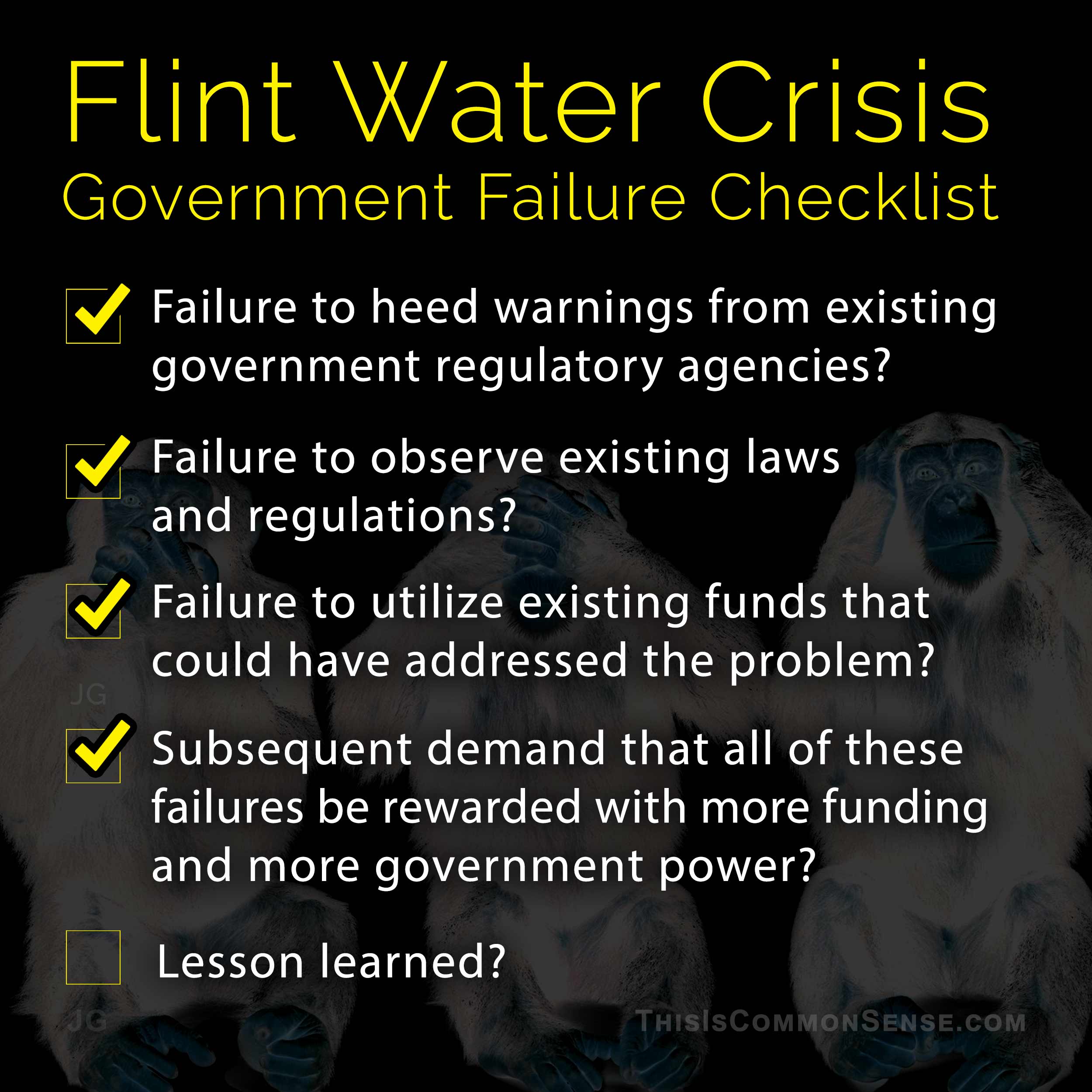
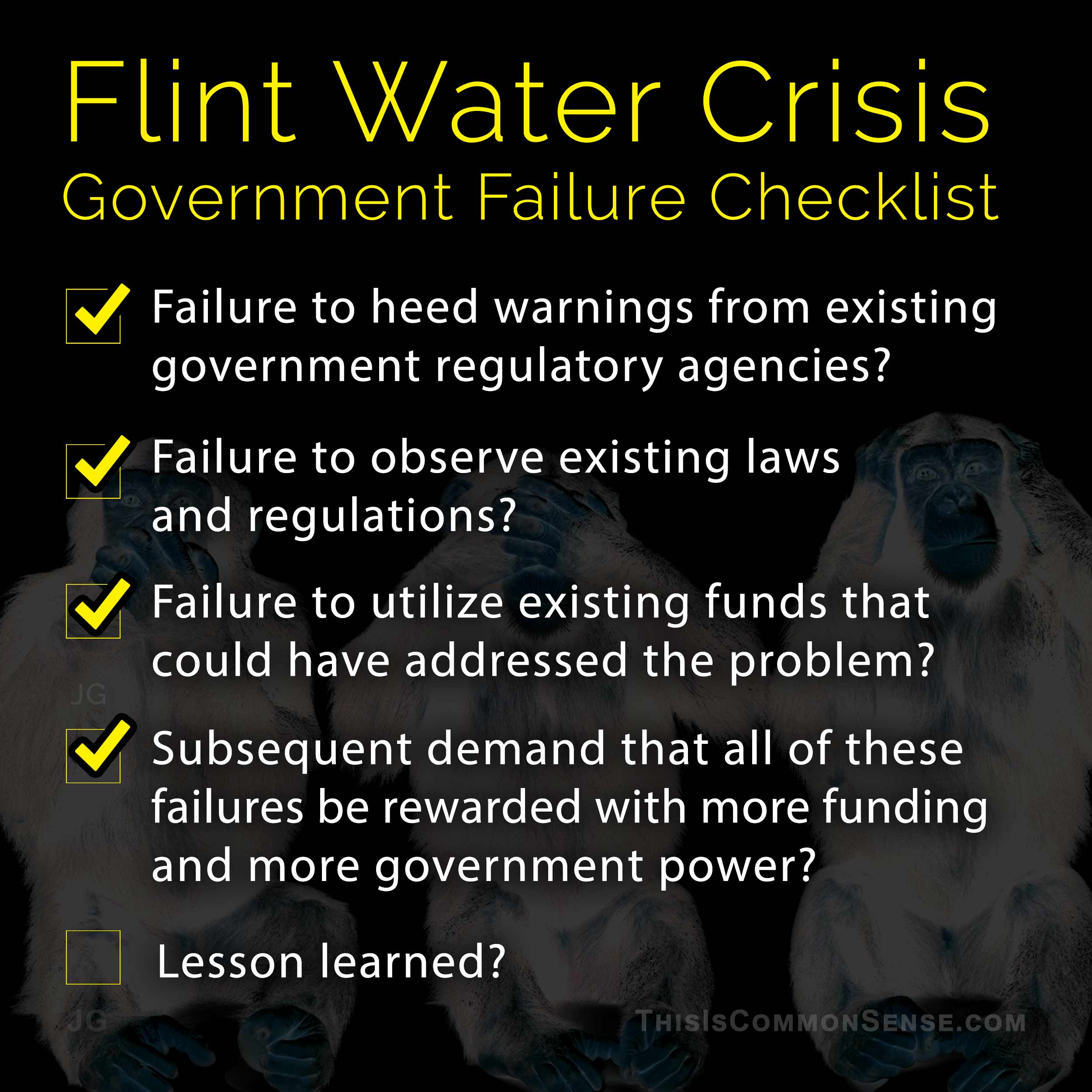
Flint Water Crisis

Government failure checklist…

Reference:

The Government Poisoned Flint’s Water—
So Stop Blaming Everyone Else

Flint’s water crisis isn’t a failure of austerity. It’s a failure of government.


Click below for high resolution version of this image.

Flint, water, crisis, poison, government, free market, austerity, failure, Common Sense, Meme, James Gill, Paul Jacob


Categories
free trade & free markets too much government

Head Over Heals for Stimulus

Which thinker is more relevant right now, Lord Keynes or Naomi Klein?

We’ve hit hard times. The Keynesian advice is to spend a lot of taxpayer money to make up for the lack of private spending, thereby jump-​starting the injured market order.

Naomi Klein, on the other hand, is best known for her book “The Shock Doctrine,” in which she charged that free-​marketers were conspiring to use social and economic crises as excuses to “take over” and remake the world in their favor.

Let’s look at the evidence, shall we? We’ve hit a crisis. The government has done the Keynesian thing. Unemployment went up, but … who has made the biggest gains?

USA Today reports that federal workers are enjoying a boom in both employment and salaries. “Federal employees making salaries of $100,000 or more jumped from 14% to 19% of civil servants during the recession’s first 18 months” — and that’s not counting overtime and bonuses!

It’s not markets being stimulated, here, but government.

Not only is this Keynesianism on its head, but Naomi-​Kleinism, too. Those who have taken advantage of the crisis are the ultimate insiders. As a Washington Examiner editorial puts it, “bad times for the rest of us are good times for the federal establishment.”

We could wish Naomi Klein were right.

But things aren’t getting better because she’s wrong.

This is Common Sense. I’m Paul Jacob.

Categories
general freedom

Panic in the Streets

A few people get sick, and schools shut down.

We have been having and enduring flu epidemics for some time. And people have died even in minor outbreaks. The difference now is that the patterns of epidemiology have become nightly news.

Why the talk about shutting down everything — schools, businesses, government offices? To prevent a major pandemic, like the 1918 Influenza outbreak, which killed millions.

The president went out of his way to tell us to avoid panic. The vice president, on the other hand, went on one of his jags and helped foment more panic.

The media, of course, abundantly repeated the message of panic.

Last autumn, the head honchos in Washington sowed the seeds of panic by proclaiming the mortgage-​based financial bubble the worst economic disaster since the Great Depression. Hardly before anyone had received a pink slip, the government was giving away billions of dollars.

And then, they switched rationales and plans. And then they gave away more. Rinse. Repeat. Only the panic remains.

Well, stock up on water and masks and food. And cash. Or gold. That’s fine. But be wary of stocking up on too much government. When we panic we are not thinking straight, that’s when we are likely to lose the most. With the government and the media leading the charge.

This is Common Sense. I’m Paul Jacob.