Categories
Accountability crime and punishment government transparency media and media people moral hazard national politics & policies privacy Snowden

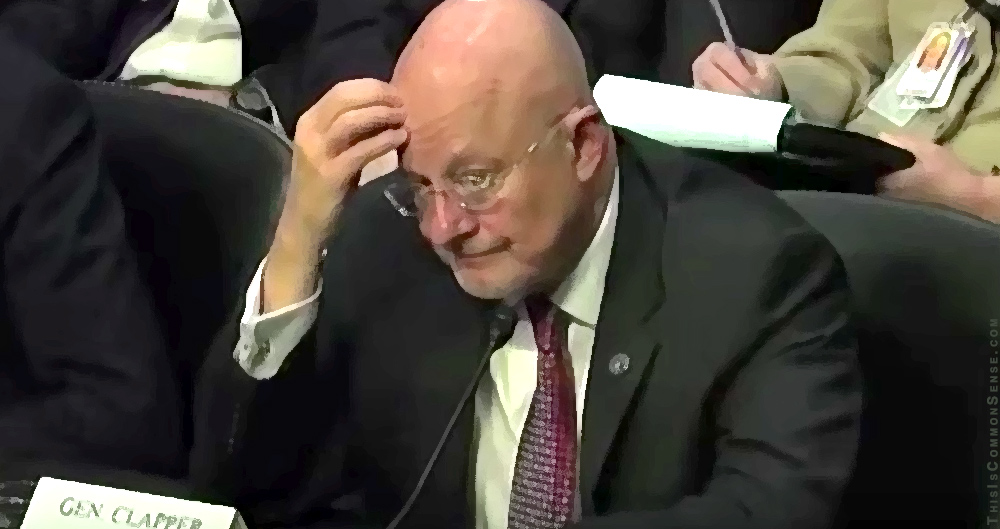
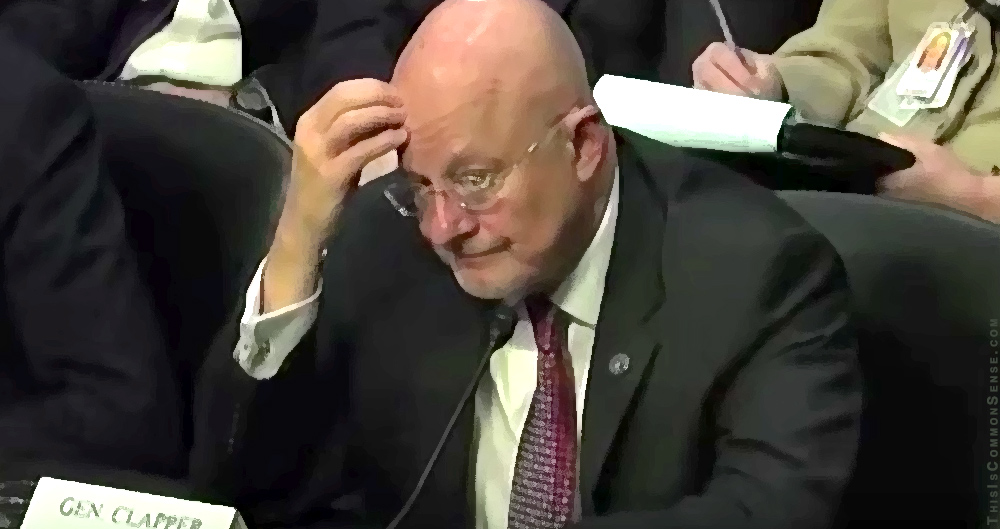
Clapper into the Clink?

Lying to Congress is a strange crime. A number of people have been prosecuted for it over the years, but Congress isn’t a court of law and, more to the point, Congress may present the densest source of lies in the United States.

The idea that it would be illegal for a citizen to lie to a den of liars is, well, a bit amusing.

But it is illegal, and definitely should be illegal, for government functionaries to give false testimony before Congress.

That’s why the case of the admittedly “untruthful”* James Clapper is so aggravating. When asked by Senator Ron Wyden, on the Senate floor, about data collection of phone calls by the U.S. federal government, he — the director of national intelligence under President Barack Obama from 2010 to 2017 — lied through his teeth.

And had not Edward Snowden leaked information on the National Security Administration’s metadata collection program, we would not have learned anything about it.

No wonder, then, that several congressmen want to prosecute Clapper before March 12, when the Statute of Limitations runs out on his crime. Steven Nelson at the Washington Examiner quotes Rep. Ted Poe (R-Tex.), Rep. Thomas Massie (R-Ky.), Rep. Louie Gohmert (R-Tex.), and Rep. James Sensenbrenner (R-Wis.) as all being in favor of siccing federal prosecutors on the forked tongue spymaster.

Senator Wyden warns that letting lies such as Clapper’s go unaddressed encourages Americans to be cynical about government, and “makes it possible, even probable, for hucksters and authoritarians to take power.”

Too late?

This is Common Sense. I’m Paul Jacob.


* Clapper’s March 2013 whopper at the Senate Intelligence Committee hearing was that the NSA was “not wittingly” collecting “any type of data at all” on millions of Americans. Later, to MSNBC, he characterized his artful dodge as having been “the least untruthful” way for him to respond.


PDF for printing


Categories
crime and punishment folly general freedom ideological culture moral hazard nannyism

Loco Micro Repression

Close but no cakewalk prize.

Modern social justice advocates sometimes come up with legitimate complaints . . . only to wander off terra firma and into cloud-cuckoo land.

“Microaggressions” is one of these airy wanderings, and Katherine Timpf has spotted another in the ever-growing catalog of social justice beefs:

The size of our society’s chairs is now being considered a “microaggression” against overweight people, according to a guide released by The New School, a private college in New York City.

Proponents of this cause, Timpf notes, insist that “Microaggression is not ‘Micro’ in Impact,” and that the best response to faux pas, slights, indelicacies, and what-have-you is snitching to the administration and intervention from same. Quite overbearing, if you ask me. During my too brief college stint it would have been considered an insult — a microaggression? — to think that young adults could not handle minor affronts such as so helpfully listed at The New School.

But let’s get real here. Microaggressions do not justify treating adults as children and setting up college administrators as in loco parentis tribunals — much less Molotov cocktails, sucker punches or bike locks in socks. At best, as has been pointed out elsewhere, Ned’s microaggression justifies Zed’s microretaliation. Nothing more.

So how does one micro-respond?

Manners; etiquette.

In olden times, a well-mannered person, when snubbed or otherwise insulted had the option of responding with a cutting remark . . . without any actual cutting, without even raising the tone of his or her voice.

Activists and collegians really should look into it.

And not bring up chair size: the micro-chair/macro-posterior issue has too many “microaggressive” jokes built into it.

This is Common Sense. I’m Paul Jacob.


PDF for printing


Categories
Accountability crime and punishment folly ideological culture moral hazard national politics & policies responsibility

Excepting Responsibility

Responsibility: demand it of others, expect it demanded of you.

So you might think that those who try to redress old grievances with compensatory (“reverse”) discrimination would be a bit more careful.

Yesterday I wrote about the bizarre Google Memo case, wherein an employee was fired for (basically) warning of a groupthink ideological monoculture at Google . . . thus proving him right.*

Last weekend I wrote about racial quotas in college entrance.

In both cases, there’s this idea that moderns in general and white males in particular must “accept responsibility” for the past.

And the evidence is undeniable: Our pale-faced ancestors — or more likely a very small percentage of other white people’s ancestors — held human beings in bondage. So, too, did almost all peoples around the world; slavery’s old. Here in these United States, after our bloodiest war, our forebears ended that ancient crime. Then there was another century of Jim Crow discrimination, with systemic violence committed against blacks in many areas of the country, often with government acquiescence or involvement.

Harvard and other educational institutions are trying to right those wrongs.

But there’s a problem: the principle behind their affirmative action schemes is lunatic: Each person of one race bears responsibility for the crimes committed by any person of that same race.

Far better is individual responsibility. Individuals have every right to compensation for any harm another has caused them, certainly. But folks have no right to create new harms against innocent people who happen merely to be of the same race or gender as those who have caused them past harm.

Justice is supposed to be blind, not crazy.

This is Common Sense. I’m Paul Jacob.


* The author, it is worth noting, addressed this monoculture in his title, “Google’s Ideological Echo Chamber.” I wonder if being proven right by one’s enemies compensates for job loss.


PDF for printing


Categories
Accountability crime and punishment folly free trade & free markets general freedom moral hazard nannyism too much government

Pardon Him, Mr. President

Presidents tend to issue pardons as their tenures draw to a close. But many victims of our government should be pardoned right now. Until the culpable agencies can be dismantled and/or sundry bad laws repealed, a steady flow of presidential pardons would provide the swiftest justice.

An Amish man in Kentucky, Samuel Girod, has been convicted of selling herbal remedies and such crimes as “failing to appear.” It doesn’t add up to one day in prison, let alone the six years of his sentence.

Girod created a salve from natural ingredients for treating skin disorders. After the state health department demanded that he stopped making certain claims for the product, he changed its name to Healing Chickweed. Told that the word “healing” was prohibited, he changed the name to Original Chickweed. The Food and Drug Administration also hounded him for selling various herbal remedies, which they called “drugs” because of his medical claims.

The man’s worst sin in all this seems to be failure to cooperate with the harassment. When FDA agents tried to examine his “manufacturing process,” he refused entry to his home. When Girod missed a hearing about his case, the government dubbed him a “fugitive.” The local sheriff can’t understand why the government is “victimizing such peaceful and law-abiding citizens.”

Yes, it’s a puzzle. Many historical, political, institutional, ideological and psychological factors would help explain it. More than answers, though, Samuel Girod needs his freedom.

How about it, Mr. President?

This is Common Sense. I’m Paul Jacob.


Printable PDF


Categories
Accountability crime and punishment free trade & free markets general freedom initiative, referendum, and recall moral hazard nannyism national politics & policies property rights

Good and Bad News

On the issue of “civil asset forfeiture” — police seizing property from folks merely on suspicion, without a criminal conviction — there is good news.

In Idaho, House Bill 202a just passed both legislative chambers overwhelmingly. “Among other changes, HB 202a would no longer allow civil forfeiture of the vehicle of a person who merely possessed a controlled substance,” explained a Spokesman Review report, “without using the vehicle in connection with trafficking offenses or obtaining it with drug-trafficking proceeds. . . .” It also puts off the table “property that’s merely in proximity to illegal drugs” and the mere possession of cash.*

Legislation is moving forward in Arizona, too. House Bill 2477 passed to the Senate Judiciary Committee last week — which unanimously cleared it despite what the Arizona Republic calledstrong opposition from . . . primarily people representing law-enforcement and prosecutors’ groups that benefit from the funds.”

The bill heightens the standard of proof required for making seizures stick from “preponderance of the evidence” to “clear and convincing evidence.” HB 2477 also increases reporting requirements, and creates a process police must follow to spend seized funds.

Unfortunately, there is also bad news.

Even with the new Idaho law and the enaction of the Arizona legislation, police in both states will continue to take people’s stuff without a criminal conviction. The level of abuse would be diminished, but not ended.

Citizens in both states can and should use the ballot initiative process to end this injustice. In total.

We must restore the bedrock principle of innocent-until-proven-guilty.

This is Common Sense. I’m Paul Jacob.


* Other provisions include a court determination on “whether a property seizure is proportionate to the crime alleged,” absolving “innocent owners from having to pay the state’s costs associated with an attempted seizure,” and some required record-keeping.


Printable PDF


Categories
Accountability crime and punishment government transparency insider corruption local leaders moral hazard porkbarrel politics term limits

Another Political Crook

Last week, the other shoe dropped.

When last we touched upon Arkansas state legislator Micah Neal, he had pled guilty to steering hundreds of thousands of state tax dollars to a small private college in exchange for big, fat bribes.

He also implicated the state’s No. 1 term limits opponent, former State Senator Jon Woods, as chief hoodlum in the criminal scheme. Woods is best known for his dishonestly worded 2014 amendment responsible for hoodwinking voters into weakening term limits.*

And it is upon Woods that the shoe fell.

The fingered wheeling-and-dealing Woods, pursued by both the FBI and an angry electorate, chose not to run for re-election in 2016. Now he’s finally been indicted on 13 felony counts of fraud and bribery. Woods helped secure $600,000 in state funds to Ecclesia College, allegedly for tens of thousands in kickbacks.

“I do know this confirms what I’ve always suspected about Jon Woods,” wrote Max Brantley in the Arkansas Times. “He never had a job. He bragged about the good life he lived off state pay, per diem, travel and the hog slopping legislators enjoy. I should mention, too, that he was the architect of the so-called ethics amendment that provided a path to 1) longer terms in office; 2) higher pay; 3) an end-around an end to wining and dining restrictions despite the appearance that’s what voters had done.”

Former Sen. Woods does deserve a longer term . . . in jail.

This is Common Sense. I’m Paul Jacob.

* State term limits activists are currently gathering the more than 100,000 signatures they need on petitions to place their original, stricter term limits on the 2018 ballot and allow Arkansans an honest vote.


Printable PDF


Categories
Accountability crime and punishment initiative, referendum, and recall moral hazard national politics & policies

Stealing Now Unpopular

Civil asset forfeiture is stealing. So, why is it still happening?

Police seize boats, cars, houses and cash that they allege were used in the commission of a crime or were proceeds from the crime. Sometimes they simply take cash found on a motorist in a normal traffic stop, claiming it’s “drug money.”

Tragically, only 13 percent of forfeiture is criminal, i.e. involving a conviction. The rest is civil, wherein the person hasn’t been convicted of anything. Often not even charged.

When officials confiscate property without due process of law, it’s theft. The legal rationale government uses to snatch our stuff via civil forfeiture is a sick joke. Our property can be deemed “guilty” without enjoying our presumption of innocence. Instead, we have to go to court to prove our stuff is innocent.

Often officials negotiate a large cut, because hiring an attorney to get one’s money back might well cost more than the money itself.

The good news? People are becoming aware of civil asset forfeiture and overwhelmingly oppose it. A Cato Institute/YouGov poll found 84 percent of Americans against taking property without a criminal conviction.

While New Mexico and Nebraska have outlawed civil forfeiture, and some other states have sought to at least minimize its abuse, there is still significant pushback from police and prosecutors, who like getting all that dough. And who often have the ears of decision-makers.

The time has come to short-circuit the watered-down half-measure. Twenty-four states and a majority of cities enjoy the initiative process.

Let’s do it ourselves.

This is Common Sense. I’m Paul Jacob.


Printable PDF

Civil Asset Forfeiture, crime, drugs, marijuana, stealing, theft, police abuse


Categories
Accountability crime and punishment folly nannyism national politics & policies responsibility too much government

Virtually Useless

Here is something I don’t quite understand about us moderns — we, oh-so-sophisticated citizens of the world; we who say that government is instituted to help us . . . but often we expect almost no real help when it comes to even the basics.

Take this very “virtual” venue: the Internet; “the Web.”

This wasn’t a thing in the first decade of my adult life. I never expected to spend so much time “on” something that did not, then, exist in any meaningful way.

Well, computers opened up brave new worlds for us, but, did you notice? Bad guys were right there from the beginning, making “viruses” and “spyware” and “malware” of all kinds. Destroying billions of dollars of data and equipment, robbing us of the most important thing of all: time.

And what did the United States government do?

Nothing, or next to it.

Belatedly, and haphazardly, it scraped together a digital defense for its own infrastructure, and began to cook up ways to surveil us all.

But did it offer to help? What programs did it provide the public, or the states, to assist us with bad guys trying to steal our savings, credit, and virtual identities?

I haven’t seen anything. And our local governments have stood around useless, too.

Yet I haven’t heard anyone complain.

Our security has been up to us. Long ago, John McAfee invented the first anti-virus software, and an industry grew up from his kernel — and that industry is where we turn to for help.

Government has mostly just stood by — in the sole area of the computer industry that it could plausibly have warrant to “interfere.”

This is Common Sense. I’m Paul Jacob.


Ask the next question.

Questions Answered:

Does government fulfill its main function consistently?

Who do Americans turn to for effective security?

The Next Question:

If government doesn’t even bother doing its main job, why give it more jobs?


Printable PDF

web, crime, virus, government, illustration


Categories
Accountability crime and punishment folly general freedom media and media people

Crime and Terror and Panic

Many people think crime is going up. But it’s going down.

Similarly, many people think terrorism is “an existential threat” to our very civilization.

Could the latter folks be wrong for the same reason the former folks are?

Because news reporting concentrates on crime, covering it intensely, incessantly — if it bleeds, it leads — we get the wrong perspective on crime. The long-term trend-line shows crime going down since the early 1990s. Though we’re now seeing upticks in certain big cities, it’s simply not all getting worse.

This is not a reason to slack off. It is a reason not to panic.

How is terrorism different?

In 15 years, there has been no repeat of 9/11/01, or anything close to it. Granted, there have been horrific homegrown terror incidents. That threat remains. Though, thankfully, last weekend’s terrorist spree wasn’t more effective: One bomb fizzled, another killed no one, and the mad jihadist knifer was himself put down before anyone was killed.

Some might note that the number of deaths as a result of automobile crashes* is far, far higher than from terrorism. Why worry more about the very small number of terrorist outbreaks in a huge country like ours?

Here’s why: the terrorism is intentional, and could become worse for whatever reasons flip normal Muslim men and women into jihadist radicals. So our vigilance must not abate.

But there’s another difference. Terrorists, unlike normal criminals, want to be noticed. The more we panic, the more they are tempted to seek to cause us to panic.

Terrorism, whether going up or down, requires, along with vigilance, a certain resolute calmness.

This is Common Sense. I’m Paul Jacob.


* Deaths from automobile accidents have been decreasing for decades, a 35 percent drop from 1979 to 2005. However, last year the U.S. had the “highest one-year percentage increase in traffic deaths in half a century.”


Printable PDF

panic, terror, terrorism, media, keep calm, illustration


Categories
Accountability crime and punishment moral hazard national politics & policies responsibility too much government

Too Much

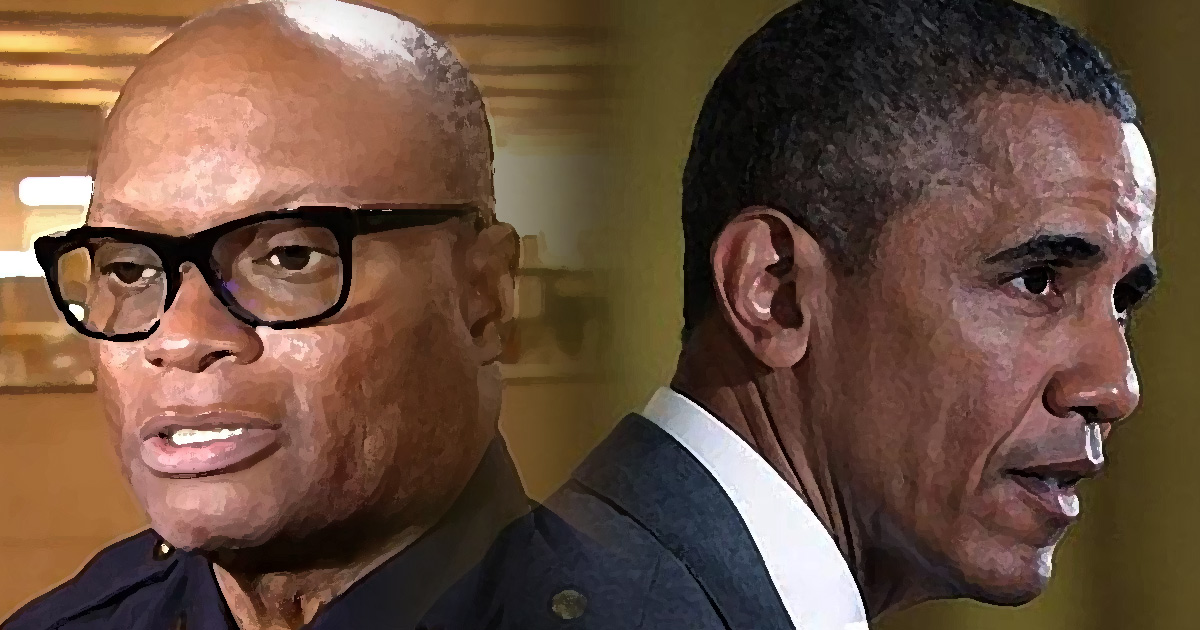
When President Obama said, “[W]e ask the police to do too much,” at the memorial service for the five slain Dallas policemen, he was echoing an idea previously expressed.

“We’re asking cops to do too much in this country,” Dallas Police Chief David Brown told reporters a day earlier. “Every societal failure, we put it off on the cops to solve,” he added, noting such problems as a lack of mental healthcare, rampant drug abuse, substandard schools and even roaming dogs.

So, what should police stop doing?

Plenty. But I’ll save that answer for tomorrow. Today, let’s pose another: Why so much crime, poverty, and violence in these communities?

Mr. Obama fingered not taxing-and-spending enough on benefits for the poor, including for “decent schools,” “gainful employment,” and “mental health programs.” Yet, after decades of expensive wars on poverty, illiteracy, drug abuse, etc., things have only gotten worse.

“We flood communities with so many guns,” the president intoned, “that it is easier for a teenager to buy a Glock, than get his hands on a computer or even a book.”

He’s playing fast and furious with the truth. Books are free at the library. Glocks cost money.

And who is this “we” he keeps bringing up?

Chief Brown mentioned a critical problem Obama did not: “Seventy percent of the African American community is being raised by single women.”

Police cannot solve all our problems, sure, but they especially cannot fix problems exacerbated by the welfare state and the educational system. Big government is no substitute for Mom and Dad.

Even freedom merely offers the opportunity to fix our own problems.

This is Common Sense. I’m Paul Jacob.


Printable PDF

Obama, Police Chief David Brown , police, abuse, poverty,