Categories
election law political challengers

Who Rigged Alaska’s Senate Race?

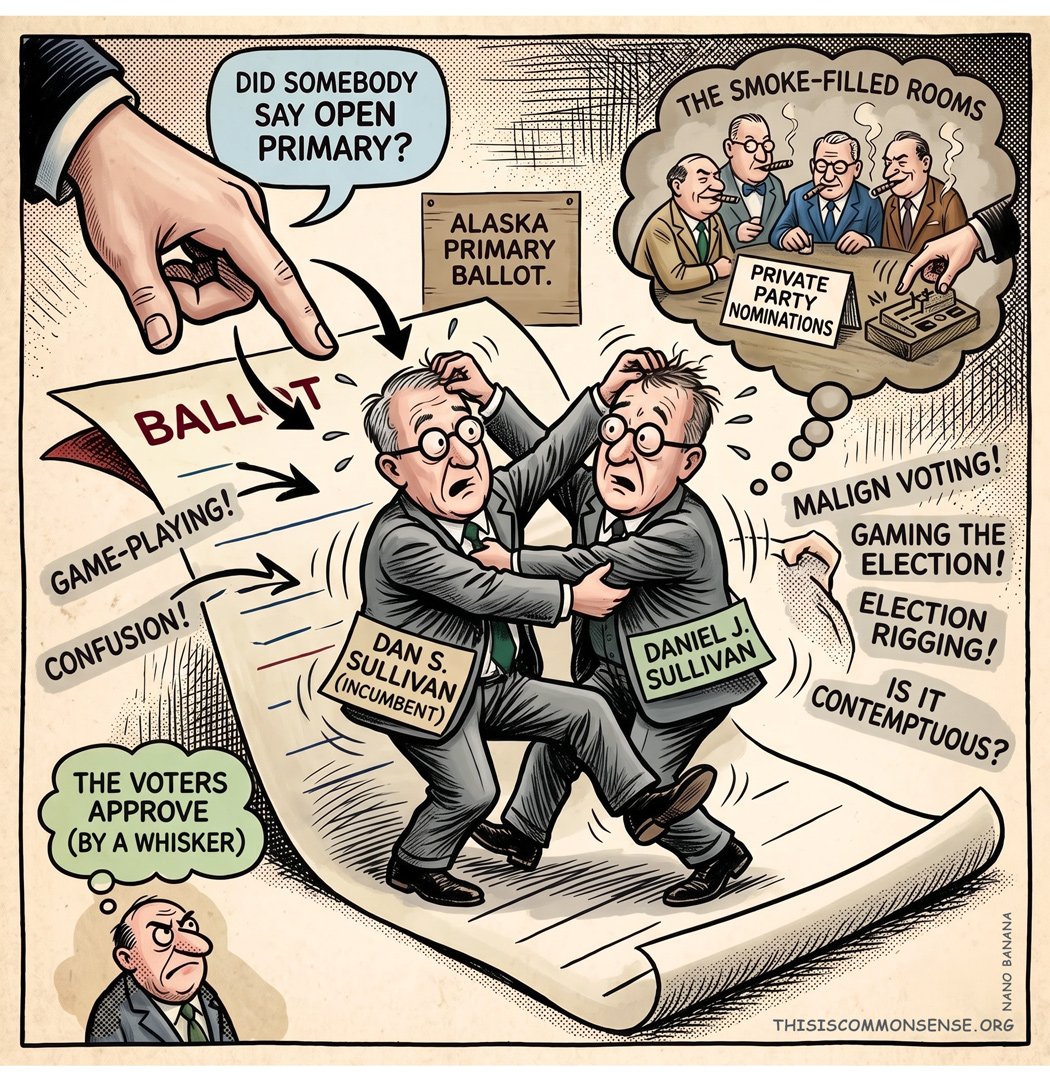
On today’s Alaska primary ballot, U.S. Senator Dan Sullivan, the Republican incumbent, faces an inconvenient challenger in the person of . . . Dan Sullivan.

The president of the United States is not pleased.

“Because of the trickery in the Voting, the Crooked, Radical Left Dumocrats have put up another man named ‘Dan Sullivan,’ and they did this to take Votes away from our Great Senator of the same name,” Donald Trump wrote on Truth.social. “Democrats are trying to ‘trick’ Alaskans, and treat Alaskan Voters with contempt.”

Is it contemptuous of Alaska voters?  

“His primary purpose is not to win an election,” contends the Senator, “it’s to confuse Alaskans and rig the vote for my opponent, the Democrat.”

Challenger Dan J. Sullivan’s run against the incumbent with the near-identical name, one Dan S. Sullivan, doesn’t quite pass the smell test. He sure appears to be gaming the election. Still, the rigging occurred when the state went to an open primary where anyone — regardless of party membership — can vote for anyone on the ballot.

Regardless of party.

Many people think this sort of thing is a great advance, and voters did approve it (by a whisker) in 2020 and voted to keep it (by an even slimmer margin) in 2024. But this “Nonpartisan Top Four Primary” (sending four candidates to the General Election) is open to malign voting and, yes, candidacies. When former Independent Party member and current Republican Party member Daniel J. Sullivan of Petersburg, Alaska, threw his hat into the ring, confusion was a natural (and likely intended) result. 

Election officials cooked up a halfway reasonable response: they list on the ballot “Sullivan, Dan S. (Registered Republican) Incumbent” and his possible vote-splitting challenger as “Sullivan, Daniel J. Jr.” unadorned.

To prevent sneaky campaigning and voting, however, Alaskans should go the opposite direction, allowing — no, requiring — political parties to privately select their candidates. And at their party’s expense, not the taxpayers’. 

Hold the General Election after political parties have freely chosen their nominees . . . confining all game-playing and election-rigging to the smoke-filled rooms. Which voters can then judge accordingly. 

This is Common Sense. I’m Paul Jacob.


PDF for printing

Illustration created with Nano Banana

See all recent commentary
(simplified and organized)
See recent popular posts
Categories
Accountability ideological culture Tenth Amendment federalism

Return to Federalism

As we make sense of this week’s sea change — of the Great Shellacking Democrats took on Tuesday — some caution is in order.

In 2006, voters did not choose the Democrats because of what they were or what they promised, but because of what they weren’t: corrupt, clueless Republicans. Now, Republicans should remember that they were mainly chosen because they aren’t Democrats: that is, hopelessly narrow-minded, self-righteous, and corrupt.

So, what should Republicans do?

Maybe it’s not to start out of the gate by repealing Obamacare, which its namesake would simply veto.

In Alaska, Oregon, and Washington, DC, voters approved the legalization of recreational marijuana use. In California, with Proposition 47, Golden State voters ushered in a new regime, downgrading many, many drug violations and former felony crimes to misdemeanor status.

This is the people of the states leading.

They are rejecting the “get tough” approach both parties have supported for decades, an approach that has had the dubious result of being most popular with public prison workers’ unions and the private prison lobby

Opposing drug use may be socially “conservative.” Politically speaking, however, granting government nearly unlimited police powers, and without regard to objective results, is not.

If the Republicans want to lead in Washington, they should follow the people in these bellwether elections. Back them up. End the Drug War and, with it, the Prison-Industrial Complex. Return criminal justice back to the states, where the Constitution originally put it. And where modifications can be more easily made.

Return to federalism. Return to reason.

This is Common Sense. I’m Paul Jacob.

Categories
ideological culture media and media people

Alaska Misfire

The wrong man was fired.

The campaign of U.S. Senate candidate Joe Miller seems to have been at least twice targeted as November 2 approached. In one case, questionable doings came to light after a reporter with CBS Anchorage affiliate KTVA forgot to turn off his phone after leaving a message with a campaign spokesman. Newsroom reporters then chatted about how to sabotage Miller’s campaign — for example, by finding that “one person” among campaign supporters who is a child molester. The station claims that a recording of the incident gives a “misleading” impression.

Then we have the campaign of Senator Lisa Murkowski, Miller’s opponent, acting to kick conservative talk-show host Don Fagan off the air.

After the Alaska Division of Elections aided Murkowski’s write-in campaign by deciding to distribute lists of write-in candidates at polling places, a listener said he had now become a registered write-in candidate himself. Fagan then suggested — on-air, as part of his regular talk programming — that other listeners might want to do the same. Uh oh. The station fired him after the incumbent’s campaign threatened to sue the station for so-called “electioneering.”

Compare the two cases. It’s fine for any media outlet to push its political opinions — but not to fabricate smears. It’s fine for candidates to make any complaint they wish to media outlets — but not to coercively curdle speech they happen to abhor.

I say, the wrong man got axed.

This is Common Sense. I’m Paul Jacob.


Categories
local leaders term limits

“A” For Effort

They don’t make it easy for citizen initiatives in Alaska.

According to state law, legislatures there are prohibited from repealing a successful initiative for two years. Two whole years. Whoo hoo! And that’s it. After this two-year moratorium, lawmakers can haul out the shredder.

In 2007, voters in Alaska’s Kenai Peninsula Borough passed a term limits measure that caps the tenure of the borough’s assembly members to two consecutive terms. The Alliance for Concerned Taxpayers gathered signatures to put the measure on the ballot.

For some strange reason, the Alliance doesn’t trust incumbent lawmakers in the borough to leave the term limits on themselves alone. They’re not the trusting type, I guess. But these term limits activists are not just wringing their hands and wailing, “Oh, I sure hope those incumbent lawmakers leave the term limits alone!”

Instead, two years after 2007, Alliance members have been out gathering signatures to put the same term limits measure back on the ballot.

Mike McBride, a spokesman for the group, says it’s easy as pie to get the signatures. “The public wants term limits, that’s the bottom line. . . . It’s a real popular idea.”

McBride says if the group has to go out and gather signatures every two years to keep term limits in place, they will. Good for them.

This is Common Sense. I’m Paul Jacob.

Categories
Tenth Amendment federalism

The Tenth Amendment Movement

When Sarah Palin announced her resignation as governor of Alaska, she caused quite a stir. Both Palin haters and Palin lovers united in their inability to talk about much of anything else.

Then, a week later, she had an op-ed on environmental policy published in the Washington Post.

And then, not long after that, she signed a resolution declaring the state of Alaska sovereign under the Tenth Amendment, and telling the federal government to back off from engaging in activities not delegated to it in the United States Constitution.

This sounds weird to lovers of big government, to Palin haters in general. But even some Palin lovers misconstrued the event.

It was not about Sarah Palin. She was not the only governor to sign such a resolution. Tennessee’s Democratic governor, Phil Bredesen, had done the same thing, earlier.

In fact, it’s not about governors at all. Other states, like Oklahoma and New Hampshire, have passed similar resolutions. As I wrote recently at Townhall.com, “[a]ll these resolutions have passed state legislatures. It’s not just lone ‘whacko’ governors doing the deed. Deliberative bodies have decided these measures.”

What’s happening is the re-emergence of the original idea of our federation: A central power limited in scope, and states with different sets of powers and responsibilities.

And people’s rights and powers limiting both.

Yes, folks, there are signs of hope.

This is Common Sense. I’m Paul Jacob.